Learn how to avoid burnout with realistic daily workflows, smart delegation, clear boundaries, and team policies that protect focus and energy.
July 31, 2026 (1mo ago)
How to Avoid Burnout with Workflows That Actually Work
Learn how to avoid burnout with realistic daily workflows, smart delegation, clear boundaries, and team policies that protect focus and energy.
← Back to blog
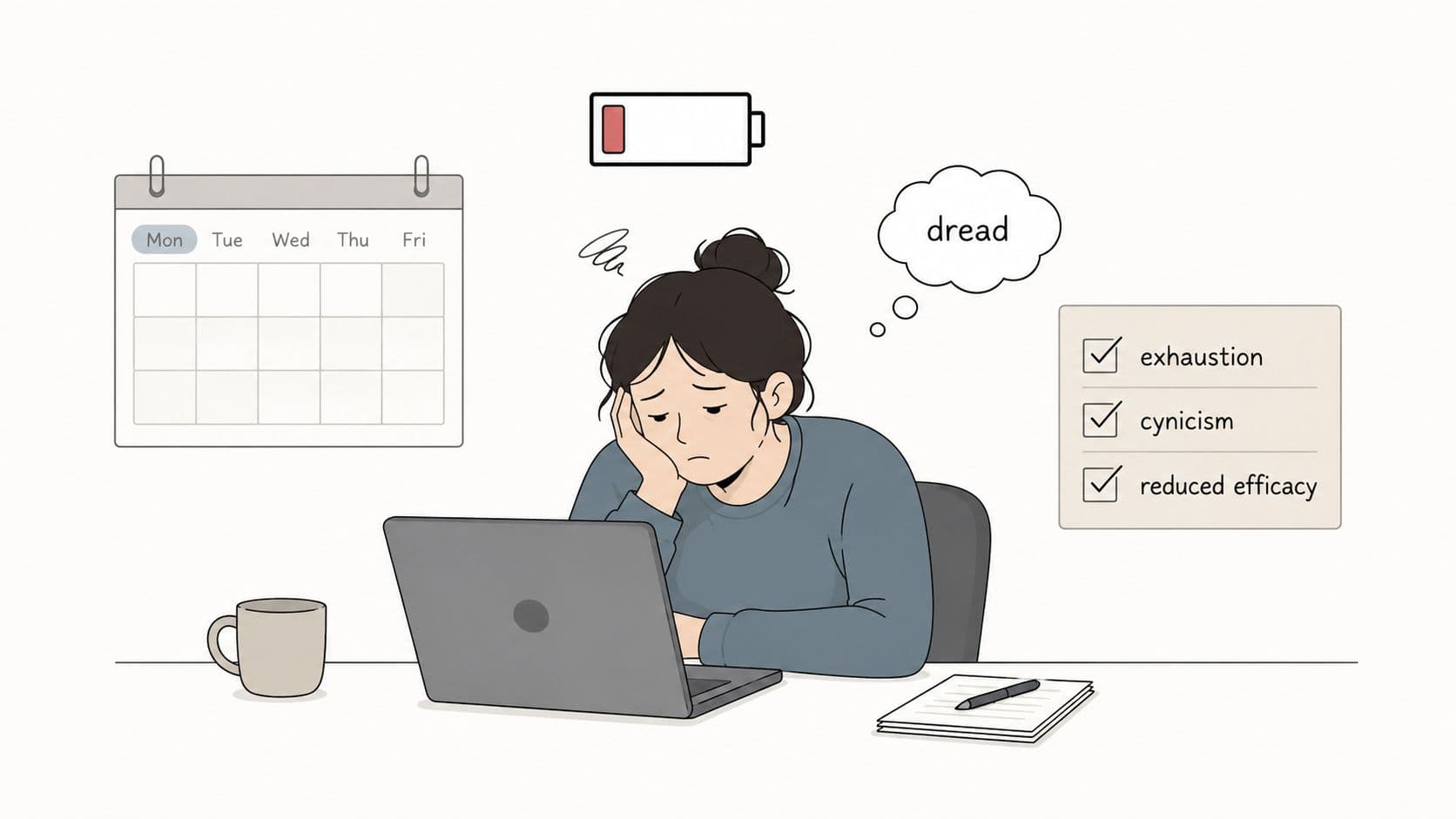
If you want to know how to avoid burnout, here's the quick truth — name the feeling and treat it like a process failure, not a personal flaw. Burnout tends to show up as exhaustion, cynicism, and a shrinking sense of impact.
What Burnout Really Looks Like in 2026
Burnout rarely just explodes into view. It usually arrives as a slow, steady erosion. You start feeling that dread on Sunday night and hit the laptop with a heavy heart the next morning. This is often the first sign that the systems around you are leaking energy.
Key takeaway Burnout maps to three observable dimensions: exhaustion, cynicism, and reduced efficacy.
The checklist below can help you spot each dimension in your daily behavior.
- Exhaustion — dragging yourself to log on, yawning through meetings, your sleep schedule getting all messed up. Quick self-check: Did you need caffeine just to pretend to care today?
- Cynicism — snapping at colleagues, a sarcastic internal monologue, feeling distant from your team. Quick self-check: When was the last time work felt meaningful?
- Reduced efficacy — taking longer to finish familiar tasks, missing details, feeling less pride in your results. Quick self-check: Can you recall a recent small win you owned?
The Three Dimensions of Burnout
| Dimension | What It Looks Like | Quick Self-Check |
|---|---|---|
| Exhaustion | Physical and emotional depletion | Did rest actually restore your energy this week? |
| Cynicism | A detached or negative attitude | Are you pulling back from your teammates? |
| Reduced Efficacy | A decline in confidence and output | When was your last proud moment at work? |
For example, a product manager who used to love shipping features now spends days in low-value meetings and leaves with no sense of completion. That pattern signals system issues — think meeting hygiene, unclear priorities, or an overloaded role — not a personal failing of will.
Next, you can use these signs to trigger concrete actions: a one-week time audit, a keep/automate/delegate/drop review, and a pre-agreed boundary script with your manager. These moves turn that vague guilt into specific fixes you can actually measure.
The Hidden Workflow Cost Nobody Talks About
Before you jump into self-care strategies, it's a good idea to map where your energy actually goes. That way, you're fixing the workflow, not trying to fix the person.
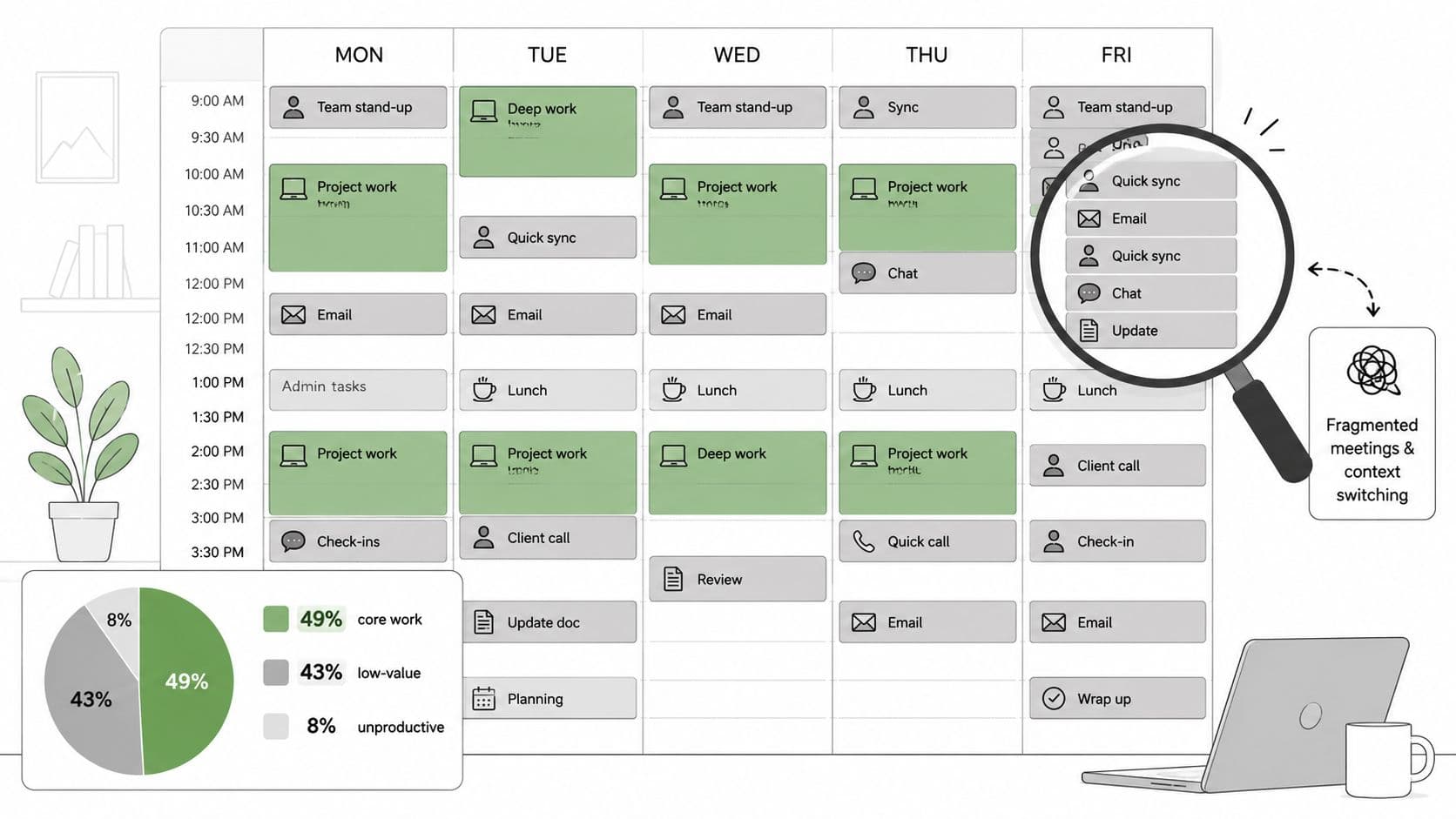
Here's where to start. Track your week in 30-minute blocks. Tag each block as core work, a low-value task, or unproductive time. You're hunting for those invisible taxes on your energy—context switching, meetings that could've been emails, or reactive busywork. This reframes "how to avoid burnout" as a design challenge you can actually tackle.
Key insight Presenteeism—showing up physically but being mentally checked out—silently drains team capacity and morale.
Run Your Weeklong Audit
- Break your calendar into 30-minute slices. Use quick tags to label what you're doing.
- Log interruptions and note the cognitive cost, especially after you've been in a deep-work block.
- Tally the totals at the end of the week to spot where your hours are leaking.
Recent workforce summaries show that employees spend just 49% of their time on core work. Another 43% goes to low-value tasks, and 8% to genuinely unproductive activity. These numbers reveal why burnout often stems from systemic issues, not just a lack of individual effort.
What To Do With Your Audit Results
- Identify recurring low-value patterns. Drop or delegate them whenever you can.
- Convert short meetings into async updates. A well-crafted document often replaces a 30-minute call.
- Batch similar tasks together. Grouping similar activities reduces the mental toll of constantly switching gears.
Consider these two real-world scenarios:
A product designer noticed they had three 15-minute syncs every day that covered nearly identical ground. By consolidating them into one focused session, they reclaimed two hours every week. Nobody missed the extra meetings.
A startup COO was drowning in calendar triage. Delegating that task alone freed up solid focus blocks for strategy work—time that had been scattered across the week.
Takeaway If nearly half your week is non-core work, just trying to "power through" is the wrong strategy. You're better off redesigning the workflow instead.
Read also: Learn more about workflow management in our guide on how workflow tools connect people and tasks Learn more about workflow management on Fluidwave
Daily Habits That Actually Prevent Burnout
Try starting your day with a hard start ritual that removes decision friction. Choose three tiny morning actions — hydrate, set a single priority for the day, and review a one-line reason why this work matters. This reduces that early indecision and makes it easier to protect your focus later.
Each evening, write a shutdown list with three concrete finish points. Ticking those off creates a sense of closure and prevents your mind from ruminating on work stuff. This practice also feeds into a simple weekly review where you can sort recurring tasks into keep, automate, delegate, or drop.
Key idea: Focusing on a single priority per day wins you more energy than staring at a long to-do list.
Design Your Day Around Focus Windows
Try batching communications into two short windows — say, mid-morning and late afternoon — to protect your deep work time. This limits context switching and lowers that chronic background stress. Between deep-work blocks, take a 20-minute walk; people report clearer decisions and fewer afternoon energy crashes after brief walks.
- Morning routine example: 10 minutes of movement, 5 minutes to pick a priority, 5 minutes to defend your calendar.
- Midday routine example: a 90–120 minute deep-work block, a 20-minute walk, and a 45-minute follow-up window.
Use your calendar to block out focus time before meetings colonize your week. Try to reserve at least three uninterrupted hours across your workday for high-impact work.
For a broader collection of expert advice on preventing burnout, consider these employee burnout strategies for HR managers
Daily Burnout-Prevention Routine
Here's what a realistic day might look like when you're actively protecting your energy. Feel free to adjust the times to fit your schedule, but try to keep the structure.
| Time Block | Activity | Why It Helps |
|---|---|---|
| 7:00–7:30 AM | Hydrate, move for 10 minutes, pick one priority | Removes decision fatigue before it even starts |
| 7:30–8:00 AM | Review calendar, defend focus blocks | Prevents meeting creep from hijacking your day |
| 8:00–10:00 AM | Deep-work session on your single priority | Tackles high-impact work when your energy is at its peak |
| 10:00–10:20 AM | Walk outside or stretch | Resets your attention and can lower cortisol |
| 10:20–11:00 AM | First communication batch (email, Slack) | Contains reactive work to a defined window |
| 11:00 AM–12:30 PM | Second deep-work block or collaborative work | Uses remaining morning focus for complex tasks |
| 12:30–1:15 PM | Real lunch break away from screens | Genuine recovery improves your afternoon output |
| 1:15–2:00 PM | Low-effort administrative tasks | Matches the post-lunch energy dip with lighter work |
| 2:00–3:30 PM | Meetings or collaborative sessions | Groups social energy into one block |
| 3:30–3:50 PM | Walk or movement break | Helps prevent the late-afternoon crash |
| 3:50–4:30 PM | Second communication batch, triage remaining items | Clears the inbox without letting it bleed into the evening |
| 4:30–5:00 PM | Shutdown list: write three finish points for tomorrow | Creates closure and stops late-night rumination |
The goal isn't perfection — it's having a framework you can return to when things get chaotic. Even following this structure three days a week can make a measurable difference in how recovered you feel by Friday.
Practical Small Rules That Scale
Limit your decision points. Adopt a three-choice rule for things like lunch, clothing, and meeting formats. Every tiny decision you eliminate preserves mental energy for work that actually matters.
Enforce an evening hard-stop. Set a repeating calendar event that signals shutdown and turns off your work notifications. The first few days might feel uncomfortable. By week two, your brain starts to trust that work truly ends.
One daily inbox sweep. Triage once in your morning batch and once in your afternoon batch. Defer everything else. You might be surprised how many "urgent" messages resolve themselves without your input.
Fluidwave-style features can make these habits easier to sustain. Auto-prioritization surfaces your single daily priority so you're not just staring at a blank screen each morning. Calendar and Kanban views defend your focus blocks visually, and delegation workflows let you hand off low-value items without losing visibility. That way, small rituals become systemic protections rather than extra tasks you have to remember.
Read also: Learn more about protecting your energy in our guide on how to protect your energy Read our guide on protecting energy
Redesigning Your Workload and Setting Real Boundaries
Here's something that changed how I approach my own capacity: a weekly review that takes maybe 20 minutes but consistently reveals just how much low-value work sneaks into my schedule. You just go through every recurring task and sort it into one of four buckets — keep, automate, delegate, or drop. That's it.
Most people who try this find that 20–30% of their weekly tasks don't actually need them to be the one doing it. That's not a small number. That's hours back in your week, and it directly addresses the question of how to avoid burnout before it even starts.
A visible Kanban board works really well for this. When tasks live only in your head, they feel bigger and more urgent than they really are. Getting them onto a board — whether it's physical or digital — makes the volume honest.
If you're someone who gets decision fatigue easily (and honestly, who doesn't?), try time-boxing the review to 30 minutes. Use clear labels. Don't let it become another open-ended chore.
Making the Weekly Review Stick
Write down every recurring task for the week, along with who owns it and roughly how long it takes. This is where you catch the tiny drains — the daily status notes, the check-in emails, the "quick syncs" that somehow eat up 45 minutes.
Then apply the four-bucket rule with a timer running. Give yourself about 4 minutes per task. The time pressure forces you to actually make a decision instead of agonizing over whether something "might" matter later.
Anything you mark as "automate" should get a specific trigger or template attached to it right then and there. For instance, if you're writing meeting summaries every week, build a standard note template and a set of canned follow-up messages. Done once, saved forever.
A consistent review helps you say no to low-value work before it becomes a habit — and habits are what burnout is actually made of.
Scripts That Protect Your Focus
Setting boundaries gets a lot easier when you have the actual words ready. Not aggressive ones — just clear, repeatable phrases that people tend to respect because they're specific.
Here are three that work in real life:
- Declining meetings politely: "Thanks for the invite — this looks like it's status-only. I'll share a written update and skip the meeting."
- Defining response windows: "I check messages twice a day at 10:30 and 4:00. If something's truly urgent, please call my phone."
- Naming deep work out loud: "I have deep work blocks Monday, Wednesday, and Friday from 9–11. Please treat those as focused time."
The key is consistency. Say it the same way every time, and you'll find people adjust faster than you'd expect.
Delegation Briefs That Actually Save Time
Vague delegation often creates more work than it eliminates. A simple one-paragraph brief — with the desired outcome, a deadline, and an example of what good looks like — can dramatically cut down on the clarification loop.
Keep a short delegation template handy. Attach a sample deliverable when possible. And agree on a check-in cadence upfront so neither of you is left guessing.
To effectively prevent burnout, understanding how to maintain a healthy equilibrium between your professional and personal life is essential. This practical guide on work-life balance with Approved Experiences covers that side of the equation well.
One practical tweak that works: take a daily 15-minute triage habit and collapse it into a single 45-minute batch three times a week. Those reclaimed stretches become the focused blocks where actual results happen — not just maintenance.
Using Delegation and Automation to Reclaim Focus
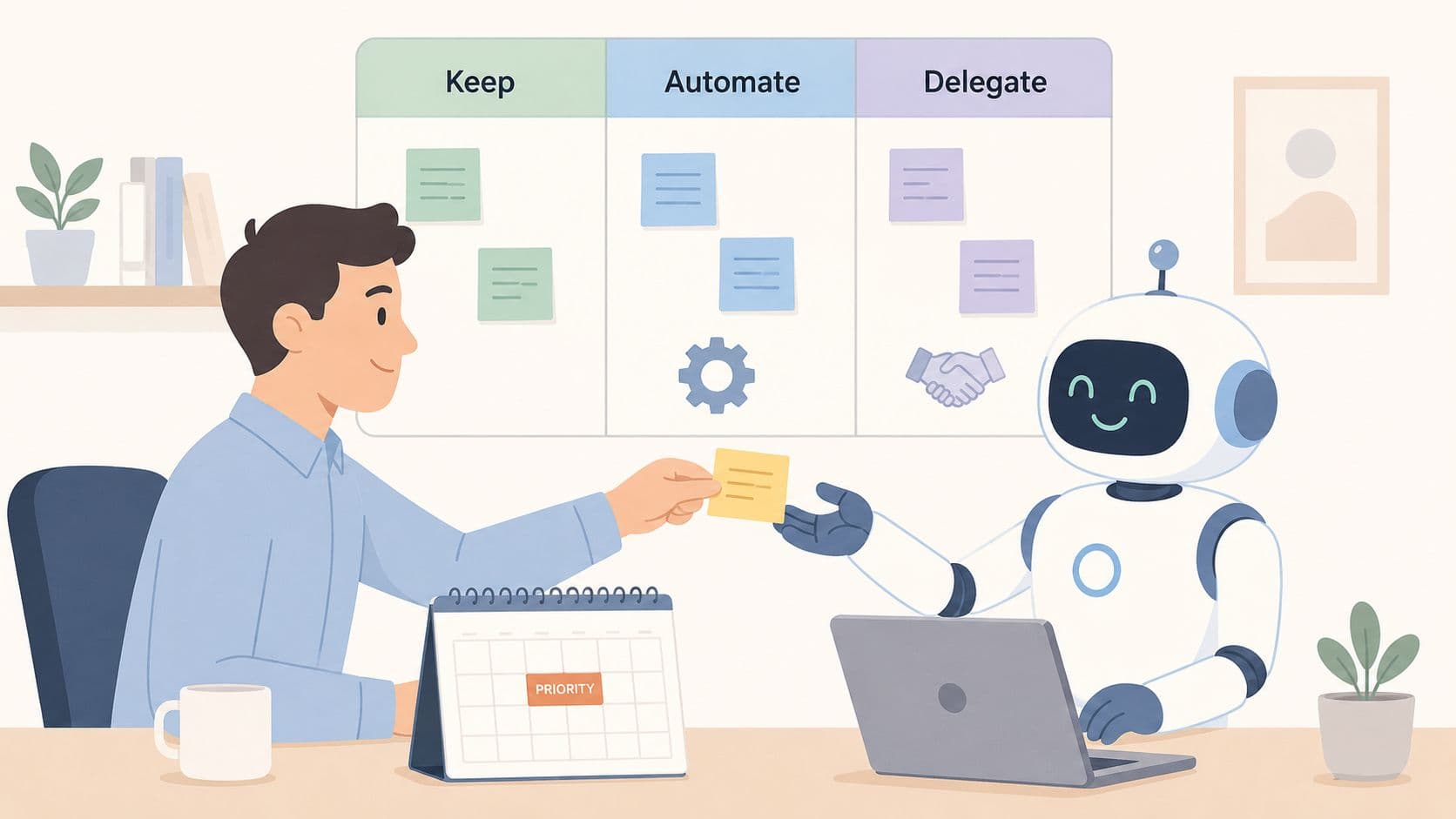
Most burnout doesn't come from one massive crisis. It builds slowly through dozens of small, repeatable tasks that quietly drain your attention. Routine research, scheduling back-and-forth, inbox triage, and data entry are the usual suspects. They don't seem like much on their own, but together they can eat up hours and leave you exhausted by midweek.
The fix isn't to push through with more discipline. It's handing off the work that doesn't actually need you.
Quick stat: Employees spend 49% of their time on core work, 43% on low-value tasks, and 8% on unproductive activity — which makes delegation and automation two of the highest-impact changes you can make. Read the full breakdown on time use and workflow findings
Spotting Tasks Worth Delegating
Not everything should leave your plate. But some tasks are basically begging to be handed off. Run each task through this little checklist:
- Repetitive outcome: The steps are nearly identical every single time.
- Low decision complexity: It follows clear rules rather than requiring a lot of judgment.
- Clear success criteria: You can point to an example of what "done" looks like.
- Predictable effort: The scope is consistent enough to fit a pay-per-task arrangement.
When a task checks at least three of these boxes, it's a strong candidate for delegation.
Writing a Brief That Saves Everyone Time
Vague instructions are the number one reason delegated tasks come back wrong. A tight brief eliminates that endless clarification cycle. Just include these five elements:
- A one-sentence goal.
- Two must-have deliverables or formats.
- The deadline and an estimated time commitment.
- An example of what acceptable work looks like.
- A built-in communication checkpoint.
That's it. Five lines are usually enough to set someone up for success without having to micromanage.
How Automation Gives You Quiet Hours Back
Once you've identified what can be delegated, automation can handle the routing so nothing stalls. Consider these as starting points:
- Route routine requests to assistants using a trigger rule.
- Auto-tag follow-ups so nothing disappears into the void.
- Set up a smart filter that surfaces only the tasks requiring a human decision.
Teams that implement even a couple of these often recover 4+ hours per week — time that goes straight back into focused, meaningful work.
How Fluidwave Acts as the Connective Tissue
This is where the pieces start to fit together. Fluidwave handles several layers of the delegation-and-automation puzzle all in one place:
- Auto-priority surfaces your single daily priority so mornings feel manageable instead of overwhelming.
- Multiple views (Kanban, calendar, list) make your actual capacity visible to teammates without needing a status meeting.
- Pay-per-task delegation connects you to vetted human assistants without locking you into a monthly subscription.
- Automation templates pair with delegation to turn recurring chores into one-click workflows.
You're not juggling five separate tools. One platform handles the handoffs and the routing.
A Practical Example
A marketing lead started routing all vendor invoices to a virtual assistant through a simple rule. The invoices got coded and queued automatically, which freed up two full hours every Friday. That small change became the buffer that stopped the Sunday-night dread cycle and cut out the late-night catch-up sessions that had become routine.
Takeaway: Delegation and thoughtful automation can reduce context switching, protect your deep work, and offer practical, immediate answers to the question of how to avoid burnout.
Team-Level Policies That Make Burnout Prevention Stick
Here's the thing — burnout is rarely just a personal failing. It's often a system problem. And managers who understand that? They're the ones who can actually move the needle on prevention.
Individual habits will only stick if the environment supports them. So let's talk about what works at the policy level.
Hybrid and Flexible Hours That Actually Matter
Giving people control over when and where they work isn't really a perk anymore — it's a baseline expectation. 75% of HR managers point to hybrid or flexible hours as one of the most effective strategies for helping employees avoid burnout. That's not a small number, and it lines up with what most of us already know: rigid 9-to-5 mandates often ignore the reality of how people actually do their best work.
If you're designing schedules, it's smart to factor in personal rhythms. Some people think best at 6 AM. Others hit their stride at 10. Flexibility respects that difference.
For the full research behind this statistic, you can learn more about flexible hours research.
Leaner Meetings, Less Mental Load
Meetings aren't free. Every invitation carries a cognitive cost — context switching, prep time, and the low-grade anxiety of wondering what's coming next. A few simple rules can dramatically reduce that burden:
- One no-meeting day per week to protect uninterrupted deep work.
- Hard-stop times that make evenings genuinely off-limits, not just in theory.
- Written agendas shared 24 hours before so nobody has to walk in cold.
Key takeaway Consistent meeting hygiene cuts down on context switching and lowers background anxiety. It sounds basic, but most teams never actually implement it.
Practical Policies That Scale Beyond One Person
Individual willpower fades. Written policies don't. Here's what tends to work across teams:
- Standardize response windows during onboarding. New hires should know upfront whether they're expected to reply within an hour or within a business day. Ambiguity is a breeding ground for burnout.
- Build workload reviews into regular one-on-ones. This helps catch scope creep before it becomes a crisis — that extra project nobody formally assigned but everyone just assumed you'd handle.
- Pay per completed task in delegation relationships. Shifting from hourly expectations to outcome-based compensation changes the entire dynamic.
Making Distributed Teams Sustainable
Remote and hybrid teams need structure that's visible and predictable. Shared task boards and real-time collaboration tools aren't luxuries — they're essential infrastructure.
- Use Kanban or table views so anyone can see what's in flight without having to hunt through threads.
- Assign clear owners and SLAs so tasks don't just vanish into email purgatory.
- Automate routine routing to assistants or automated workflows. Teams that implement this consistently report saving 4+ hours per week for focused, meaningful work.
For lasting team wellbeing, you need to combine flexible schedules with clear boundaries and visible workflows. One without the other tends to fall apart.
What This Looks Like in Practice
- A sales team introduced a single no-meeting day and reclaimed five hours per person per month. That's nearly a full work week recovered across the quarter.
- A remote engineering group shifted vendor triage to a pay-per-task assistant model. Those nightly catch-up calls? Eliminated. The work still got done, just without the unnecessary sync overhead.
That's the real win here. These aren't heroic individual efforts — they're systems that turn smart tactics into cultural defaults. When the policy supports the behavior, the behavior sticks.
Your 30-Day Burnout Prevention Plan
You can jump in tomorrow, but try to treat the whole thing like a measurable experiment. The first week is purely about observation. Log your energy levels, track any shifts in your sleep, and jot down those moments of Sunday dread without trying to fix anything yet. This gives you a solid baseline to measure against at the end of the month.
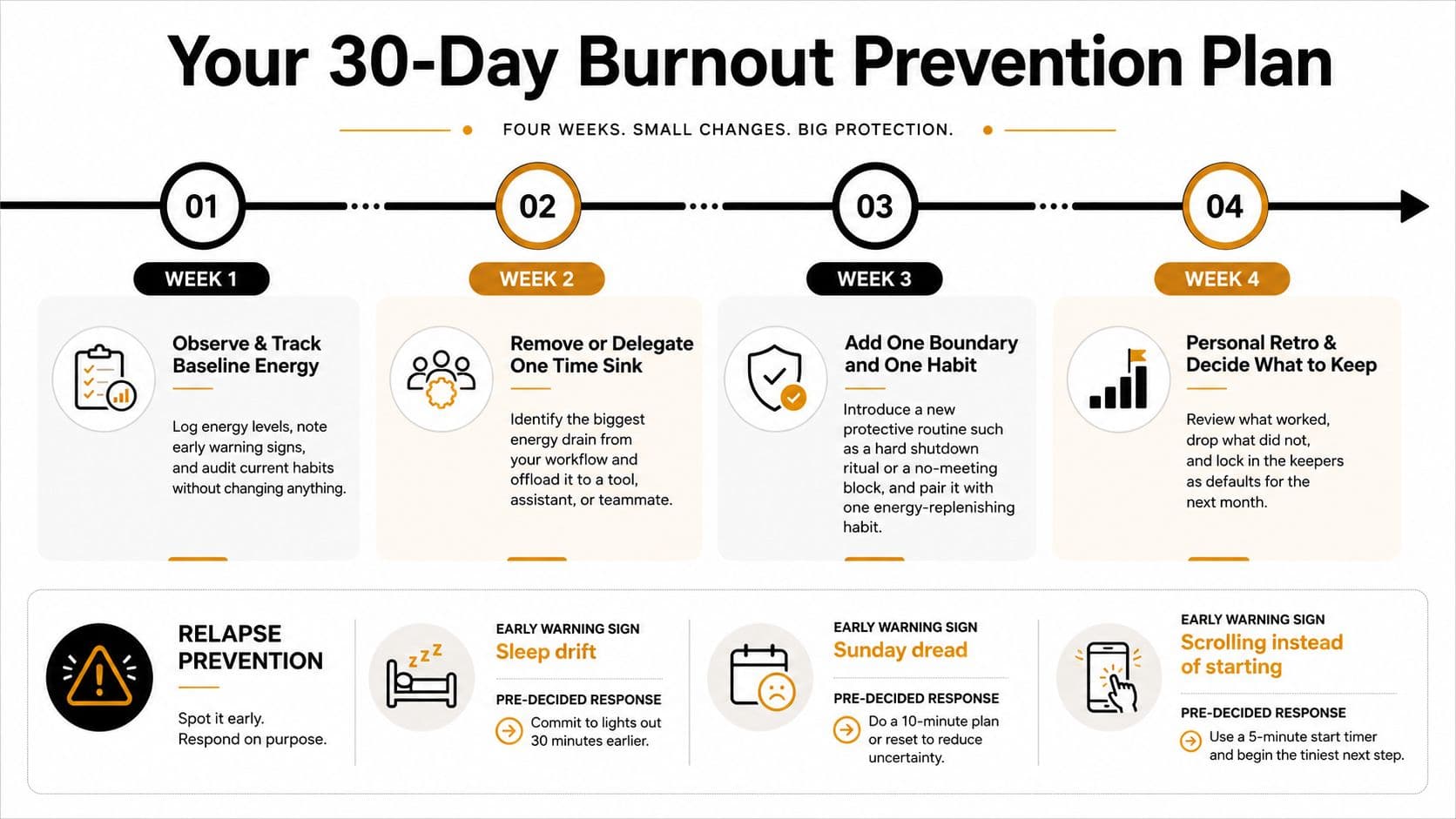
During the second week, target one obvious time sink to remove or delegate. Find a recurring, low-value task and hand it off to a teammate, an assistant, or an automation rule in your task management tool. This is where features like Fluidwave's auto-prioritization and pay-per-task delegation can really shine. They turn a vague mental drain into a concrete handoff, instantly reclaiming hours in your week.
By week three, introduce one new boundary and one supportive habit. Maybe it's a hard shutdown ritual or a dedicated no-meeting block. Pair that boundary with something like a 20-minute midday walk or an evening shutdown list. Block the time on your calendar so your team can see it and respect it.
In the final week, run a personal retrospective and decide what sticks. Compare your current baseline against the hours you've reclaimed and any shifts in your mood. Keep the wins, drop the rest, and set your new defaults for the month ahead.
Relapse Prevention
Pre-decide your responses to early warnings like sleep drift, Sunday dread, or scrolling instead of starting.
- Pinpoint the three earliest warning signs you personally notice.
- Assign a single, concrete response to each one—like taking a short walk, pausing your inbox, or triggering a delegate rule.
- Schedule a weekly check-in to adjust these triggers as needed.
For a practical next step, pick one task to remove this week, schedule a no-meeting block for next Wednesday, and set a 30-minute retrospective four weeks from now.
FAQ
How long does burnout recovery usually take?
Recovery really varies, but it rarely happens overnight. Most people start feeling some relief within 2–4 weeks once they introduce real rest and adjust their workflow. But fully recovering from burnout can take 3–6 months, especially if you're redesigning the underlying systems that caused it in the first place.
Short breaks help, but changing your workload and boundaries is what actually prevents a relapse.
Can you prevent burnout without changing jobs?
Absolutely. Staying at your current role and preventing burnout is usually about changing how you work, not where. You can shift your task mix, hand off low-value work, and set clearer boundaries. Running a simple weekly review—deciding what to keep, automate, delegate, or drop—often reveals that 20–30% of your workload can be removed or streamlined. Using delegation workflows and automation lets you offload that busywork without losing visibility on what matters.
What is the difference between regular stress and clinical burnout?
Ordinary stress tends to fluctuate and usually has a clear end point. Burnout feels different: it's a persistent exhaustion, a growing sense of cynicism, and a noticeable drop in your ability to get things done effectively. When symptoms like chronic sleep disruption or weeks of detachment start piling up, it's a good idea to treat it like burnout. If you're unsure, it's always best to seek professional help while also addressing the workflow patterns that might have brought you here.
Does delegation just create more coordination work?
It can, if you do it poorly. A sloppy handoff creates endless back-and-forth. But a solid delegation brief—one clear sentence on the goal, the deadline, and an example of what good work looks like—cuts through the noise. Pair that with automation templates and rules, and you can reclaim 4 or more hours every week without drowning in coordination overhead.
Where can I find more detailed guidance?
Revisit the sections on workload redesign, daily habits, delegation, and team policies for step-by-step plans. The most practical starting point is to do a one-week time audit. From there, remove one obvious time sink, then protect a 30-minute weekly review to keep the momentum going.
If you want a tool that helps you put these workflows into practice, check out Fluidwave https://fluidwave.com.
Focus on What Matters.
Experience lightning-fast task management with AI-powered workflows. Our automation helps busy professionals save 4+ hours weekly.