Master how to prioritise projects using proven methods like Eisenhower Matrix, RICE, and MoSCoW. Get actionable steps to manage your workload effectively in
September 7, 2026 (1mo ago)
How to Prioritise Projects: Master Top Methods for 2026
Master how to prioritise projects using proven methods like Eisenhower Matrix, RICE, and MoSCoW. Get actionable steps to manage your workload effectively in
← Back to blog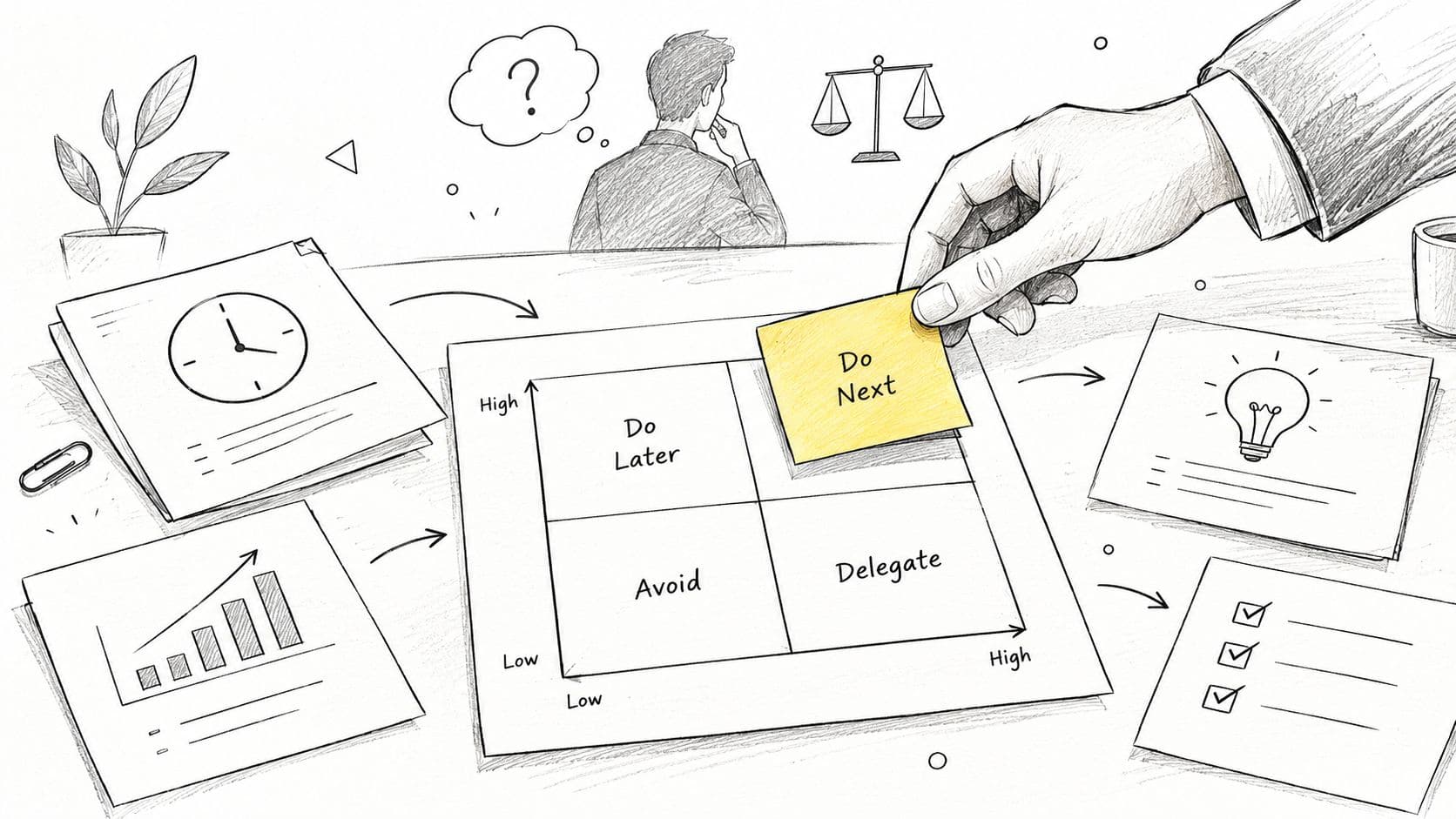
You open your project tracker and find a familiar mess. A regulatory deadline sits beside a product launch, an executive request, a customer escalation, and several “quick” improvements that have been waiting for weeks. Every stakeholder says their initiative is urgent. Your team is busy, but progress feels strangely thin.
This is rarely a motivation problem. It's usually a prioritization system problem. Learning how to prioritise projects means creating a repeatable way to compare value, risk, timing, dependencies, and available capacity, then making the trade-offs visible to the people affected by them.
The right framework won't make every request disappear. It will help you decide what starts, what waits, what changes, and what should leave the queue entirely.
That Feeling When Everything Is a Top Priority
A project manager I worked with once began each morning by checking three channels: the leadership dashboard, the team inbox, and the customer support queue. Each one contained a different “highest priority” item. By midmorning, the team had discussed several initiatives, changed direction twice, and committed to none of them with confidence.
The problem wasn't that the team lacked effort. People were working late, responding quickly, and trying to protect important relationships. The problem was that every new request entered the system with the same status. “Urgent” became a polite way of saying, “Someone important is asking.”
That creates a painful contradiction. You can have a full pipeline, a capable team, and plenty of activity while still failing to deliver the outcomes that matter most. Starting another project may feel responsive, but it also consumes attention, creates dependencies, and makes existing commitments less reliable.
Practical rule: A priority isn't just a label attached to a project. It's a decision about where scarce attention goes next.
A useful system starts by separating importance from immediacy. A compliance project may need fast action because the consequence of delay is serious. A strategic research project may matter greatly but require protected time rather than immediate execution. A small operational fix may deserve attention because it removes a bottleneck for several other initiatives.
You don't need a perfect ranking of every request before taking action. You need enough structure to make the next decision consistently, explain it clearly, and revisit it when conditions change. Frameworks are valuable for that reason. They're not rigid commandments. They're shared tools that turn emotional debates into visible trade-offs.
The Core Principles Behind Smart Prioritization
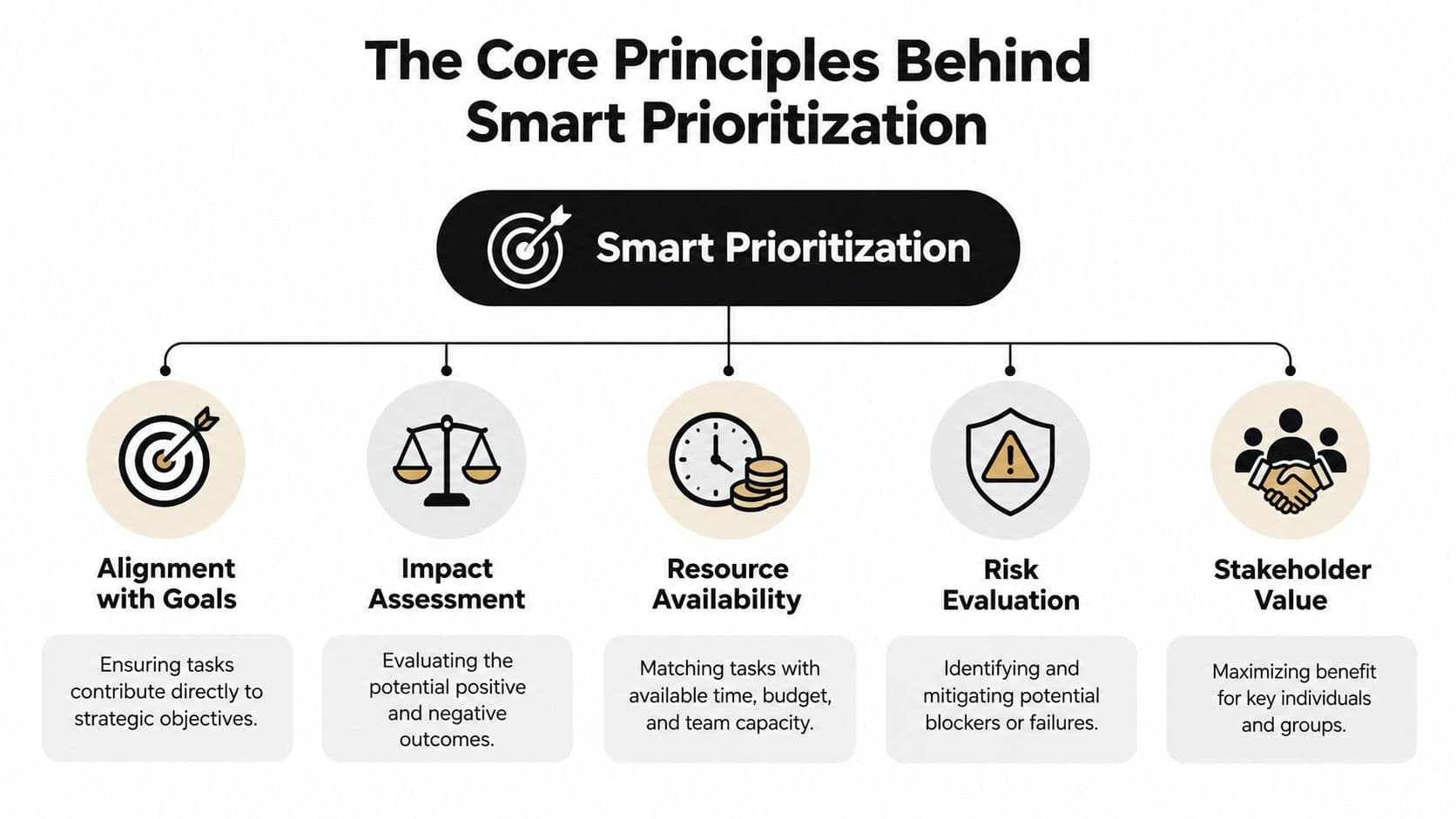
Smart prioritization begins before anyone assigns a number or places a card on a board. First, define the decision you're trying to make. Are you choosing which projects deserve funding, which initiative starts next, or which tasks a team should complete this week? A portfolio decision and a daily sequencing decision need related but different evidence.
Modern project prioritization is commonly treated as a weighted matrix problem. Teams establish criteria, assign scales, weight each criterion, score projects, total the results, and then review the outcome with stakeholders. This approach formalizes a decision that might otherwise depend on the loudest request or the most senior person in the room. The multiple-criteria portfolio selection methodology describes prioritization as two connected steps, defining a priority relation among projects and selecting a portfolio under budget and other constraints.
Start with alignment
A project that doesn't support a current goal needs a clear reason to exist. Ask which strategic objective it advances, which customer or operational problem it addresses, and what would happen if it were postponed. “The sponsor wants it” is context, not a value case.
Assess impact and effort together
Impact includes positive outcomes, but it also includes avoided loss, customer trust, operational resilience, and the opportunity created for other work. Effort should include more than delivery hours. Account for specialist availability, decision latency, training, procurement, dependencies, and the cost of switching attention.
Treat risk as part of value
A project with attractive benefits may still be a poor starting point if its assumptions are weak or its blockers are unresolved. Score delivery risk, regulatory exposure, technical uncertainty, and dependency risk separately when they could change the decision.
Apply the capacity filter
A high-scoring project that has no available team, budget, or infrastructure isn't ready to start. Marking it “top priority” without capacity only creates false urgency. Prioritization must end with a feasible portfolio, not an impressive list.
Make stakeholder review deliberate
Stakeholders should challenge assumptions, not solely negotiate for their own project. Show the criteria, scores, dependencies, and capacity limits. When people can see why a project moved down the list, disagreement becomes easier to manage.
A practical matrix might use strategic alignment, financial value, urgency, risk reduction, feasibility, dependencies, and compliance. Keep the scoring language consistent, document evidence beside each score, and review borderline results with the people who understand the work. The matrix doesn't replace judgment. It gives judgment a structure that others can inspect.
Popular Prioritization Methods Unpacked
Different frameworks solve different problems. The Eisenhower Matrix creates quick clarity for personal workload. RICE supports evidence-based comparison when teams have reach and impact information. MoSCoW helps stakeholders negotiate scope inside a fixed delivery window. None of them should be treated as a universal ranking machine.
Eisenhower Matrix
The Eisenhower Matrix sorts work into four categories based on urgency and importance:
- Important and urgent: Act on work that protects a deadline, customer, or serious business obligation.
- Important but not urgent: Schedule strategic work before it becomes a crisis.
- Urgent but less important: Delegate, automate, or batch requests that demand attention without requiring your direct involvement.
- Neither urgent nor important: Remove, defer, or question the work.
Suppose you're launching a client portal. A production security issue belongs in the first quadrant. Defining the portal's long-term reporting model belongs in the second. Reformatting a presentation that someone else can handle belongs in the third. An optional dashboard with no identified user belongs in the fourth.
The matrix is fast and useful when one person needs to regain control. It becomes less reliable when a team compares large, interconnected projects because “important” can mean something different to every participant.
RICE
RICE uses Reach, Impact, Confidence, and Effort to compare opportunities. A common operational rule expresses confidence on a percentage scale, with 100% representing strong evidence, 80% moderate evidence, and 50% low confidence. Atlassian's explanation of the RICE framework provides the underlying factors and confidence approach.
Consider three features for a new mobile app. A referral flow may reach many users and require moderate effort. A profile redesign may have meaningful impact but limited reach. A reporting export may serve fewer users, yet support a high-value customer segment. RICE forces the team to expose those differences instead of allowing the most enthusiastic stakeholder to determine the result.
Its weakness is false precision. A score can look scientific even when reach estimates are guesses. Use evidence where you have it, record confidence accurately, and treat the output as a conversation starter.
MoSCoW
MoSCoW divides scope into Must have, Should have, Could have, and Won't have. Dai Clegg developed the method in 1994 for rapid application development, helping teams decide what belonged inside a constrained delivery effort. It became influential because it turned prioritization into a scope-management conversation, not merely a ranking exercise. The history and categories of MoSCoW explain how the method was used with iterative delivery approaches.
For an invoicing project, a legally compliant invoice might be a Must have. Custom branding could be a Should have. Additional export formats might be a Could have. An experimental animation could be a Won't have for the current release.
MoSCoW works well when the team needs agreement about what can be cut. It doesn't reliably order every Must have from first to last, so pair it with dependencies, capacity planning, or a sequencing method.
| Framework | Best For | Key Benefit |
|---|---|---|
| Eisenhower Matrix | Individual workloads and immediate decisions | Separates urgency from importance quickly |
| RICE | Product opportunities and feature comparison | Makes reach, impact, confidence, and effort visible |
| MoSCoW | Agile scope and stakeholder alignment | Protects essential scope while creating room to defer |
For a broader view of how to combine urgency, importance, and execution context, use this work prioritization matrix guide. The practical lesson is simple: choose a framework based on the decision you need to make, not its popularity.
How to Choose the Right Method for You
Start with the decision you need to make, then choose the method that exposes the relevant trade-offs. For an individual facing a crowded task list, the Eisenhower Matrix separates immediate obligations from work that needs protected calendar space. It creates quick clarity without requiring a score for every email or appointment.
Product teams comparing customer-facing opportunities need a different view. RICE makes reach, expected impact, confidence in the evidence, and delivery effort visible. The inputs are estimates, not facts, so use the scores to structure discussion rather than disguise uncertainty.
Choose MoSCoW when the dispute is about scope. It gives stakeholders a shared way to decide what belongs in the current release and what can wait. That matters when a timeboxed delivery has a fixed boundary while requests continue to grow.

Use complexity as the deciding factor
Simple labels work for simple choices. They become weak when projects compete for specialist skills, depend on one another, or expose the business to different levels of risk. One cited prioritization review reports that high, medium, and low labels are used by 39%, while executive orders are used by 30% of organizations. Either approach can allow seniority or request volume to outweigh value.
Use weighted scoring when several criteria affect the decision. Set the criteria and their weights, score every project against the same scale, multiply each score by its weight, and add the results. A portfolio playbook uses 4 to 6 criteria, weights totaling 100%, and a 1 to 10 scoring scale. The PMI playbook on evaluating strategic alternatives describes this model.
WSJF fits situations where delay has an economic or timing cost and capacity is limited. Its formula is Cost of Delay divided by Job Duration. Cost of Delay commonly combines business value, time criticality, and risk reduction or opportunity enablement. This WSJF comparison shows why WSJF supports sequencing rather than simple effort ranking.
Overloaded teams should combine methods by decision layer. Use weighted scoring to select investments, MoSCoW to control release scope, and a capacity-aware board to order daily work. A guide to combining task prioritization techniques can help map those layers. The result is a sustainable system, rather than one matrix forced to decide what to fund, what to ship, and what to do next.
Automating and Delegating Priorities with Fluidwave
A prioritization framework only helps if the queue reflects reality. Tasks arrive through email, meetings, support channels, and personal notes. If those requests stay scattered, even a well-designed scoring model becomes stale.
Fluidwave can organize tasks across table, list, calendar, Kanban, and card views, allowing the working surface to match the type of decision being made. A Kanban view can expose work in progress, while a list can make ownership and due dates easier to scan. The point isn't to create more views. It's to give the team one dependable place to see what has been accepted, what is waiting, and what needs attention.

Turn decisions into an operating queue
A practical setup looks like this:
- Capture every candidate: Add projects and tasks before deciding their order. Include the owner, desired outcome, deadline, dependencies, and any known constraint.
- Define the decision fields: Add urgency, importance, effort, risk, and strategic alignment where those factors affect the choice.
- Separate selection from execution: Decide which work belongs in the active portfolio before asking the team to sequence every task.
- Set capacity boundaries: Make available people, specialist skills, and competing commitments visible.
- Review exceptions: Any task that jumps the queue should have a reason, an owner, and a consequence for the work it displaces.
AI-assisted ordering can reduce the manual effort involved in sorting a changing queue. Fluidwave's described functionality includes AI-supported prioritization and task ordering based on factors such as deadlines, dependencies, workload, and timing. That can surface a sensible next action, but it shouldn't remove human review for compliance-sensitive, ambiguous, or politically consequential work.
Delegate the work that doesn't need your attention
Prioritization becomes useful when it changes who does the work. A task that is low impact but still necessary may belong with an assistant rather than on an executive's personal list. Administrative preparation, research collection, scheduling, and routine follow-up are examples where clear instructions and an agreed budget can make delegation practical.
Fluidwave connects task management with a network of human virtual assistants, allowing users to delegate tasks on a pay-per-task basis. Before assigning work, define the expected output, deadline, relevant files, approval rules, and budget. Without that brief, delegation merely transfers ambiguity to someone else.
Professionals in regulated fields may also benefit from specialist guidance on separating strategic work from routine administration. This guide to outsourcing legal admin is a useful reference when deciding which non-billable activities can be handled outside the core professional role.
Use the Fluidwave step-by-step tutorial to translate the model into task creation, assignment, budget, timeline, and progress tracking. The sustainable goal is not to make every task urgent. It's to protect human attention for decisions that require judgment while routing repeatable work through clear workflows.
Making Your Prioritization System Stick
A prioritization system survives when people trust its decisions. That trust comes from consistency, visible trade-offs, and a willingness to change the plan when the evidence changes. If leaders bypass the queue whenever someone applies pressure, the team quickly learns that the official process is decorative.
Review priorities on a regular operating rhythm, but don't confuse review with constant reshuffling. A project should move because its value, risk, deadline, dependency, or capacity context changed. It shouldn't move because someone mentioned it most recently.
Protect the queue from surprise work
When a stakeholder brings an urgent request, ask four questions:
- What changed: Is there a new deadline, risk, customer commitment, or legal obligation?
- What is displaced: Which active project will lose attention if this starts?
- Who owns the decision: Can the requester accept the impact on existing commitments?
- What happens next: Is this an emergency, a temporary interruption, or a new project?
Write the answer into the work system. A verbal exception is easy to forget and hard to govern.
A priority change without a displaced commitment is usually just extra work.
Overload also requires more nuanced sequencing than one urgency and impact score. Research on multiple-project management indicates that simple short tasks may be handled first when available, larger workloads can be prioritized by size, complex collaborative work by due date, and high-error-risk activities by whichever can start first. The research on task prioritization in multiple-project management shows why task type and bottleneck conditions matter when work in progress is saturated.
Keep the system human
Limit active work, clarify ownership, and make dependencies visible. If three projects all require the same specialist, the right decision may be to sequence access rather than debate which project has the most impressive score.
Communicate the “why” behind major choices. Teams can accept a postponed initiative more readily when they understand the criterion, the capacity constraint, and the condition that would cause the decision to change. Celebrate completed outcomes, not merely new projects approved. A full intake list is not progress.
The best prioritization system is dynamic, evidence-based, and modest enough to use under pressure. It gives leaders a way to say no, gives teams permission to focus, and gives everyone a shared answer when the next urgent request arrives.
Fluidwave brings task capture, AI-assisted ordering, multiple work views, collaboration, and pay-per-task delegation into one workflow. Use it to turn your prioritization decisions into a visible queue, then visit Fluidwave to create a clearer, more sustainable way to manage overloaded work.
Focus on What Matters.
Experience lightning-fast task management with AI-powered workflows. Our automation helps busy professionals save 4+ hours weekly.