Learn how to plan your week with a routine that sets priorities, estimates real capacity, protects sleep and adapts when plans change.
November 17, 2026 (Today)
How to Plan Your Week: A Weekly Routine That Holds Up
Learn how to plan your week with a routine that sets priorities, estimates real capacity, protects sleep and adapts when plans change.
← Back to blog
30.5% of adults slept less than 7 hours on average in 2024, according to CDC National Health Interview Survey data. Set that next to the way most of us plan a week, which is to open a calendar showing 168 empty hours and start filling them until something snaps.
A week isn't a list. It's a budget. Sleep comes out first, then the amount of deliberate work you can sustain in a day, then the two or three outcomes that would make the week count, then room for the interruptions that always arrive. Plan in that order and the plan survives Tuesday. Plan in the reverse order, as nearly everyone does, and you spend the week negotiating with your own optimism.
The routine below is the one I run with teams, built around how people behave rather than how they'd behave in an undisturbed week. It takes about 85 minutes to set up and 10 minutes to hold together, and you can start it this Friday.
Weekly Planning Routine at a Glance
Here's the routine, sized so you can run it this Friday without rearranging anything else.
| Routine step | When | Time needed | Output |
|---|---|---|---|
| Clear inboxes and notes | Friday afternoon | 20 minutes | One list of open items |
| Review last week | Friday afternoon | 15 minutes | Notes on what slipped and why |
| Set three weekly outcomes | Friday or Sunday | 10 minutes | Three priorities for the week |
| Block time for each outcome | Sunday evening | 30 minutes | Calendar blocks with a buffer |
| Mid-week check | Wednesday | 10 minutes | Re-prioritized list |
85 minutes total, most of it on Friday afternoon and Sunday evening, with a short checkpoint mid-week. That's the entire system. Most of what's written about how to plan your week is commentary on these five moves.
Friday's sweep covers food too, because a week collapses from the kitchen as fast as from the calendar. Decide how much to cook before you shop, and keep storage and reheating tips for prepped meals handy so a Sunday batch is still worth eating on Thursday instead of turning into a takeaway order.
The logic is thinner than the productivity industry suggests. A weekly plan is an operational tool: it clarifies priorities, anticipates disruptions, and gets unfinished work out of your head. A 2023 field experiment that retained 947 weekly entries from 208 participants found that a structured planning exercise raised time-management planning (γ = 0.56) and contingency planning (γ = 1.07), and was associated with fewer unfinished tasks, less rumination, and greater cognitive flexibility, as reported in the National Library of Medicine's PMC archive. The same study found no significant improvement in weekly work engagement.
That last result is the useful one. Planning won't make you love your job or feel energized on a Monday morning. It makes the week legible and takes the mental residue off your desk, which is worth having and is a different promise.
What to judge it on: by Friday, fewer tasks should carry over than last week, and there should be one clear list of what comes next. If both hold, the routine is working. If neither holds, the plan was too big, not too small.
Calculate Real Capacity Before You Schedule
Start with hours, not tasks.
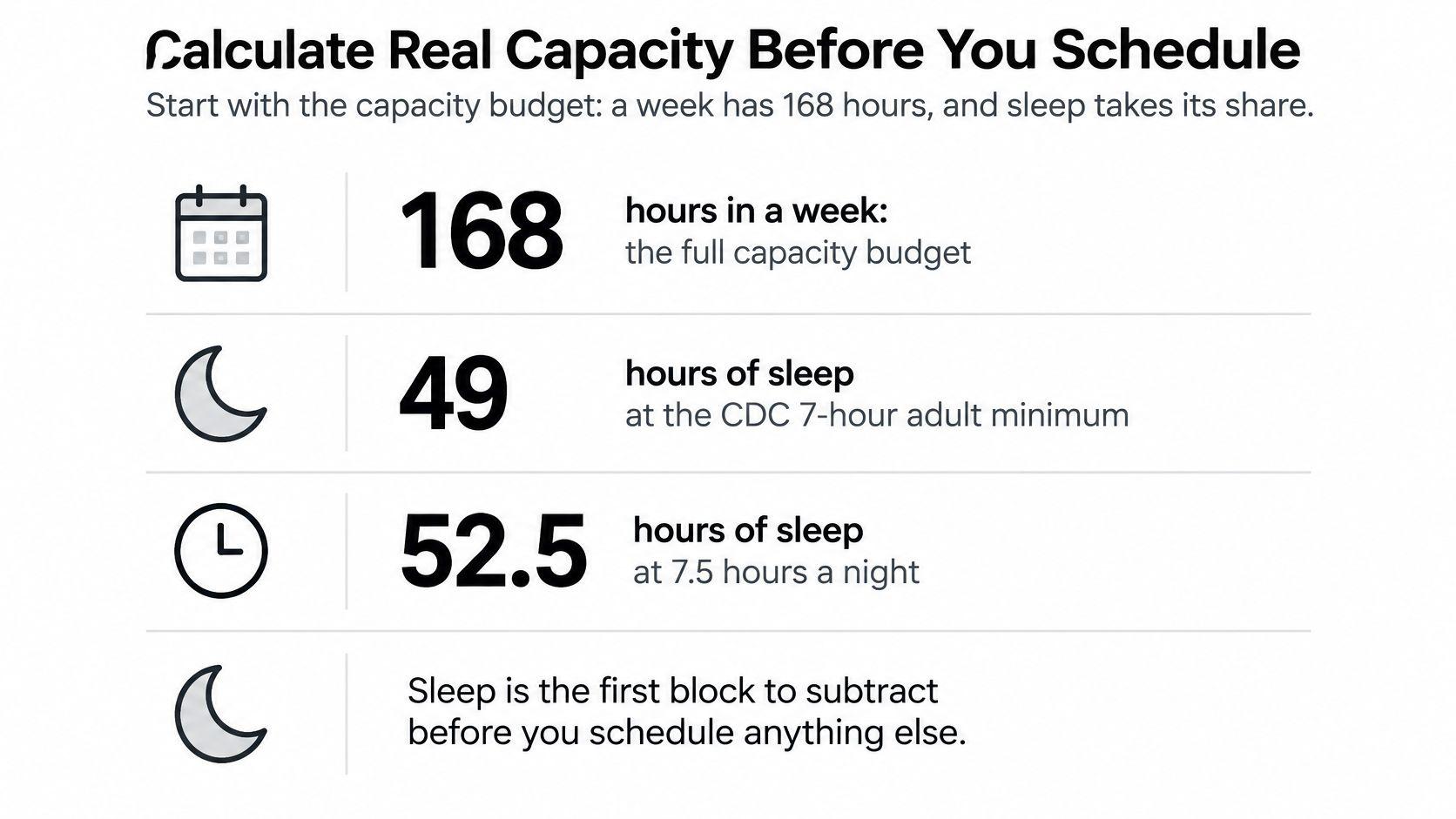
| Item | Value and notes |
|---|---|
| Total hours in a week | 168 hours, the full capacity budget |
| Sleep at the 7-hour minimum | 49 hours |
| Sleep at 7.5 hours a night | 52.5 hours; use your own number if you need more |
| Waking hours at 7.5 hours of sleep | 115.5 hours |
| Deliberate work in a 5-day week | 33 hours 20 minutes, at 6 hours 40 minutes a day |
Sleep comes out first as a fixed block, never as the time left over after everything else. A week built on 7.5 hours a night leaves 115.5 waking hours, and meals, commutes, family, and recovery take a large bite before any work is scheduled.
The deliberate work limit
The second subtraction is harder to accept. Knowledge workers systematically overestimate what they can finish: in a diary study from UCL's Discovery research archive.pdf), participants planned an average of 7 hours 44 minutes of work a day and completed 6 hours 40 minutes, with 34% of planned work still unfinished when the day ended.
The operating rule follows directly. Schedule no more than roughly 6 hours 40 minutes of deliberate work in a nominal 8-hour day, which is 33 hours 20 minutes across five days. The balance of the day belongs to meetings, messages, breaks, and requests that arrive unannounced. A team that books 40 hours of focused work into a 40-hour week has planned a week that doesn't exist, then blames itself when the week behaves accordingly.
The accuracy ratio
Every Friday, divide actual time by estimated time for each task type and keep the ratio. If research tasks consistently run 1.3 times over, multiply the next research estimate by 1.3 rather than trusting the optimistic number. A job you'd call three hours gets a four-hour block, and the block holds.
Apply that ratio to open-ended work only after separating it from fixed commitments. A meeting takes the time printed on the invite. A proposal, a diagnostic, or a first draft takes whatever it takes, and that's where estimation error lives, so that's where the buffer goes. It's the same discipline teams use in capacity planning: count the hours available, then decide what gets them.
Set your own sleep baseline
The public minimum isn't a personal optimum. NIOSH's work-hour training puts most adults at about 7 to 8 hours of good-quality sleep a night, and notes the requirement varies between people and may be partly inherited. Its practical test is whether you wake refreshed and stay alert through the day. Track planned sleep against afternoon alertness for two weeks, and if you're drowsy by 3 p.m., raise the protected block and let the work shrink to fit.
If your capacity moves with a health condition, build that into the grid instead of planning for a hypothetical good week. A migraine-aware scheduling guide for busy professionals shows how to protect the hours around an attack rather than pretending they won't happen.
How to Run Your Weekly Review Step by Step
A review is a sequence, not a mood. Run it in this order and each step leaves a decision on the page, not a vague sense that you thought about the week. Treat the week as a capacity budget: sleep and a realistic workday come off first, then fixed commitments, and only the remainder is available for new work. Build the plan for interruptions, not for a clean calendar that never arrives.
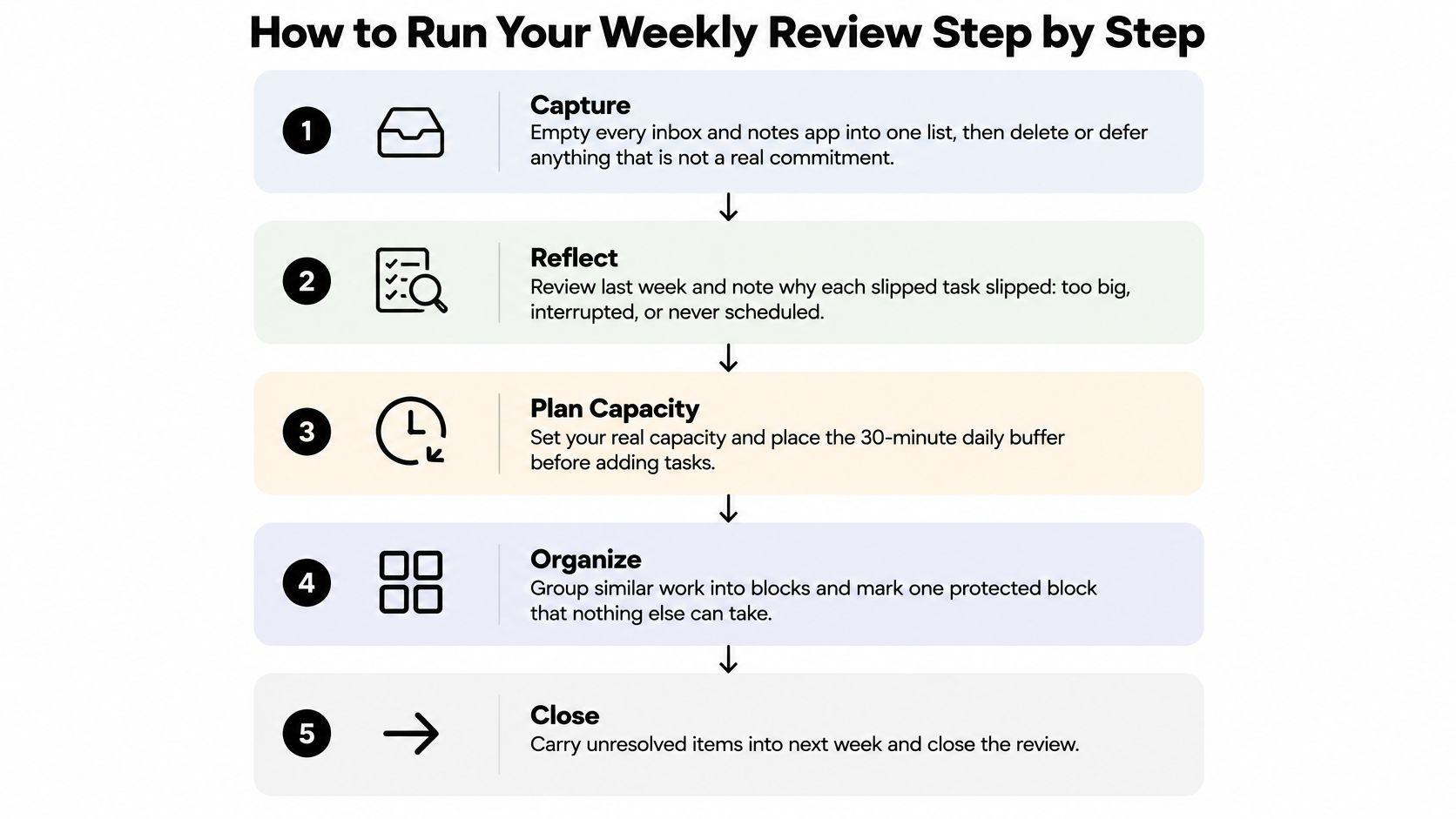
- Empty every inbox into one list. Notes app, email, paper scraps, the message you sent yourself at 11 p.m. Delete or defer whatever is not a real commitment. You cannot judge a week you cannot see, and duplicates hide inside open loops.
- Review last week for causes, not feelings. Beside each task that slipped, write one word: big, interrupted, unclear, or underestimated. The cause picks the fix, so do this before you build the new plan. A weekly review breakdown spells out the inputs and outputs of that process if you want the sequence named in full.
- List the coming week's commitments. Fixed meetings, deadlines, travel, and the work you want to finish. Write the total before you choose anything else. Then subtract those hours from the time left after sleep and a realistic workday. What remains is the budget. If the list already exceeds it, cut before you schedule.
- Choose three outcomes that would make the week a success. Outcomes, not a pile of tasks. Three is the ceiling. If a fourth matters, label it optional so Wednesday's version of you knows what to drop when the budget is gone.
- Estimate duration and dependencies. Apply your accuracy ratio to open-ended work, and name what each outcome waits on: a client reply, a colleague's draft, a decision. Anything with an unconfirmed dependency becomes a follow-up task, not a time block. A block you cannot start is borrowed capacity you will not get back.
- Attach each outcome to a cue. Turn it into an if-then rule: "If it is Monday at 9:00 a.m., then I will spend 45 minutes drafting the client proposal." Gollwitzer and Sheeran's 2006 meta-analysis of 94 studies found implementation intentions improved goal achievement at d = 0.65 and protected goal pursuit from derailment at d = 0.77. The cue makes the decision on Monday so you do not remake it under pressure.
- Add contingency and a fallback. Hold an interruption block inside the remaining hours, and name one task small enough for a low-energy hour. A bad afternoon should shrink the plan, not end the week.
- Park the plan where Monday will see it. Pin it to your calendar or the front screen of your task app, and mark the Wednesday check now, before the week starts. That check is where you compare hours used against the budget and drop the optional outcome if the week has already spent it.
If a written walkthrough helps, this covers the same sequence in a few minutes.
Adjusting Your Week When Plans Change
Assume something breaks the plan by Tuesday, because it will. The key question isn't whether the week holds its shape, it's how fast you can restore it. A workable plan looks like this on paper.
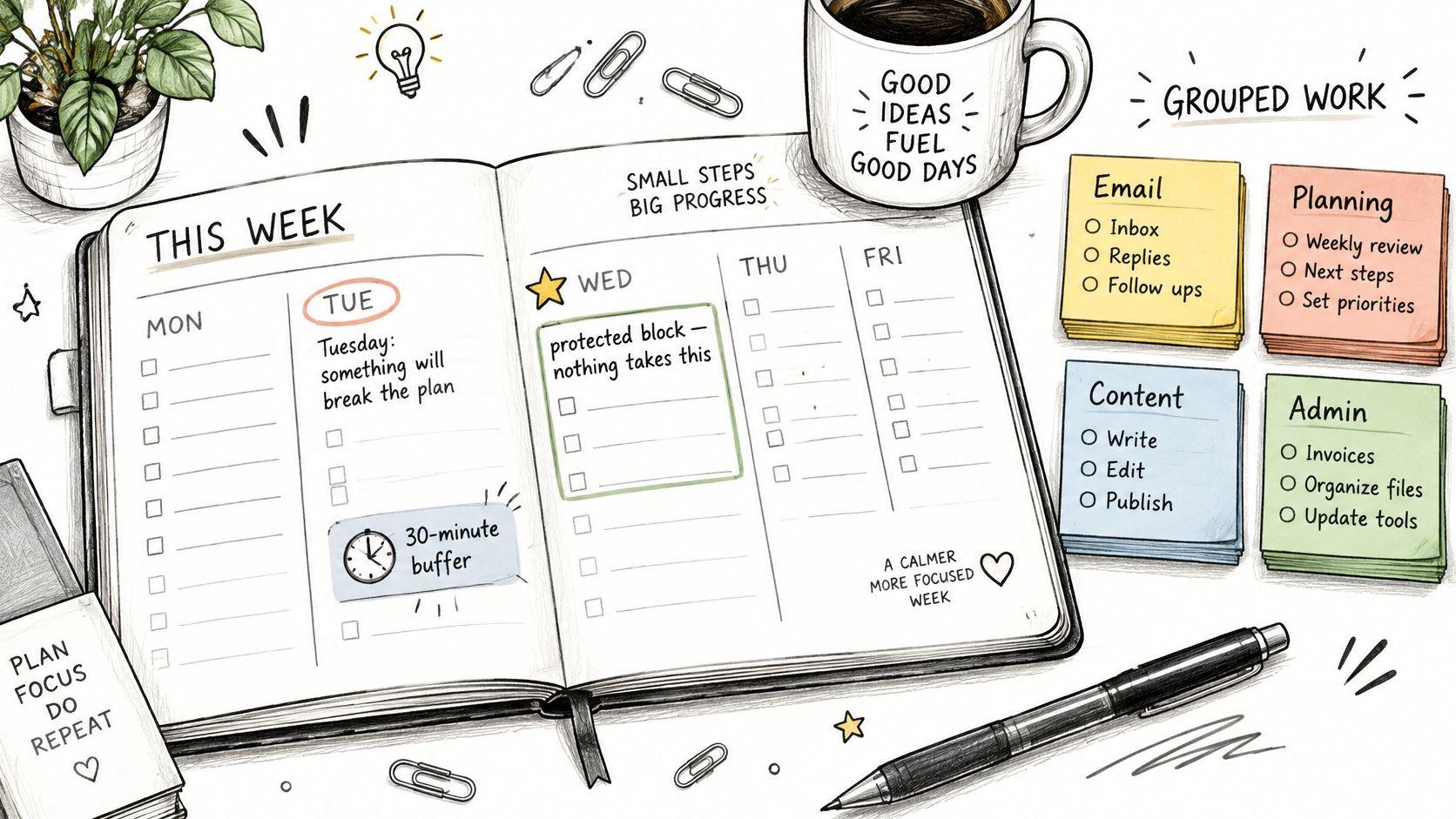
Three mechanisms do most of the restoring. A 30-minute daily buffer absorbs a single interruption without moving anything else. Grouping work by project or type of thinking makes a switch a context change rather than a full restart, which is why batching calls into one afternoon leaves the morning usable. And a re-entry note, one line written before you stop that says the next action, turns a fifteen-minute return into a two-minute one.
Interruptions cost more than the minutes they consume. Research on software developers found that people working across two or more projects spent an average of about 17% of development effort on cross-project interruptions, and the number of projects correlated strongly with the number of interruptions. Newer experimental work suggests a distraction may leave performance on your main task intact while cutting performance and earnings on secondary tasks and delaying your return to the primary one. That's the argument for writing the re-entry note first and taking the interruption second.
Take a Tuesday that goes sideways. A manager loses her afternoon to a launch review that overruns. She moves the least important outcome to next week, keeps the other two, and writes one sentence to her team explaining the change. The week still has three things worth doing, only now it has two, and nobody is guessing why.
Rule of replacement: a new urgent request replaces an outcome. It never joins the list as an extra.
- Schedule the buffer before the meetings, not after. A buffer added later gets eaten.
- Decide what you won't do this week and say it out loud to whoever expects it.
- Keep a fallback task for the low-energy hour after a hard call.
- Review the week's changes on Friday so the next plan starts from accurate data instead of an idealized week.
The Wednesday check is where this lives in practice. Ten minutes, same three outcomes, one question: what has changed enough that the plan should change? If you want the mechanics of the blocks themselves, these time-blocking methods cover how to lay them out without leaving gaps that meetings fill.
Fixing a Plan That Keeps Falling Apart
Ask people why their plan failed and most say they didn't plan hard enough. The opposite is usually true. Failing plans carry too many outcomes, estimates that ignore history, and no slot in the calendar for the review itself.
| Symptom | Likely cause | Fix |
|---|---|---|
| Plan is finished by Tuesday | Too many outcomes | Cut the list to three and move the rest to a backlog |
| Same task rolls over every week | Estimate too low or task too large | Split it into a smaller next action and apply your accuracy ratio |
| Plan is ignored by Wednesday | No weekly time for review | Schedule a 10-minute mid-week check |
| Blocks vanish when meetings land | No buffer | Add a 30-minute buffer each day |
Sleep sits underneath all four. The CDC's sleep recommendations put adults aged 18 to 60 at at least 7 hours a night, adults 61 to 64 at 7 to 9 hours, and adults 65 and older at 7 to 8. Sleeping fewer than 7 hours is associated with higher risks of obesity, diabetes, high blood pressure, coronary heart disease, stroke, frequent mental distress, and all-cause mortality. A plan that routinely borrows from that window isn't ambitious, it's subsidized by next month's performance.
The rollover task is the most common single failure and the easiest to misread. Say a freelancer's invoice run slips four weeks in a row. The task isn't being avoided because she's lazy, it's too large and has no entry point. The fix is a next action she can start cold: send three invoices, twenty minutes, Thursday at 4 p.m., with the accuracy ratio applied to last month's actual time.
The plan isn't failing on discipline. It's failing because it holds more than one week can carry.
Change one thing at a time and give it two weeks before judging it. Swapping systems mid-month tells you nothing, because you never learn whether the old one would have worked with a smaller list. A plan with no review slot will drift no matter how good the outcomes are, so if yours is abandoned by Wednesday, add the mid-week check before you touch anything else.
For readers whose attention and time estimates swing week to week, the fix is to separate choosing work from starting it. A 2025 survey of 106 employees with ADHD across 21 industries, summarized in this look at executive dysfunction at work, found that 79.3% said ADHD negatively affected their work performance while only 58.5% used workplace adjustments, and of those who did, 80.6% reported better productivity. Use a fixed daily start cue, keep the three outcomes visible, and turn each into a 20-minute next action instead of a full day's goal.
Run Your First Planning Session This Week
Thirty minutes on Friday is enough for a first pass. Empty the inboxes, review last week, and choose three outcomes. Sunday blocking waits until the following week, when you have a real list to place against the hours you have.
Subtract sleep and a realistic workday before any task gets a slot. Meetings and the interruptions you already expect take their share first. The three outcomes go into what remains.
Before you close the laptop, put a Wednesday check on the calendar for 10 minutes and paste the three outcomes into the description. That appointment stops the plan from becoming a document you wrote once.
On the next Friday, count how many tasks carried over and whether the three outcomes finished.
Fluidwave's AI scheduling reads your Google Calendar, finds free time, and blocks it for your most important tasks. It can split a task into work sessions inside your working hours and leave breaks around meetings. You still pick the outcomes and protect the sleep window. Automation only fills the hours you have.
A plan that fits your real capacity beats a perfect list you never use.
Recurring tasks, such as the weekly metrics review and monthly planning, come up on their own, so the routine doesn't have to be rebuilt each week. Visit Fluidwave and start your next weekly review with a plan that already fits.
Focus on What Matters.
Experience lightning-fast task management with AI-powered workflows. Our automation helps busy professionals save 4+ hours weekly.