Executive dysfunction at work can look like laziness. Learn the signs, how it affects tasks and teams, and practical fixes for employees and managers.
November 13, 2026 (Today)
Executive Dysfunction at Work: Signs, Fixes and Support
Executive dysfunction at work can look like laziness. Learn the signs, how it affects tasks and teams, and practical fixes for employees and managers.
← Back to blog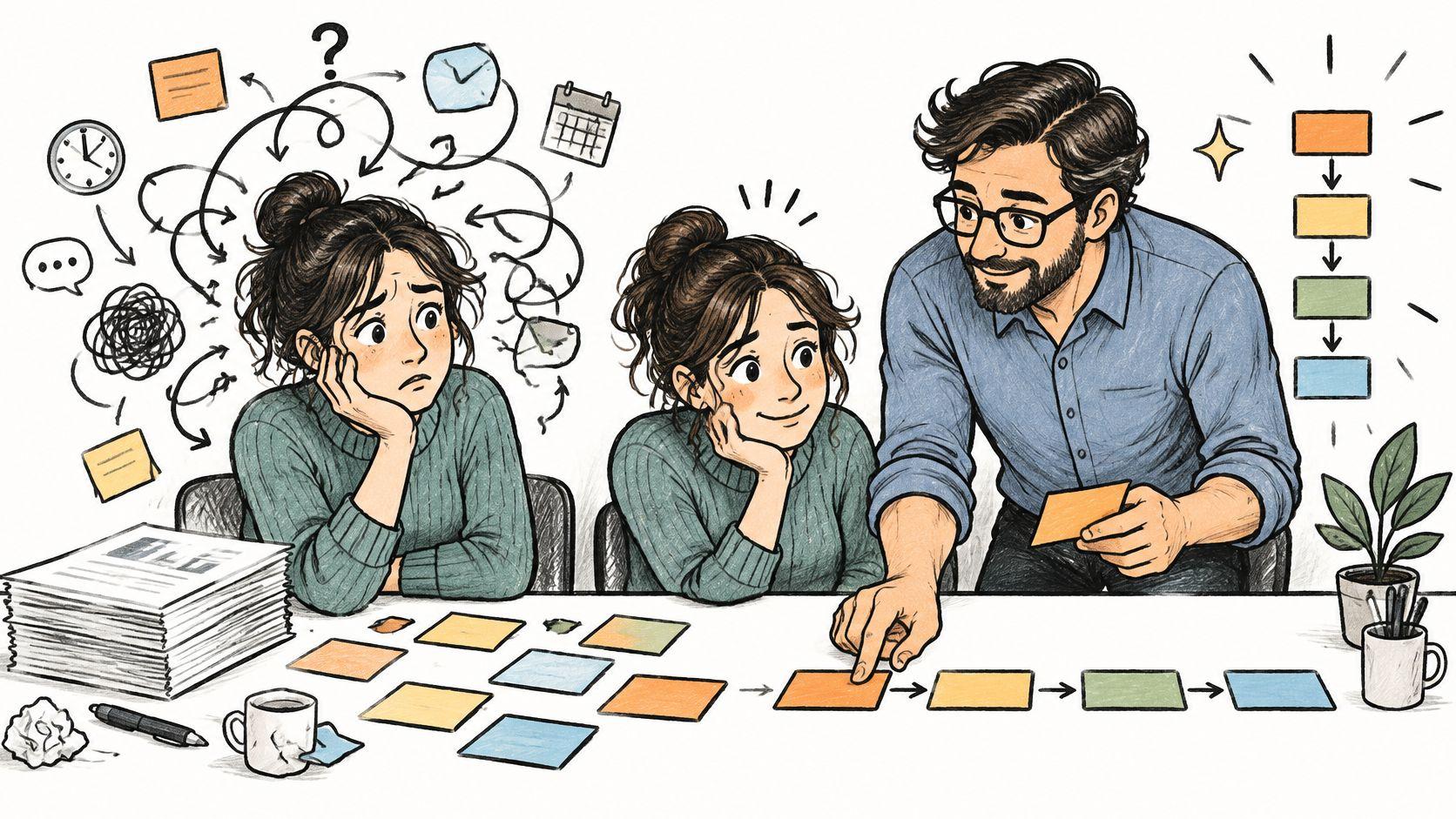
It's 9:40 on a Tuesday. The report that decides whether the quarter stays on track is open in one tab, the inbox is open in another, and the last forty minutes went to messages that felt urgent and changed nothing. The person at that desk isn't lazy. They're stuck at the handoff between knowing what matters and starting it.
That gap is what people usually mean by executive dysfunction at work. It isn't a shortage of intelligence, effort, or care. It's a bottleneck in the mental skills that plan, start, sequence, and monitor work. Some of those bottlenecks can be reduced by the employee. Others only move when a manager changes the operating rhythm. Separating the two is the difference between a useful fix and another productivity ritual that collapses by Thursday.
Recognizing Executive Dysfunction at Work
A capable analyst clears 60 emails before lunch and still hasn't opened the pricing model. A project lead means to send a follow-up, remembers it twice, and never sends it. Both people look busy. Both are losing the day to the same problem: the work is visible, but the first step isn't.
Executive dysfunction is not limited to poor concentration. It involves impaired initiation, organization, working-memory management, time estimation, and sustained self-regulation, as a 2024 systematic review of ADHD and employment research sets out. Those skills show up in ordinary tasks, not just in big strategic ones.
| Skill | What It Looks Like | Typical Workplace Effect |
|---|---|---|
| Task initiation | Work sits untouched until a deadline forces a start | Late starts and rushed deliverables |
| Working memory | Instructions and open loops are forgotten mid-task | Repeated questions and missed follow-ups |
| Time estimation | Tasks take far longer or shorter than planned | Overcommitment and missed meetings |
| Organization | Files, inbox and priorities pile up without a system | Lost documents and duplicated work |
| Sustained attention | Focus drifts within minutes, not hours | Unfinished reports and rework |
| Emotional and impulse control | Quick replies sent before thinking, or stalled responses to conflict | Friction with colleagues and unclear decisions |
The same review reports that the mental effort required to suppress hyperactivity or impulsivity can produce exhaustion, interfere with task initiation and maintenance, and compound organizational, memory, and time-management difficulties. That matters because the exhaustion is easy to misread. A person who is fighting to stay seated, stay quiet, or stay on one thread is spending effort that never appears in the output.
Occupational studies also find that employees may overestimate their performance relative to supervisors or independent observers, which is why externalized progress measures are more reliable than self-assessment alone. A 2024 occupational-outcomes study further identified time management as a consistent predictor of lower income, greater workplace boredom, and lower satisfaction with coworkers and supervisors. Organization and motivation-related difficulties predicted most assessed outcomes.
The useful distinction: effort is how hard someone is trying. Capacity is how much executive control they have available for starting, sequencing, and checking work today. The two aren't the same, and treating them as the same is how capable people end up with a performance problem.
These patterns can come from ADHD, anxiety, depression, poor sleep, or chronic stress. A pattern at work is a reason to look closer, not a diagnosis. Before you name anything, name the bottleneck: which of those six skills shows up most in your week? Pick two. The next sections work from those two, not from a total personality overhaul.
The Real Cost to Employees and Teams
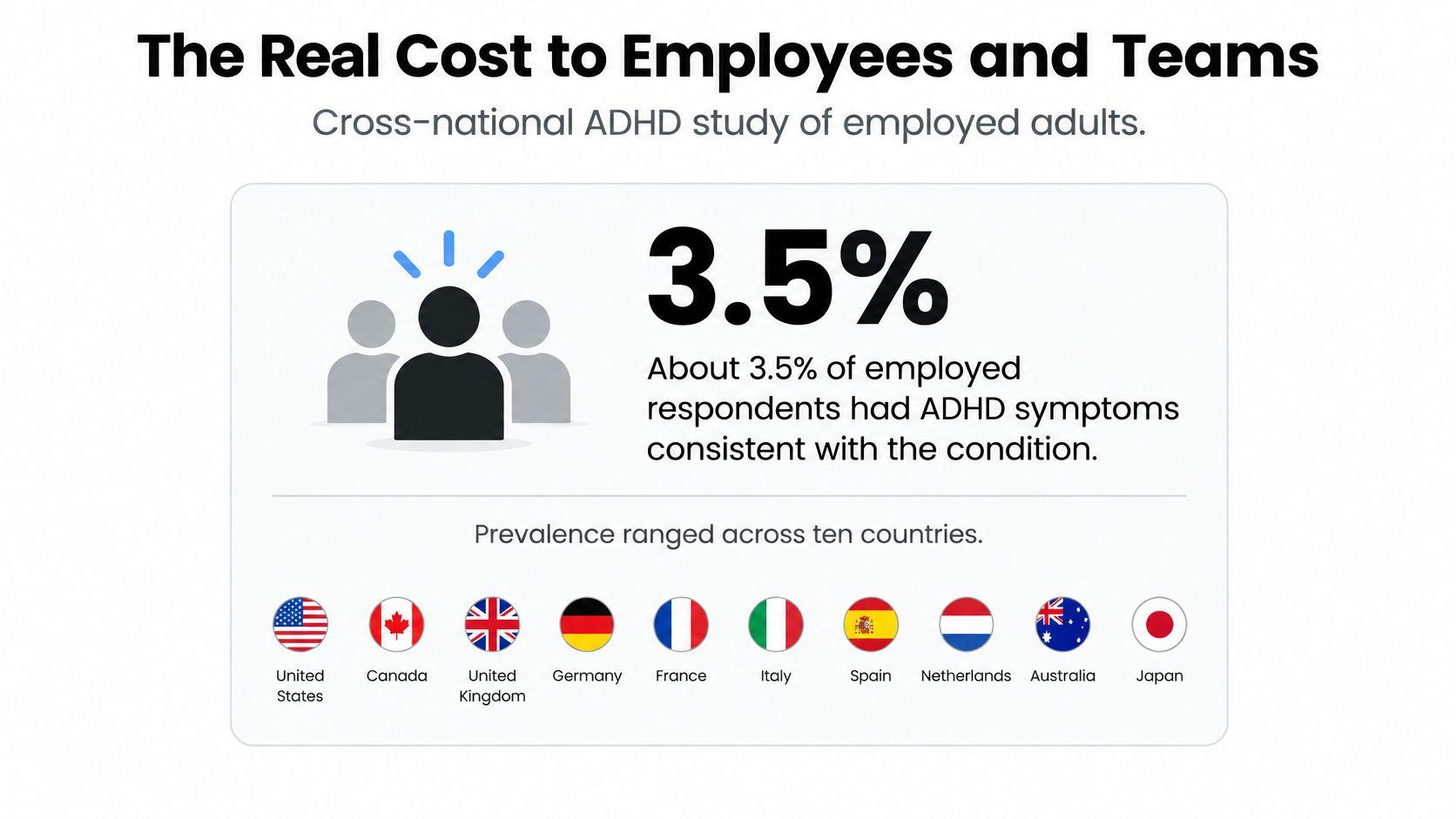
The cost shows up before anyone has a diagnosis. The 2008 cross-national study of adults with ADHD examined 10 countries and found that about 3.5% of employed respondents reported symptoms consistent with the condition, with prevalence ranging from 0.9% in Lebanon to 4.5% in the United States and 6.3% in France. The same study measured the output gap: employees with ADHD missed an average of 9 additional workdays per year, and inattention while present was estimated at roughly 22 additional days of lost productivity annually. Add those two separate measures and you get a planning sum of about 31 workdays of annual impact per affected employee, not a universal total for any one person. The point is presenteeism: much of the cost sits with people who are at their desks but cannot start, sequence, sustain, or finish the work.
A UK web-based survey of 135 employed adults with ADHD found that they missed 15.71% of work time because of health problems, reported 40.59% impairment while working, and 45.65% overall work impairment. Those numbers separate absence from the quieter problem. Many respondents weren't away. They were present and substantially less effective.
| Measure | Figure | Study Context |
|---|---|---|
| Employed prevalence, United States | 4.5% | Cross-national study, 10 countries |
| Employed prevalence, France | 6.3% | Cross-national study, 10 countries |
| Employed prevalence, Lebanon | 0.9% | Cross-national study, 10 countries |
| Extra missed workdays per year | 9 days | Employees with ADHD vs. without |
| Productivity lost to inattention while present | About 22 days per year | Estimated equivalent |
| Work time missed due to health problems | 15.71% | UK web survey, 135 employed adults |
| Impairment while working | 40.59% | UK web survey, 135 employed adults |
| Overall work impairment | 45.65% | UK web survey, 135 employed adults |
Knowledge work makes the presenteeism problem sharper because the job is mostly prioritization, sustained attention, task switching, and deadline management. A factory line makes a slow day visible. A knowledge worker can sit at a laptop for eight hours, look responsive, and still fail to produce the one document that mattered.
How to use these numbers: treat them as evidence that the cost is real and worth planning around. Don't turn the 31-day sum into a forecast for a colleague, a direct report, or yourself. It's a rough planning total built from two different measures, missed days and equivalent productivity loss, not a diagnostic score.
That framing helps in a conversation with HR or a manager. The argument isn't "I need special treatment." It's "this work design creates a measurable output gap, and here's the smallest change that would reduce it." The same logic applies to workload planning: if a team has several people with this pattern, the buffer has to exist somewhere, or it gets absorbed by evenings and weekends.
Why Switching Tasks Drains Executive Control
Every switch between unrelated work is a folder close and a folder open, except the folder is in your head and some of the thread falls out each time. The cost isn't dramatic. It's the slow tax that makes an executive look busy while progress stalls.

Research on task switching finds that switching between task sets is more cognitively demanding than switching between tasks of the same type. In a team-based experimental environment, lower switching frequency was associated with higher working-memory estimates and better performance, while the productivity benefit of multitasking diminished as cognitive load increased, according to the study of task switching and working memory. The worker has to reconfigure goals, retrieve the relevant rules, and reload partially maintained information. That takes time even when the switch looks instant.
Watch a manager's afternoon. Budget approval, then a hiring dispute, then a client escalation, then back to the budget. By 5 p.m. there are three half-finished threads and no clear next step on any of them. Nothing was wasted in the obvious sense. The waste is in the repeated reconstruction: reading the same email chain, reopening the same spreadsheet, remembering what the decision was supposed to be.
The practical split is between same-set batching and cross-set switching. Processing approvals, reviews, or similar email together is same-set work. Moving between strategic planning, personnel issues, finance, and operational interrupts is cross-set work, and it's the expensive kind. A day full of the second kind will feel frantic even if the calendar looks efficient.
A working rule: batch the similar, protect the complex, and route the low-value interruption away from the person who has to do the thinking.
Some switching is fine. Moderate switching can use idle time, and a rigid zero-interruption policy usually fails because work has real dependencies. The problem starts when switching consumes more cognitive capacity than the work produces. That's when people mistake motion for progress.
If you want the mechanics in more detail, this explanation of what context switching does to working memory is worth reading before you redesign your calendar. And if the problem is not the calendar but the pull of the inbox, KeenVerdict's free focus app rankings are a practical place to compare tools that block or batch interruptions. The design goal is simple: a short next-action queue, uninterrupted blocks for complex work, and a route for low-value interrupts that doesn't run through the person doing the deep work.
Practical Steps Employees Can Take Now
The fixes that work are small, cheap, and specific. They don't require a new identity or a perfect system. They require making the next action visible and reducing the number of executive decisions between you and the work.
-
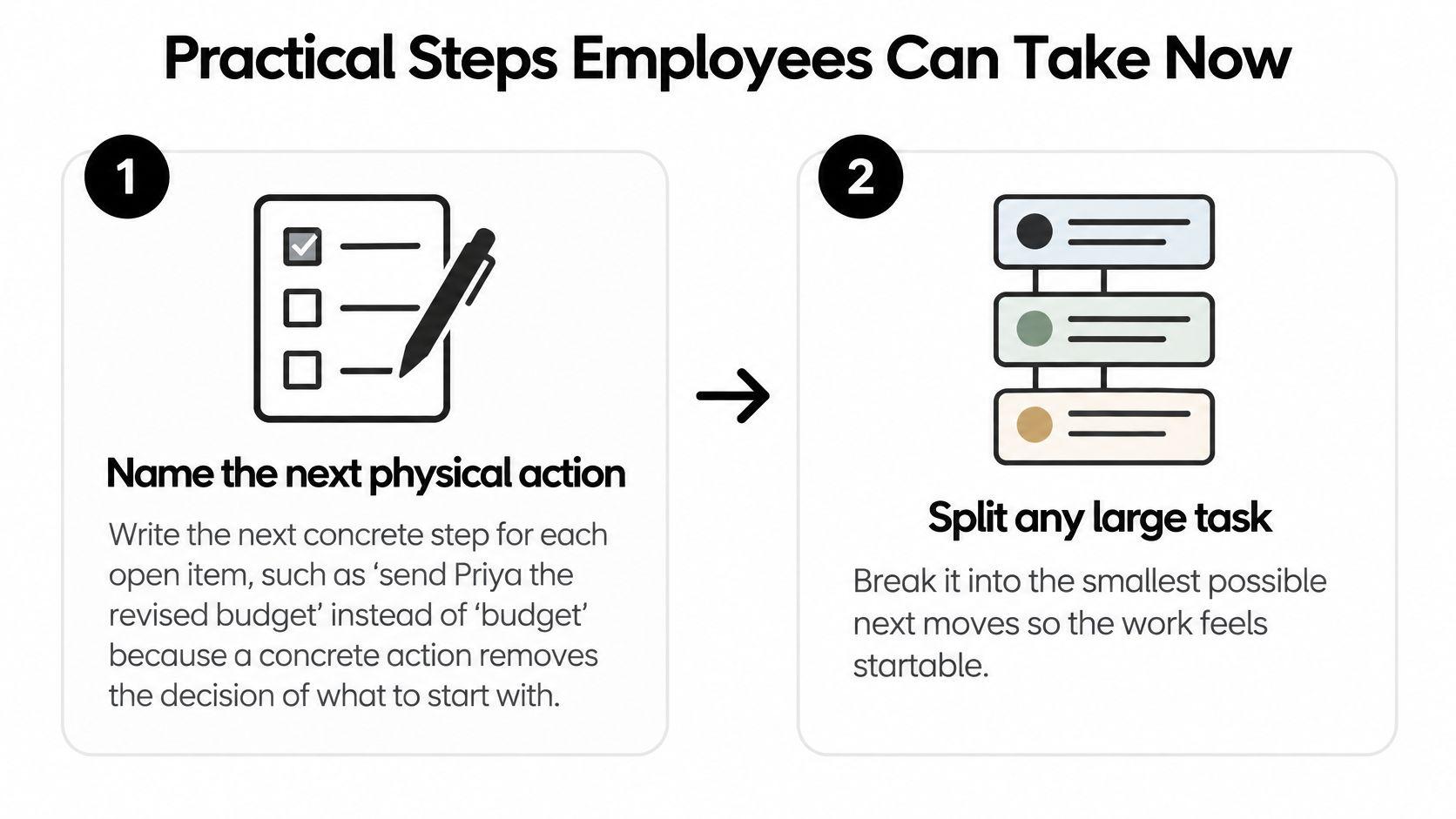
Name the next physical action. Write "send Priya the revised budget" instead of "budget." A concrete action removes the decision of what to start, which is the part that stalls. This is the task initiation problem in its ordinary form. The usual slip is a next action that is still vague, like "work on report," which puts you back at the same decision with a little more guilt.
-
Split any task that won't fit one session. Cut it into pieces sized to a single time block so the work gets a daily slot instead of a heroic push. Fluidwave can split a long task across several sessions, which helps when the task is too big to start. The slip is splitting into steps that are still too large to begin, so the list looks organized but nothing moves.
-
Batch similar work into fixed windows. Process email, approvals, and reviews together at set times instead of answering each arrival. The reason is switching cost, not tidiness. The slip is batching that becomes constant checking, which is the same interruption with a nicer name.
-
Hide what you can't act on yet. Keep the working list filtered to what is actionable now and move items waiting on someone else out of view. Fluidwave's auto-prioritization and Active filter hide tasks you can't act on right now and put the most important task at the top. The slip is a list so complete it becomes another source of noise.
-
Place work inside working hours and leave buffers. Put tasks on the calendar at realistic lengths, with gaps around meetings. Fluidwave's AI scheduling splits tasks into work sessions and places them in free time inside your working hours, leaving breaks around meetings. The slip is scheduling back-to-back and treating the buffer as optional, which turns every overrun into the next meeting's problem.
-
Close the day with a five-minute review. Note what moved, what carried over, and the first action tomorrow. That review externalizes memory and gives tomorrow a starting point. The slip is skipping it when you're tired, which is exactly when it pays.
If you want to go deeper on the underlying skills, these executive function improvement strategies cover the training side rather than the tool side. I would start with the cheapest fix first: one written next action, one protected block, one end-of-day review. Run those for two weeks before buying another app.
How Managers Can Reduce the Load Without Micromanaging
A 2025 systematic review drawing on 56 studies from 12 countries found that supervisor misunderstanding, exclusion, inadequate accommodations, and masking were persistent barriers, while supportive managers, flexible work arrangements, and assistive technologies were facilitators. The lesson isn't that managers need to become therapists. It's that the operating rhythm is part of the intervention.
Outcome-based evaluation tends to help more than rewarding visible busyness. If the person who replies fastest and stays latest is the one who gets praised, you're asking for fragmentation. If the person who ships the deliverable gets the credit, you're asking for focus.
What to change in the operating rhythm
-
Write decisions down. After each meeting, record the decision, the owner, and the date. A short written record reduces the working-memory load on everyone and stops the same conversation from reopening three times.
-
Cut deliverables into dated pieces. "Finish the strategy" is not a milestone. "Draft the pricing section by Thursday" is. Smaller pieces give a person a startable unit and give you an earlier signal if something is stuck.
-
Set predictable check-ins. A fixed 15-minute slot at the same time each week is easier to prepare for than an ad hoc "quick chat" that arrives when the person is already deep in something else.
-
Agree reminders in advance. Ask what kind of nudge helps and where it should land. A calendar reminder, a written note, or a message from an assistant all work differently, and the wrong one becomes noise.
-
Name the owner of each follow-up. Unowned actions become nobody's action. The point isn't surveillance. It's making the handoff visible so the person carrying it doesn't have to hold it in memory.
The line to hold is between supportive externalization and harmful rigidity. Supportive externalization makes the next action visible, such as a written brief, a default priority, or a clear definition of done. Harmful rigidity adds excess notifications, open-ended delegation, and constant interruption, then calls it structure. The first reduces cognitive load. The second relocates it.
Routine follow-up can be handed off. On Fluidwave, setting a task to Delegate sends it to a human assistant through the marketplace, which takes low-value chasing off a specialist's day. That's not a substitute for good management. It's a way to stop spending expensive attention on work that doesn't need it.
A simple test before delegating: would a new hire understand this task without asking? If not, the task is still a decision, not a deliverable.
No workflow fixes hostile management. If the culture rewards visible panic and punishes quiet progress, templates and check-ins won't save the person on the receiving end. And monitoring keystrokes in the name of support isn't support. It's surveillance with a wellness label. If the strain is already affecting sleep, mood, or attendance, the conversation needs to widen to mental health at work, not just task design.
Supporting a Struggling Colleague Without Diagnosing Them
The first sign is rarely dramatic. A follow-up doesn't arrive. A question gets asked twice. A deadline slips without warning, and the person seems as frustrated as everyone else. The useful move is to make the work visible, not to diagnose the cause.
Start with the next action rather than the reason. "What's the first step you're planning on this?" is a better question than "why hasn't this moved?" It gives you information you can act on and avoids turning a work problem into a character review. If the answer is vague, help shrink the step until it's startable.
Offer a fixed check-in instead of chasing ad hoc. A short standing slot gives the person a predictable point to prepare for and gives you a predictable point to catch drift. Then agree in writing who owns each follow-up. A shared note with names and dates prevents the quiet resentment that builds when one person becomes the memory for the whole team.
Peers can take on some of the load without absorbing all of it. A handover note, a shared deliverable split into two clearly owned halves, or a five-minute review at the end of a joint task can keep the work moving. If the trade-off is real, name it to the manager. "I'm covering the status updates on this project, and that's taking two hours a week" is a workload statement, not a complaint about a colleague.
Describe the work, not the condition. "The brief is still ambiguous" is fair and private. "They're obviously ADHD" is neither. Keep the conversation about the task, the deadline, and the support that would make the next step possible.
Escalate when performance affects safety, client commitments, or a team deadline. At that point the manager needs to be in the room, not hearing about it after the fact. For health concerns, point toward HR or occupational health rather than offering a diagnosis from the next desk.
Testing Accommodations and Fixes as Two-Week Experiments
The accommodation gap is not mainly a list problem. It's an implementation problem. A 2025 U.S. neurodiversity at work survey found that 68% of employed neurodivergent adults did not know what accommodations they were entitled to, and 51% did not know whom to approach at work.
The evidence also undercuts one-size-fits-all advice. In a 2025 survey of 106 employees with ADHD across 21 industries, 79.3% said ADHD negatively affected work performance, but only 58.5% used workplace adjustments. Remote or hybrid work, flexible schedules, and noise control were rated most helpful, while rigid structures and open offices were least effective. After adjustments, 87.1% reported lower stress or anxiety and 80.6% reported better productivity.
That's the argument for treating accommodations as experiments tied to a specific bottleneck, not as generic perks. A quiet room doesn't help a time-estimation problem. A planner doesn't fix sensory overload. Match the trial to the failure.
| Bottleneck | Trial to Run | Suggested Measure |
|---|---|---|
| Task initiation | Written next-action list with a defined first step per task | Fewer tasks carried over to the next day after two weeks |
| Working memory | Written meeting notes and reminders set at the start of each task | Fewer follow-up questions from colleagues |
| Time estimation | Calendar blocks with built-in buffer time | Deadlines met without late-night rushes |
| Sensory regulation | Noise-cancelling headphones or a quiet work window | Self-rated focus and stress across a trial month |
| Sustained attention | Flexible start time or a remote day for deep work | Output quality and stress ratings before and after the change |
Run one trial at a time
-
Name the bottleneck and write a baseline. Count the tasks carried over at the end of each day, the interruptions in a morning, or the meetings that ran over. A baseline turns a vague feeling into something you can compare.
-
Change one thing only. If you change the schedule, the headphones, and the task list in the same week, you won't know what worked. One variable gives you a clean read.
-
Log the measure weekly for two to four weeks. A single good day isn't evidence. Two weeks is usually enough to see whether the change survives a normal mix of meetings and deadlines.
-
Keep, adjust, or drop it. A trial that doesn't work is still useful, because it rules something out. The point isn't to collect accommodations. It's to find the smallest change that reduces the load.
When you ask for support, describe the functional need rather than the diagnosis. You can request a quiet block, a written brief, or a flexible start without naming a condition. If your manager is the right first stop, keep it short and specific.
A manager conversation script: "I do my best work when I have a written brief and a quiet block in the morning. I'd like to trial a 9 to 11 focus window for two weeks and measure whether the Thursday report goes out on time. Can we review on the 19th?"
Know when to take the request to HR. If the adjustment touches a formal policy, a medical absence, or a workplace risk, HR or occupational health is the right channel, not a hallway conversation. And if symptoms are severe, persist across settings, or affect your health, a clinician can help identify the underlying causes. A workflow trial is not a diagnosis, and it isn't a substitute for care.
Bring three things to the conversation: the functional need, the trial you ran, and the result. That's a far stronger position than a general request for "support," and it gives your manager something concrete to approve.
Fluidwave is built for the kind of work this article describes: an AI task manager that turns a vague list into prioritized next actions, splits long tasks across sessions, and lets you delegate routine follow-up to a human assistant. If you want to test one small change this week, start with a single task, give it a realistic session, and measure what happens. Visit Fluidwave to try it.
Focus on What Matters.
Experience lightning-fast task management with AI-powered workflows. Our automation helps busy professionals save 4+ hours weekly.