Learn to define, identify, and track critical success factors (CSFs). Our guide shows you how to connect CSFs to KPIs and daily tasks to achieve your goals.
June 9, 2026 (1mo ago)
Critical Success Factors: Find Your Focus and Drive Results
Learn to define, identify, and track critical success factors (CSFs). Our guide shows you how to connect CSFs to KPIs and daily tasks to achieve your goals.
← Back to blog
Your calendar is full. Your inbox keeps refilling. Slack pings arrive faster than you can clear them. By late afternoon, you've handled a dozen urgent requests and checked off a respectable number of tasks, yet the critical work still feels untouched.
That's not a discipline problem. It's usually a filtering problem.
Most professionals don't fail because they aren't working hard enough. They fail because their task list mixes strategic work with administrative residue, reactive requests, and low-value busywork. Everything appears important when it lands in the same place.
Critical success factors solve that problem. They give you a way to separate what must go right from everything that is merely useful, interesting, or loud. Done well, they don't live in a slide deck. They shape what gets scheduled, what gets delegated, and what gets ignored.
Why Your To-Do List Is Lying to You
A typical workday can look productive from the outside and still be strategically empty.
You start with a planning app full of tasks. Then a client email jumps the queue. A meeting runs long. Someone needs a quick review. Finance wants input. A teammate asks for context. By noon, you've been busy nonstop, but none of that work has moved the one outcome that would make the quarter successful.
That's why a raw to-do list can be deceptive. It tracks activity, not strategic impact.
Most lists are democratic. They give equal visual weight to “prepare board narrative,” “approve invoice,” “fix onboarding handoff,” and “reply to low-stakes message.” Once those items sit side by side, your brain treats them as competing claims on attention. If you're already mentally overloaded, you'll drift toward the easiest item, not the most important one.
That's also why so many smart people need systems to overcome indecision and overthinking. The issue often isn't effort. It's the absence of a reliable method for deciding what deserves effort first.
Busy isn't the same as effective
A founder trying to stabilize cash flow might spend the day approving design tweaks. A project lead trying to hit delivery dates might get trapped in status updates instead of removing blockers. A freelancer trying to build a stronger pipeline might spend an hour perfecting a proposal template when the issue is inconsistent outreach.
Those aren't bad tasks. They're just not critical tasks.
Practical rule: If a task disappears and your main goal is still intact, that task probably isn't tied to a critical success factor.
When people first adopt a prioritization method like the 1-3-5 rule for daily planning, they often feel immediate relief because the day stops looking infinite. Critical success factors take that one level higher. They help you decide which tasks belong in the “1” and which tasks shouldn't be on today's list at all.
What the filter changes
Critical success factors act like a lens.
Instead of asking, “What do I need to get done today?” you start asking, “What has to go right for this goal to succeed?” That shift sounds small, but it changes decisions fast. Meetings get shorter. Delegation gets easier. Lower-value work becomes easier to spot.
A useful to-do list should reflect your strategic bottlenecks, not your latest notifications.
What Are Critical Success Factors Really
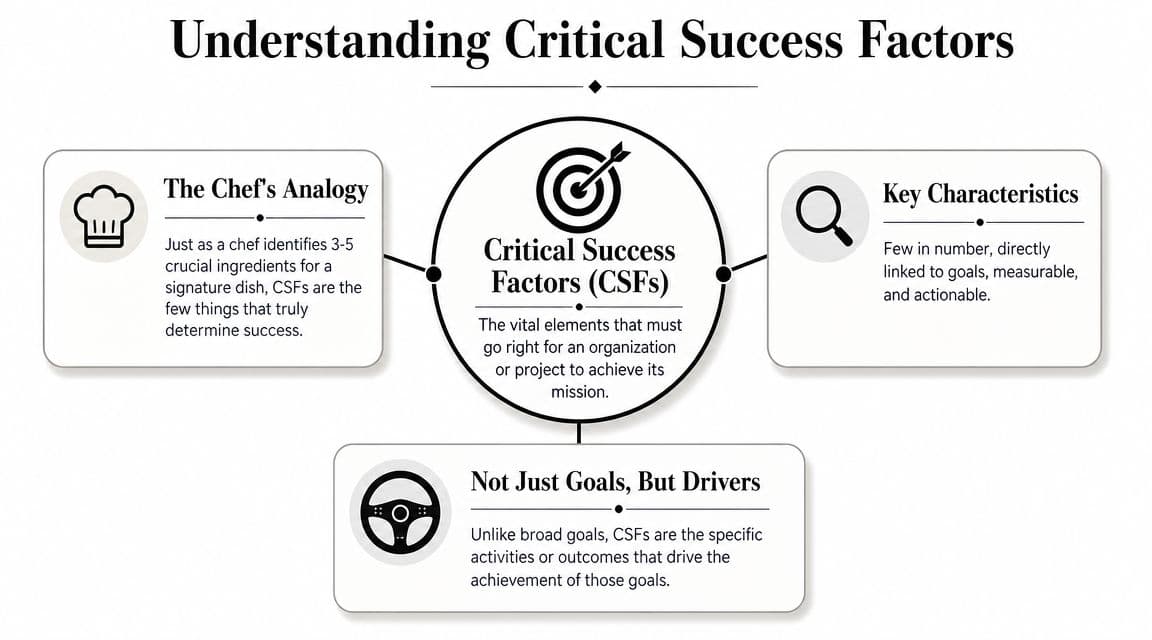
The cleanest way to think about critical success factors is this. They are the few conditions that must go right if you want a goal, strategy, or project to work.
John F. Rockart formalized the concept in 1979 as the “limited number of areas” where things must go right for an organization to achieve successful competitive performance, according to the MIT CISR primer on critical success factors. That idea still holds because most organizations don't suffer from a lack of ideas. They suffer from too many priorities competing at once.
A ship captain doesn't monitor every bolt on the vessel to stay on course. The captain watches a few essential readings. If those drift, the journey drifts. Critical success factors work the same way in business.
The easiest way to distinguish the terms
People often lump goals, objectives, CSFs, and KPIs together. That creates messy plans.
Here's the simpler separation:
| Term | What it means | Example |
|---|---|---|
| Goal | The destination | Become the preferred provider in a niche |
| Objective | A concrete milestone | Launch a stronger referral channel this year |
| Critical success factor | A make-or-break condition | Deliver consistently excellent client experience |
| KPI | The measure that shows whether it's happening | Response time, renewal trend, referral volume |
If you skip the CSF layer, teams jump straight from ambition to metrics. That creates dashboards full of numbers without clear strategic meaning.
What a CSF is not
A critical success factor is not a task.
“Send follow-up emails” is a task. “Maintain a healthy qualified pipeline” could be a critical success factor. One is an action. The other is a condition that determines whether the business succeeds.
A CSF also isn't a vague aspiration. “Be better at communication” sounds worthy, but it doesn't guide decisions. A stronger version is “Keep cross-functional handoffs clear enough that work doesn't stall between teams.” That statement tells people what must go right.
For teams that already track output, a strong companion to this idea is project tracking metrics that connect work to outcomes. The key is sequence. First define what matters. Then decide how you'll measure it.
The test that matters
A practical test is blunt.
Ask: If this factor goes wrong, can we still succeed?
If the answer is yes, it's probably helpful but not critical. If the answer is no, you're getting close.
Most weak planning happens because teams confuse “important” with “mission critical.”
That distinction is where critical success factors earn their keep.
How to Identify Your Own Critical Success Factors
Finding your own critical success factors is less about brainstorming everything that matters and more about identifying what would break success if neglected.
That means you don't start with your task manager. You start with the outcome.
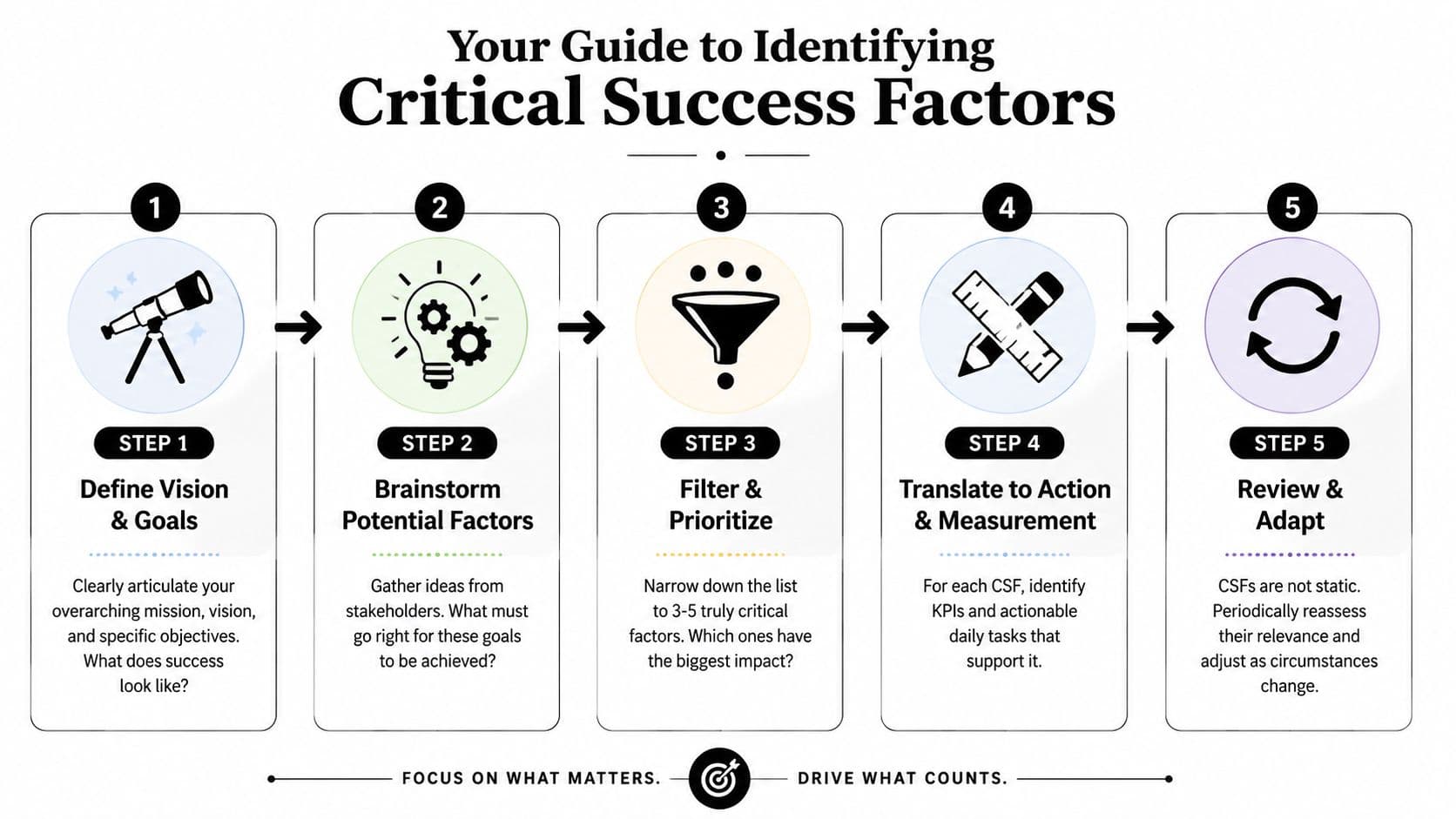
Modern guidance recommends using methods like benchmarking, expert consultation, and PESTLE analysis to identify critical success factors, then linking them to quantitative indicators so they can be tracked in practice, as outlined in Asana's guide to critical success factors. That's useful because it keeps the exercise grounded in both internal reality and external context.
Start with one real goal
Don't begin with your company mission statement unless you're doing a full strategic review. Start with one live priority.
Examples:
- Executive team: Improve operating discipline during a growth phase
- Project lead: Deliver a launch without last-minute chaos
- Consultant: Build a more stable referral-driven pipeline
- Freelancer: Raise quality while reducing context switching
Now ask a harder question than teams usually ask: What must go right for this to work?
Not what would help. Not what would be nice. What must go right.
Look at where things usually break
Most organizations already know more than they think. The clues sit in recurring failures.
Use prompts like these:
- Repeated delays: Where does work consistently stall?
- Quality issues: What keeps forcing rework?
- Decision friction: Where do approvals or unclear ownership slow momentum?
- External pressure: What market, regulatory, customer, or technology shift changes the game?
- Competitive gap: What do stronger operators in your space do with more discipline than you do?
If your team struggles to prioritize this analysis, frameworks like the Eisenhower Matrix with practical examples can help separate urgent noise from structural issues.
Cut the list aggressively
At this stage, many individuals grow complacent.
A long list of “critical” factors is usually just a disguised wish list. Good CSFs are pruned. If you can't remember them without opening a document, you have too many.
Try this filtering table:
| Candidate factor | If ignored, does success break | Can the team influence it directly | Keep or cut |
|---|---|---|---|
| Faster stakeholder decisions | Often yes | Yes | Keep |
| Better slide design | Usually no | Yes | Cut |
| Clear project ownership | Often yes | Yes | Keep |
| More internal meetings | Usually no | Yes | Cut |
A short list creates usable focus.
Working rule: If every department can add three “critical” items without argument, no prioritization has happened.
Write them as conditions, not slogans
Weak CSFs sound like posters. Strong CSFs sound like operating conditions.
Compare the difference:
-
Weak: Improve customer success
-
Stronger: Keep onboarding and support coordinated enough that new customers reach first value quickly
-
Weak: Be more efficient
-
Stronger: Remove recurring approval and handoff delays that slow core delivery
-
Weak: Grow brand presence
-
Stronger: Maintain a consistent pipeline of qualified conversations from the right audience
If you want these to stick, pair them with habits. Even very basic simple recurring routines for productivity can keep a CSF visible instead of letting it vanish under daily noise.
Sanity-check each factor
Before you finalize a CSF, test it against three questions:
- Is it essential? If this fails, does the goal likely fail?
- Is it actionable? Can someone own it?
- Is it observable? Will you be able to tell whether it's healthy?
If a factor fails one of those tests, rewrite it. If it fails two, remove it.
From Factors to KPIs and Daily Tasks
A lot of teams say they have priorities. Then you open the task manager and see a flat list of deadlines, follow-ups, approvals, and reminders with no signal about what protects the outcome.
That is where CSFs either become useful or disappear into presentation slides.
The practical conversion is simple:
CSF → KPI → review rhythm → daily tasks
Keep that order. A team that jumps from strategy to task creation usually produces a lot of motion and weak alignment. A team that stops at dashboards gets measurement without intervention. The missing middle is the operating rhythm. Someone has to review the signal, decide what changed, and adjust the work.
KPI Fire explains the same underlying idea in its article on critical success factors. CSFs work when they are tied to measurable indicators and used to guide execution, not filed away as abstract goals.

A simple translation example
Take a CSF like reliable client delivery.
That phrase only becomes useful once you define what has to stay true. Work needs to move on time. Handoffs need clear ownership. Risks need to surface early enough to act on them. If those conditions weaken, delivery quality usually slips a week or two later.
Now add the KPI layer:
- Delivery predictability: Are commitments landing when promised?
- Rework trend: Are clients asking for the same corrections again?
- Blocker response time: Are issues being raised and resolved before they threaten deadlines?
Then turn those signals into weekly and daily behavior:
- Review blocked work before noon
- Assign an owner to each open client dependency
- Compare upcoming deliverables against actual capacity
- Chase approvals that can stall delivery this week
This is the fundamental shift. The KPI shows whether the condition is healthy. The task list becomes a maintenance system for that condition.
What good mapping looks like
A working CSF system is usually lighter than people expect.
One CSF does not need a stack of metrics. It needs a small set of measures that help a person make decisions. In practice, three design choices matter more than fancy reporting:
- One owner per CSF: someone is accountable for spotting drift and calling for action
- Two or three KPIs per factor: enough signal to judge health, not so much that review turns into analysis paralysis
- A fixed review cadence: weekly is common, but the right rhythm depends on how fast the condition can deteriorate
The final piece is traceability. If a task cannot be tied back to a CSF or to ordinary maintenance work, it probably does not deserve priority.
Here is a practical model:
| CSF | KPI | Weekly review question | Example tasks |
|---|---|---|---|
| Strong sales pipeline | Pipeline health and conversion trend | Are enough qualified conversations entering the funnel? | Outreach, follow-up, proposal review |
| Clean project handoffs | Delay and rework pattern | Where is work getting stuck between people? | Clarify owners, update briefs, resolve blockers |
| High client trust | Retention signals and feedback trend | Are we creating avoidable friction? | Improve response flow, fix recurring confusion |
Where task managers help and where they don't
Task tools are good at storing work. They are less good at preserving strategic meaning unless you set that up on purpose.
A useful configuration is straightforward. Add a custom field, tag, or project label for the parent CSF. Use it only for tasks that directly support a make-or-break condition. Then review your week by CSF, not just by due date. Executives can use that view to protect decision time. Team leads can use it to catch recurring bottlenecks. Freelancers can use it to separate client-critical work from low-value admin. Neurodivergent professionals often find it especially helpful because it reduces the cognitive load of deciding what matters every time they open the app.
Fluidwave can support that setup by giving teams a place to structure tasks, assign ownership, and delegate work to human assistants inside the platform. The value is not the tool itself. The value is forcing a clean distinction between work that supports a critical condition and work that is merely present.
That distinction matters. If every task gets tagged as strategic, the system collapses. If only the tasks that protect a CSF get that tag, the task manager starts acting like a decision filter.
A good daily prompt is simple: which next action protects a condition the business depends on?
CSFs in Action Examples for Every Role
Critical success factors become easier to use when you stop treating them like an executive-only concept.
They work for anyone who has limited time, competing demands, and an outcome that matters. The exact factor changes by role. The discipline does not.
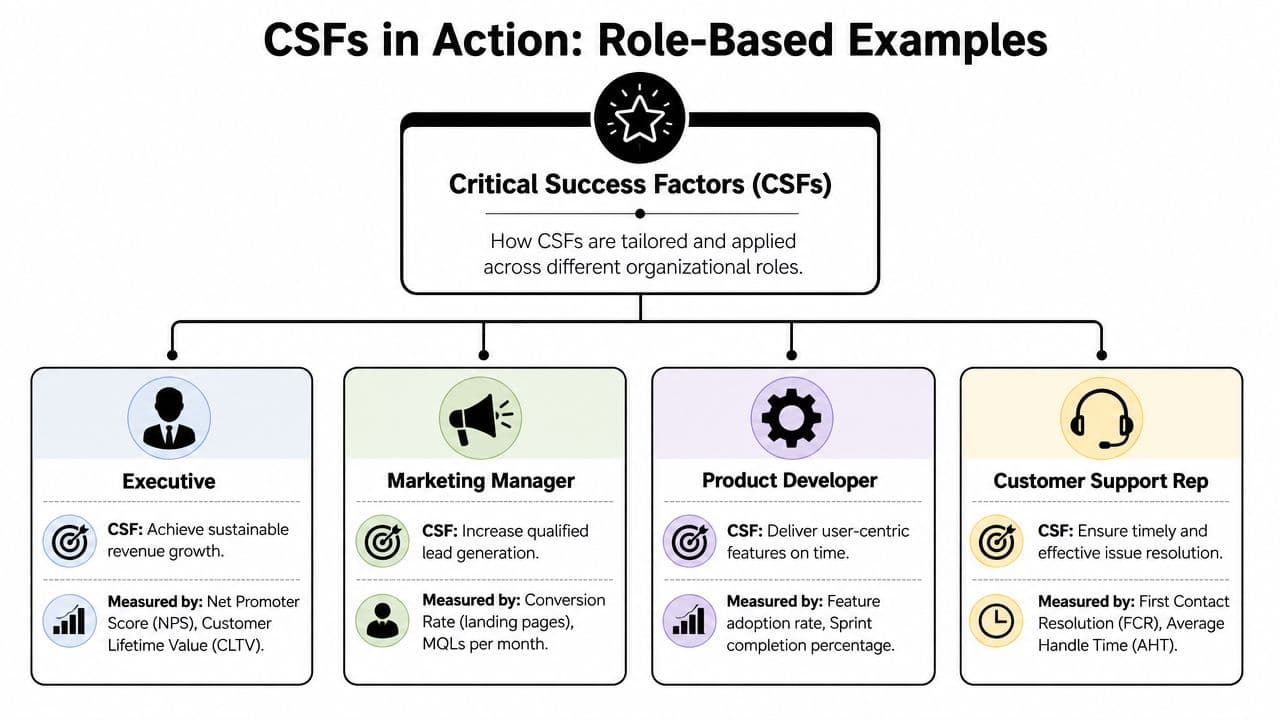
Project guidance rooted in PRINCE2 stresses pruning CSFs to the minimum viable set and aligning stakeholders early, because failure often comes from coordination breakdowns rather than one bad metric, as noted in PRINCE2 guidance on critical success factors. You can see that clearly in day-to-day roles.
Executive
An executive team may set a goal around sustainable growth. The mistake is turning that into a broad list of parallel priorities: pricing, hiring, partnerships, market expansion, culture, process redesign, and brand repositioning all at once.
A sharper set of CSFs might be:
- Decision speed at the leadership level
- Reliable forecasting
- Retention of high-value customers
Once those are clear, the calendar changes. Leadership meetings focus less on reporting and more on unresolved decisions, forecast assumptions, and churn risks. A lot of activity falls away because it isn't tied to the few conditions that determine whether growth is healthy.
Project manager
A project manager often inherits a plan with too many milestones and not enough agreement about what success requires.
For a complex launch, the true CSFs may be:
- Clear scope control
- Fast escalation of blockers
- Clean handoffs between teams
That shifts the PM's daily behavior. Instead of spending all week polishing status decks, they spend more time surfacing dependency conflicts, forcing ownership clarity, and tightening acceptance criteria. The project usually doesn't fail because one task took longer than expected. It fails because teams made different assumptions and no one corrected them soon enough.
Freelancer
Freelancers often default to client work because it feels billable and immediate. The hidden risk is pipeline fragility.
A freelancer's CSFs might be:
- Consistent lead generation
- Strong client experience
- Fast proposal turnaround
This helps with a common trap. When work is busy, marketing disappears. When work slows, panic starts. A CSF lens protects the activities that keep future work alive. Outreach, relationship maintenance, and proposal follow-up stop feeling optional because they're tied to a make-or-break condition.
A freelancer with no pipeline discipline usually isn't facing a motivation issue. They're facing a systems issue.
Virtual assistant
A strong virtual assistant becomes more valuable when they understand the client's critical success factors, not just the client's task list.
If a client's key factor is investor readiness, the VA can prioritize meeting prep, follow-up organization, and document flow over lower-impact admin. If the key factor is customer retention, the VA can protect response workflows, flag unresolved issues, and maintain cleaner operating visibility.
That's the difference between task taking and strategic support. A VA who understands the parent factor can make better prioritization calls without waiting for instructions on every item.
Neurodivergent and ADHD professionals
For neurodivergent professionals, including many people with ADHD, critical success factors can reduce cognitive load because they pre-filter the field of choices.
Without that filter, every task can feel equally urgent, equally unfinished, and equally capable of pulling attention. With a short CSF list, the question becomes narrower: Which tasks support the conditions that matter most?
That can make planning less abstract. Instead of staring at a long backlog, a person can create a small daily view:
- one task tied to a key client relationship
- one task tied to revenue continuity
- one task tied to delivery quality
The benefit isn't perfection. It's reduced decision friction. The task list stops acting like a wall of equal demands.
A quick comparison
| Role | Likely CSF | What daily work changes |
|---|---|---|
| Executive | Better strategic decision flow | Fewer updates, more decision clearing |
| Project manager | Cleaner cross-team execution | More blocker removal, less passive reporting |
| Freelancer | Stronger pipeline continuity | Regular outreach and follow-up stay protected |
| Virtual assistant | Alignment to client priorities | More proactive triage and delegation support |
| Neurodivergent professional | Lower cognitive overload around priorities | Smaller, pre-filtered work choices |
The pattern is consistent. Once the critical factors are visible, lower-value work becomes easier to reject.
Making Your CSFs a Living Part of Your Workflow
The biggest mistake with critical success factors is treating them like a workshop output.
Teams define them, nod at them, add them to a planning document, and then go back to reacting. A month later, the document still exists, but the operating system hasn't changed.
That approach fails because conditions change. Priorities shift. Tools change how work gets done. Customer expectations move. Even the internal capacity of a team can alter which factors are critical.
A useful reminder comes from RapidBI's discussion of static frameworks. It notes that this challenge is getting sharper as the environment speeds up, including McKinsey's finding that 72% of organizations now use AI in at least one business function, up from 55% the year before, which means the drivers of success are changing faster than annual planning cycles often acknowledge in RapidBI's piece on critical success factors.
Review triggers beat annual rituals
An annual review is better than nothing, but it's often too slow.
A stronger approach is to review CSFs when one of these happens:
- Strategy changes: New market, new offer, new leadership mandate
- Execution breaks down: Deadlines slip repeatedly, quality drops, handoffs fail
- Operating model shifts: New tooling, automation, restructuring, delegation changes
- External conditions move: Customer behavior, competitive pressure, or regulation changes
Don't ask only, “Are we making progress?” Also ask, “Are these still the right few things to protect?”
A 30-minute reset you can do this week
You don't need a retreat or a strategy offsite to start.
Use half an hour:
- Choose one important goal. Pick something live, not theoretical.
- Name one critical success factor. Write the condition that must hold if that goal is going to succeed.
- Pick one KPI and three tasks. One measure tells you if the factor is healthy. Three tasks make it operational this week.
That's enough to test the system.
If it works, repeat it for the next priority. If it doesn't, the usual problem is that the factor was too vague or the tasks weren't directly connected to it. Tighten both.
Critical success factors aren't another layer of paperwork. They're a discipline for protecting what matters from the flood of everything else.
If you want a practical place to turn critical success factors into visible, assignable work, Fluidwave can help you map priorities into tasks, delegate lower-value work, and keep daily execution tied to the outcomes that matter most.
Focus on What Matters.
Experience lightning-fast task management with AI-powered workflows. Our automation helps busy professionals save 4+ hours weekly.