Stop feeling overwhelmed! Learn the 1 3 5 rule to boost productivity in 2026. Prioritize one big, three medium, and five small tasks daily.
May 30, 2026 (4mo ago)
The 1 3 5 Rule: Master Your Productivity in 2026
Stop feeling overwhelmed! Learn the 1 3 5 rule to boost productivity in 2026. Prioritize one big, three medium, and five small tasks daily.
← Back to blog
By 10 a.m., many people have already “worked” for hours without moving anything important forward. They've answered messages, reacted to requests, clicked between tabs, and rewritten the same to-do list twice. The list gets longer, not clearer.
That's why the 1-3-5 rule keeps showing up in serious productivity conversations. It's simple enough to use when your day is messy, but strict enough to stop the usual pattern of calling everything a priority. Used well, it gives your day shape. Used badly, it turns into another pretty list you ignore by lunch.
What Is the 1-3-5 Rule and Why Does It Work
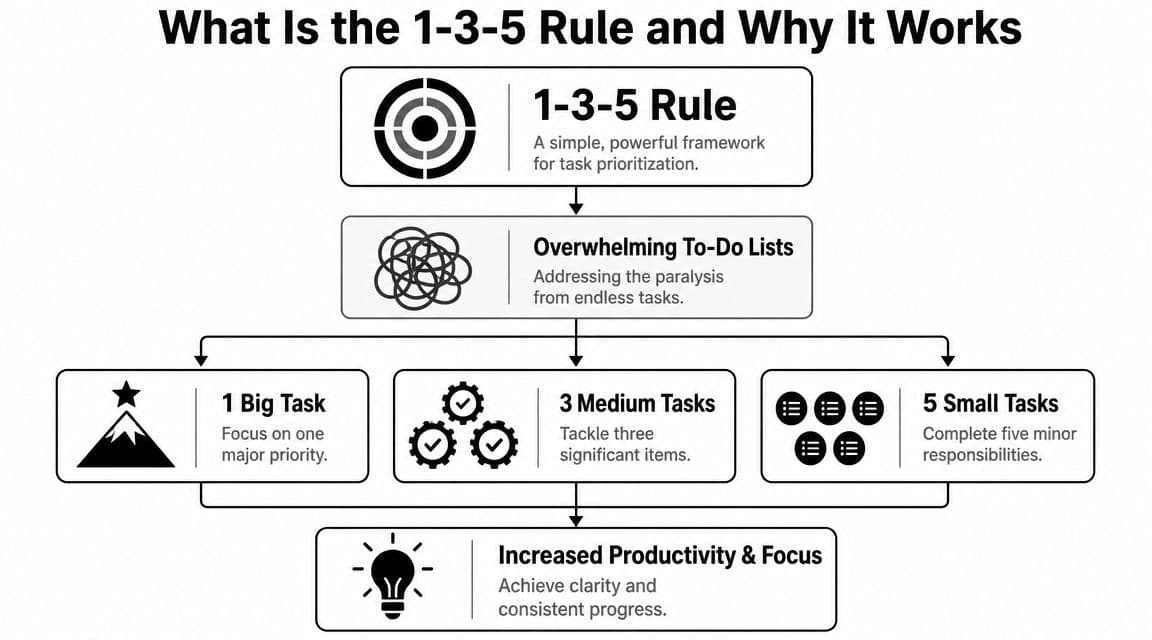
The 1-3-5 rule helps when your task list has become a parking lot for every obligation, idea, and half-finished follow-up. Instead of trying to “get through the list,” you commit to a smaller structure: 1 big task, 3 medium tasks, and 5 small tasks.
That sounds almost too neat. The reason it works is that it forces a decision before the day gets noisy. You stop treating all tasks as equal and start naming what matters.
The structure is the point
The “1” is your highest-impact task. It's the piece of work that would make the day feel meaningful if completed.
The “3” are solid, important tasks that support projects, people, or operations. They matter, but they shouldn't require the same level of concentration as the big item.
The “5” are the quick tasks that keep work moving. Think replies, approvals, scheduling, filing, or short updates.
Why people stick with it
Most overloaded professionals don't need more ambition. They need fewer open loops. The 1-3-5 rule reduces the number of choices you face during the day, which lowers friction. You're not constantly asking, “What should I do next?”
It also creates momentum. The small tasks give you visible progress, while the big task prevents the day from being swallowed by maintenance work.
The method works because it limits options and makes trade-offs visible. If a task doesn't fit the day, it doesn't belong on today's plan.
There's another reason seasoned operators like this rule. It exposes overcommitment fast. If you can't fit your real priorities into a 1-3-5 structure, the issue usually isn't motivation. It's that your day is overloaded, your tasks are poorly sized, or both.
What the rule is not
It isn't a license to cram nine random things onto a list.
It also isn't proof that every day should contain one giant strategic milestone, three meaningful wins, and five tidy loose ends. Some days are meeting-heavy. Some days are travel days. Some days your “1” is protecting a block of attention long enough to finish a deliverable.
That's why the best practitioners treat the 1-3-5 rule as a decision framework, not a rigid ritual. The shape matters. The exact contents should reflect reality.
How to Build Your Daily 1-3-5 Plan
The common mistake is starting with the final list. They pick one task they feel guilty about, add three more that seem reasonable, then dump five easy items underneath so the day looks complete. That's backwards.
Start by clearing the deck.

Step one: capture everything
Do a full brain dump. Write down every open task, follow-up, admin item, meeting prep need, personal errand, and “don't forget” thought. Don't sort yet.
Uncollected work distorts prioritization. You can't choose well if half your obligations are still floating around in your head.
If you struggle with attention drift or planning overload, some of these effective ADHD time management tips can help you reduce friction before you build the list.
Step two: sort by impact and effort
Once everything is visible, classify tasks by what they require.
- High-impact work means a deliverable or outcome that materially moves a project, decision, or commitment forward.
- Medium work supports progress but doesn't need your deepest focus.
- Small work should be quick and low-friction.
A useful refinement comes from TrackingTime's guidance on the 1-3-5 rule. The method works best when it's treated as a capacity-constrained planning system. Capture all open work, choose exactly 1 high-impact task, 3 medium tasks, and 5 small tasks, then verify that the plan fits the time available in your calendar.
Practical rule: The real limit isn't the number of tasks. It's your available focused time.
That one distinction changes everything. A list can look balanced on paper and still be impossible in a meeting-heavy day.
Step three: build the day around time, not optimism
Before you lock the list, check your calendar. If your “1” needs concentrated attention, give it the best part of the day. Don't leave it floating between calls and hope it happens.
The supporting tasks go around it. Quick items can fill low-friction gaps. If you need a better way to decide what belongs on the list in the first place, this guide on how to prioritize tasks is a practical companion to the method.
This walkthrough shows the mechanics well:
A sizing habit that prevents repeated failure
One of the most useful technical adjustments is to size tasks by actual elapsed time over a short sample. If your “1” keeps taking much longer than expected, the problem isn't discipline. Your estimates are wrong, and the whole model will keep overcommitting the day.
That's why experienced users review the plan after work. What fit? What spilled? What was mislabeled as “small” but wasn't? Without that loop, the 1-3-5 rule becomes theater.
Sample 1-3-5 Templates for Your Day and Week
Examples help because the rule often sounds cleaner than real work feels. Below are two versions that reflect the messiness of actual professional days.
Daily example for a project manager
A project manager's day usually mixes strategic work, stakeholder communication, and operational cleanup. The 1-3-5 format works when the “1” is a deliverable, not a vague ambition.
| Category | Task Description |
|---|---|
| 1 Big Task | Finalize draft of client implementation timeline for internal review |
| 3 Medium Tasks | Review team status updates and flag blockers |
| 3 Medium Tasks | Prepare agenda and notes for afternoon stakeholder call |
| 3 Medium Tasks | Follow up with design and engineering on open dependencies |
| 5 Small Tasks | Approve meeting notes |
| 5 Small Tasks | Reply to two pending client emails |
| 5 Small Tasks | Update project board labels |
| 5 Small Tasks | Send revised meeting invite |
| 5 Small Tasks | File vendor estimate in project folder |
What makes this plan realistic is the mix. The big task creates forward motion. The medium items keep the project coordinated. The small tasks stop admin residue from piling up.
Weekly example for a freelancer
Freelancers often do better with a weekly adaptation. The idea isn't to force a strict 1-3-5 list for the whole week. It's to decide the week's anchor work, supporting work, and quick maintenance tasks.
| Category | Task Description |
|---|---|
| 1 Big Weekly Focus | Deliver first draft of client website copy package |
| 3 Medium Weekly Priorities | Send proposal to a new lead |
| 3 Medium Weekly Priorities | Revise onboarding document for new client |
| 3 Medium Weekly Priorities | Record and send project update videos |
| 5 Small Weekly Tasks | Send invoices |
| 5 Small Weekly Tasks | Schedule discovery calls |
| 5 Small Weekly Tasks | Organize research notes |
| 5 Small Weekly Tasks | Clean up task backlog |
| 5 Small Weekly Tasks | Archive completed files |
This version is helpful when your days vary too much for rigid daily planning. You still get structure, but you give yourself room to shift tasks across the week.
A strong template should reduce hesitation, not create another form to maintain.
If you want more formats you can adapt by role, workload, or work style, these to-do list examples give useful starting points.
Supercharge Your 1-3-5 Rule with Fluidwave
Pen and paper can handle the rule. A notes app can too. The problem usually isn't writing down 1, 3, and 5. The problem is maintaining the system once priorities shift, tasks multiply, and low-value work keeps sneaking back in.
That's where a task manager earns its place. In practice, the 1-3-5 rule works best when your tool can surface priorities, reduce sorting overhead, and make delegation easy.
Set up a dedicated planning view
Create a simple daily workflow with labels or tags for 1, 3, and 5. In a Kanban or list view, that gives you an at-a-glance map of the day instead of one long undifferentiated backlog.
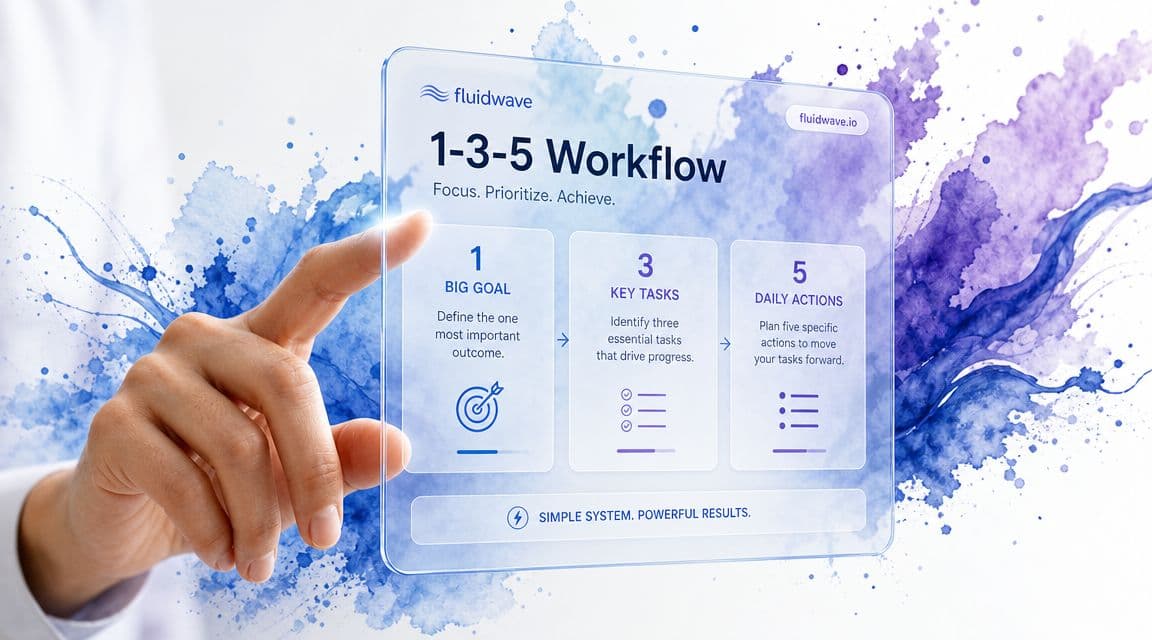
A practical setup looks like this:
- Create one intake area for all uncategorized tasks so ideas and requests land in one place.
- Add task labels for big, medium, and small work.
- Build a filtered daily view that shows only today's chosen items.
- Keep backlog separate so your committed list isn't buried under everything else.
If you reuse the same planning format each day, a saved structure helps. This tutorial on how to make a template is useful when you want your daily planning ritual to take minutes, not mental effort.
Let the tool assist the decision, not replace it
Fluidwave is one option that fits this workflow because it supports multiple task views, AI-driven prioritization, and delegation in the same system. That matters for the 1-3-5 rule because your “1” often gets lost in the noise unless the tool can surface it clearly.
Use the AI prioritization layer as a first pass, not a final verdict. Let it bring likely high-impact tasks to the top, then make a human judgment call. A machine can sort urgency signals. It can't fully understand political context, creative energy, or the cost of delay the way you can.
If your tool picks the “1” for you every day and you never challenge it, you're automating your assumptions.
Use delegation to protect your big task
Significant value is often realized through this approach. The “5” category is often full of necessary work that doesn't need your personal attention. Scheduling follow-ups, collecting background research, organizing notes, and other low-friction support tasks can consume the exact attention your “1” needs.
A modern task manager with delegation lets you identify those smaller items and hand them off cleanly. That keeps the spirit of the rule intact. You stay focused on high-impact work while smaller operational tasks still move forward.
A good handoff includes:
- A clear outcome so the assistant knows what done looks like
- Any constraints such as timing, format, or budget
- Context files or links so the task doesn't bounce back to you for missing details
Review the system, not just the checklist
The 1-3-5 rule breaks down when users treat the daily view like a static promise. In software, your list should be easy to revise as reality changes. If a “small” task grows teeth, relabel it. If the “1” becomes a multi-step project, split it before it poisons the rest of the day.
The tool should make those adjustments painless. Otherwise you'll avoid the review, and the method will decay into clutter.
Troubleshooting Common 1-3-5 Rule Pitfalls
The 1-3-5 rule fails in predictable ways. Not because the framework is weak, but because people load it with the wrong kinds of tasks.
The first failure point is the oversized “1.” If your big task is really a project, the day is already misplanned. “Finish annual strategy” isn't a daily task. “Draft the opening section” might be.
When the big task keeps spilling over
A technically stronger version of the method uses energy mapping and weekly calibration. Todoist recommends putting the big task in your peak-energy hours, medium tasks in mid-level energy windows, and small tasks in lower-energy periods, while tracking energy and focus for a week to identify when deep work is most viable, as described in Todoist's 1-3-5 method guide.
That advice matters because many people assume task failure is a motivation problem. Often it's a timing problem. They're trying to do deep work in their lowest-focus window.
When interruptions wreck the list
Urgent requests don't care about your neat plan. A client calls. A teammate needs an answer. A family obligation lands in the middle of your work block.
When that happens, don't pretend the original list still stands. Re-rank the day.
- Protect the anchor if the “1” is still achievable in one focused block.
- Drop or swap small tasks first, because they should be the most flexible part of the plan.
- Move unfinished medium tasks back to the backlog instead of dragging them forward automatically.
This keeps the rule flexible without turning it into chaos.
A broken day doesn't require a new system. It usually requires a cleaner reset.
When you keep running out of steam
If the “5” tasks always get ignored, that's useful information. It may mean your day is overfilled, or it may mean your so-called small tasks carry hidden friction. Admin work often looks tiny but requires context switching, decision-making, and follow-through.
Track your own patterns for a week. Notice when you think clearly, when you tolerate admin well, and when you should avoid anything cognitively heavy. Then schedule the rule around your actual rhythm, not an idealized version of yourself.
That's the difference between using the 1-3-5 rule as a rigid formula and using it as a practical operating system.
Frequently Asked Questions About the 1-3-5 Rule
People usually understand the rule quickly. The harder part is adapting it to real work without flattening everything into a self-help slogan.
Can teams use the 1-3-5 rule?
Yes, but teams should use it for visibility and alignment, not as a mandatory one-size-fits-all quota. A manager can ask each person to identify their top priority, key supporting work, and smaller maintenance items for the day or week. That helps reduce random interruptions because coworkers can see what deserves protection.
The risk is misuse. If leaders treat everyone's 1-3-5 list like a performance scoreboard, people will game it. They'll choose safer tasks, understate complexity, or hide work that doesn't fit the format.
What should you do if you finish early?
Don't immediately refill the day with more commitments. First review why you finished early. Maybe you estimated well. Maybe you finally broke tasks into the right size. Maybe the day had fewer interruptions than usual.
Then choose one of three responses:
- Pull one meaningful task forward from the backlog if you still have attention for it.
- Use the time for review by cleaning up tomorrow's list, closing loops, or clarifying project next steps.
- Stop working if the right move is recovery rather than squeezing in more output.
Finishing early isn't a failure of the system. It often means the system is doing its job.
Is the 1-3-5 rule good for ADHD or neurodivergent users?
This needs a careful answer. There is no direct neuroscience or clinical research validating the 1-3-5 rule as an ADHD treatment, even though it's widely recommended to reduce overwhelm and ADHD paralysis, as discussed in this review of the 1-3-5 rule for ADHD.
That distinction matters. The rule can still be useful as a productivity support tool. Many neurodivergent people benefit from external structure, smaller decision sets, and visible prioritization. But that doesn't make the method a clinical intervention, and it doesn't mean the standard nine-item format will suit everyone.
For some users, the fixed cap may feel calming. For others, it may create pressure, especially when attention, energy, and task-switching costs vary sharply from day to day. In practice, the better approach is to treat the rule as adjustable. Keep the prioritization principle, but adapt the load, the task sizes, and the review cadence to how your brain works.
If the framework reduces overwhelm and improves follow-through, keep it. If it creates shame, rigidity, or repeated failure, modify it or replace it. A productivity method should support functioning. It shouldn't become another source of self-judgment.
If you want a cleaner way to run the 1-3-5 rule inside a real workday, try Fluidwave. It gives you one place to capture tasks, sort priorities, organize work across different views, and delegate smaller items when they shouldn't stay on your plate.
Focus on What Matters.
Experience lightning-fast task management with AI-powered workflows. Our automation helps busy professionals save 4+ hours weekly.