Learn what a baseline in project management is and why it's crucial for success. This guide covers scope, schedule, and cost baselines with practical examples.
May 24, 2026 (4mo ago)
What Is a Baseline in Project Management? a Practical Guide
Learn what a baseline in project management is and why it's crucial for success. This guide covers scope, schedule, and cost baselines with practical examples.
← Back to blog
A lot of teams don't realize they have a baseline problem until the project starts wobbling.
At first, everything looks normal. The kickoff went well. Stakeholders sounded aligned. The task list exists. Then the small shifts begin. A deadline slides by a few days. Someone asks for one more feature. Finance wants to know why spend is climbing faster than expected. The team says they're “mostly on track,” but nobody can point to one approved version of the plan and say, “This is what we committed to.”
That's where baseline in project management stops being jargon and starts being useful. A baseline is the approved reference point for the work. It gives you a stable way to compare what's happening against what was agreed. Without it, project control turns into opinion, memory, and negotiation. With it, you can spot drift early, talk openly about changes, and make decisions before a project goes sideways.
Why So Many Projects Veer Off Course
The pattern is familiar. A project starts with enthusiasm, a rough timeline, and a lot of verbal agreement. People nod in meetings. Someone shares a spreadsheet. Work begins before the plan is fully locked.
A few weeks later, the cracks show. The designer is working from one assumption, engineering from another, and the sponsor thinks a major deliverable is already included. Nobody is being reckless. The project just never had a fixed reference point.
What the team usually experiences
Here's what veering off course looks like in practice:
- Deadlines become fuzzy: Dates exist, but they were never formally approved.
- Budget conversations get defensive: Teams can't tell whether costs are rising because of poor execution or added work.
- Scope expands informally: Requests come in through chat, hallway conversations, or side calls and get treated as harmless.
- Status reporting becomes subjective: One manager says “yellow,” another says “fine,” and neither is measuring against the same plan.
That's why I think of the baseline as the project's GPS, not its paperwork. It doesn't prevent wrong turns by itself. What it does is tell you that you've taken one.
A project without a baseline can still move fast. It just can't tell whether it's moving in the right direction.
For independent operators, this matters just as much as it does for large PMOs. If you're juggling client work, retainers, and changing priorities, good operating discipline from resources on project management for freelancers can help. The same principle applies. If the work isn't anchored to an agreed scope, timeline, and budget, every update becomes an argument.
What a baseline actually fixes
A project baseline gives the team one approved version of the plan to compare against actual results. It becomes the benchmark for asking the only questions that matter during delivery:
- Are we doing the work we said we'd do?
- Are we hitting the dates we approved?
- Are we spending within the budget we accepted?
Once you have that, conversations get cleaner. Variance becomes visible. Trade-offs become explicit. Accountability becomes fair.
Defining the Three Pillars of Your Project Baseline
A useful baseline rests on three core components: scope, schedule, and cost. Major project management references repeatedly identify those as the core baseline elements, and some guidance broadens the picture to include quality as well. In day-to-day control, though, the classic three are the foundation because they define what will be delivered, when it should be delivered, and how much it should cost, which gives teams a benchmark for tracking slippage, scope creep, and overruns early, as noted in Wrike's overview of project baselines.
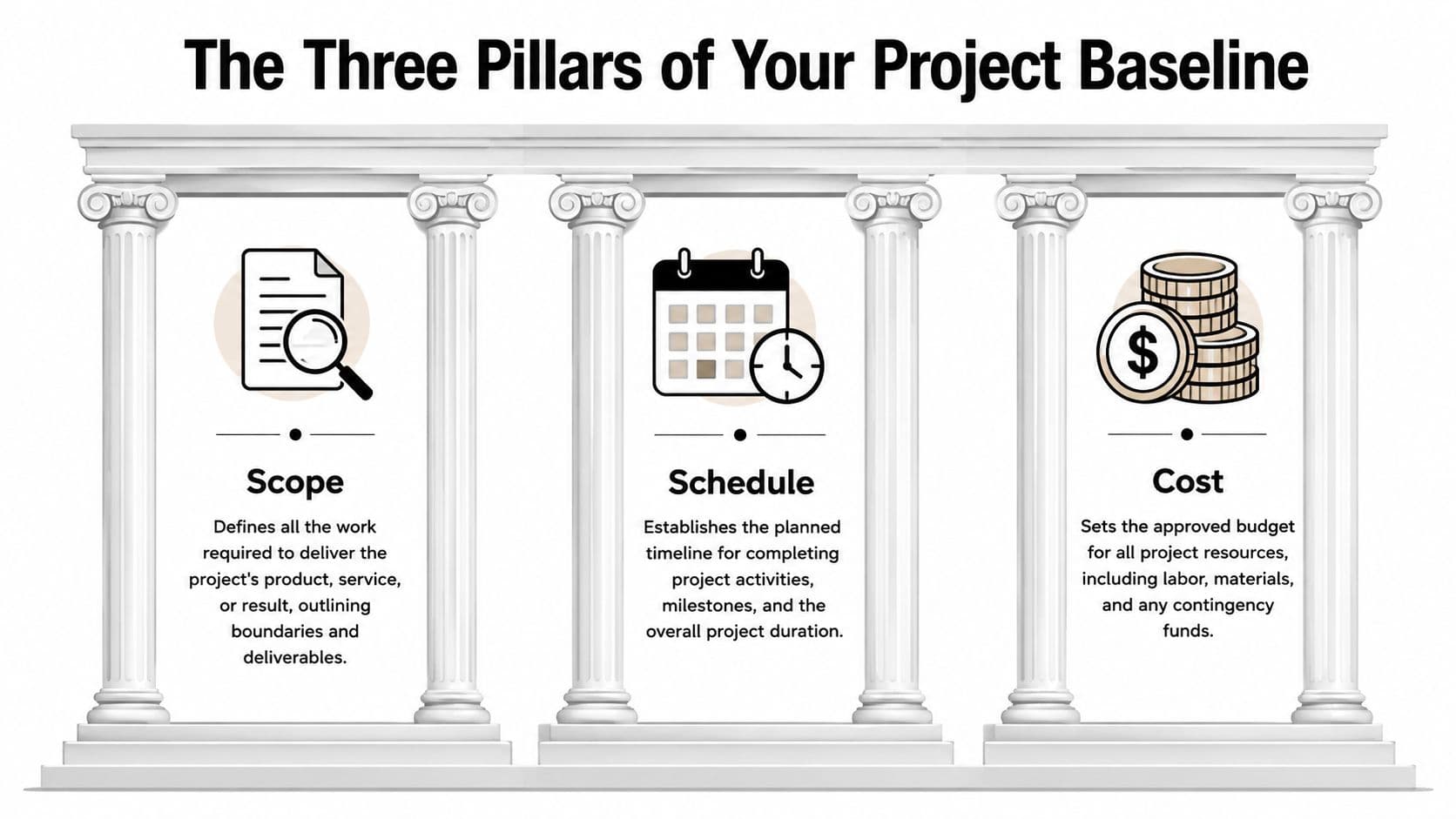
Think of these three pillars like a stool. If one leg changes and the others don't, the whole thing tips.
Scope defines the work
Scope baseline is the agreed boundary of the project. It tells the team what's in, what's out, and what deliverables count as done.
In practical terms, this usually comes from the requirements, deliverable definitions, and the breakdown of work into manageable pieces. If scope is vague, the rest of the baseline becomes fiction. You can't schedule or budget work nobody has clearly defined.
Schedule defines the timing
Schedule baseline is the approved version of the timeline. It covers activities, milestones, sequencing, and the dates the team is aiming to hit.
This is not the draft timeline somebody built early in planning. It's the version that got reviewed, adjusted, and accepted. If the team treats every date as provisional, then schedule reporting doesn't mean much.
Practical rule: If you change dates casually in the tool every week, you haven't got a schedule baseline. You've got a live to-do list.
Cost defines the spend
Cost baseline is the approved budget for delivering the scope on the approved schedule. It includes the planned use of resources and the financial assumptions the project is operating under.
Cost baselines force real trade-offs. If someone adds work, the team needs to decide whether budget rises, delivery moves, or something else gets cut. That tension is healthy. It keeps planning honest.
The three core project baselines at a glance
| Baseline Type | What It Defines | Common Artifacts |
|---|---|---|
| Scope | The approved work, deliverables, and boundaries | Requirements, deliverables list, WBS, acceptance criteria |
| Schedule | The approved timeline for tasks and milestones | Project schedule, milestone plan, dependencies, Gantt chart |
| Cost | The approved budget for resources and delivery | Budget sheet, cost estimates, resource plan, funding assumptions |
The point isn't to manage these in isolation. It's to manage them together. Teams that only track schedule often miss that delays were caused by added scope. Teams that only watch budget miss that costs rose because the timeline stretched.
If you want a simple companion read on the discipline behind this, TimeTackle has a useful piece on how to achieve project success that fits well with baseline thinking. Projects stay healthier when teams stop treating scope, dates, and budget as separate conversations.
Creating and Documenting Your Initial Project Baseline
A baseline should be created at the end of planning, not at the beginning. Project management guidance commonly places it after scope, schedule, and cost have been approved by stakeholders. That shift helped turn project control into a measurable management practice instead of a subjective one, as described in Project Management Academy's explanation of the schedule baseline.
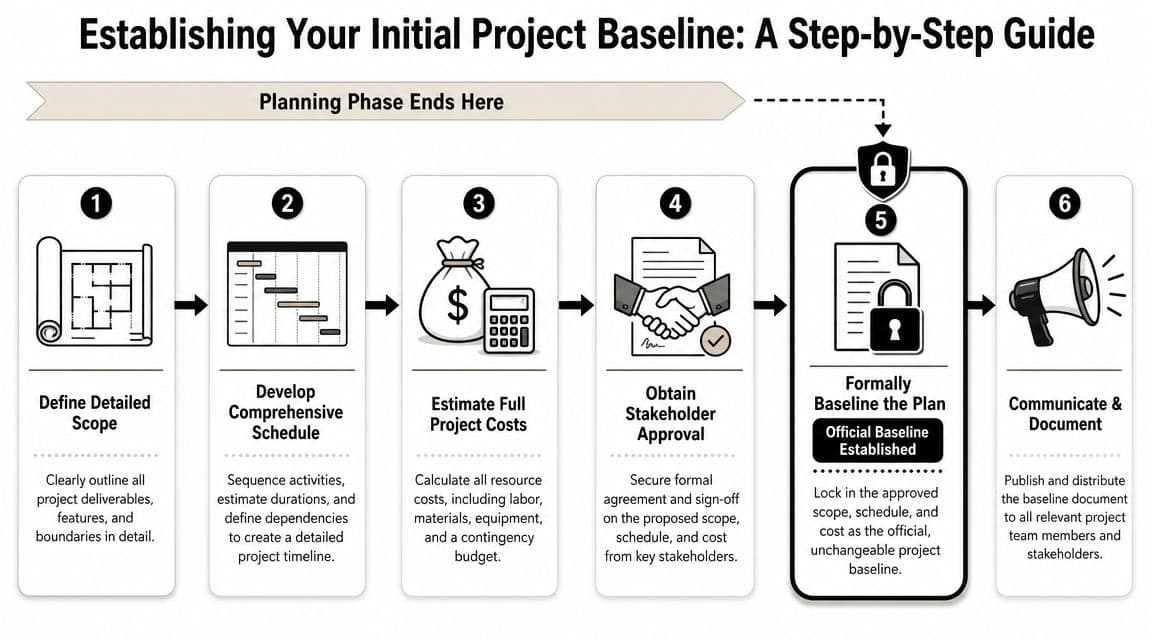
The biggest mistake I see is teams baselining too early. They freeze a rough plan because leadership wants momentum. Then they spend the next month discovering missing work, hidden dependencies, and unrealistic dates.
Start with detail, not optimism
Before you baseline anything, get specific enough that the plan can survive first contact with execution.
- Define the deliverables clearly. If the team can't describe what “done” looks like, baseline later.
- Break the work down. A work breakdown structure or equivalent task hierarchy helps expose missing pieces.
- Sequence the work realistically. Dependencies matter. So do approval steps and handoffs.
- Estimate resources and budget. Use the actual people, tools, and costs the project will rely on.
- Document assumptions. A baseline built on silent assumptions fails fast.
A detailed schedule view helps here. If you need a refresher on structuring that timeline visually, this guide on how to create a Gantt chart is a practical starting point.
The sign-off is what gives it authority
A plan becomes a baseline when stakeholders approve it and agree that it will be the reference point for control.
That approval matters because it changes the conversation later. If the sponsor asks for new work, the team can evaluate that request against an approved baseline instead of debating what was “probably implied.” If delivery slips, the team can assess variance against a committed plan instead of a draft.
Don't lock a baseline because the calendar says planning is over. Lock it when the plan is detailed enough to manage against.
What should be documented
At minimum, the baseline package should capture:
- Approved scope artifacts: The deliverables, boundaries, and work breakdown.
- Approved schedule artifacts: Milestones, dependencies, and planned dates.
- Approved cost artifacts: Budget assumptions, resource allocations, and spending plan.
- Version reference: A named baseline version with date and approver.
- Distribution: A way for the team to access the same approved documents.
When this is done properly, people stop asking, “Which version are we using?” Everyone already knows.
Keeping Your Project on Track with Variance Analysis
Once the baseline is approved, it stops being a planning document and starts being a control tool. A project baseline becomes the comparison standard for variance analysis and earned value management. If teams change it informally, the numbers stop meaning anything because managers can no longer separate execution problems from scope changes, as explained in Galorath's baseline guidance.

Variance analysis sounds technical, but the idea is simple. Compare actual performance to the approved baseline and ask where the gap is.
What variance looks like in real life
Suppose your schedule baseline says a milestone should be complete by Friday. Friday arrives, and only part of the work is done. That's schedule variance.
Suppose the cost baseline assumed a certain level of effort, but the team needed more contractor time than planned. That's cost variance.
Neither issue tells you what to do on its own. What it does give you is a fact pattern. That's valuable because project meetings often drift into opinion unless someone can show the gap between plan and reality.
What to review every reporting cycle
A simple review usually includes:
- Milestone status: Which baseline dates were met, missed, or put at risk.
- Budget position: Whether spend is tracking to plan.
- Scope movement: Whether work underway still matches approved deliverables.
- Trend direction: Whether the gap is narrowing or widening over time.
For cost control specifically, teams often use cost variance calculations to understand whether actual spend is above or below the value of work performed. If you want a plain-English breakdown, WeekBlast explains how to track project budget with CV=EV-AC, and this related guide on the cost variance formula is useful when you need the concept in operational terms.
Here's a short video that gives additional context on how baselines support project tracking:
Why teams get this wrong
The common failure isn't that people can't calculate variance. It's that they keep changing the planned numbers to match what's happening.
That may make the dashboard look cleaner, but it destroys the baseline's value. If every week's report updates the original target to whatever the team now thinks is realistic, nobody can tell whether performance improved or the target moved.
If reporting always says “on track” after the plan was quietly edited, the project isn't under control. The report is.
Navigating Project Changes Without Losing Control
Projects change. Clients rethink priorities. Leaders add requirements. Vendors slip. Regulation shifts. None of that is unusual.
What causes damage is not change itself. It's uncontrolled change.
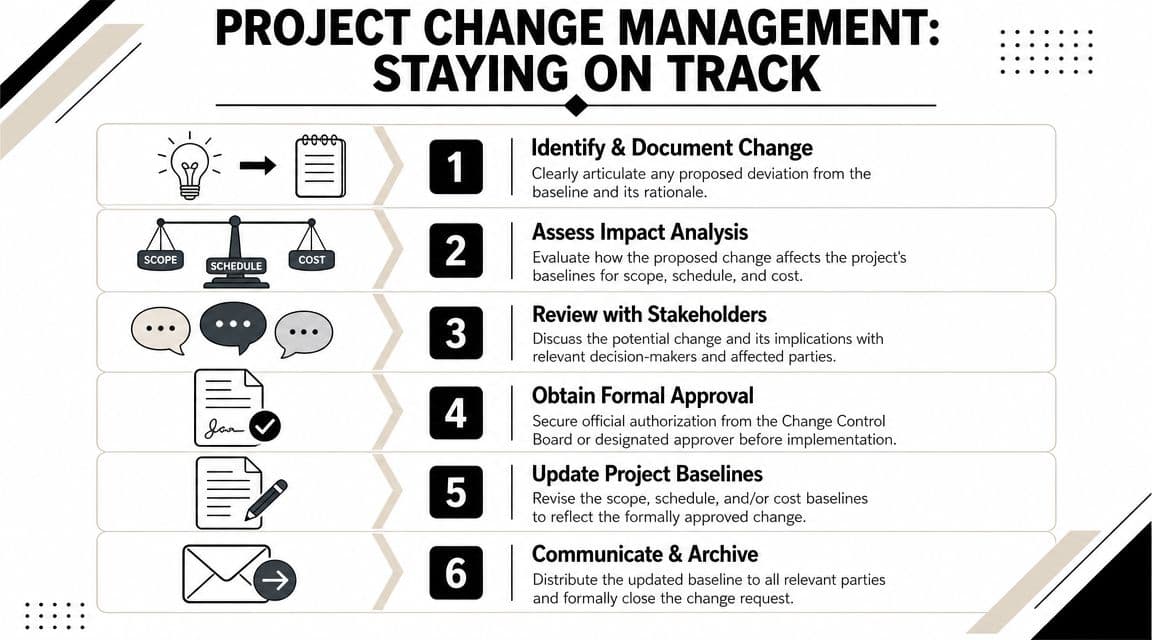
A lot of teams hear “change control” and think bureaucracy. They picture forms, committees, and delay. In reality, a lightweight formal process is what protects delivery. It forces the team to decide whether a change is worth its impact before the impact occurs unnoticed on the schedule and budget.
A good change process is small but firm
You don't need a giant PMO machine to manage baseline changes well. You do need a few things to happen every time someone asks for something outside the approved plan.
A useful change request should cover:
- What is changing: Be concrete about the requested addition, removal, or adjustment.
- Why it's needed: Tie the change to a business reason, not preference alone.
- What it affects: Assess impact on scope, schedule, and cost.
- Who approves it: Name the decision-maker before work starts.
- What gets updated: Record which baseline components change if the request is approved.
If your team struggles with unofficial additions to the workload, this guide on managing project scope creep is a helpful operational reference.
What works and what doesn't
What works is forcing the request into daylight. When a stakeholder sees that a “small” addition means extra budget or a later launch, better decisions follow.
What doesn't work is burying the cost inside the team. That creates fake stability. The sponsor thinks the project absorbed the change easily. The team knows it absorbed it by dropping quality, burning out, or delaying something else.
Here's the practical difference:
| Informal update | Controlled change |
|---|---|
| A task gets added in chat | A change request is documented |
| Team starts work immediately | Impact is reviewed before approval |
| Dates shift quietly | Schedule impact is made visible |
| Budget pressure appears later | Cost impact is discussed upfront |
| Nobody knows what changed | Decision trail is preserved |
Stakeholders usually don't resist change control because it exists. They resist it when it arrives late, after trust is already thin.
A formal process also protects the team. It keeps project leads from carrying hidden commitments they never approved. It gives sponsors visibility into trade-offs. Above all, it keeps the baseline meaningful. Without that discipline, every project slowly becomes a pile of exceptions.
The Tough Call When to Rebaseline Your Project
Rebaselining is where theory and reality collide.
A regular change updates the project through approved change control. Rebaselining is different. It resets the approved reference point because the old one no longer reflects the project you are managing.
Many articles often remain vague. Guidance often explains what a baseline is, but not when rebaselining is appropriate. That gap matters because weak change control is a major failure driver, and executives need a way to manage baseline drift without losing accountability, as noted in Deltek's discussion of project baselines.
When rebaselining is justified
Rebaselining makes sense when a major approved shift has made the original baseline operationally useless.
Examples include:
- A substantial scope change: The project is now delivering something materially different from the original commitment.
- A formal recovery effort: Leadership has acknowledged the current plan is no longer credible and approved a reset.
- A structural change in delivery conditions: Key assumptions behind the baseline no longer hold.
In those cases, forcing the team to report forever against an obsolete target doesn't improve control. It just creates noise.
When it's the wrong move
Rebaselining should not be used to hide poor execution.
If the team missed dates because work was underestimated, approvals were slow, or risks were ignored, resetting the baseline too quickly can erase the evidence needed to learn from the miss. It can also make a troubled project look healthier than it is.
Ask these questions before rebaselining:
- Did the project itself change, or did performance deteriorate?
- Has the approving authority explicitly accepted the new reality?
- Will the original baseline still be preserved for historical comparison?
- Does the new baseline improve forecasting, or just improve appearances?
Preserve the original baseline. Otherwise, you lose the story of how the project actually moved.
That historical view matters. It lets leaders separate approved strategic change from execution variance. It also gives future planners a more honest record. Rebaselining can be a responsible move, but only if it keeps accountability intact instead of wiping the slate clean.
Baselines in Modern Task Management
Traditional baseline in project management assumes a fairly stable plan. Modern work often doesn't look like that. Teams use rolling priorities, short cycles, and adaptive delivery. In that environment, the old question “What's the baseline?” needs a better follow-up question. What exactly are we baselining?
That's a key challenge in agile, hybrid, and AI-assisted work. The classic scope-schedule-cost model is less stable, so teams may need to baseline task scope, time allocation, throughput, service levels, or business outcomes instead, which is the practical gap raised in Plane's discussion of project baselines in adaptive work.
What changes in flexible environments
The principle doesn't disappear. The unit of control changes.
For a sprint-based team, the baseline might be the committed work for the next cycle. For an operations team, it might be response expectations and workload capacity. For an executive team managing knowledge work, it could be the agreed priorities for the quarter.
What still matters is the same discipline:
- Agree on the target
- Make it visible
- Measure actuals against it
- Handle changes deliberately
That's where modern task platforms become useful. Tools like Asana, Jira, ClickUp, and Fluidwave can help teams keep an agreed reference point visible even when work is dynamic. In Fluidwave's case, that means organizing tasks across views, clarifying priorities, tracking progress, and delegating work in a structured way so the team can see what changed and what stayed committed.
The baseline no longer has to be a rigid artifact sitting in a PM binder. It can be a living, controlled reference inside the system where the team works. That's the modern version that holds up.
If your team needs a clearer way to turn plans into visible, trackable work, Fluidwave is worth a look. It gives teams a practical place to organize tasks, monitor progress, and keep changing priorities from turning into silent baseline drift.
Focus on What Matters.
Experience lightning-fast task management with AI-powered workflows. Our automation helps busy professionals save 4+ hours weekly.