ADHD decision fatigue explained: why repeated choices drain focus, and which defaults, decision rules and delegation steps reduce the load.
November 14, 2026 (3d ago)
ADHD Decision Fatigue: Causes and Practical Fixes
ADHD decision fatigue explained: why repeated choices drain focus, and which defaults, decision rules and delegation steps reduce the load.
← Back to blog
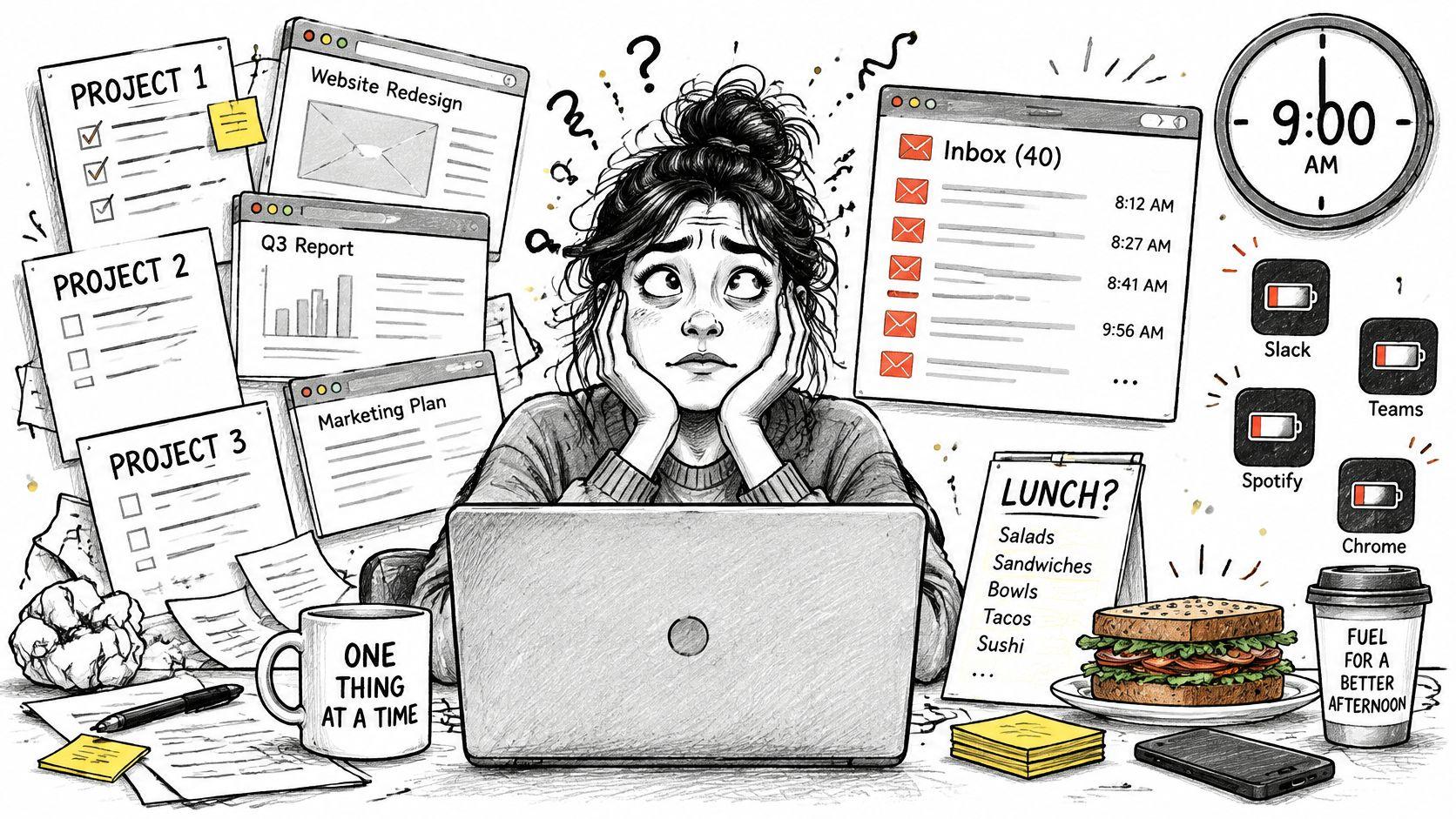
Nine in the morning. Forty unread emails, three projects open in three tabs, a message asking for a call you don't want to take, and a lunch decision that somehow feels like the hardest item on the list. You're capable of all of it. You just can't pick which one to touch first, so you open the email you already read yesterday and read it again.
The strange part isn't the workload. It's that the small stuff costs so much. A strategy call with a client feels manageable. Choosing between two invoice templates at 4 p.m. feels impossible. That gap is where ADHD decision fatigue lives, and it has far less to do with willpower than with how much each choice charges against a limited cognitive budget.
Treat this as a cost problem rather than a character problem, and the fixes change. What follows is where the cost comes from, why one set of advice doesn't fit everyone, which decisions drain the most, and the specific defaults you can put in place today.
How ADHD Makes Everyday Choices Costly
A phone with thirty apps running in the background dies by noon, even if you never opened a single one. Every undecided item on your list behaves the same way. It keeps running in the background, drawing a little attention whether or not you're looking at it. By the time you sit down to the work that matters, the battery reads 20 percent.
ADHD decision fatigue is a consequence of repeated executive demands, not a standalone diagnosis. That distinction matters because it tells you where to intervene. The peer-reviewed study on effort-related decision-making sets out the machinery: every choice draws on four functions that ADHD commonly affects.
- Sustained attention: holding focus on the comparison long enough to finish it
- Working memory: keeping options, criteria, and deadline in mind at the same time
- Response inhibition: blocking both the tempting option and the irrelevant one
- Effort and reward weighing: deciding whether the payoff justifies the work
The same study found something specific and useful. Adults with ADHD showed greater discounting of rewards when effort was required than control participants, even after the researchers adjusted the task so both groups rated the effort as equally demanding. In practice, two people can look at the same task, agree it's equally hard, and only one of them is likely to slide toward the lower-effort option or disengage as choices pile up. That's why prioritizing tasks, switching contexts, deciding what to defer, and judging when work is "good enough" cost far more than their stakes suggest.
What the research does not say: it doesn't prove every person with ADHD experiences decision fatigue, and it doesn't name a number of decisions that triggers it. What it identifies is a mechanism, where effort costs carry more weight when rewards are delayed or uncertain.
The scale shows up in survey data. In a 2025 study of 50 adults diagnosed with ADHD, 82% reported frequent difficulty making decisions, and 68% said decision paralysis significantly affected their work performance, as published in the National Library of Medicine. Fifty people is a small sample, so read those percentages as a signal rather than a population estimate.
Run one check this week. Notice the point in the day when choices start getting skipped, deferred, or answered with whatever option appears first. That timestamp is your data, and it's more useful than any generic productivity rule.
Why the Same Advice Does Not Fit Everyone
Two people can face the same choice and need different kinds of support. Research on decision-making in adults with ADHD remains limited. A 2022 systematic review in Frontiers in Psychology found only one adult ADHD study using the Iowa Gambling Task. Overall performance did not differ significantly from controls, though the ADHD group performed worse in a later task block.
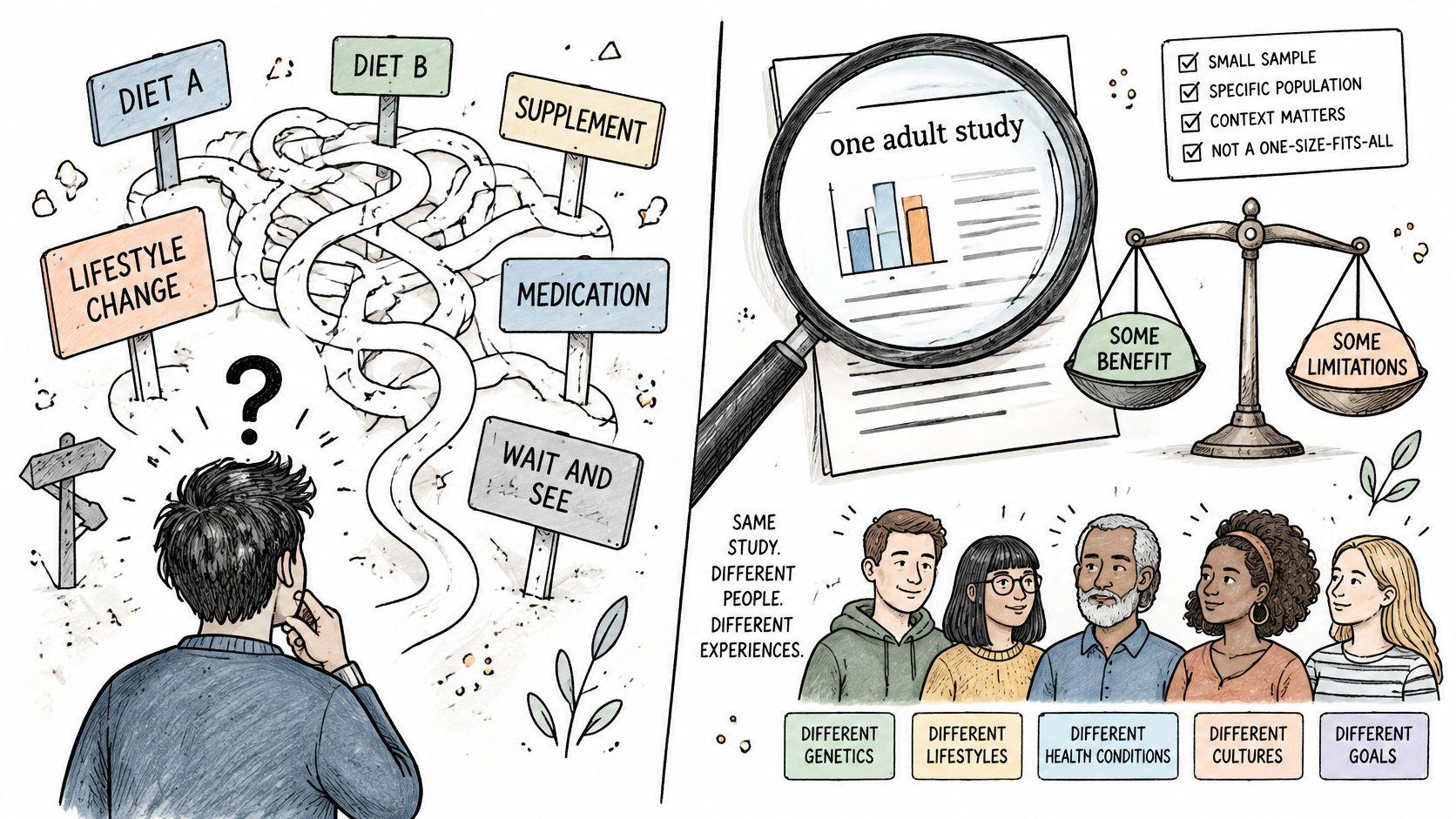
These findings do not mean that decision quality is always unaffected, or that everyone with ADHD struggles in the same way. They do show why it helps to distinguish the choice itself from the work required to make and sequence choices. Even when a person reaches a sound decision, repeated choices can consume attention and make the next decision harder.
Find your own hardest link
Use last week as a guide. Which part of managing work repeatedly slowed you down?
- If switching drained you most, you may have read several pages and realized you had not taken them in. Batching similar work may help more than changing your to-do list.
- If organization and supervision were harder, unfinished commitments may be the main source of friction. A visible, trusted place for open loops can make them easier to track.
- If planning and selective attention were harder, starting from a blank page may take extra effort. Templates and pre-written sequences can reduce the number of decisions required to begin.
Your capacity can also vary with sleep, medication status and timing, workload, task type, and stress. A rule that fails after a poor night may need adjusting for that day, rather than being discarded altogether.
Before adopting a default, keep a two-week log: note the decision, the time, and how long you stalled. Then look for recurring patterns, not just the hardest day. If decision difficulty is severe, persistent, or affecting your work or health, bring the log to a clinician. Treatment preferences may also be worth revisiting as circumstances change.
Decisions That Cost the Most and Lighter Defaults
The drain isn't spread evenly across your day. A handful of decision types repeat dozens of times and cost far more than their stakes justify, while consequential choices happen rarely. The table maps the repeat offenders against a default that removes most of the choosing.
| Decision type | Why it drains | Lower-load default |
|---|---|---|
| Choosing the next task | Many open items compete and none is ranked | One pinned next action per project |
| Triaging the inbox | Each message needs a fresh judgment about urgency | Three fixed folders: act today, act this week, reference |
| Deciding what to defer | Postponing requires remembering what was postponed | A single deferred list reviewed at one set time each day |
| Switching context | Each switch rebuilds the criteria for the new task | Batch similar tasks into one block and finish a block before switching |
| Judging when work is good enough | No stopping rule, so each check reopens the question | A written done definition agreed before starting |
| Repeated routine choices | Small daily choices such as meals or outfits add up across the day | Fixed rotation or pre-set options chosen once a week |
How to actually use it
Don't try to install all six defaults. That's another list of choices, which is the exact problem. Work in this order instead.
- Scan the middle column and pick the two rows that appear most often in a normal day. Not the most annoying ones, the most frequent ones.
- Write the default for the first row today. One sentence, somewhere you'll see it before you start work.
- Add the second default three days later, once the first one has survived a bad morning.
- Check the table again after two weeks and add a third row only if the first two feel automatic.
The reframe that makes this bearable: separate judgment decisions from repeated low-stakes decisions. Whether to take on a new client, whether to change role, whether to have a hard conversation, those deserve your full attention and more than one sitting. Which invoice template to use does not. Most of what exhausts you falls into the second group, and the second group only needs a fixed answer written down once.
Watch for three signals that a row is costing too much. You reread the same message three times without replying. You defer something without being able to say why. You choose whatever is nearest on the screen because it's visible, not because it matters. Any of those means the default is missing, not that your judgment failed. When the freeze is driven by anxiety rather than load, this piece on help with anxious indecision covers a different mechanism with a different fix.
Keep the table where you plan your day, not in a folder you'll find later. A default you can't see at 8:50 a.m. is a default you won't use.
Decision Rules That Hold Up Under Pressure
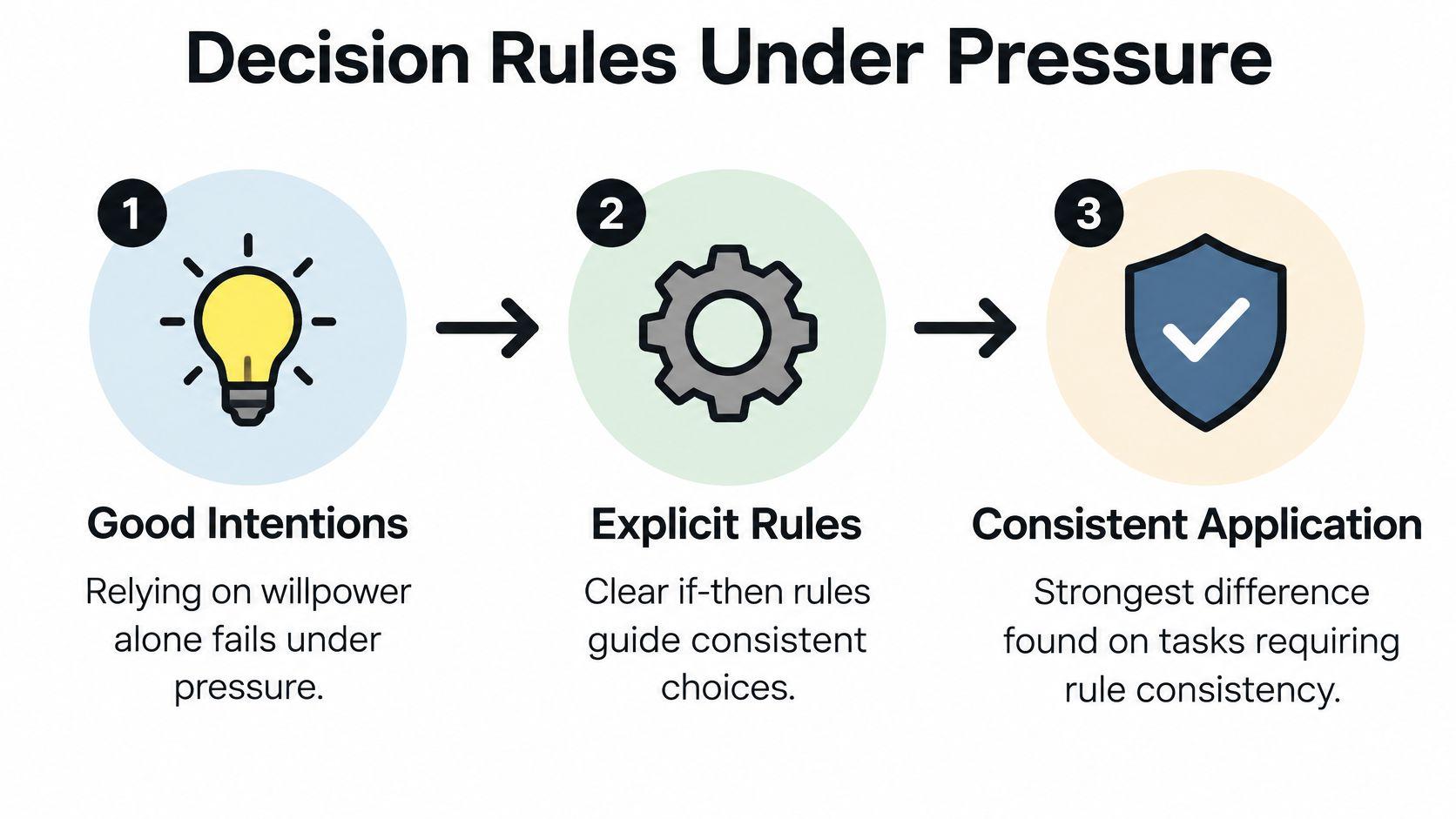
Willpower isn't the missing ingredient here. Rules are. In a study of adults with ADHD published in the Journal of Attention Disorders, participants showed impairment across both analytic and affective decision tasks, and the strongest predictor was difficulty applying explicit decision rules, the task that leans hardest on sustained prefrontal control. Repeated choices get expensive when you have to hold the criteria in working memory, inhibit competing responses, and apply the same rule consistently every time.
The study also found impairment on emotionally charged decisions, which is why a rule written calmly still collapses at the moment an immediately rewarding option shows up. That isn't hypocrisy. It's the rule competing with a reward signal while your resources are low.
Four moves that take the rule out of your head
- Cap the criteria at three. For any recurring decision, write the maximum three things that must be true: deadline, client impact, effort required. A fourth criterion doesn't improve the outcome. It just gives you one more thing to hold while you're already tired.
- Convert ambiguous tasks into a chain of binary next actions. "Work on the proposal" has no entry point, so it gets re-decided every time you look at it. "Open the draft" does.
- Attach the rule to the task itself. A rule stored in your memory is a rule you'll re-derive under pressure. Put it in the task description, the calendar note, or the title: "Proposal. First action: open draft, write three lines, send to one reviewer." That single line turns one large ambiguous decision into three obvious ones, and none of them needs a judgment call.
- Retire anything that never changes the outcome. Once a week, look at your criteria and delete the one that has never once altered a decision. Rules that survive because they feel responsible rather than because they work are just expensive decoration.
If the rule chains get long enough that you want to diagram them, a decision tree template gives you a structure to lay the branches out before you're in the middle of one.
Try this today: pick one decision you make every single day, write three must-have criteria for it, and store them where the decision happens. That's the whole assignment.
The point isn't to assume impulsivity causes every poor choice. It's to stop rebuilding the same criteria from scratch under conditions where rebuilding is hardest.
Where Delay and Task Switching Come From
At 3 p.m., a report is due at five. You open chat, reorganize a folder, check the news, then reread the report's first paragraph. The deadline is clear, yet the next step keeps losing out to tasks that offer quicker relief.
One possible explanation is that heavy working-memory demands can make it harder to hold a goal in mind while resisting an immediate distraction. A controlled study of children aged 8 to 12 found greater real-time delay discounting among children with ADHD than among typically developing children. In the ADHD group, increased cognitive load on response control was associated with a stronger preference for immediate rewards.
The limitation to hold onto
These findings concern children, so apply them cautiously to adults. They suggest a design idea to try, not a diagnosis: reduce the mental work involved in choosing a next step, and make progress visible.
The burden can come from juggling deadlines, constraints, and follow-ups while comparing several priorities. Each detail takes up space in working memory, like notes spread across a desk. Put those details somewhere you can see them, and fewer of them have to be held in your head.
- Write the deadline and one constraint beside the next action. Keep both facts in a single line.
- Put each open loop on a deferred list. A short reminder is enough; you do not need to plan it now.
- End work at a defined point, such as the end of a work block, and record one completed step where you will see it again.
If beginning is harder than choosing, this guide to ADHD task initiation and getting started explains how the two problems differ.
Try this before you stop working: write down every open loop. Tomorrow, you can start with a visible list instead of searching your memory.
Delegation, Automation and Shared Decisions
Most advice on this topic stops at personal hacks: timers, routines, rigid defaults. Those help, and they leave the harder questions untouched. When should a choice be automated, when should it be handed to someone else, how much control should you keep, and how do you stop an assistant or a rule from generating new review work for you?
The treatment literature takes a similar shape. A 2025 umbrella review in The BMJ found moderate-certainty evidence that atomoxetine, cognitive behavioural therapy, methylphenidate, and, when limited to higher-quality trials, amphetamines improve adult ADHD symptoms, and it emphasizes tools that help patients and clinicians compare treatments rather than tools that add options. NICE guidance points the same way: a full plan spanning psychological, behavioural, and occupational needs, with preferences revisited as circumstances change instead of settled in one appointment. Your workflow deserves the same treatment, reviewed rather than decided once.
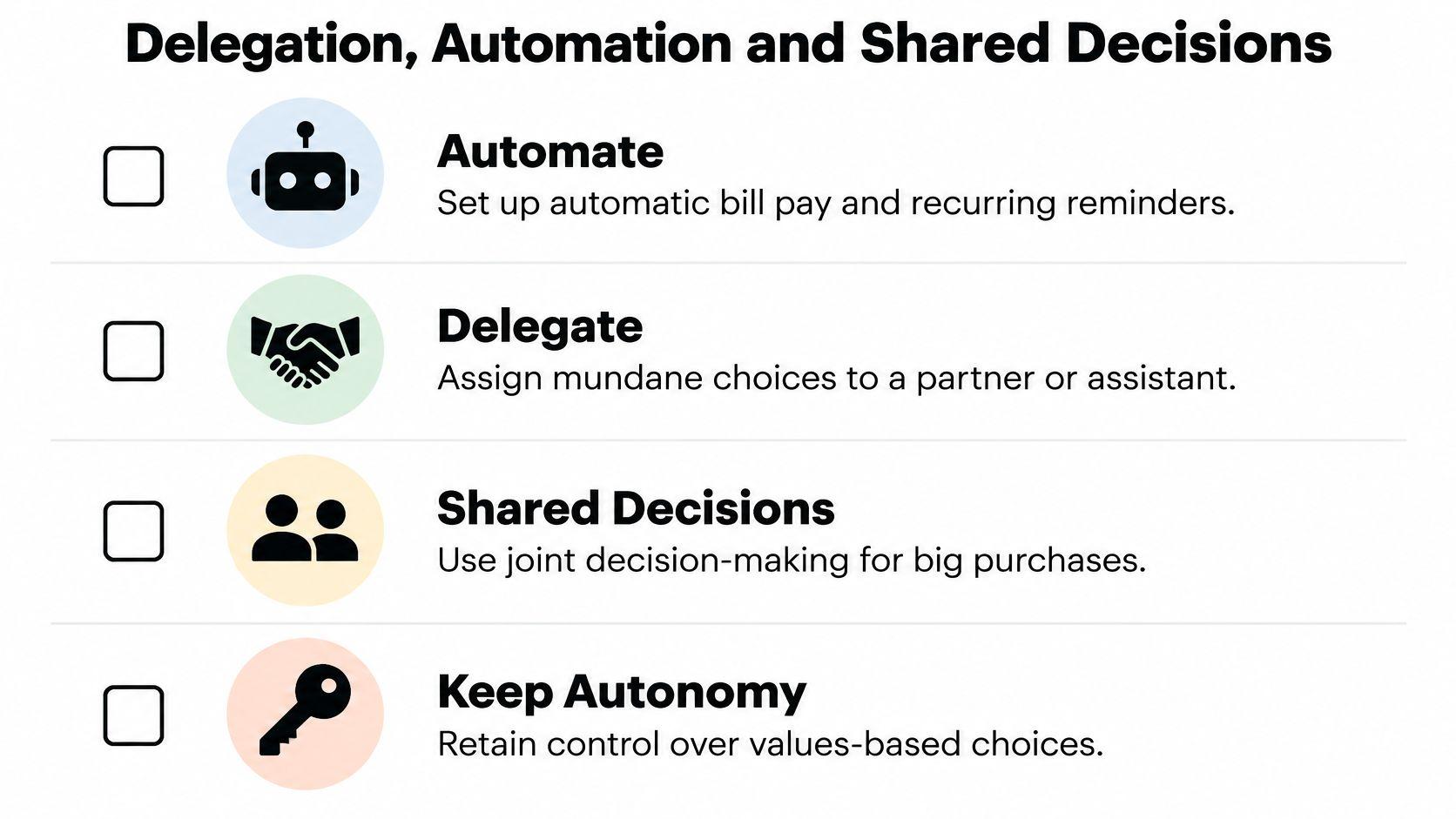
Four categories of decision
Assign every recurring decision to one of these, and the volume drops without giving up control.
Decide it yourself when judgment, values, or a relationship is at stake. Hiring a freelancer for a role that shapes your product belongs here, and it deserves a protected window rather than a spare five minutes.
Delegate it when the choice follows known criteria and someone else has better context. Booking travel inside a set budget is the clean example: you write the budget and the dates, they pick the flights.
Automate it when the outcome is the same every time. Recurring invoice reminders, standing calendar holds, and standard replies to the ten emails you write most often.
Set a fixed default when the stakes are low and repeatable. The same lunch on Tuesdays. The same two-hour block for deep work. Boring on purpose.
Escalation rules and a review cadence
Write down which decisions an assistant or a rule can make alone, which need a short message back to you, and which always come to you regardless. Without that line, everything escalates and you've only moved the review work.
Then put two dates in the calendar. A weekly check that your automations still fire correctly and still match reality, and a monthly review of which delegated categories are working. Overlapping rules with no owner create monitoring, correction, and lost trust, which costs more than the decisions you removed. If you want a walkthrough of how to structure the automation side, this guide to workflow and automation is a sensible starting point.
Copy this checklist for each decision you hand off: decision, category (decide, delegate, automate, fixed default), owner, escalation trigger, next review date.
Set Up Your First Week of Lower Decision Load
A week of small defaults can show you which repeated choices deserve less attention. Try one change at a time, then keep what reduces friction.
- Day one. Choose the decision from the earlier table that drains you most often. Write a one-sentence default for it.
- Days two and three. Create a decision rule with no more than three criteria. Attach it to the recurring task where you need it.
- Day four. Choose a regular time to review deferred tasks. For each active project, identify a next action you can take now.
- Day five. Sort recurring decisions into four groups: decide, delegate, automate, or use a fixed default.
- Day six. Review the two-week log from earlier, or start one now if you skipped it. Look for patterns rather than relying on memory.
- Day seven. Keep the defaults that reduced friction. Drop the ones that added ceremony, without guilt.
A task platform can reduce the number of choices in view. Fluidwave automatically prioritizes tasks by urgency and importance, while its Active filter hides tasks you cannot act on right now. Try it with one project and notice whether a shorter, actionable list makes choosing easier. Its free product includes AI prioritization, email triage, and an AI assistant: Fluidwave.
Which decision will you stop making from scratch this week? Name it before you close this page.
Focus on What Matters.
Experience lightning-fast task management with AI-powered workflows. Our automation helps busy professionals save 4+ hours weekly.