You have a strong project idea and initial approval, but many projects stall before real work begins. This practical guide shows how to define scope, align stakeholders, and launch with momentum.
January 16, 2026 (8mo ago) — last updated April 14, 2026 (5mo ago)
Como Iniciar um Projeto do Jeito Certo
Defina o âmbito, alinhe stakeholders e evite armadilhas no arranque do projeto com um método prático e direto.
← Back to blog
Como Iniciar um Projeto do Jeito Certo
Aprenda um método comprovado para iniciar um projeto: definir o âmbito, alinhar as partes interessadas e evitar armadilhas comuns no arranque.
Introduction
You have a strong project idea, budget approval, and initial excitement. Yet many projects stall before real work begins. The main challenge today isn’t the plan or the funding — it’s finding the right people and structure to execute. This guide shows a practical, step-by-step approach to define scope, secure stakeholder alignment, and launch with momentum.
The Hidden Hurdle in Modern Project Management
The project gets approved and momentum is high. Then reality sets in: who owns it, who has bandwidth, and who has the specific skills needed? Too many initiatives land with teams that are already stretched or lack the right expertise. That’s a fundamental problem that slows or kills progress.

The Widening Talent Gap
The project management world faces a supply-and-demand crunch: there are nearly 40 million skilled project professionals globally, but growth isn’t keeping pace with demand1. Projections warn of a potential shortfall of up to 29.8 million project experts by 20352. This talent gap helps explain why roughly 65% of projects fall short of their goals3.
We’re not just talking about finding someone with “project manager” in their title. It’s about securing the right expertise to handle complexities and drive momentum from day one.
A Smarter Staffing Strategy
Hiring a full-time expert for every new initiative is often too slow and costly. Instead:
- Embrace flexible staffing: on-demand specialists or virtual assistants for defined phases.
- Keep internal teams focused on core strengths and outsource administrative work.
- Use tools to automate repetitive tasks and create a single source of truth.
These choices let you launch projects with confidence, knowing operational details are covered and leadership can focus on strategy.
Defining Your Project’s North Star
Before writing code or creating tasks, pause and answer: what are we trying to accomplish? Skipping this is like sailing without a map. Define a clear, shared vision and use it to anchor decisions.
Start with scope: treat it as a fence that shows what’s in and out. Without it, scope creep—those small changes that derail projects—quickly compounds and undermines success4.
For example, building a new customer onboarding flow should include UI, backend logic, and CRM integration. Adding a referral program midway is scope creep unless formally approved.
Set SMART Goals
Translate the vision into measurable targets. SMART goals turn vague ambitions into concrete objectives:
- Specific: “Reduce onboarding support tickets by 25%.”
- Measurable: tie to ticket volume or another metric.
- Achievable: ensure the target is realistic.
- Relevant: supports broader business aims.
- Time-bound: “within three months of launch.”
A clear North Star helps the team evaluate new ideas: does this move us closer to the goal?
Secure Stakeholder Buy-In Early
Identify stakeholders beyond the budget approver: end users, marketing, support, and others affected by the project. Buy-in is an ongoing conversation—understand needs, manage expectations, and align goals so stakeholders become champions, not blockers.
For founders launching software, this founder’s guide to launching a SaaS product is a useful deep dive into validation and MVP building: https://submitmysaas.com/blog/how-to-launch-a-saas-product.
Building Your Actionable Blueprint
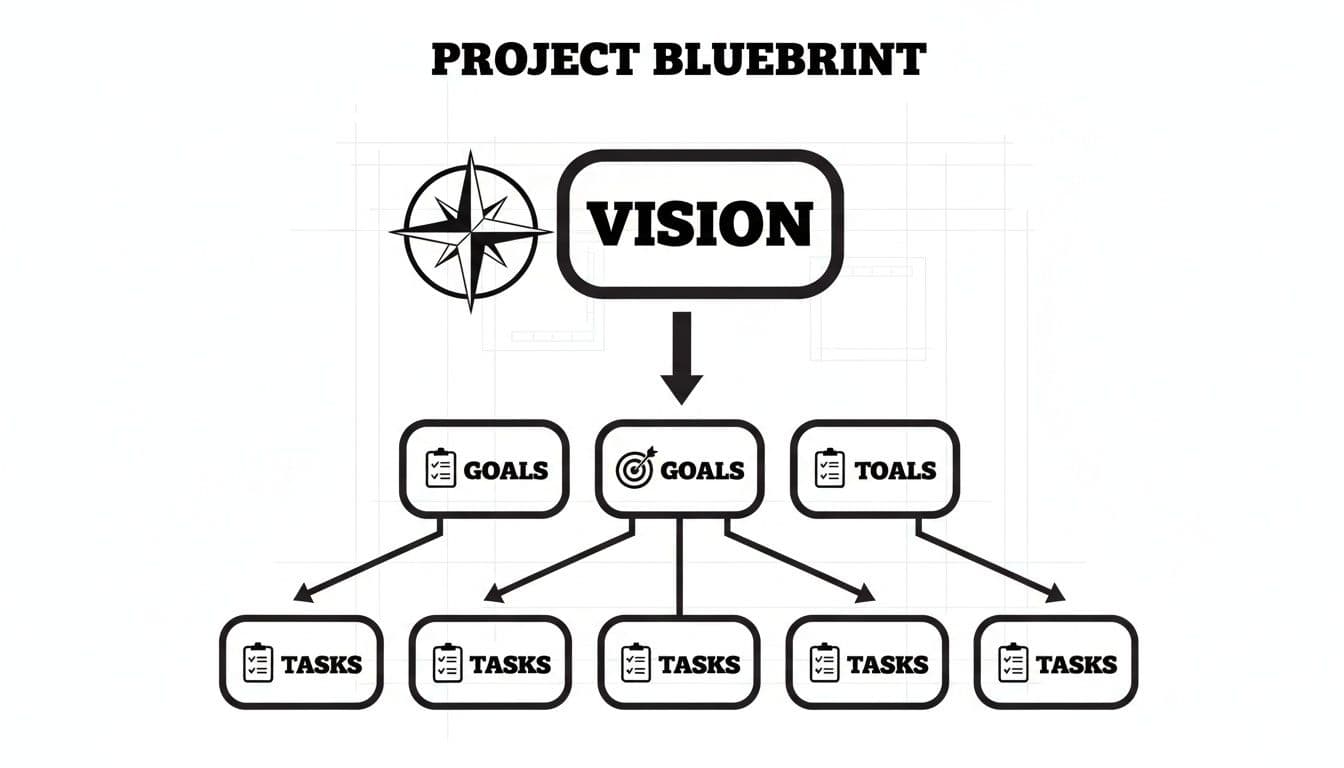
A vision is the spark; an actionable blueprint turns it into reality. Start with a Work Breakdown Structure (WBS): break the project into manageable pieces and then into bite-sized tasks. This hierarchy reveals how everything fits, from vision to execution.
From Tasks to Timelines
Assign realistic dates and milestones, accounting for dependencies. Milestones give the team signposts and reasons to celebrate:
- Milestone 1: Finalize ad copy and creative assets.
- Milestone 2: Complete technical setup of advertising platforms.
- Milestone 3: Launch campaign across channels.
See a detailed project outline example for how these elements fit together: https://fluidwave.com/blog/project-outline-example.
Essential Project Initiation Checklist
| Component | Key Question | Example |
|---|---|---|
| High-Level Goal | What is the single most important outcome? | Increase qualified marketing leads by 20% in Q3. |
| Key Milestones | What major checkpoints show progress? | Landing page design complete; ad creative finalized; campaign launched. |
| Task Breakdown | What specific actions support each milestone? | Write copy for 3 ads; design 5 banners; set up Google Ads account. |
| Timeline Estimate | How long will each phase take? | Design: 2 weeks; Development: 3 weeks; Launch & test: 1 week. |
| Dependencies | Which tasks must finish before others start? | Ad creative design waits for copy approval. |
| Resource Plan | Who is responsible and what tools are needed? | Anna: Copy; Mike: Design; Fluidwave VA: Ad setup. |
These elements form your project’s safety net.
Visualizing Your Workflow
Visual tools make plans tangible. Kanban boards show flow with columns like “To Do,” “In Progress,” and “Done.” Gantt charts map schedules and dependencies on a timeline. Both views help teams stay aligned. For business planning fundamentals, see: https://www.startrightnow.co/blog/how-to-write-a-business-plan.
Assembling Your Team and Delegating with Confidence
Momentum comes from the team executing the plan. Map tasks to the skills needed. Think skills first, not job titles. Identify gaps and bring in specialists where required.

Modern Delegation for Lean Teams
Long hires aren’t always the answer. Specialists and virtual assistants let you access expertise for the exact scope and duration you need. Delegation is strategic: place tasks with the most capable hands so your core team focuses on high-impact work.
The Art of the Clear Hand-Off
Great delegation requires clarity. A delegation brief should include:
- Desired outcome: what “done” looks like.
- Key constraints: budget and hard deadlines.
- Essential resources: documents, brand guidelines, and logins.
- Communication cadence: how and when updates are expected.
A ten-minute brief prevents hours of rework and keeps projects moving.
Choosing the Right Tech to Start Strong
The wrong tools kill momentum. Spreadsheets may work early, but they break down with real-time collaboration and complex dependencies. A dedicated project management system creates clarity and accountability.
A projected $12.02 billion project management software market by 2030 shows how the space is growing5. Yet many organizations still rely on spreadsheets rather than specialized tools, limiting efficiency gains6.
What to Look for in a Modern PM Tool
Choose a platform that offers:
- An intuitive interface that teams adopt quickly.
- Seamless collaboration with real-time updates.
- Powerful integrations with calendars and messaging apps.
- Flexible views: Kanban, lists, calendars, and Gantt charts.
AI-powered prioritization can also help teams focus on the most important work next. Compare options in our task management software comparison: https://fluidwave.com/blog/task-management-software-comparison.
Common Project Initiation Pitfalls to Avoid
Many failures begin in initiation. Here are traps to avoid.
Unrealistic Expectations
Excitement can lead to overly optimistic timelines. Anchor plans in the actual tasks from your WBS, not just an attractive launch date.
Poor Communication and Vague Objectives
Assuming clarity is dangerous. If teams aren’t aligned on what success looks like, efforts will diverge. Use your project charter as the single source of truth and confirm that all stakeholders can articulate the goals the same way.
Spotting these issues early helps you build a resilient plan. For more, read Why Projects Fail: https://fluidwave.com/blog/why-projects-fail.
Common Questions We Get About Kicking Off a Project
How detailed should the initial plan be?
Enough detail to align the team: clear scope, SMART goals, major milestones, and initial responsibilities. Leave room for adaptation.
What’s the one mistake that sinks projects early on?
Failing to secure genuine stakeholder alignment. Ensure everyone knows the problem, the success criteria, and the target audience before work begins.
When should you start delegating?
Delegate as soon as you can define self-contained tasks from your WBS. Clarity enables confident delegation.
Concise Q&A — Quick Practical Answers
Q: How do I stop scope creep? A: Treat scope like a fence: document inclusions and exclusions, use your North Star to evaluate requests, and require formal change approvals.
Q: When should I bring in external specialists? A: When tasks need skills your team lacks or when you need temporary capacity without hiring full time.
Q: Which tool matters most at the start? A: A project management system that’s intuitive, integrates with your stack, and supports the views your team needs.
Ready to kick off your next project with clarity? Fluidwave combines smart task management with on-demand virtual assistants so projects start strong and finish stronger. Delegate the details, automate processes, and focus on hitting your goals.
Get started with Fluidwave for free.
1.
PM Wares, “Global Project Management Workforce Estimates,” https://pmwares.com.
2.
PM Wares, “Projected Project Management Talent Shortage to 2035,” https://pmwares.com.
3.
Standish Group, CHAOS Report (project performance and outcomes), https://www.standishgroup.com.
4.
Project Management Institute and industry analyses on scope creep as a common failure factor, https://www.pmi.org.
5.
Grand View Research, “Project Management Software Market Size, Share & Trends Analysis,” https://www.grandviewresearch.com/industry-analysis/project-management-software-market.
6.
Industry adoption studies on tool usage versus spreadsheets, including vendor and analyst reports, https://www.capterra.com.
Concentre-se no que Importa.
Experimente gerenciamento de tarefas ultrarrápido com fluxos de trabalho movidos por IA. Nossa automação ajuda profissionais ocupados a economizar 4+ horas por semana.