Wondering what is an organizational charter? Learn its purpose, key components, and how to write one for your team or project to ensure clarity and alignment.
May 26, 2026 (5mo ago)
What Is an Organizational Charter and How to Write One
Wondering what is an organizational charter? Learn its purpose, key components, and how to write one for your team or project to ensure clarity and alignment.
← Back to blog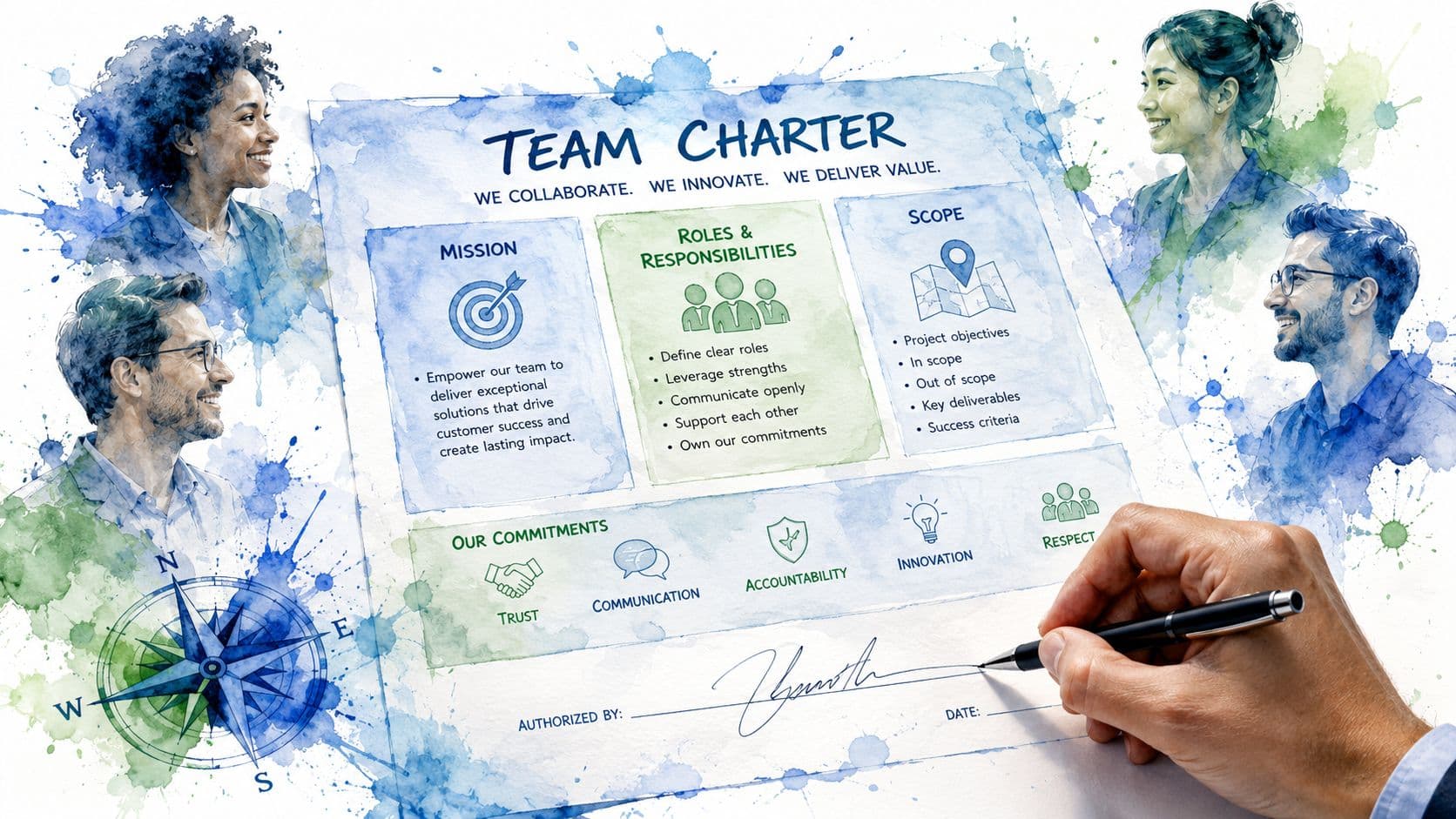
Your team has a deadline in six weeks. Three people think they own the same deliverable. Another person is waiting for approval that nobody realized they needed. Meetings keep ending with “let's take that offline,” but nothing gets settled.
That's usually the moment someone asks a basic question that should've been answered at the start: Who is this group, what are we responsible for, and how do we make decisions?
That's what an organizational charter is for.
A good charter isn't paperwork for its own sake. It's a team's constitution. It names the mission, sets the boundaries, assigns roles, and explains how the group will operate. In team settings, it's typically created early in the lifecycle and acts like an official work contract that enables the team to act, as described in The Team Charter overview. That same source also notes that the U.S. Office of the Comptroller of the Currency recorded 25 formal enforcement actions in the referenced year tied to how banks establish and maintain corporate structures, which is a reminder that chartering and governance can have real-world consequences in regulated environments.
For a new project manager, that matters for a simple reason. Confusion feels like a people problem, but it's often a design problem. If the team has no shared operating agreement, smart people will still pull in different directions.
Your Guide to the Organizational Charter
An organizational charter is a formal document that defines a group's mission, scope, boundaries, roles, and measures of success. In plain English, it answers the practical questions people ask once the kickoff excitement wears off.
What are we here to do?
What are we not here to do?
Who decides?
Who owns what?
How will we know if this group is working?
That's why I tell project managers to think of the charter as a team's constitution. A constitution doesn't do the work itself. It creates the rules and authority that let people work without constant confusion.
What a charter does in real life
When a charter is clear, it gives a team a common reference point. Instead of reopening the same argument every week, people can point to the document and say, “This is in scope,” or “That decision belongs with this role,” or “We agreed to escalate that kind of issue this way.”
A charter also signals legitimacy. It tells the team, sponsors, and adjacent departments that this group exists for a defined purpose and has permission to act within agreed boundaries.
Practical rule: If your team keeps debating ownership, approval paths, or priorities, you probably don't have a personality problem. You have a charter problem.
What a charter is not
It's not a slogan.
It's not a project schedule.
It's not a legal filing in every case.
That last point causes a lot of confusion, especially for founders and newer managers. Sometimes “charter” refers to a legal corporate document. Other times it refers to an internal team or project governance document. Both meanings are valid, but they're not interchangeable.
If you remember one thing from this section, remember this: a charter translates intent into operating clarity.
Why a Charter Is Your Team's North Star
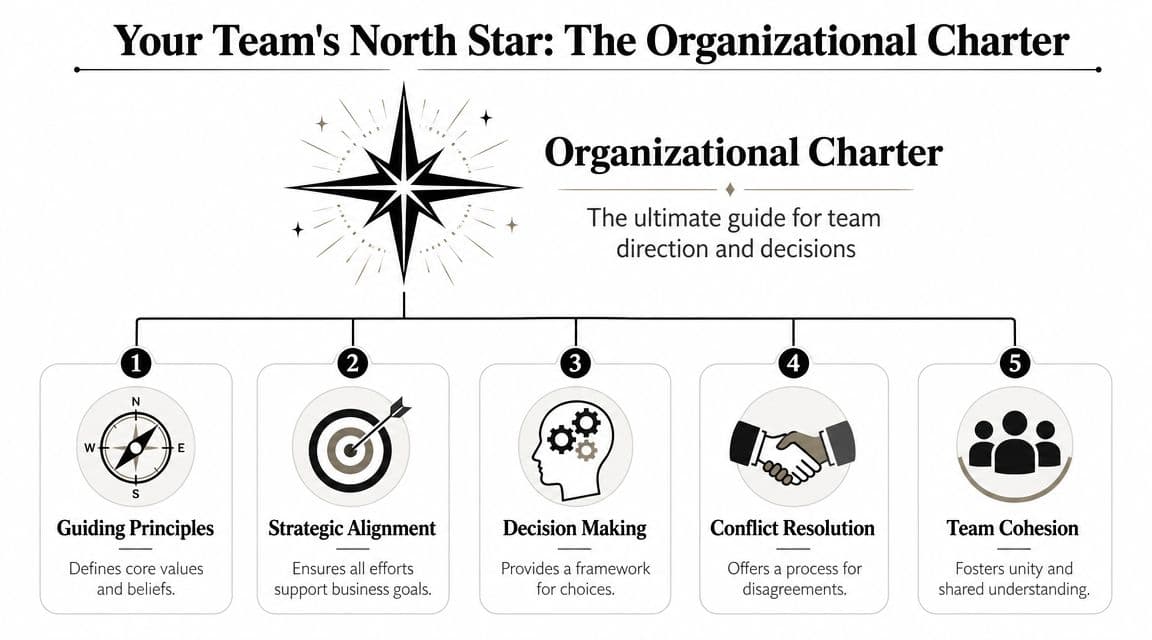
Teams drift when nobody has written down the rules of the game. One person optimizes for speed. Another protects quality. A third keeps adding requests because nobody defined the boundary. The charter becomes the North Star because it turns broad intent into day-to-day operating rules.
The Center for Creative Leadership describes a charter this way: it functions like a lightweight operating contract, converting a mission into operational controls. It also notes that ambiguity in roles and scope is a primary source of duplicated work and slow decisions, and that codifying those points early reduces misalignment by creating a shared reference for who owns what, what the team will and won't do, and how disputes are handled over time, as explained in their guide on team purpose and role clarity.
Why teams feel the difference quickly
A charter doesn't remove hard work. It removes avoidable friction.
- Clear scope stops expansion by accident: If the charter states what's in scope and out of scope, the team has a basis for saying yes, no, or not now.
- Defined roles reduce overlap: Two capable people can still duplicate effort if nobody drew the lines.
- Decision rights speed things up: Teams slow down when every issue gets treated like a committee question.
- Working norms lower tension: Many “conflicts” are really disagreements about process, not intent.
A practical way to connect this to planning is to ground your charter in the importance of business objectives. If objectives tell you where the business is going, the charter explains how this specific group will contribute without stepping on itself.
Here's a short explainer if you want another perspective on the concept in team settings:
Think of it as a decision filter
When a request arrives late, the charter helps the team ask:
- Is this part of our mandate?
- Who has authority to accept or reject it?
- What tradeoff does it create?
- Does this require sponsor input or team-level action?
A strong charter doesn't make every choice easy. It makes the basis for the choice visible.
That's why good teams don't treat charters as administrative overhead. They treat them as operating infrastructure.
Charter vs Mission Statement vs Project Plan
A new project manager joins a kickoff meeting and hears three instructions in ten minutes: “Update the mission,” “fix the charter,” and “build the project plan.” Everyone nods as if those terms mean the same thing. They do not. When a team blurs them together, confusion shows up fast. People agree on the purpose but not the authority, or they build a timeline before anyone has defined who can make tradeoff decisions.
The cleanest way to separate them is to ask a simple question: what job is this document doing?
A mission statement explains why the group exists. It is directional and high level. An organizational charter translates that purpose into operating rules: scope, authority, roles, decision rights, and the way the group will govern itself. A project plan turns approved work into action by laying out tasks, dependencies, timing, owners, and milestones.
You can read them like three layers of the same system. The mission gives meaning. The charter gives order. The project plan gives sequence.
Organizational Charter vs. Related Documents
| Document | Primary Purpose | Audience | Lifespan |
|---|---|---|---|
| Organizational Charter | Define purpose, scope, roles, decision rights, and operating boundaries | Team members, sponsors, stakeholders | Medium to long term, reviewed and updated as needed |
| Mission Statement | Express why the group exists | Broad internal and sometimes external audience | Long term |
| Project Plan | Organize deliverables, timing, dependencies, and execution activities | Project team and delivery stakeholders | Usually tied to the life of a project |
A useful analogy is a team's constitution. The charter works like that constitution. It does not describe every task people will do this month, and it does not replace the organization's reason for existing. It sets the rules of the game so day-to-day work has a stable frame.
That distinction matters even more because the word charter has both a legal meaning and an operational one.
The legal meaning versus the operational meaning
Many articles mix these up, which leaves new managers with the wrong mental model.
- Legal charter: the formal company-level document tied to incorporation, legal status, and governance at the entity level.
- Operational charter: the internal document used by a team, function, department, or project group to define how it will operate.
If the question is “How does this company legally exist?” you are in legal-charter territory. If the question is “Who decides, what do we own, and how do we work together?” you are dealing with an operational charter.
Both can matter at the same time. A company may have legal formation documents on file, while its leadership team, PMO, or cross-functional program still needs an internal charter to prevent overlap, delay, and avoidable conflict.
What each document actually helps you do
A mission statement is broad by design. It helps people understand intent.
A charter is more practical. It helps a team govern itself. It answers questions a mission statement cannot answer, such as who approves a scope change, which work belongs elsewhere, and how disagreements get resolved. If you are sorting out team roles and responsibilities across a project group, you are doing charter work, not mission-writing.
A project plan is narrower and more time-bound. It helps the team deliver a defined body of work. It should sit downstream of the charter. Otherwise, the team can build a polished schedule on top of fuzzy ownership.
The mistake people make with charters
Some teams treat the charter like setup paperwork. They write it once during kickoff, save it in a folder, and never reopen it.
That weakens the whole document.
An operational charter should be a living governance tool. As the team's mandate shifts, stakeholders change, or decision bottlenecks appear, the charter should be reviewed and updated. The mission may stay steady for years. The project plan may change every week. The charter sits between them, stable enough to guide behavior, flexible enough to reflect reality.
Common mix-ups to avoid
- Calling a mission statement a charter: Purpose alone does not define authority, boundaries, or decision rights.
- Calling a project plan a charter: A schedule cannot settle governance questions.
- Using “charter” without saying which kind: In a startup, nonprofit, or scaling company, that can mean either a legal document or an internal operating document.
- Treating the charter as permanent text: Internal charters need periodic review so they keep matching the way the team operates.
A practical rule helps here. If you are a project manager, always label the document clearly. Use legal corporate charter for entity-level formation and operational team or project charter for internal governance. That one habit prevents a surprising amount of confusion.
The Essential Components of a Powerful Charter
A useful charter is specific enough to guide behavior and simple enough that people will use it. If it reads like policy fog, nobody will open it after the kickoff.
The strongest charters usually include a small set of core elements. Each one solves a different failure point.
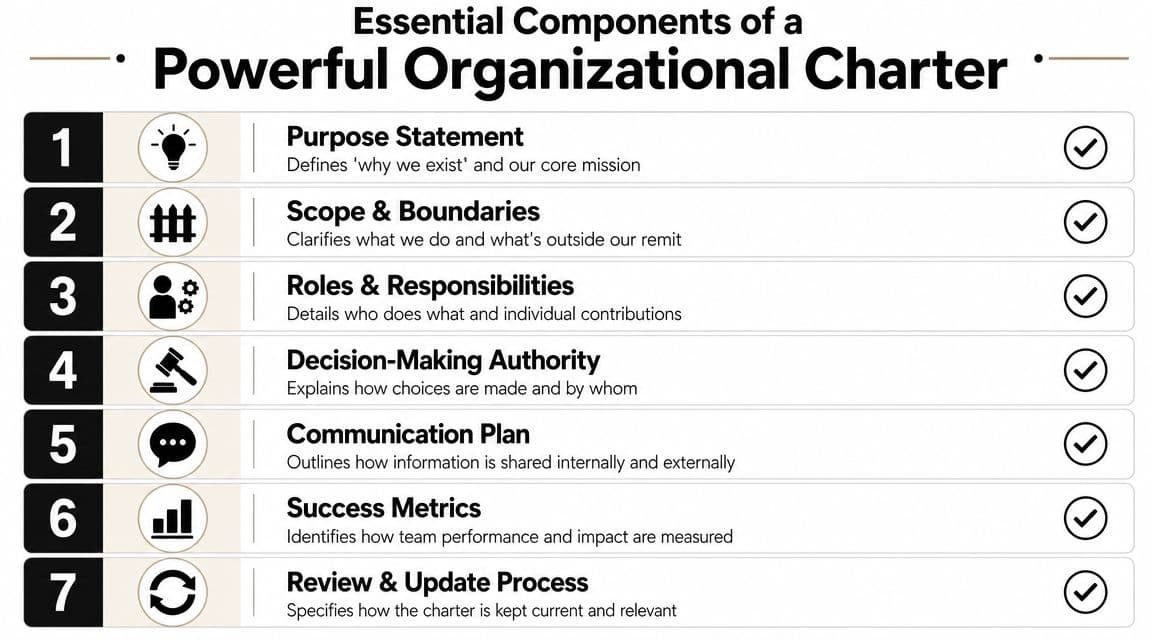
Purpose and scope
Start with the mission in one or two plain-language sentences. Then define the edges.
Ask questions like:
- Purpose: Why does this team exist right now?
- In scope: What work falls clearly inside the team's remit?
- Out of scope: What work belongs elsewhere?
Example: A customer onboarding team might own kickoff, implementation coordination, and first-use readiness. It might explicitly exclude contract negotiation and post-renewal support.
Roles and decision rights
The handling of this element often determines a charter's utility. Name the core roles and the responsibilities attached to each one. Keep it practical. You don't need a giant matrix if a lighter version will do.
A simple prompt set works well:
- Owner: Who is accountable for the outcome?
- Contributors: Who does the work or provides input?
- Approver: Who makes the final call when needed?
- Escalation point: Who steps in when the team can't resolve an issue?
If you need help mapping ownership cleanly, this guide on team roles and responsibilities is a useful companion resource.
Manager's shortcut: If two names appear next to one critical decision, assume nobody owns it until you state otherwise.
Resources and working norms
A charter should also state what the team can use. That includes people, tools, budget categories if relevant, and any constraints that shape execution.
Then add a few operating norms, such as:
- Communication channels: Where updates happen
- Meeting rhythm: What gets discussed and how often
- Escalation path: What triggers sponsor involvement
- Response expectations: What “timely” means for this team
Success measures and review rules
If success isn't defined, every stakeholder will define it differently later.
Use a small number of practical measures. These can be milestones, service levels, quality checks, adoption indicators, or other team-relevant outcomes. Keep them close to the work. Avoid stuffing the charter with metrics the team can't influence.
Also include one line on maintenance:
- Who owns the charter?
- Who can propose a revision?
- How will updates be approved?
That final point matters more than it seems. A charter that can't be updated becomes a historical artifact instead of a management tool.
How to Create an Organizational Charter Step by Step
Most weak charters fail before anyone writes the first sentence. They're drafted by one person, approved by another, and ignored by everyone else. The process matters because the act of creating the charter forces alignment.
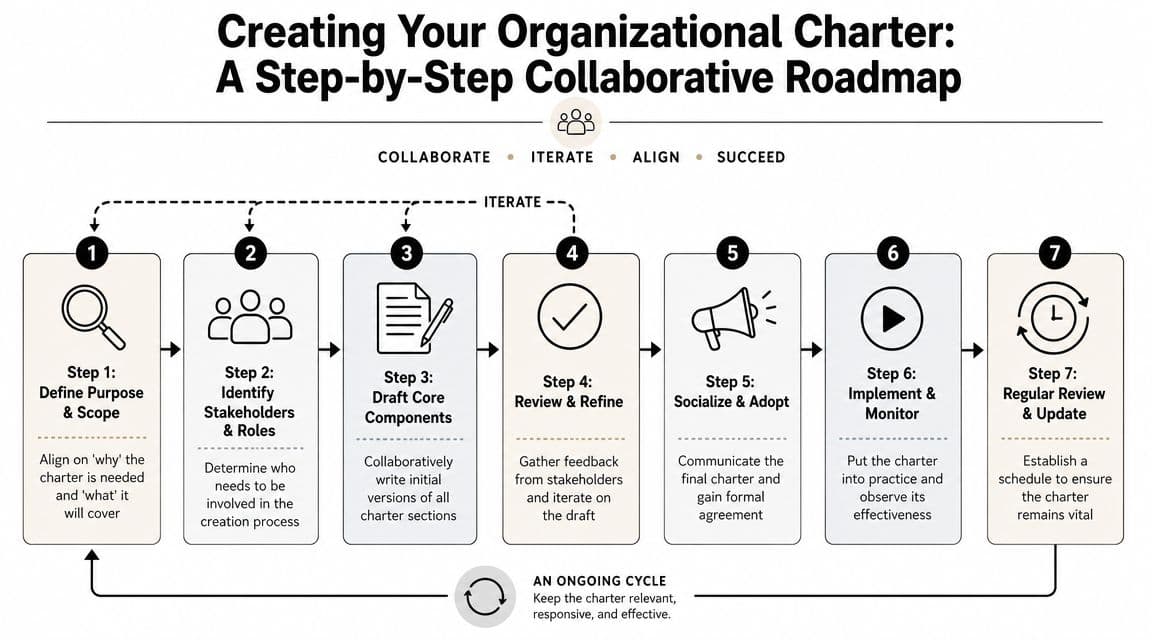
Step 1 and Step 2
First, identify the core team and the stakeholders around it. Those aren't always the same people. The core team will live inside the charter. Stakeholders will care about its boundaries, outputs, and decision rules.
Second, run a working session. Don't make it a presentation. Make it a structured conversation with prompts such as:
- What problem is this team meant to solve?
- What work should stay outside the team?
- Which decisions should the team make on its own?
- Which issues must be escalated?
Step 3 and Step 4
Draft the charter collaboratively, but don't aim for literary perfection. Aim for usable language. If a sentence sounds polished but nobody knows what it means on Monday morning, rewrite it.
Then circulate the draft for review. During this review, hidden assumptions usually surface. Finance may spot a resource issue. A sponsor may clarify authority. Another team may point out overlapping scope.
Write for the person who joins the team three months from now. If they can't understand the charter without a translator, it's too vague.
Step 5 and Step 6
Get formal sign-off from the person or group with governance authority: an unsigned charter is often treated like a suggestion.
After approval, socialize it. That means more than uploading a file. Walk the team through the document. Explain what changed, what decisions it settles, and where people should use it.
A practical rollout looks like this:
- Confirm authority: Make sure sponsors agree on decision rights.
- Share the final version: Put it in the team's standard workspace.
- Use it in live work: Reference it in kickoff meetings, disputes, and change requests.
- Test edge cases: Use real examples to see whether the rules hold up.
Step 7
Schedule the first review while the charter is still fresh. If you leave maintenance undefined, it usually never happens.
That's the pattern I recommend to new project managers: co-create, clarify, approve, use, revisit.
Putting Your Charter into Action with Modern Tools
A charter stored in a folder doesn't change behavior by itself. Teams need to translate the document into visible routines, assignments, and workflows.
That usually means mapping charter elements into the tools people already use every day.
Turn the charter into operating mechanics
Here's how that translation works in practice:
- Roles and responsibilities become task ownership: Every recurring deliverable should have a named owner.
- Decision rights become approval workflows: If a budget exception or scope change needs review, the system should reflect that.
- Success measures become dashboards or milestone checks: Teams should be able to see whether the charter is being honored in execution.
- Communication norms become channels and cadences: If status updates belong in one place, don't let them scatter across five tools.
For teams evaluating software to support that kind of discipline, this overview of task management software for teams can help frame the options.
Some organizations also need a legal or compliance layer around governance documents and approval trails. In those cases, resources like LegesGPT's picks for legal tech can be useful for understanding the broader range of tools.
One practical example
A platform like Fluidwave can support this operational side by letting teams organize tasks, assign ownership, track progress across views such as list, calendar, Kanban, and table, and delegate work with clear accountability. That doesn't replace the charter. It gives the charter somewhere to live in daily execution.
If you can't point from a charter statement to a real workflow, approval step, or owner in your operating system, the team will eventually revert to memory and habit.
Keeping Your Charter Alive Governance and Maintenance
The biggest mistake teams make is treating the charter like a launch document. They create it once, get everyone to nod, and never touch it again.
That approach breaks down fast when priorities shift, teams change, or new dependencies appear.

A better approach is to manage the charter as a living governance tool. Guidance summarized in this review of organizational charter examples notes that charters should be reviewed and updated rather than treated as static templates, and some experts explicitly recommend an annual review so norms, checks and balances, and outcomes stay aligned with changing strategy.
What charter governance should include
A workable governance model answers four questions:
| Governance Question | Practical Answer |
|---|---|
| Who owns the charter? | Usually the team lead, department head, or project sponsor |
| Who can suggest changes? | Team members, stakeholders, and governance owners |
| Who approves revisions? | The role or group with formal authority over the team |
| When is review triggered? | On a schedule and after material changes in strategy, structure, or scope |
A maintenance rhythm that works
You don't need bureaucracy. You need rhythm.
- Use periodic check-ins: Add the charter to regular team retrospectives or operating reviews.
- Run a deeper annual review: Reconfirm scope, decision rights, measures, and interfaces with other teams.
- Update after major changes: New leadership, reorganizations, strategy shifts, or recurring disputes usually signal that the charter needs revision.
- Keep version control simple: Date each revision and note what changed.
If your organization already uses documented processes, it helps to align charter governance with related practices such as how to create standard operating procedures. The charter sets the governing rules. Procedures handle the repeatable details.
A charter stays useful only if the team can answer two questions quickly: Which version is current, and who had authority to approve it?
Teams don't need perfect documents. They need current ones.
Frequently Asked Questions About Organizational Charters
A new project manager joins a cross-functional team and asks a simple question: “Do we already have a charter?” One person sends the articles of incorporation. Another shares a project timeline. A third points to the mission statement. That confusion is common, and it usually signals that legal documents and operating documents are being mixed together.
An organizational charter works like a team's constitution. It is not the document that creates a company in a legal sense. It is the document that helps a team operate clearly, make decisions consistently, and revisit its rules when the work changes.
FAQ
| Question | Answer |
|---|---|
| What is an organizational charter in simple terms? | It is a written agreement that explains why a group exists, what it owns, who has authority, how decisions get made, and how the group will judge progress. It works like a team's constitution. |
| Is an organizational charter the same as a mission statement? | No. A mission statement explains purpose in broad terms. A charter adds the operating rules, such as scope, roles, boundaries, and decision rights. |
| Is a charter the same as a project plan? | No. A project plan lays out work, timing, and dependencies. A charter defines the rules and responsibilities that guide the people doing the work. |
| Do I need a legal charter, a team charter, or both? | Use the document that matches the decision you need to make. A legal charter or related formation document helps establish the organization as a legal entity. A team charter is an internal governance tool that helps a department, initiative, or cross-functional team run well. Some organizations need both because they solve different problems. |
| Who should write the charter? | The team lead, project manager, or sponsor usually facilitates the process. The content should be shaped with input from the people who will use it and the stakeholders who depend on it. |
| When should a team create one? | Create it early, before habits, workarounds, and role confusion set in. A charter has the most value when it prevents friction instead of documenting it after the fact. |
| How often should the charter change? | Review it on a regular cadence and after real changes in strategy, structure, leadership, or scope. A good charter is stable enough to guide the team and flexible enough to stay current. |
| What if people disagree about the charter? | That usually means the discussion is doing its job. Disagreement brings hidden assumptions to the surface. The sponsor or other designated approver should resolve open governance questions before the charter is adopted. |
| How long should a charter be? | It should be long enough to remove ambiguity and short enough that people will read it during actual work. Clear language matters more than page count. |
| What's the biggest sign that a charter is missing or weak? | You will see repeated confusion about ownership, recurring scope disputes, slow decisions, duplicate work, and conflict over who gets to decide what. |
One point is easy to miss. A charter is not a one-time setup file that gets stored away after kickoff. It is a living governance document. If the team changes and the charter does not, the written rules stop matching reality.
If you're leading a new team or a cross-functional initiative, write the first version while the group is still forming. Then treat it like an operating document, not a formality. Fluidwave gives teams a practical way to organize tasks, assign responsibilities, and keep execution aligned with the way the team is supposed to operate.
Focus on What Matters.
Experience lightning-fast task management with AI-powered workflows. Our automation helps busy professionals save 4+ hours weekly.