Discover what does gtd mean and how the Getting Things Done method can boost productivity and reduce stress in your daily tasks.
February 20, 2026 (7mo ago) — last updated March 9, 2026 (7mo ago)
What Does GTD Mean? A Simple Guide — what does gtd mean
Discover what does gtd mean and how the Getting Things Done method can boost productivity and reduce stress in your daily tasks.
← Back to blog
So, what does GTD actually mean? It’s a pretty popular productivity method that stands for Getting Things Done, and it's all about managing your tasks and projects with a whole lot less stress. Think of it as a system designed to help you tame the chaos by moving everything out of your head and into a trusted place you can rely on.
The Core Idea Behind Stress-Free Productivity

Ever feel like you’re juggling a dozen mental to-do lists at once? You're trying to focus on a report, but your brain keeps piping up with reminders to buy groceries, schedule that dentist appointment, or follow up on an important email. This constant mental chatter isn't just distracting; it's flat-out exhausting.
The core idea of GTD, developed by productivity consultant David Allen, is both simple and powerful: your mind is for having ideas, not holding them.
When you try to use your brain as a filing cabinet for every single task, reminder, and brilliant idea, you create what Allen calls "open loops." These are the unfinished commitments that ping around in your head, draining your focus and energy. The entire point of GTD is to close these loops by giving you a reliable external "brain."
By capturing everything—from major project deadlines to tiny errands—into an organized system you trust, you give your mind permission to let go. This frees up precious mental real estate, letting you be fully present and engaged.
A Mindset for Clarity and Control
At its heart, GTD is less about a rigid set of rules and more about a flexible way of thinking. The methodology first appeared in David Allen's book way back on March 13, 2001, just as folks were starting to feel drowned by the digital age. Its promise of "stress-free productivity" really struck a chord, and by 2020, the book had sold over 2 million copies worldwide.
This system isn't just for C-suite executives; it's for anyone feeling bogged down by mental clutter. It gives you a structured way to get back a sense of clarity and control over all your commitments. When a whole team gets on board, this approach can also improve team productivity calmly. Ultimately, GTD provides a systematic path to navigate your responsibilities without that constant nagging anxiety that you’ve forgotten something.
Here’s a quick look at the core principles that make GTD work.
GTD Principles at a Glance
| Core Principle | What It Means for You |
|---|---|
| Capture Everything | Write down every task, idea, or reminder. Don't let anything float around in your head. |
| Clarify What It Is | Decide if an item is something you can act on. If not, trash it, file it, or stick it on a "someday/maybe" list. |
| Organize It | Put things you can act on where they belong: on a calendar, a project list, or a "next actions" list. |
| Reflect Regularly | Look over your system weekly to stay current, clear your head, and trust your choices. |
| Engage with Confidence | With a clear system, you can confidently pick what to work on right now. |
This table shows how GTD turns the fuzzy idea of "getting organized" into a real, repeatable process. It's about building a trusted system so your mind can do what it does best: think, create, and solve problems.
Getting to Grips with the 5-Step GTD Workflow
At its heart, GTD isn't just a philosophy—it’s a hands-on workflow for handling everything life throws at you. Imagine your mind is like a physical inbox on your desk. If you let every letter, memo, and random note pile up, you'll eventually feel buried, and important stuff will definitely slip through the cracks. The GTD method gives you five clear steps to process that inbox so you can stay ahead of the chaos.
These five stages—Capture, Clarify, Organize, Reflect, and Engage—are designed to work together, creating a seamless and reliable process. The idea is to stop managing tasks on the fly and start building systems that handle growth, both personally and professionally. Let's walk through each step.
From Mental Clutter to Clear Actions
It all starts with Capture. Think of this as your collection phase. Your only job here is to get everything out of your head and into a trusted system. That could be a simple notebook, a digital app, or even an actual tray on your desk. Every fleeting idea, task, and reminder gets tossed in here—no filtering, no exceptions.
Next up is Clarify. You go through your collection bin, one item at a time, and ask two key questions: "What is this?" and "Is there anything I need to do about it?" If the answer is no (like a receipt you don't need or a random thought), you either trash it, file it away for reference, or add it to a "someday/maybe" list for later.
If something is actionable, the next move is to define the very next physical action you need to take. This one small habit is a game-changer for beating procrastination. If you want to dive deeper into making these kinds of decisions, check out our guide on task prioritization techniques.
From Organization to Execution
Once you've clarified an item, it's time to Organize it. This just means putting it where it belongs. Does it take less than two minutes? Just do it now and get it off your plate. Does it have a hard deadline? Slap it on your calendar. Is it one step in a multi-step goal? Add it to a dedicated project list.
The weekly review is arguably the most critical habit in the entire GTD system. It’s the glue that holds everything together, ensuring your system stays current, complete, and trustworthy.
The fourth step, Reflect, is where you maintain the system. This is your scheduled check-in, usually done once a week. You’ll look over all your lists, clean things up, and make sure everything is current. This simple ritual is what builds unwavering trust in your setup and keeps things from falling through the cracks.
Finally, you Engage. With a clear, organized, and up-to-date system, you can now make trusted choices about what to do at any given moment. You're no longer just reacting to the latest email or the loudest demand. Instead, you're making intentional decisions based on your context, how much time you have, and your energy levels. This is what stress-free productivity really feels like.
The Real-World Payoff: What GTD Actually Does For You
Putting the GTD method into practice is about way more than just tidying up your to-do list. It’s a complete overhaul of how you relate to your commitments, and the results can be pretty profound. The first thing most people notice is a huge drop in stress. Getting every single task, idea, and reminder out of your head and into a system you trust frees you from that constant, low-level hum of anxiety—the nagging feeling you’ve forgotten something important.
With that mental clutter gone, you suddenly have the bandwidth for real focus. Instead of your brain’s processing power being gobbled up by remembering to buy milk or follow up on an email, it’s free for deep, creative, and high-value work. You can be fully present, whether you're hammering out a complex report or just brainstorming with your team.
From Chaos to Control
The real magic of GTD lies in its structured workflow, which systematically gives you a feeling of control over your world.
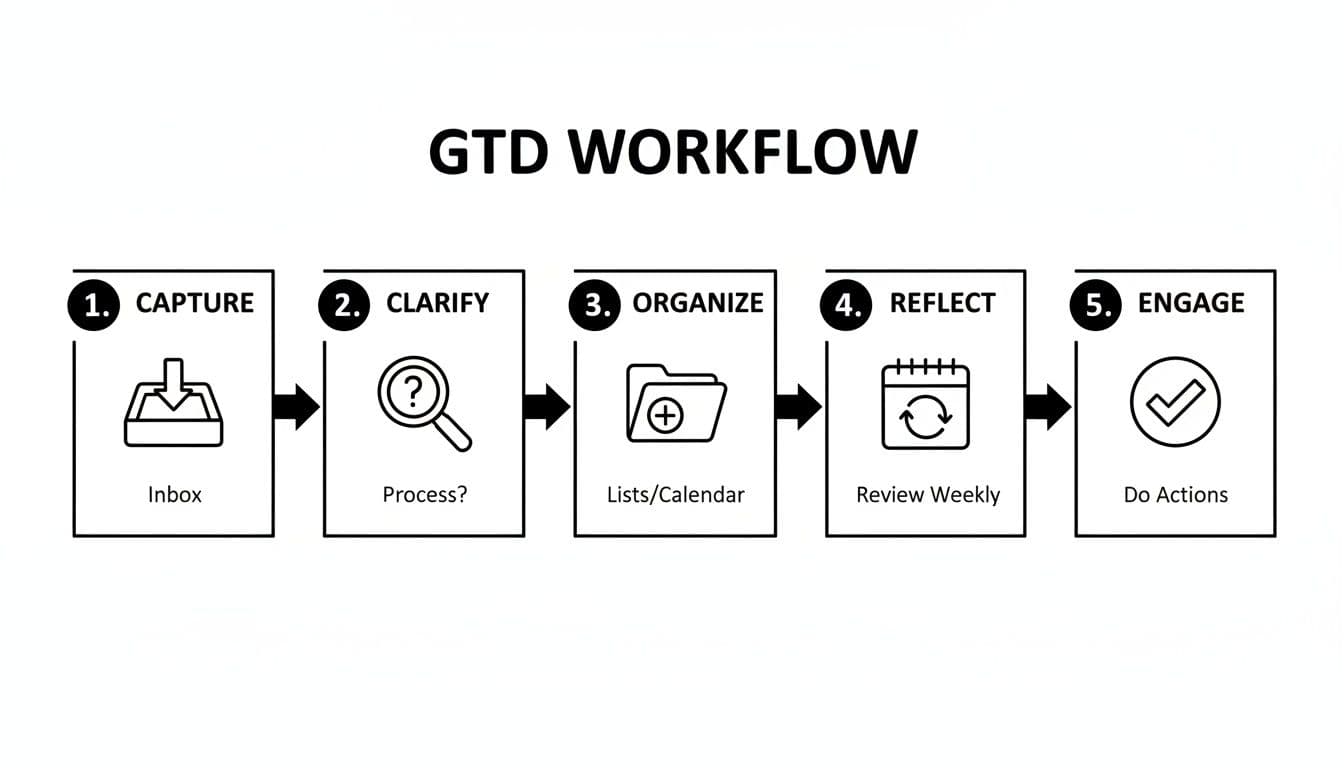
By consistently moving your to-dos through these five stages, you create a reliable process that ensures nothing ever falls through the cracks. It’s this systematic approach that builds an unshakeable sense of command over your life and your workload.
This isn't just a nice idea; the numbers back it up. A David Allen Company survey of 5,000 users found that a remarkable 92% felt less anxiety after only 90 days. On top of that, 65% were completing 20-50% more tasks every single day. The method is also a game-changer for those with ADHD—a condition impacting 366 million adults globally—with 78% in a Reddit poll reporting it significantly improved their executive function. The folks at LogRocket have even more on these effective strategies.
The weekly review is the habit that builds unbreakable confidence in your system. It’s your dedicated time to get clear, get current, and make sure you are focused on what truly matters for the week ahead.
This regular check-in is what keeps your system in sync with reality. It reinforces your trust in the process, allowing you to relax and fully engage with your work, knowing with certainty that everything is accounted for. That’s the true feeling of being productive and present.
Why GTD is a Game-Changer for Neurodivergent Minds
The structured, almost rhythmic, nature of GTD makes it an incredible ally for people with ADHD and other forms of neurodivergence. For anyone who struggles with executive functions—the brain's project manager for planning, organizing, and actually starting things—daily life can feel like an uphill battle. GTD provides a sturdy external framework to support those very skills.
Instead of trying to juggle every single thought and to-do in an already crowded mental workspace, GTD gives you a reliable process for getting it all out. By methodically capturing your commitments, you can drastically quiet the mental noise that so often leads to feeling overwhelmed and stuck.
From Overwhelm to Actionable Steps
One of the most powerful aspects of GTD is its simple rule: break down big, intimidating projects into tiny, concrete "next actions." This single habit is a direct antidote to the procrastination and task paralysis that can happen when a goal feels too vague or just too large to tackle.
This kind of structure can be a lifeline for those with ADHD, which affects 4-5% of people worldwide. It’s not just theory, either. In a 2022 poll on a popular ADHD forum, a staggering 85% of users reported that using GTD cut their sense of overwhelm in half. You can explore user discussions about GTD's impact to see firsthand accounts.
GTD isn't just about managing tasks; it's about creating an environment of psychological safety where your brain is allowed to focus on one thing at a time, confident that nothing else is being forgotten.
This systematic approach offers a clear path forward, making it much easier to navigate professional demands with less stress and more confidence. For more targeted strategies, check out our guide on task management for ADHD. By providing a clear framework, GTD helps you build momentum and achieve what you set out to do.
Bringing Your GTD System to Life with Modern Tools
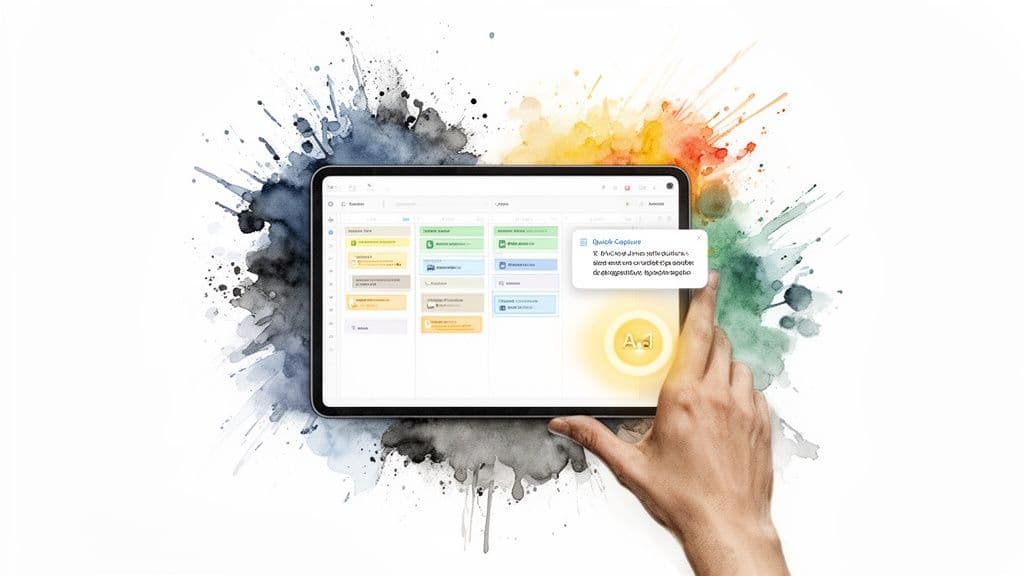
Sure, you can run a perfectly good GTD system with just a notebook and pen. For years, that's how it was done. But the right digital tools can make the entire workflow faster, more intuitive, and honestly, a lot easier to stick with.
The trick is finding a platform that doesn't just add another layer of complexity. A good tool should feel like a natural extension of your brain, getting out of the way so you can just do.
Platforms like Fluidwave are designed to support exactly this kind of structured thinking. Let's look at how the five steps translate from paper to screen.
Implementing the 5 Steps in a Digital World
Your Capture step has to be totally seamless. If it takes more than a few seconds to add a task, you just won't do it. With Fluidwave, you can toss ideas into your inbox from any device, anytime. That thought that pops into your head during a meeting? It's captured in your system before you have a chance to forget it.
Next up is Clarify. This is where you process your inbox. Fluidwave's AI-powered prioritization can give you a nudge, suggesting which items might be urgent, helping you decide what's actionable right now. In a few clicks, you can add due dates, connect an item to a larger project, or punt it to your "Someday/Maybe" list.
When it comes to the Organize step, one size never fits all. You need flexibility. You might want to see your "Next Actions" in a simple checklist, view your week on a calendar, or track a project's flow on a Kanban board. To see how different platforms handle this, check out our task management software comparison for a deeper dive.
The point of a digital GTD system isn't just to store your to-do list. It's to create a dynamic, trusted environment where you can easily review your commitments and confidently decide what to work on next.
Finally, you Reflect and Engage. Your weekly review becomes much simpler when all your lists are in one place and instantly searchable. When it's time to get to work, you can trust that what you're seeing is exactly what you should be focused on.
The Ultimate Delegation Tool
GTD always included the "Delegate It" option, but what does that look like in the real world? Modern tools take this idea and run with it.
A standout feature in Fluidwave is the ability to delegate tasks directly to a network of human virtual assistants. So instead of just assigning a task to a colleague, you can actually offload it to a skilled professional who gets it done for you. This turns delegation from a simple "assign" button into a powerful way to clear your plate and focus on what truly matters.
Still Have Questions About GTD?
Even with the best guides, jumping into a new system like GTD can feel a little intimidating. Let's walk through a few common questions that pop up, so you can get started with total confidence.
Isn't This Just a Glorified To-Do List?
Not really. A simple to-do list is just a brain dump of tasks, often jumbled together without any real context. It’s a list that quickly becomes a source of stress rather than a tool for clarity.
GTD, on the other hand, is a complete workflow. It’s a system designed to capture everything vying for your attention, force you to clarify what each item actually is, and then organize it all in a way that makes sense. The real magic is its focus on defining the very next physical action for every project, which transforms overwhelming chaos into a series of clear, manageable steps.
How Long Until I Actually Get the Hang of This?
You can learn the core principles in an afternoon, but making GTD an automatic, second-nature habit? That usually takes a few weeks to a couple of months. Don't try to boil the ocean on day one.
The key is to start small. Focus on mastering just one piece at a time, like the Capture habit. Get really good at writing everything down the moment it pops into your head.
If there’s one habit to nail down, it’s the Weekly Review. Once that becomes a non-negotiable part of your routine, you’ll find the rest of the system just clicks into place.
Do I Need to Buy Special Software?
Nope. David Allen created GTD with nothing more than a pen and a stack of file folders. You can absolutely run the entire system with a simple notebook.
That said, the right digital tool can seriously level up your GTD game. Modern apps make it ridiculously easy to capture ideas wherever you are, organize complex projects visually, and pull up your lists on any device. Plus, features like AI-powered organization and built-in delegation can help you manage your workload in ways a paper system just can't match.
Ready to build a trusted system that finally clears your mind? Fluidwave provides the perfect digital environment to implement GTD, from effortless capture to powerful AI-driven organization and unique delegation features. Start managing your tasks with clarity today at fluidwave.com.
Focus on What Matters.
Experience lightning-fast task management with AI-powered workflows. Our automation helps busy professionals save 4+ hours weekly.