Unlock the true value of a team. Learn how to measure team effectiveness, calculate ROI, and implement proven strategies like automation to boost productivity.
May 10, 2026 (4mo ago)
The Value of a Team: How to Measure and Maximize It
Unlock the true value of a team. Learn how to measure team effectiveness, calculate ROI, and implement proven strategies like automation to boost productivity.
← Back to blog
Most advice about teamwork starts in the wrong place. It starts with culture slogans, offsites, and personality frameworks. Those can help, but they don't tell you what a team is worth.
The value of a team shows up in execution. It shows up when priorities are clear, handoffs don't break, decisions don't stall, and work keeps moving even when someone is out or the plan changes. A strong team isn't just a group of capable people. It's a system that converts effort into results with less friction.
That distinction matters more than most leaders admit. Plenty of organizations still evaluate teams like they evaluate individuals. They look at visible output, compare top performers, and assume the math is simple. It isn't. Teams create value through coordination, trust, speed, judgment, and resilience. Those things don't fit neatly into a single productivity report, but they drive the report.
Why Team Value Is Your Most Important Metric
A team's value isn't a soft concept. It's an operating metric.
If you only track individual output, you'll miss the forces that determine whether a business scales cleanly or stalls under its own complexity. Two teams can have similarly talented people and still produce very different outcomes. One burns energy in status meetings, duplicate work, and avoidable rework. The other makes fast decisions, shares context well, and keeps execution steady under pressure.
That gap is expensive.
Research summarized by Plecto found that businesses with the highest levels of employee engagement demonstrate 21% higher profitability, a 41% reduction in absenteeism, and a 17% boost in productivity, with some seeing up to 23% profit increases (employee engagement statistics). That's not a morale story. That's a business performance story.
Why leaders misjudge team value
The common mistake is treating a team like a basket of individual contributors. Add enough smart people, and the assumption is that value rises automatically. In practice, the opposite often happens. More people can create more drag if the team lacks role clarity, decision rules, and a reliable way to coordinate work.
A high-value team does four things well:
- It reduces friction: People know who owns what, where work lives, and how decisions get made.
- It protects focus: The team spends less time chasing updates and more time moving important work.
- It compounds knowledge: Context isn't trapped in one person's head.
- It stays functional under stress: Work continues when priorities shift or someone is unavailable.
Operational design matters as much as talent for this very reason. If your workflow is messy, your best people end up spending their energy compensating for the system instead of advancing the business. Teams become reactive. Managers become bottlenecks. Everyone feels busy, but little of that busyness turns into a true competitive advantage.
For leaders focused on operational efficiency, this is the point that changes the conversation. The question isn't just, "Do we have good people?" It's, "Does this team reliably turn effort into profitable, repeatable outcomes?"
Practical rule: If a team needs heroic effort to hit normal goals, the team has low structural value even if the people are excellent.
The value of a team is your most important metric because it tells you whether performance is durable. Revenue can spike for a quarter. A star employee can carry a function for a while. But if the team itself isn't creating an advantage, those gains don't last.
Beyond the Sum of Its Parts What Team Value Really Means
A team is an engine, not a pile of parts.
You can lay the best components on a table and still have nothing that moves. The value comes from fit, timing, alignment, and the way each part transfers force to the next. Teams work the same way. Individual skill matters, but the true value of a team comes from how people combine their skill inside a shared operating system.

Output is not the same as value
Most managers can tell you what their team produces. Fewer can explain what makes the team valuable beyond output.
Output is the visible result. Campaigns shipped. Tickets closed. Features released. Value is broader. It includes how reliably the team delivers, how well it adapts, how much supervision it requires, and whether it gets stronger as work gets more complex.
That's one reason why teamwork is important is still an active management question rather than a settled cliché. The point isn't just collaboration for its own sake. It's building a unit that can solve harder problems with less waste.
Where team value actually lives
In practice, team value usually sits in places that don't show up clearly on individual scorecards:
- Shared context: People don't need every detail repeated before they can act.
- Trust in execution: Team members believe commitments will be met.
- Decision quality: Disagreement improves choices instead of slowing them down.
- Recovery speed: The team can absorb errors, clarify, and move again.
- Role fit: Work goes to the person or function best equipped to handle it.
These are structural assets. They increase the return you get from the same headcount.
The sports world offers a useful parallel. An analysis of NFL franchise values found that regular season winning percentage explains only 2.6% of the variation in team value growth, which suggests that organization, market, and operational efficiency matter far more than short-term record (NFL franchise value analysis).
That result should make any executive pause. If even professional sports teams aren't valued mainly on visible wins, business leaders shouldn't assume a team's worth can be reduced to this quarter's output.
Strong teams create confidence beyond this week's numbers. Leaders trust them with ambiguity, customers feel the consistency, and the organization depends on them when stakes rise.
A valuable team doesn't just perform. It creates capacity. It lowers the cost of coordination. It makes quality more repeatable. It gives the business more room to take on difficult work without everything becoming fragile.
How to Measure the Unmeasurable KPIs and ROI for Team Value
Team value is not too fuzzy to measure. Leaders usually fail because they track the easiest numbers, then confuse activity with value.
Output, utilization, and deadline hit rate still matter. They show what the team delivered. They do not show whether the team is getting faster to trust, cheaper to coordinate, or better at turning effort into business results. That gap is where a lot of management decisions go wrong.
Leading vs lagging indicators of team value
The cleanest way to measure team value is to pair business results with operating signals. One shows what happened. The other shows whether the system that produced those results is improving.
| Indicator Type | Definition | Examples | Actionability |
|---|---|---|---|
| Leading | Signals that predict future team performance and resilience | decision speed, clarity of ownership, quality of handoffs, engagement, meeting load, risk surfacing | High. Leaders can change these through process, staffing, and management habits |
| Lagging | Results that show what the team already produced | deadlines met, customer outcomes, revenue contribution, defects, retention, absenteeism | Moderate. Useful for validation, but slower to improve once problems are visible |
A practical test helps. If a metric gets worse, can the team do something about it this month? If yes, it belongs on the dashboard. If not, keep it for review, not daily management.
What to track in the real world
Useful measurement starts small. Five to seven indicators is enough if they reflect how work moves through the team.
Track signals such as:
- Time to value: How long it takes for a new initiative to produce useful output.
- Decision cycle time: How fast the team moves from issue to owner to action.
- Handoff reliability: Whether work passes cleanly between people or functions.
- Rework rate: How often work gets redone because expectations were unclear.
- Coverage resilience: Whether work continues when a key person is unavailable.
- Delivery consistency: Whether the team keeps commitments without late heroics.
For a more structured framework, this guide to measuring team performance is a useful companion because it separates visible activity from the measures that help leaders intervene.
One caution. Do not let morale become a soft side note. It affects speed, retention, and execution quality. If a team is drained, output may hold for a quarter, then slip all at once. Helpside's guide for boosting team morale is useful here, especially for leaders who treat morale as cultural fluff instead of an operating variable.
A simple ROI lens
ROI from team value usually shows up in four places:
- More productive hours
- Less waste and rework
- Lower people risk
- Better execution on high-value work
McKinsey reports that employees can spend a large share of their week on tasks that could be automated with current technology, which gives leaders a concrete way to reclaim capacity instead of adding headcount too early (McKinsey on automation and work time).
That is the point of ROI measurement. It turns broad claims about teamwork into operating choices. If intelligent delegation removes approval bottlenecks, cycle time should drop. If automation takes reporting and admin work off specialists, more hours should shift to customer work, problem solving, or revenue-generating delivery.
Management test: Before you invest in a new workflow, tool, or coaching effort, define which two indicators should improve and what result would justify the cost.
A basic ROI model is sufficient for many teams:
- Identify one friction point: missed handoffs, overloaded managers, duplicate reporting, unclear ownership
- Choose one intervention: redesign intake, automate repeat work, rebalance responsibilities, improve delegation
- Measure one leading signal and one lagging result: for example, handoff quality and project cycle time
- Review after a fixed period: keep what changes team behavior and business results
Perfect attribution is not required. A useful management signal is enough.
The standard to apply is simple. Is the team becoming easier to run, easier to trust, and more productive with the same resources? If the answer is yes, team value is no longer abstract. It is showing up in the economics of the work.
Four Levers to Systematically Increase Team Value
Teams rarely fail because people do not care enough. They fail because the operating system around the work is poorly designed.
When results slip, many leaders add pressure. More status meetings. More approvals. More escalation. That usually increases drag. Team value rises when work moves with less friction, decisions happen at the right level, and expensive talent spends time on the problems only they can solve.
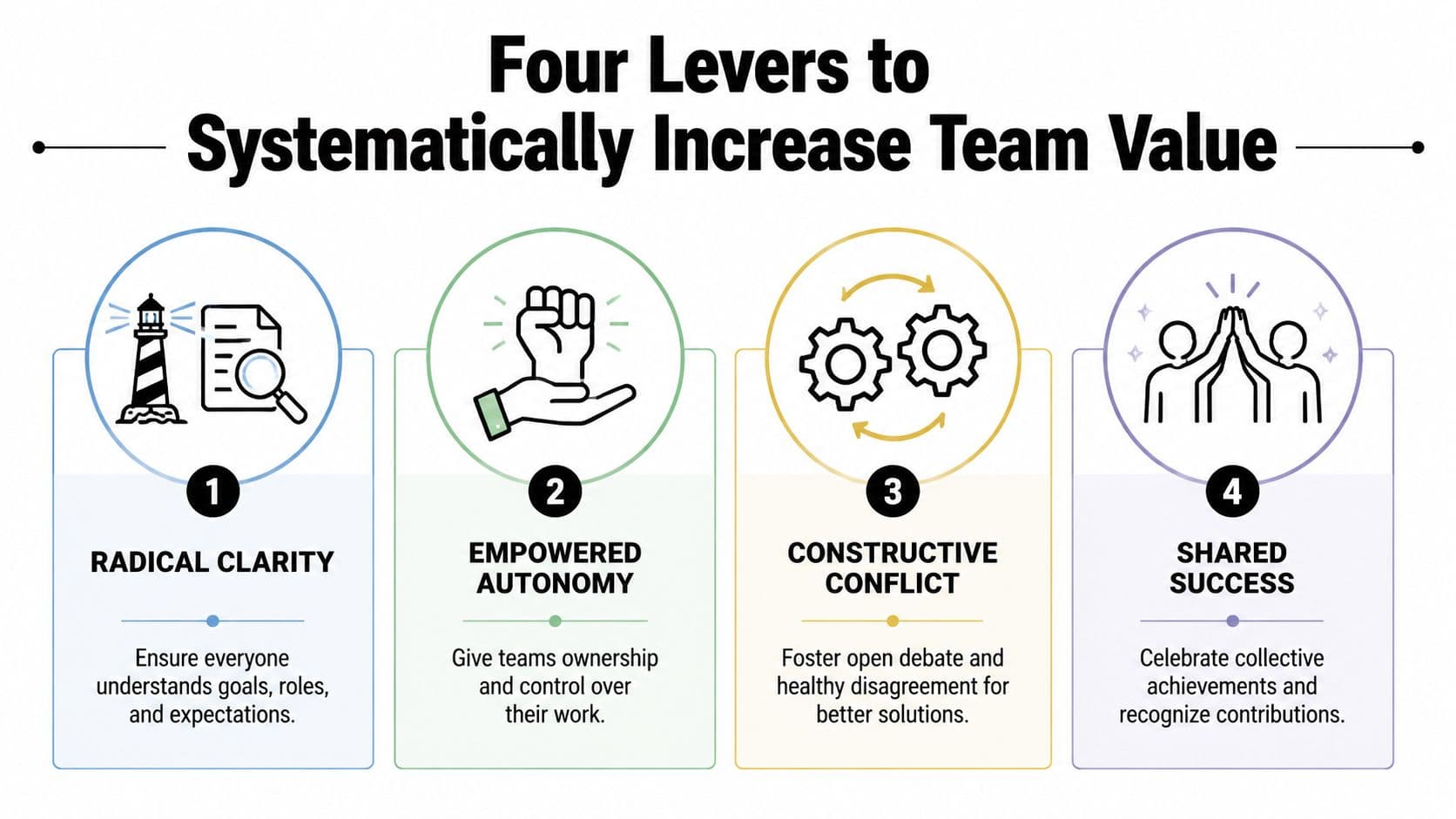
Radical clarity
Ambiguity is a hidden tax. It shows up as duplicate work, delayed decisions, quiet resentment, and deadlines that move without anyone explicitly resetting them.
Strong teams reduce that tax with a few hard rules. Every meaningful outcome needs a clear owner. Quality standards need to be defined before execution starts, not argued about during review. Approval paths should be narrow and deliberate. Default decisions should exist for routine cases so people do not reopen the same debate every week.
A simple ownership map often does more for execution than another recurring meeting. In practice, the complaint labeled as a communication problem is often an ownership problem with better branding.
Process improvement and automation
A high-value team protects attention the way a good finance leader protects margin.
Skilled people should not burn prime hours on manual routing, repetitive updates, version chasing, or rebuilding the same request brief from scattered messages. Standardize repeat work first. Then automate the parts that follow rules reliably. That is how teams create capacity without adding headcount.
Useful places to start are usually boring, which is why they pay off:
- Intake forms: Require the same inputs for every request so scope is clear before work starts.
- Task routing: Send work to the right person based on type, urgency, or function.
- Status visibility: Keep progress in one system instead of buried across chat threads and meetings.
- Templates and checklists: Use them for onboarding, launches, reports, and other recurring work.
Tools help after the workflow makes sense. For a practical example of how to improve team productivity, the pattern is usually the same. Clear task views, smart automation, and disciplined delegation in one workflow beat a stack of disconnected apps. Teams might use Asana, ClickUp, Trello, Notion, or Fluidwave. The software matters less than whether the process reduces handoff friction.
Intelligent delegation
Delegation is a capacity decision, not a courtesy exercise.
The point is not to push undesirable work downhill. The point is to match work to the lowest-cost level of competent ownership. If a manager spends two hours coordinating calendars, updating trackers, and cleaning meeting notes, the team is paying leadership rates for administrative throughput. That is a design mistake.
Strong operators treat specialization like portfolio allocation. Some roles produce value through direct output. Others produce value by removing drag across the entire system. Research support, project coordination, workflow administration, and AI-assisted task preparation can all raise the output of specialists when the role is defined well. McKinsey's research on organizational health and performance also points to the business value of role clarity, disciplined execution, and teams that spend more time on high-value work instead of coordination overhead (McKinsey on performance and organizational health).
That trade-off gets missed often. Companies reward the visible closer and underinvest in the person who makes ten other people faster.
Psychological safety with standards
Psychological safety is not about being nice. It is about getting bad news early enough to do something useful with it.
Teams stay expensive when people hide risk, nod through weak plans, or wait too long to admit a miss. Teams get stronger when people can question assumptions, flag capacity problems, and say a handoff is failing before the customer feels it.
A few management practices work well here:
- Blameless reviews: Examine process failures, decision gaps, and unclear ownership before focusing on individuals.
- Visible disagreement norms: Ask for objections before decisions close, not after rollout.
- Manager modeling: Say when a call was wrong or when new information changed the plan.
- Recognition of team wins: Reward coordination, reliability, and shared execution, not only heroics.
Morale still matters. It just works best when it supports performance rather than substituting for it. Helpside's guide for boosting team morale is useful because it focuses on concrete activities teams can run, instead of vague culture talk.
Team value increases when people can ask for clarity, raise risk early, and transfer work cleanly without adding delay.
Team Value in Action Real-World Examples
Theory gets easier to trust when you can see what it looks like under pressure.

The marketing team that stopped drowning in requests
A marketing team was taking work from everywhere. Sales sent messages directly. Leadership dropped in last-minute asks. Product wanted launch support with little warning. The team looked busy all the time because it was busy all the time.
The fix wasn't hiring first. It was creating a proper intake process, defining campaign tiers, and assigning a single owner for prioritization. Once requests came through one channel with the same required information, the team stopped wasting energy on clarification loops. People could finally distinguish urgent work from loud work.
The quality of the team improved before the quantity of output did. That's what leaders often miss. Structure creates room for better work.
The startup that protected its builders
A small startup had founders and early employees spending too much time on operational debris. Calendar coordination, inbox triage, invoice follow-up, meeting notes, task cleanup. None of it was unimportant, but it was consuming attention that should have gone into product and customer conversations.
They shifted recurring coordination and admin tasks away from the core builders through a mix of documented process, automation, and external support. The immediate gain wasn't just speed. It was focus. The product team had longer stretches for deep work, and leaders had fewer context switches.
Here's a useful perspective on how these shifts play out in technical environments:
The remote software team that fixed broken handoffs
A distributed software team had a pattern every manager recognized. Bugs weren't always hard to solve. They were hard to trace. Ownership was fuzzy, incident context was incomplete, and handoffs between teams were unreliable.
When technical teams improve data quality and process reliability to reduce failed handoffs, they can cut mean time to resolution for errors from 4 hours to 1 hour and directly lead to 15-20% workflow efficiency gains (data quality and workflow ROI). The team didn't need more urgency. It needed clearer incident records, better handoff standards, and post-mortems that produced process changes.
The biggest gains often come from making work easier to continue, not from asking people to work harder.
After a few cycles, the team became easier to run. Fewer issues got stuck between functions. Fewer meetings existed just to reconstruct what had happened. That is the value of a team in action. Less friction, more trust, and a higher quality of execution under real conditions.
Your First Steps to Unlocking Team Value Today
Team value does not improve because leadership announces a transformation. It improves when the operating system gets tighter. Clearer ownership, less low-value work, faster decisions, better use of specialist time.
A practical starting point is a 30-day reset. Keep the scope narrow enough to finish. Teams get momentum from visible gains, not from a long backlog of aspirations.
A 30-day sprint that leaders can actually run
Week 1: clarify ownership Hold one working session to map responsibilities to outcomes, decisions, and recurring tasks. Skip broad job descriptions. Focus on what the team ships, approves, maintains, and escalates. If two people own the same result, decide who has final call. If nobody owns it, assign it before the meeting ends.
Week 2: remove one repeat drain
Choose one task that burns time without requiring much judgment. Standardize it, automate part of it, or hand it to the right support layer. Do not redesign the whole workflow. One repeated drain removed well is worth more than a big process plan that never gets implemented.
Week 3: add one leading indicator
Pick one signal that shows whether team value is rising or slipping. Rework rate works. Handoff quality works. Decision turnaround works. Make it visible, review it weekly, and treat movement as an operating issue rather than a reporting exercise.
Week 4: review role fit
Strong teams do not spread every task across expensive generalist talent. They protect high-skill time. As noted earlier, some roles carry outsized value because they remove bottlenecks, handle specialist work faster, or make delegation easier to scale. Look for places where senior people are still doing work that could sit with a specialist, a documented process, or an automated step.
What works and what doesn't
What works is concrete. Clear decision rights. Fewer approval layers. Better task intake. Visible priorities. Delegation that matches the complexity of the work.
What fails is familiar. Managers ask for more collaboration, but leave ownership muddy. Teams add meetings to fix confusion created by the last set of meetings. Good people spend prime hours stitching together updates, chasing context, and doing work below their level because nobody redesigned the flow.
Use a simple stress test:
- If one key person disappeared for a week, would work continue cleanly?
- Can the team explain priorities without waiting for manager interpretation?
- Are skilled people spending their best hours on work only they can do?
A no answer points to a design problem, not a motivation problem. That matters because design problems are fixable, and they usually show returns faster than culture programs.
If you're ready to turn team value into something operational, Fluidwave gives teams a way to organize tasks across list, table, calendar, Kanban, and card views, automate routine workflows, and delegate specific tasks through human support when needed. For leaders trying to reduce friction instead of demanding more output, it's a practical place to start.
Focus on What Matters.
Experience lightning-fast task management with AI-powered workflows. Our automation helps busy professionals save 4+ hours weekly.