Stop firefighting and reclaim focus with a practical system to prioritize, automate, and delegate. This guide helps founders protect deep work and scale with intention.
December 25, 2025 (2mo ago) — last updated January 22, 2026 (1mo ago)
Time Management for Founders: A Practical Guide
Stop firefighting and reclaim focus with a practical system to prioritize, automate, and delegate time for strategic growth.
← Back to blog
Time Management for Founders: A Practical Guide
Stop firefighting and reclaim focus. This practical system helps founders prioritize, automate, and delegate so you can scale with intention.
Let’s be real for a moment. Effective time management for founders isn’t about trendy productivity hacks. It’s about a practical system that cuts through urgent noise and protects time for work that drives growth.
This guide shows a framework that guards your focus, stays true to big-picture goals, and fits the chaotic reality of wearing many hats every day. Use these steps to stop reacting and start building strategically.
Why Generic Time Management Fails Founders
Classic productivity advice often misses the mark for founders. Waking up at 5 AM, color-coding your calendar, and following a rigid to-do list can work in a predictable 9-to-5, but entrepreneurship is far less predictable.
One minute you’re the CEO; the next you’re marketing, selling, and handling customer support—often before coffee. That constant context-switching is exhausting and makes deep work nearly impossible. Standard tips weren’t designed for that kind of whiplash.
The Tyranny of the Urgent
The real struggle is the tension between working in your business and working on it. Many founders feel perpetually behind because they spend most of their time on daily operations instead of strategic growth1. Business owners also report long workweeks and frequent overtime2.
This isn’t a personal failure; it’s a systemic trap. Urgent, low-impact tasks trick you into feeling productive. You may be busy, but are you moving the needle?
Build a Resilient System
To reclaim time, drop the corporate playbook. Stop only managing tasks and start managing focus and energy.
This system follows three principles:
- Clarity over complexity: decisions should get easier, not harder.
- Flexibility over rigidity: your schedule must bend when crises or opportunities appear.
- Impact over activity: prioritize work that directly contributes to growth.
“Your calendar isn’t just a schedule; it’s a statement of your priorities.” If it’s filled with reactive tasks and other people’s agendas, you’re not in the driver’s seat.
We’ll move beyond to-do lists and build a framework that forces strategic thinking and protects your most valuable asset: focused attention.
Designing Your Entrepreneurial Productivity System
Your command center for time management needs to be agile and dynamic. This isn’t a glorified to-do list; it’s a personalized system that brings clarity, filters noise, and helps you focus on what grows your venture.
Ask this question constantly: Is this task helping me work on the business or just in it?
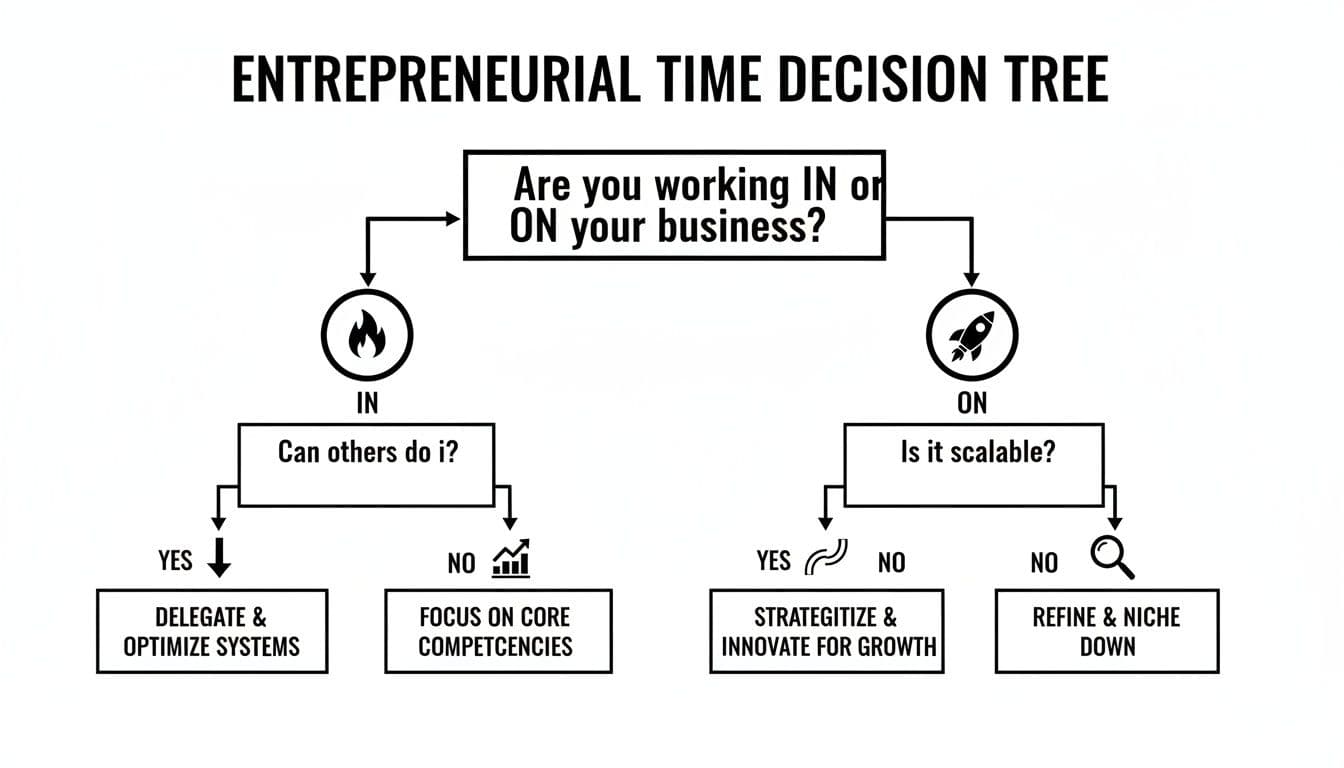
Sustainable growth happens when you intentionally carve out time for high-level strategic work. The purpose of your productivity system is to fiercely protect that “on the business” time.
Set Lean Goals for Agility
Corporate OKRs are powerful but often overkill for solo founders or small teams. Borrow the core idea and simplify it.
Each month, pick one Objective—your North Star—and three Key Results that are measurable outcomes. If you hit them, you’ve achieved the objective. This lean approach forces focus and makes it easier to say no.
Example:
- Monthly Objective: Launch a new software feature to beta users.
- Key Results:
- Get 25 beta testers signed up from our email list.
- Hit a 75% completion rate on the onboarding tutorial.
- Collect and tag at least 50 unique pieces of feedback.
This structure gives a decision filter for every day.
Stack Prioritization Frameworks for Daily Clarity
With lean goals set, translate them into daily action by stacking prioritization methods: use the Eisenhower Matrix for weekly planning and Most Important Tasks (MITs) for daily execution.
| Framework | Best For | Key Benefit | Potential Pitfall |
|---|---|---|---|
| Eisenhower Matrix | Juggling strategic and operational tasks | Forces you to separate what’s important from what’s loud | Can neglect Important/Not Urgent work if you’re always firefighting |
| MITs (Most Important Tasks) | Building momentum when overwhelmed | Creates laser daily focus and a sense of accomplishment | Without context, you may pick the wrong important tasks for long-term growth |
| Time-Blocking | Need deep, uninterrupted focus | Protects high-value time and reduces context-switching | Can feel rigid; requires discipline when interruptions arise |
| Ivy Lee Method | Clear priorities when stuck on where to start | Eliminates decision fatigue by pre-committing to six tasks | Less effective on highly unpredictable days |
No single framework is a silver bullet. Combine tools—for example, use the Eisenhower Matrix for weekly overview and MITs for daily focus.
The Eisenhower Matrix
Dwight D. Eisenhower said, “I have two kinds of problems, the urgent and the important. The urgent are not important, and the important are never urgent.” The matrix splits tasks into four quadrants:
- Urgent & Important (Do First): crises, client emergencies, hard deadlines.
- Not Urgent & Important (Schedule): strategic planning, relationship building, learning.
- Urgent & Not Important (Delegate): routine emails, some meetings, other people’s priorities.
- Not Urgent & Not Important (Eliminate): mindless scrolling, busywork.
Every Sunday night or Monday morning, sort upcoming tasks into these quadrants. Aim to live in Quadrant 2 as much as possible.
“By proactively scheduling important but not urgent work, you stop it from becoming an urgent crisis.”
The Most Important Tasks (MITs) Method
After your weekly view, use MITs to sharpen daily focus. Each morning, identify 1–3 tasks that will make the biggest positive impact on your goals. These are non-negotiable.
Example for a SaaS founder:
- MIT 1: Ship the patch for the login bug. (Quadrant 1)
- MIT 2: Outline the first draft of the marketing campaign. (Quadrant 2)
This blends weekly strategy with laser daily focus. For templates and a time-blocking schedule, see the time-blocking template or our workflow automation guide.
Mastering Your Daily and Weekly Workflow
A prioritization system matters, but momentum comes from turning that system into a consistent rhythm. Predictable rituals turn strategy into habit and remove decision fatigue.

The 30-Minute Weekly Review
Protect a 30-minute block every week. Sunday evening works for many founders. This session sets the tone for the week.
Try this breakdown:
- Reflect (10 minutes): Review the past week. What were the wins? Where did you get stuck? What drained or energized you?
- Prioritize (15 minutes): Pull up big-picture goals and upcoming deadlines. Using the Eisenhower Matrix, map key projects for the week.
- Load (5 minutes): Move priorities into your calendar or task manager. Schedule them—don’t just list them.
This ritual ensures you start Monday with clarity.
The 15-Minute Daily Startup Routine
Each morning, before email or Slack, spend 15 minutes setting the day’s agenda. Define your MITs and block time for them immediately. This time-blocking step defends deep work.
For ready-made templates, see the time-blocking template.
A Founder’s Sample Daily Schedule
Here’s a realistic structure for founders balancing creative work, client management, and admin tasks:
- 7:00–7:15 AM: Daily startup routine (define 3 MITs).
- 7:15–9:15 AM: Deep work block 1 (MIT #1—strategic or creative work).
- 9:15–10:00 AM: Communication block (process critical emails, respond to team).
- 10:00 AM–12:00 PM: Deep work block 2 (MIT #2, product or marketing work).
- 12:00–1:00 PM: Lunch and break.
- 1:00–2:30 PM: Client and meeting block (batch external meetings).
- 2:30–4:00 PM: Admin and shallow work (MIT #3, invoicing, follow-ups).
- 4:00–4:15 PM: Daily shutdown (review accomplishments, plan tomorrow’s MITs).
This structure isn’t about rigidity; it’s about intention. It carves protected time for high-value work while acknowledging reactive tasks.
Reclaim Time Through Automation and Delegation
You can’t do it all. The real secret isn’t more hours; it’s strategically buying back time you already have. Automation and delegation are essential.
If a task doesn’t require your unique expertise, you shouldn’t be the one doing it. Your energy is finite—spend it on high-impact strategic work. Everything else should be automated, delegated, or eliminated.

Put Your Business on Autopilot
Automation is your first defense against repetitive work. Automate these common time-sinks:
- Social media scheduling: Batch-create and schedule posts a week or month ahead.
- Email follow-ups: Use automated sequences for onboarding and sales inquiries.
- Invoicing and payments: Accounting tools can generate recurring invoices and reminders.
Automation keeps the business running while you focus on strategy. For more, see our workflow automation guide. Automation tools can significantly reduce repetitive work and speed up processes for small teams5.
Demystify Delegation
Letting go can feel risky, but training someone usually pays back in reclaimed hours. Start small with low-risk tasks and build trust.
Look for tasks that are:
- Repetitive: data entry, weekly reports.
- Time-consuming: inbox triage, scheduling.
- Outside your zone of genius: graphic design, bookkeeping.
Begin with a clear brief and measurable expectations. Example for delegating competitor research to a virtual assistant:
- Write a crystal-clear brief with company names, URLs, pricing, key features, and social profiles.
- Set scope and deadline, for example “Complete by Friday 5 PM and populate the spreadsheet.”
- Provide constructive feedback on the first deliveries.
Platforms offering pay-per-task virtual assistants let you test delegation without full-time hires. See our virtual assistant service. Research shows entrepreneurs spend a notable portion of their week on administrative tasks, making them prime for delegation4.
Overcoming Common Productivity Blockers
Even with the best systems, some days are a slog. Entrepreneurship isn’t a smooth climb; it’s a series of distractions, self-doubt, and exhaustion. Spot these killers and shut them down.
One of the most damaging culprits is interruptions. A quick Slack message or “urgent” email isn’t minor. Context-switching can cost more than 20 minutes to recover from each interruption3. That’s a huge productivity tax.
Taming Interruptions
Guard your focus. Batch communications: pick two or three times a day to process email and messages. Outside those windows, go dark. Turn off notifications and use browser blockers to remove social media and news distractions.
Defeating Procrastination and Perfectionism
Procrastination isn’t laziness. It’s often overwhelm. Use the “5-Minute Rule”: commit to just five minutes on a task. Starting is usually the hardest part.
Perfectionism keeps projects from seeing the light. Shipping at 80% is usually better than waiting for perfect. Treat launches as experiments: ship, learn, iterate.
Manage Energy, Not Just Time
Energy matters more than time. An empty calendar won’t help if you’re drained. Strategic breaks are non-negotiable. The Pomodoro Technique—focused 25-minute sprints with 5-minute breaks—prevents cognitive fatigue.
When focus fades, step away. Take a walk or do something unrelated. You’ll return sharper.
Answering Your Top Time Management Questions
How do I choose the right tool?
Pick the tool you’ll actually use. Identify the main pain point—forgotten tasks, double bookings, or chaotic projects—and choose accordingly. Start with something simple that offers multiple views and a free plan, and test it for a couple of weeks.
What should I delegate first?
Start with repetitive, time-consuming, or low-skill tasks: inbox triage, calendar juggling, basic social posts, data entry. Use pay-per-task virtual assistants to test delegation without heavy overhead.
How do I stay disciplined when motivation is low?
Discipline creates motivation. Shrink big tasks into tiny first steps and use the 5-Minute Rule. Reconnect with your mission and schedule breaks and rewards. Rely on your system on low-energy days.
Ready to stop managing tasks and start leading your business? Fluidwave combines smart task management with on-demand virtual assistants so you can automate, delegate, and achieve deep focus. Start organizing your work for free today at https://fluidwave.com.
Quick Q&A — Common Founder Pain Points
Q: How do I protect time for strategic work? A: Schedule it first. Block Quadrant 2 time on your calendar each week and treat it as non-negotiable.
Q: What’s an easy win for reducing my workload? A: Automate recurring processes like social scheduling and invoicing, then delegate repetitive admin tasks to a VA.
Q: How can I stop getting derailed by interruptions? A: Batch communications, turn off notifications, and use focused work blocks to limit context switches.
Concise Q&A — Fast Answers for Busy Founders
Q: What’s the single best daily habit? A: A 15-minute morning startup that defines 1–3 MITs and blocks time for them.
Q: Where should I spend my energy? A: On tasks that move the business forward—product, growth, and high-level partnerships.
Q: How do I begin delegating safely? A: Start with a clear brief, measurable outcomes, and low-risk tasks. Test with a pay-per-task VA.
1.
Agility PR, “How Founders Spend Their Time,” https://agilitypr.com/blog/founders-time/
2.
Survey on small business work hours and overtime, https://www.statista.com/
3.
Gloria Mark et al., UC Irvine study on interruptions and task resumption, https://www.ics.uci.edu/~gmark/CHI2005.pdf
4.
Time management and entrepreneur task breakdowns, https://lifehackmethod.com/blog/time-management-statistics/
5.
Zapier, “What Is Automation?” https://zapier.com/learn/automation/what-is-automation/
Focus on What Matters.
Experience lightning-fast task management with AI-powered workflows. Our automation helps busy professionals save 4+ hours weekly.