Master team management skills with practical strategies for clear communication, delegation, and resilient teams.
February 1, 2026 (4mo ago)
Team Growth: team management skills for high-performing teams
Master team management skills with practical strategies for clear communication, delegation, and resilient teams.
← Back to blog
Team Growth: Core Management Skills for High-Impact Teams
Great team management isn’t just a collection of soft skills—it’s the operating system that powers high‑performing teams. This guide breaks down four pillars and practical steps to communicate clearly, delegate effectively, and build resilient teams, whether you’re in the office or remote.
Think of these abilities not as a scattered set of traits, but as the essential toolkit that keeps a high‑performing team running smoothly.
Why Team Management Skills Define Modern Leadership

Let’s be real—we’ve all seen a project go off the rails because of poor leadership. The line between a team that innovates and one that just spins its wheels often comes down to the manager’s ability to actually lead. In today’s fast‑paced world, these skills aren’t optional—they’re the core that makes a leader successful.
Picture your team as a high‑performance engine. You can have the best components and the most talented engineers, but without a skilled operator who understands how all the parts fit, the engine won’t reach its full potential. Strong management skills are the oil, fuel, and regular maintenance that keep everything running smoothly.
The Real Impact of Strong Leadership
Effective management has a direct ripple effect on everything from daily output to long‑term employee loyalty. When leaders communicate with clarity, delegate with trust, and coach for growth, they create an environment where people feel seen and empowered. This isn’t just about a feel‑good culture; it drives real business outcomes.
A team that trusts its leader is more likely to take calculated risks, share innovative ideas, and collaborate openly. This foundation of psychological safety is what separates good teams from truly great ones. 1
On the flip side, a lack of these skills creates friction and drags everyone down. Micromanagement kills trust, poor communication causes chaos, and ignoring conflict lets resentment build. The fallout is predictable: missed deadlines, sinking morale, and high turnover—all of which hammer the bottom line.
Bridging the Skill Gap
Even though everyone knows how important these abilities are, there’s a sizable gap. In a world crying out for effective leaders, a common stat shows a sizable portion of leaders struggle with core management capabilities. A core part of modern leadership is building out a solid learning and development strategy that encourages continuous growth. Investing in these skills isn’t an expense; it’s a direct investment in the company’s future, turning managers into genuine leaders who can navigate any challenge and inspire their teams to do great work.
Mastering the Four Pillars of Effective Team Management
Great team management isn’t a secret formula; it’s a foundation built on a handful of core skills. These are the practices that separate managers who just assign tasks from leaders who inspire incredible work. When you focus on these four pillars, you start building a team environment that’s clear, empowered, and consistently high‑performing.
Let’s move past the abstract ideas and dive into practical actions you can start using today. This is about creating a reliable system for leadership success, not just hoping for the best.
1. Radical Candor and Clear Communication
Communication is more than talking—it’s about creating a shared reality. The best managers are masters of clarity. They ensure every person on their team understands not just what they’re doing, but why it matters. This starts with crystal‑clear expectations for every project, task, and role.
Think of it like giving someone a map. Simply saying “head west” means they’ll likely get lost. But providing clear coordinates, landmarks, and a final destination ensures they arrive on target. The same goes for team projects. When expectations are fuzzy, people fill the gaps with assumptions, which leads to confusion, wasted effort, and rework.
Real‑World Mistake to Avoid: A manager tells a designer to “handle the client presentation.” The designer spends days crafting a beautiful deck, only to discover the manager just needed a one‑page summary for an internal check‑in. The problem wasn’t effort; it was a lack of specific expectations. 2
Quick‑Win Strategy: Introduce a “Definition of Done” for your most important tasks. Before anyone starts, agree on what a finished task looks like. It can be a simple checklist:
- All code has been peer‑reviewed.
- The client has signed off on the final mockups.
- The report includes data from the latest quarter.
This habit wipes out ambiguity and aligns the team on the exact target.
2. The Art of Strategic Delegation
Delegation isn’t just about getting work off your plate. It’s a powerful way to develop your team’s talent and build a culture of trust. Too many managers fall into two traps: micromanaging every detail or dumping work and vanishing. Both kill momentum and growth.
Strategic delegation means matching the right task to the right person, giving them the resources and authority they need, and then stepping back. It’s a shift from being the primary doer to becoming the chief enabler of your team’s success. This frees you to focus on strategy while empowering your people to own their work.
Real‑World Mistake to Avoid: A manager who refuses to let go, approving every minor decision—from email wording to meeting agendas. The team stops taking initiative, becoming a bottleneck, and productivity grinds to a halt. 3
Quick‑Win Strategy: Use the “70% Rule.” If someone on your team can do a task at least 70% as well as you can, delegate it. That 30% gap is a fair trade for growth and frees you up. Give them the goal, context, and freedom to figure out the “how.”
3. Ruthless Prioritization
On any given week, your team faces a dozen demands. The critical skill is slicing through the noise to focus energy on work that creates the most value. Without a clear sense of priority, teams drift toward what’s easiest or loudest, not what’s most important.
Being a ruthless prioritizer means making tough calls. It means saying “no” or “not right now” to good ideas that aren’t the best fit for this moment. Your job is to connect daily tasks to bigger goals, acting as a filter to protect your team from distractions so they can do their best work.
Real‑World Mistake to Avoid: A manager treats every request as urgent. The team keeps switching gears, chasing fires, and never making real progress on core projects. This reactive churn leads to burnout. 4
Quick‑Win Strategy: Hold a weekly 15‑minute “Top 3” huddle. At the start of each week, align on the three most critical objectives. This ritual creates clarity and keeps everyone pulling in the same direction.
4. Coaching for Growth
Your role as a manager goes beyond project oversight—it’s about developing people. Coaching for growth means shifting from boss to mentor. It’s about spotting strengths and weaknesses and actively helping team members level up.
This pillar can be challenging, but it’s also the most rewarding. Consider how powerful it would be to lead a team where everyone knows exactly how to grow. Yet surveys show a skills gap: only a fraction of leaders are effective at delivering high‑quality coaching and feedback. To improve, invest in ongoing learning and practical coaching guides. See how to develop leadership skills through structured practice. 5
Real‑World Mistake to Avoid: Saving all feedback for annual performance reviews. When feedback only comes once a year, it feels like a surprise attack rather than a continuous conversation. This misses countless small opportunities for course correction. 6
Quick‑Win Strategy: Separate feedback from career conversations. Use quick, informal check‑ins for real‑time feedback on specific tasks (e.g., “That was a great way to handle that client question”). Reserve dedicated time for broader career discussions. This makes both conversations clearer and more effective.
To get started, reflect honestly on where you’re strongest and where you have room to grow across these four essentials. The table below helps you assess your core management skills and plan improvements.
Assessing and Improving Your Core Management Skills
| Core Skill | Self‑Assessment Question (Rate 1‑5) | Actionable Improvement Tip |
|---|---|---|
| Clear Communication | “Does my team consistently understand the 'what' and the 'why' behind their tasks without needing clarification?” | Pick one recurring task this week and co‑create a Definition of Done checklist with your team. |
| Strategic Delegation | “Do I delegate impactful work that stretches my team, or do I only offload tasks I don’t want to do?” | Identify one task you currently do that someone else could handle 70% as well. Delegate it this week with clear context. |
| Ruthless Prioritization | “Is my team focused on a few high‑impact goals, or are they spread thin across many 'urgent' requests?” | Start Monday’s team meeting by explicitly stating the “Top 3” priorities for the week. Write them down where everyone can see them. |
| Coaching for Growth | “In the past month, have I had meaningful conversations about career development, separate from project feedback?” | Schedule a 30‑minute career chat with one team member this month. Make it clear the only agenda item is their growth. |
Use this as your personal roadmap. Being an effective manager is a journey of continuous improvement, and knowing where to focus your energy is the first and most important step.
5. Conflict Resolution: Turning Friction into Forward Motion
The true measure of a leader isn’t how they perform when everything runs smoothly. It’s how they navigate the inevitable moments of friction, disagreement, and stress. This is where your management skills are really put to the test.
Many managers shy away from these tough conversations, either by ignoring conflict or by mishandling it so poorly that people stop speaking up. But these moments aren’t obstacles to avoid; they’re opportunities to forge a stronger, more resilient team.
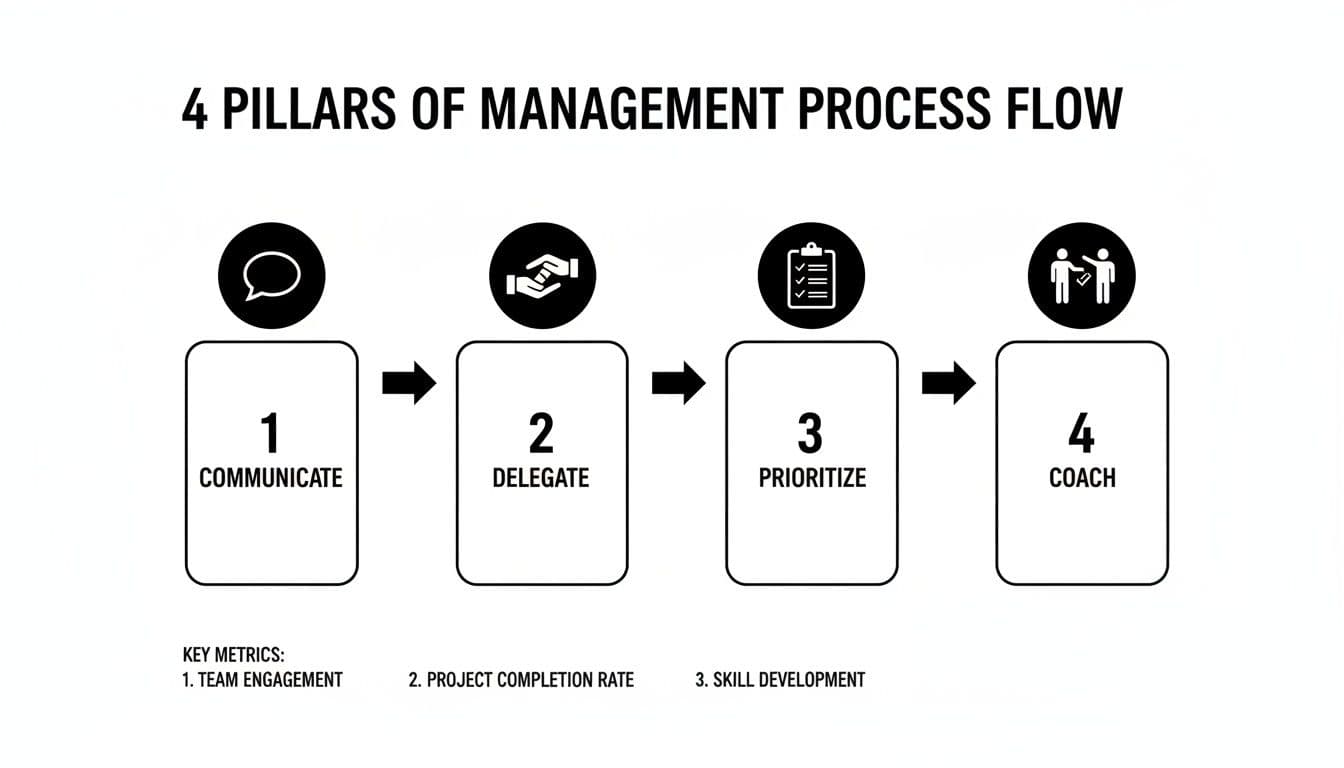
As you can see, strong communication and coaching lay the groundwork for everything else, especially when handling complex team dynamics with confidence.
Turning Conflict into a Catalyst for Growth
Let’s be clear: unaddressed conflict is toxic. It poisons team culture, kills collaboration, and slows productivity. A well‑managed approach drives constructive outcomes. A structured framework can turn a heated argument into a productive dialogue. By providing a clear framework, you can steer conversations away from personal attacks and toward a shared solution.
Here’s a practical, step‑by‑step framework for mediating disagreements:
- Acknowledge and Validate: Speak with each person individually to listen and validate their perspective without taking sides. A simple, “I can see why that would be frustrating” goes a long way.
- Define the Problem, Not the People: When you bring them together, frame the discussion around the issue itself. Shift language from “you always do this” to “we have a problem to solve together.”
- Find Common Ground: Pinpoint the shared goal. Do both parties want the project to succeed? A less stressful work environment? Anchoring the conversation to a mutual objective is your key to de‑escalation.
- Brainstorm Solutions Together: Encourage proposals from both sides. Ownership over the resolution helps transform adversaries into collaborators.
Following this process reframes conflict as a problem‑solving exercise. It not only fixes the immediate issue but also equips your team to handle future disagreements. For a deeper dive, see our guide on how to improve team communication on Fluidwave (the bedrock of healthy conflict resolution). 7
6. Psychological Safety: Building the Bedrock of High Performance
What’s the secret ingredient shared by Google’s highest‑performing teams? It’s psychological safety—the shared belief that it’s safe to take interpersonal risks on the team.
When your team feels psychologically safe, people aren’t afraid to admit mistakes, ask a “stupid” question, or pitch a wild idea. This climate is the foundation for innovation, learning, and resilience. 8
Without it, you wind up with a culture of silence. Mistakes get brushed under the rug instead of becoming lessons, and the team’s collective intelligence plummets.
Creating this environment is an ongoing practice. It’s built through daily actions that prove to your team their voices matter and vulnerability won’t be punished.
Practical Ways to Foster Psychological Safety:
- Model Fallibility: Be first to admit when you’re wrong or don’t have the answer. Saying, “I was wrong about that assumption” is a powerful signal.
- Encourage Dissent: When deciding, actively seek opposing viewpoints. Ask, “I’m leaning this way—what am I missing?”
- Respond Productively: Thank the person for transparency, focus on what was learned, and move forward—together.
At the end of the day, conflict resolution and psychological safety are two sides of the same coin. A team that navigates disagreements constructively is a team that trusts each other. That trust is the essence of psychological safety.
Leading High‑Impact Teams in a Hybrid World
Managing a team you don’t see every day requires a whole new playbook. The old “management by walking around” doesn’t work when your people are scattered across cities, time zones, and home offices. This new reality demands a more intentional and sophisticated set of team management skills.
The move to hybrid work has highlighted a leadership gap. The numbers are telling: a recent study by CentrX found that only 27% of leaders feel effective at managing virtual teams. This lines up with a broader trend showing only 12% of leaders feel effective across key skills, and that only 29% of companies offer relevant training. 9
Success in this environment comes down to one thing: building a strong, cohesive culture without being in the same room. It’s all about connection, clarity, and trust through a screen.
Fostering Culture and Fairness from a Distance
When half your team is in the office and the other half remote, an “us vs. them” vibe can creep in. The in‑office folks benefit from spontaneous chats, creating a proximity bias that can leave remote workers feeling disconnected.
As a manager, your job is to level the playing field on purpose. Create channels and rituals that bring everyone together, no matter where they’re logging in from.
Here are a few practical ways to make fairness a reality:
- Hybrid Meeting Etiquette: If one person joins remotely, everyone joins from their own device. This reduces side chatter and puts everyone on equal footing.
- Virtual “Water Cooler” Moments: Dedicate non‑work channels for casual conversations—pet photos, weekend updates, hobbies.
- Equal Access to Information: Document major decisions and updates in a central place so remote teammates aren’t left behind.
By consciously designing an inclusive experience, you can build a truly unified team where everyone feels seen, valued, and empowered to contribute their best work.
Mastering Asynchronous Communication
In a hybrid world, trying to sync up for every question is a fast track to meeting fatigue. The real game‑changer is mastering asynchronous communication—writing to be read, not immediately answered.
Asynchronous work isn’t about ignoring each other; it’s about respecting each other’s time and focus. It’s a shift from urgency to clarity. 10
This approach forces you to be clear and thorough in written communication. Vague messages can cause days of delay while waiting for clarification across time zones. To dive deeper, see our guide on managing virtual teams with confidence. 11
Shifting from Activity to Outcomes
Great hybrid leadership means letting go of old metrics like online status. Monitoring activity breeds mistrust and presenteeism—being visible without real productivity. Focus on outcomes.
Setting crystal‑clear goals and giving your team autonomy to hit them in their own way builds real ownership. This outcomes‑driven approach is the real secret to leading high‑impact teams anywhere.
Using Technology to Amplify Your Leadership Skills

Great leaders have always used the best tools available. Today’s tools are digital, and the right technology can be a powerful force multiplier for your team management skills. It’s not about piling on another platform; it’s about finding a system that works with you and augments your natural abilities.
Modern tools handle the administrative noise, freeing you to focus on coaching, mentoring, and strategic thinking. When you adopt the right tools, you’re not just managing tasks—you’re building a smarter, more efficient system for getting work done.
From Manual to Automated Delegation
Delegation is a classic leadership skill, but it can be a massive time drain. Writing briefs, checking progress, and answering clarifying questions can feel as time‑consuming as doing the task yourself. This is where intelligent delegation tools change the game.
Imagine assigning a task with a few clicks, confident that the platform will handle reminders, track progress, and house context. This isn’t futuristic fantasy; it’s modern task management.
Key benefits include:
- Less Administrative Drag: Spend less time managing the process and more time on strategy.
- Crystal‑Clear Ownership: Tasks are assigned to specific people with transparent deadlines.
- Empowered Teams: With information centralized, people work with more autonomy and confidence.
These platforms become your virtual project manager, ensuring nothing falls through the cracks and enabling you to delegate more effectively with trust.
Enhancing Clarity with Visual Workflows
Clear communication isn’t just about words. Visual workflows like Kanban boards and shared calendars provide a single source of truth that the whole team can see at a glance.
Think of a visual workflow as a shared map for your project. Everyone can see the journey from To‑Do to Done, creating instant alignment and reducing the need for status update meetings. 12
Visual boards demystify the project lifecycle. Team members understand how their tasks connect to the bigger picture, which boosts purpose and engagement. This is especially powerful for remote or hybrid teams. A well‑organized digital board can replicate the feeling of a whiteboard session, no matter where people are. For more on asynchronous collaboration tools, see our guide on asynchronous collaboration tools.
Sharpening Focus with AI‑Driven Prioritization
Ruthless prioritization is easier with data. AI tools can analyze due dates, dependencies, and project importance to suggest the most valuable order of work. This data‑driven approach removes emotion from the equation, helping you and your team concentrate on high‑value tasks.
Technology brings management principles to life. It turns abstract ideas like prioritization and delegation into tangible, trackable actions. With the right tools, you’re not just managing tasks—you’re building a smarter, more efficient operating system for your team.
Answering Your Top Team Management Questions
Even with solid theory, real‑world management throws curveballs. This section addresses common questions and pain points managers face when applying these skills in practice.
What’s the single most important skill a new manager should focus on first?
If you’re new to management, communication is your top priority. It underpins delegation, coaching, feedback, and building a safe space for your team to speak up. Without clear communication, other skills can’t land.
Nailing communication from the start saves you from misunderstandings later. It’s the trust you need for your team to buy into your leadership. 13
Think about it: you can’t delegate effectively if you can’t explain what needs to be done. You can’t coach if you can’t deliver feedback in a way that’s heard. All other management skills flow from clear, empathetic communication.
How can I improve if my company doesn’t have a big training budget?
You don’t need a big budget to sharpen leadership skills. Some of the most powerful growth happens through accessible, low‑cost approaches that require your time and intention.
A great first step is to find a mentor. Seek a senior leader you respect and ask if they’d be willing to chat now and then. You can also tap into high‑quality free resources, like leadership podcasts or articles from respected publications such as Harvard Business Review.
But the most important step is deliberate self‑reflection. After a tough meeting, take five minutes to jot down:
- What went well?
- What could have gone better?
- What’s one thing you’ll try next time?
Small, consistent improvements compound over time.
How do I hold my team accountable without becoming a micromanager?
The secret is to manage the outcome, not the process. Start with crystal‑clear expectations—define success and set a few milestones for check‑ins. Then step back and trust your team to figure out the how.
Giving people autonomy to find the best path builds ownership and confidence. Accountability becomes a shared agreement on the destination; micromanagement is a map you force others to follow. This mindset shift is what separates a true leader from a taskmaster.
Ready to see how the right tools can make all of this easier? Fluidwave gives you the power of intelligent automation and human virtual assistants, helping you delegate tasks, clarify priorities, and keep your team’s workflow running smoothly. Start managing with more impact today.
1.
Google’s Project Aristotle found that psychological safety is a key predictor of team performance. See Google Project Aristotle for details.
2.
“The Costs of Miscommunication in the Workplace.” Harvard Business Review as referenced by multiple leadership resources. See Harvard Business Review for related articles on communication and team effectiveness.
3.
Misguided micromanagement and bottlenecks harm team momentum; see McKinsey on teamwork for insights on preventing bottlenecks and enabling execution.
4.
Weekly Top 3 prioritization as a practical discipline is discussed in leadership practice guides. See LinkedIn Learning for courses on prioritization and time management.
5.
Coaching effectiveness and leadership development gaps are explored in the Global Coaching Survey and related leadership development literature. See Deloitte 2023 Global Human Capital Trends for broader training and capability data.
6.
Annual feedback versus continuous coaching effectiveness is discussed in leadership practice journals and articles. See Harvard Business Review for ideas on ongoing feedback and development.
7.
For a deeper dive into effective team communication as a foundation for conflict resolution, see Fluidwave guide on team communication.
8.
Google re:Work. “What Google Learned From Its Quest to Build the Perfect Team.” Google Project Aristotle.
9.
CentrX study on leadership effectiveness in hybrid environments. See CentrX research for more context on virtual leadership challenges.
10.
“Asynchronous work” guidance and the shift toward time‑shifted collaboration. See Fluidwave and related resources on asynchronous communication.
11.
Guide to managing virtual teams with confidence: Fluidwave – How to Manage Virtual Teams.
12.
Visual workflows and Kanban boards as a single source of truth. See industry discussions and tool guides at Atlassian Kanban Guides.
13.
Effective communication for new managers. See Harvard Business Review coverage on foundational management skills and first steps for new leaders.
7. FAQS
Q: What is the quickest way to start improving team management today?
A: Start with clear, written expectations for one key project. Create a Definition of Done with your team and use it as a daily compass to align effort and reduce rework. 14
Q: How can I build psychological safety in a distributed team?
A: Model vulnerability, invite dissent, and respond constructively to feedback and mistakes. Guard the conversation with a focus on learning and improvement, not blame. 15
Q: What tools can help me manage a hybrid team more effectively?
A: Look for a platform that supports clear task ownership, asynchronous communication, and transparent progress tracking. Integrate visual workflows (Kanban), central information hubs, and automated reminders to reduce confirmation bias and keep everyone aligned. 16
14.
General guidance for new managers; see Harvard Business Review for introductory management best practices.
15.
Google re:Work on psychological safety and team learning. See Google Project Aristotle.
16.
Recommendations on hybrid work tools and practices from leading practitioners. See McKinsey on hybrid teams and related tool guides.
OPTIMIZATION TASKS: 1. Improve the title for better SEO (keep it under 60 characters) 2. Enhance the summary/meta description (keep it under 160 characters) 3. Optimize the introduction for better engagement 4. Add 3 concise Q&A sections to bottom of article: Summarize the content as a series of questions and answers that address common user queries and pain points related to the topic 5. Add citations and statistics as linked footnotes: Integrate relevant statistics, data points, and authoritative citations to support claims and enhance credibility. All footnotes must be properly linked and formatted according to Chicago Manual of Style (e.g., superscript numbers within the text referencing sequentially numbered endnotes or footnotes at the bottom). CRITICAL: Format footnotes using the following structure: - In-text references: Use 1, 2, etc. for footnote references - Footnote content: Place footnotes at the end of the article using this exact format:
1.
- Example: "This is a claim1" followed by footnotes at the end: Footnote content here
1.
- IMPORTANT: If you add a link to a footnote, add a Markdown link to the footnote content. Example: "[http://example.com](http://example.com)"
- IMPORTANT: Use className="footnote" (not class="footnote") and place all footnotes at the very end of the article content
6. Improve content structure, readability, and SEO
7. Suggest better tags (max 5 relevant tags)
8. Fix any grammar, spelling, or formatting issues
9. Add internal linking opportunities where relevant
10. Improve headings and subheadings for better structure
11. REMOVE AI ARTIFACTS: Remove any AI-generated artifacts or meta-communication such as "If you'd like, I can:", "Tell me which you'd like next", or any other instructions/offers from the AI to the user that don't belong in the published article
Source citation here
REQUIREMENTS:
- CRITICAL: Return ONLY the improved article content with the requested changes applied. Do NOT add any extra content, commentary, explanations, or sections that weren't in the original article
- CRITICAL: Remove ALL meta-text, internal notes, AI commentary, and editorial comments from the final content. Examples to remove: "Internal link opportunity:", "SEO opportunity:", "Note:", "Comment:", "[internal note]", "(AI suggestion)", "Here's how to:", "You can also:", etc.
- Maintain the original article's core message and value
- Keep the same author and published date
- Use markdown formatting with actual HTML tags where needed
- Ensure content flows naturally
- Focus on user experience and search engine optimization
- Write naturally and authentically as a human being would, avoiding overly polished or robotic language patterns
- Use stylized quotation marks for quotes, such as “ or ” instead of " or '\n- Use stylized apostrophe character ’ NOT single quote ' when text contains apostrophes such as "don’t" or "it’s". Example: "don’t" should be "don’t" and "it's" should be "it’s".
- Use fewer em dashes (—) and write with more natural language flow
- CRITICAL: Remove any AI-generated meta-communication or artifacts at the end of articles, such as "If you'd like, I can:", "Tell me which you'd like next", "Generate meta tags", etc. These are not part of the actual article content and must be removed completely
- CRITICAL: Remove ALL internal commentary, meta-text, and AI-generated notes such as "Internal link opportunity:", "SEO opportunity:", "Note:", "Comment:", or any text in brackets like [internal note] or (AI suggestion). Only include content that should be visible to end users
- FOOTNOTE FORMATTING: When adding footnotes, use the exact format: 1 for references and 1.for footnote content. Place all footnotes at the very end of the article content. Do NOT use numbered lists (1., 2., etc.) or other formats for footnotescontent
- HTML RENDERING: Use actual HTML tags like 1 and 1.. Do NOT escape HTML or use HTML entities. The content will be rendered as HTML, not plain textcontent
Focus on What Matters.
Experience lightning-fast task management with AI-powered workflows. Our automation helps busy professionals save 4+ hours weekly.