Master the stage gate process, from concept to launch. Understand stages, gates, implementation, & avoid pitfalls for better project governance.
May 22, 2026 (4mo ago)
Stage Gate Process: Concept to Launch Mastery
Master the stage gate process, from concept to launch. Understand stages, gates, implementation, & avoid pitfalls for better project governance.
← Back to blog
A project starts with energy. The team is aligned, the slide deck looks solid, and everyone believes they're building the right thing. A few months later, the same project is absorbing time, budget, and attention, but nobody can say with confidence whether it should still move forward.
That's the moment when teams realize they never had a real decision system. They had momentum.
The stage gate process gives you a way to replace momentum with evidence. It creates structured points where leaders stop, review what the team has learned, and decide whether the project deserves more resources. Used well, it protects good ideas from chaos and weak ideas from dragging on too long. Used badly, it turns into paperwork and delay. The difference comes down to how you implement it.
Why Your Big Projects Need a Better Roadmap
Most troubled projects don't fail all at once. They drift.
A team starts with a promising concept. Engineering moves ahead because nobody wants to lose time. Marketing builds assumptions into launch plans before customer demand is clear. Finance gets updated late. Operations sees the project only when handoff problems are already baked in. By the time leadership asks hard questions, too much work has been done to feel comfortable stopping.
That pattern usually looks like a delivery problem. It's often a governance problem.
The cost of skipping decision points
When there's no formal pause between major steps, teams keep investing because work is already in motion. That's how scope expands subtly, technical debt accumulates, and commercial risk gets discovered late.
A stronger project structure usually begins before execution. If your team is still shaping priorities, this guide to building successful product roadmaps is a useful complement because it helps clarify what should make it into the plan in the first place. Once that roadmap exists, the next challenge is deciding when a project has earned the right to keep moving.
That's where the stage gate process helps. It doesn't assume every idea deserves full development. It assumes uncertainty is normal, and that leaders need planned checkpoints to test whether the case is getting stronger or weaker.
Projects rarely go off course because teams are lazy. They go off course because nobody defined when to stop, challenge assumptions, or change direction.
Why teams still rely on it
The model became influential for a reason. In 2010, an AC Nielsen study found that companies using a rigorous stage-and-gate system increased sales performance from new products by a factor of 6.5 times, a result highlighted by Wellspring's review of Stage-Gate history and impact.
That number gets attention, but the practical lesson matters more. Teams need a roadmap that doesn't just organize work. They need one that creates permission to question the work before the next round of spending begins.
If you're trying to add that structure without overcomplicating planning, a simple project planning template can help standardize what the team must define before each major review.
The Stage Gate Process Explained
The stage gate process came out of new product development practices in major aerospace and pharmaceutical companies in the 1960s, where organizations needed a structured way to reduce risk and make go or kill decisions on complex work, as described in this overview of the model's origins.
That history matters because it explains what the model is for. It was never meant to be a fancy status tracker. It was built to handle uncertainty in expensive, high-consequence projects.
Stages are where teams gather proof
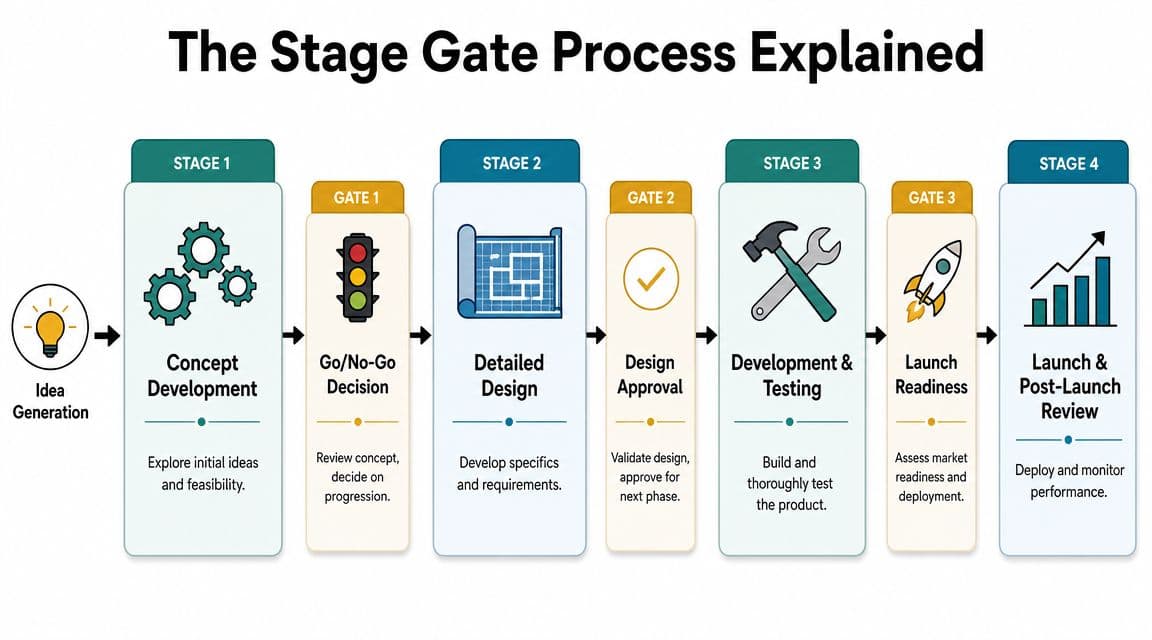
A stage is a block of work. The team explores, tests, builds, or validates something. But a stage's output isn't activity. It's evidence.
Think of building a house. Pouring the foundation is a stage. Framing is another. Electrical and plumbing are more stages. Each one produces something concrete that can be inspected before the next investment makes sense.
In product and innovation work, the same principle applies. A team might spend one stage exploring market fit, another building the business case, another developing the solution, and another testing whether customers and operations are ready.
Gates are where leaders decide
A gate is not a progress meeting. It's a decision checkpoint.
At that point, gatekeepers review what the team produced in the prior stage and ask a simple question: based on the evidence in front of us, should we continue investing?
Core principle: The stage gate process works when each stage is designed to produce exactly the information needed for the next decision.
That distinction is easy to miss. Many teams run phase reviews that amount to “show us what you did.” A real gate review asks, “Have you reduced enough uncertainty to justify the next commitment?”
If you want a broader view of how product work matures over time, this product lifecycle stages guide is useful context. Lifecycle thinking helps teams see that gates aren't interruptions. They're the moments where strategy, market reality, and execution meet.
What people get wrong
The most common misunderstanding is treating stages as a linear checklist and gates as approvals that happen automatically once tasks are complete.
That approach fails because completed work is not the same as decision-ready work.
A team can finish research and still not know whether demand is real. They can finish development and still not be commercially ready. They can finish testing and still not have the operating support needed for launch.
What works is simpler:
- Define stage outputs clearly: Every stage should end with specific evidence, not vague progress.
- Make gate criteria visible early: Teams should know from day one what gatekeepers will ask.
- Separate work ownership from decision authority: The people doing the work shouldn't be the only people deciding whether it continues.
Navigating the Stages and Decision Gates
The most useful way to understand the stage gate process is to treat it as an information-gathering system. Each stage exists to produce the evidence needed for the next gate, which helps leaders reduce uncertainty before committing more capital. That's the practical framing used in the Stage-Gate overview from Stage-Gate International.
In practice, that means early stages should answer “Is this worth pursuing at all?” Later stages should answer “Can we build it, validate it, support it, and launch it with confidence?”
The standard five-stage model
| Phase | Primary Objective | Key Gate Questions |
|---|---|---|
| Discovery | Identify the opportunity and frame the problem clearly | Is this idea strategically relevant? Is the problem important enough to investigate? |
| Scoping | Test early feasibility and market logic | Is there a plausible customer need? Does the concept look feasible enough for deeper work? |
| Business Case | Build the commercial, technical, and operational case | Does the evidence support continued investment? Are assumptions explicit and credible? |
| Development | Create the product, solution, or service | Is the team building what was approved? Are major technical and delivery risks under control? |
| Testing and Validation, then Launch | Confirm readiness for market and internal execution | Did it pass validation? Are customers, channels, support, and operations ready for launch? |
What each stage should actually produce
Discovery should narrow the field, not expand it. Teams often overload this stage by trying to answer everything too early. The better approach is to identify the customer problem, the broad opportunity, and the strategic reason the idea belongs in the portfolio.
The gate after discovery should challenge strategic fit first. If the idea doesn't matter, deeper analysis only wastes time.
Scoping is where teams test whether the concept deserves a real business case. This is usually light investigation, not a full-scale study. You're trying to understand whether the opportunity has enough substance to justify more expensive work.
At this point, decision-makers should ask whether the concept still looks viable across market, technical, and organizational dimensions.
Business Case is where weak projects often reveal themselves. This stage should force clarity around target users, value proposition, core risks, likely delivery approach, and resource needs. If a team can't explain why the project should win or what assumptions still need proof, the project isn't ready.
A useful companion here is this piece on the relationship between decisions and trade-offs. Gate reviews are rarely about perfect options. They're about making explicit trade-offs with limited time, money, and attention.
Questions gatekeepers should ask at each review
Gate reviews improve dramatically when questions change by stage. Too many organizations use the same template throughout, which leads to shallow reviews.
Use stage-specific questions instead:
- At the first gate: Does this align with current strategy? Is the problem meaningful enough to pursue?
- At the scoping gate: Is there enough early evidence of demand and feasibility to justify a business case?
- At the business case gate: Are the market, technical, and operational assumptions strong enough to fund development?
- At the development gate: Has the team built the right thing, not just built something?
- At the launch gate: Can the organization support release, adoption, and follow-through?
A good gate doesn't ask whether people worked hard. It asks whether uncertainty fell enough to justify the next spend.
What strong gate deliverables look like
Gatekeepers don't need every document the team has produced. They need a focused set of materials that answer decision questions cleanly.
Effective gate packs usually include:
- A current recommendation: Proceed, pause, rework, or stop, with rationale
- Evidence tied to the stage: Research, validation results, technical findings, readiness indicators
- Top unresolved risks: Not a long register. The few risks that could materially affect the next stage
- Resource implications: What the next stage will require from engineering, product, operations, and leadership
- Decision requests: What exactly the team wants approved now
What doesn't work is stuffing the review with slides that document activity but avoid judgment. Gatekeepers need interpretation, not a data dump.
How to Implement the Stage Gate Process
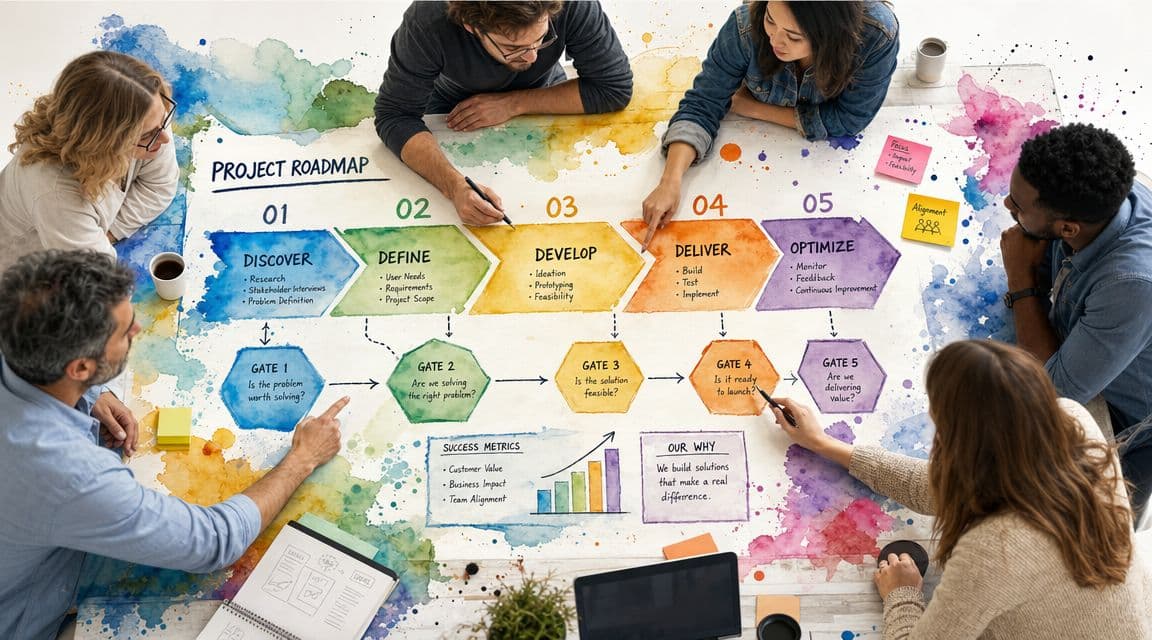
You don't implement the stage gate process by drawing a flowchart and announcing new templates. You implement it by defining who decides, what evidence counts, and how teams prepare for review.
A key feature of the model is the use of predefined gate criteria and cross-functional gatekeeper reviews. Projects move forward because evidence supports continued investment, not because work happened on schedule. That's the governance logic described in Asana's explanation of the stage-gate process.
Start with roles, not paperwork
If roles are fuzzy, the process gets political fast.
A workable setup usually includes a project leader, a core cross-functional team, and a small group of gatekeepers. The project leader prepares the evidence and recommendation. The team produces the work. Gatekeepers decide whether the project advances, pauses, or stops.
Keep those responsibilities distinct. When the same people own delivery and final approval, gate reviews drift into self-justification.
Build simple gate criteria
Teams often make the process heavier than it needs to be. You don't need an elaborate scoring model to start. You need a few criteria that are stable, understood, and relevant across projects.
Use criteria such as:
- Strategic fit: Does the project support current priorities?
- Market attractiveness: Is there a credible reason to believe customers will care?
- Technical feasibility: Can the team build and support the solution with acceptable risk?
- Competitive or product advantage: Is there a meaningful reason this should win?
- Investment logic: Does the next commitment make sense given what's now known?
Practical rule: If teams can't explain a gate decision in a few sentences, the criteria are too vague or the review pack is too bloated.
Use a scorecard that forces judgment
A gate scorecard should help teams and decision-makers focus, not create the illusion of precision.
Sample gate scorecard
Strategic fit
Market evidence
Technical feasibility
Operational readiness for the next stage
Major risks and mitigation status
Clear recommendation and requested decision
Notice what's missing: endless subcriteria. Keep the structure lean enough that people use it properly.
After teams understand the basics, this video is a helpful visual refresher on how gate-based governance works in practice.
Pilot on one project family first
Don't roll this out across every initiative at once. Start with projects that have enough complexity to justify governance, but not so much complexity that every review becomes a special case.
A sensible pilot usually shares three traits:
- Cross-functional dependency: More than one department has skin in the outcome.
- Meaningful investment: The cost of pushing forward blindly is real.
- Visible leadership support: Gatekeepers will make decisions, not just listen politely.
The first version won't be perfect. That's fine. What matters is whether teams leave each gate knowing what was decided, why it was decided, and what evidence is needed next.
Avoiding Bureaucracy with Modern Stage Gate Models
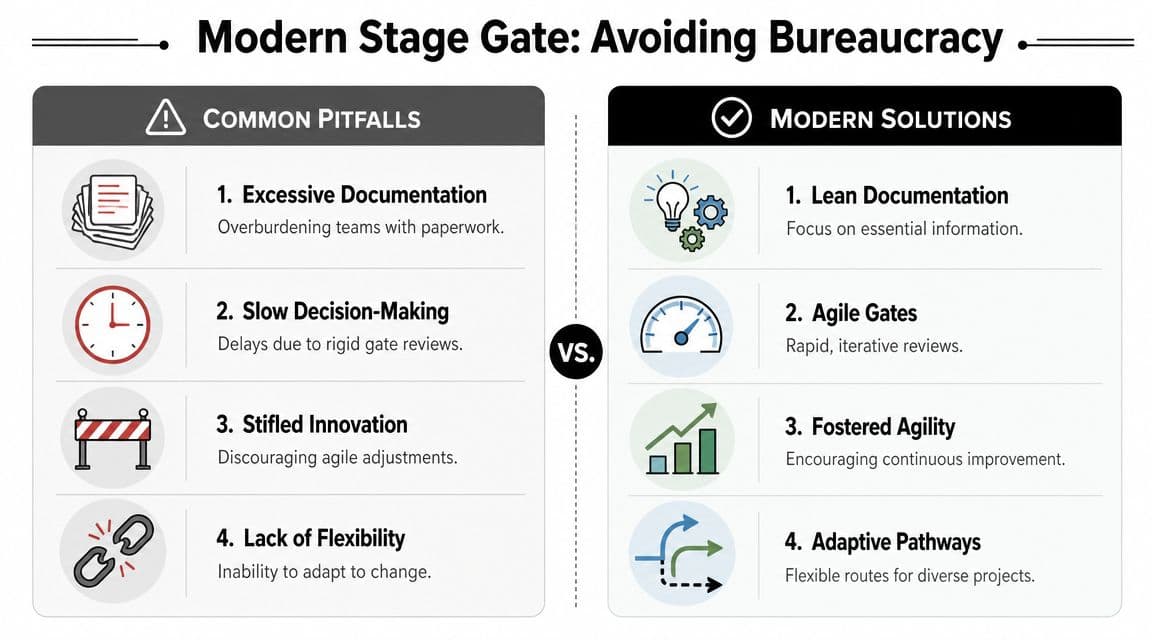
The biggest complaint about the stage gate process is also the most justified. It can become slow, rigid, and overly administrative.
That usually happens when organizations confuse discipline with drag. They add approval layers, require bulky documentation at every step, and run gate meetings where nobody wants to make a hard call. The process survives, but speed and ownership disappear.
Modern guidance on Stage-Gate points in a different direction. It emphasizes hybridizing Stage-Gate with Agile methods so teams keep the governance benefits of gates while shortening cycle times, especially in digital and AI-driven work. That shift is described in the 5th Generation Stage-Gate model.
What turns a good process into a bad one
The warning signs show up early:
- Documentation becomes the work: Teams spend more time formatting gate packs than reducing uncertainty.
- Reviews happen too slowly: Decisions lag because gatekeepers treat meetings as optional.
- Criteria are applied mechanically: A checklist replaces judgment.
- Every project follows the same path: Small initiatives get the same burden as high-risk bets.
Those choices don't strengthen governance. They make people route around it.
What a modern hybrid looks like
The better approach is to keep gates fixed and make work inside the stages more flexible.
A product team, for example, might run iterative sprints during development, test assumptions in smaller loops during scoping, and update business case inputs as learning improves. The gate still exists. Leadership still decides whether to continue. But the stage doesn't require one long, linear block of work.
That hybrid model works well when the environment changes quickly or when the team needs fast feedback from users, operations, or technical experiments.
Keep the gate strict about decisions, not rigid about how the team learns between decisions.
Practical ways to stay fast
A few adjustments make a big difference:
- Scale deliverables to risk: High-risk projects need deeper evidence. Lower-risk work needs lighter reviews.
- Use pre-gate checks: Catch missing inputs before the formal review so the meeting stays focused on decisions.
- Shorten the gate pack: If a reviewer can't find the recommendation quickly, the pack is too long.
- Allow conditional progress: Sometimes the right answer is proceed with specific gaps to close, not binary approval or shutdown.
The strongest stage gate systems don't worship the model. They use it selectively, adapt it to project type, and protect the few governance moments that matter.
Using Fluidwave to Power Your Stage Gate Process
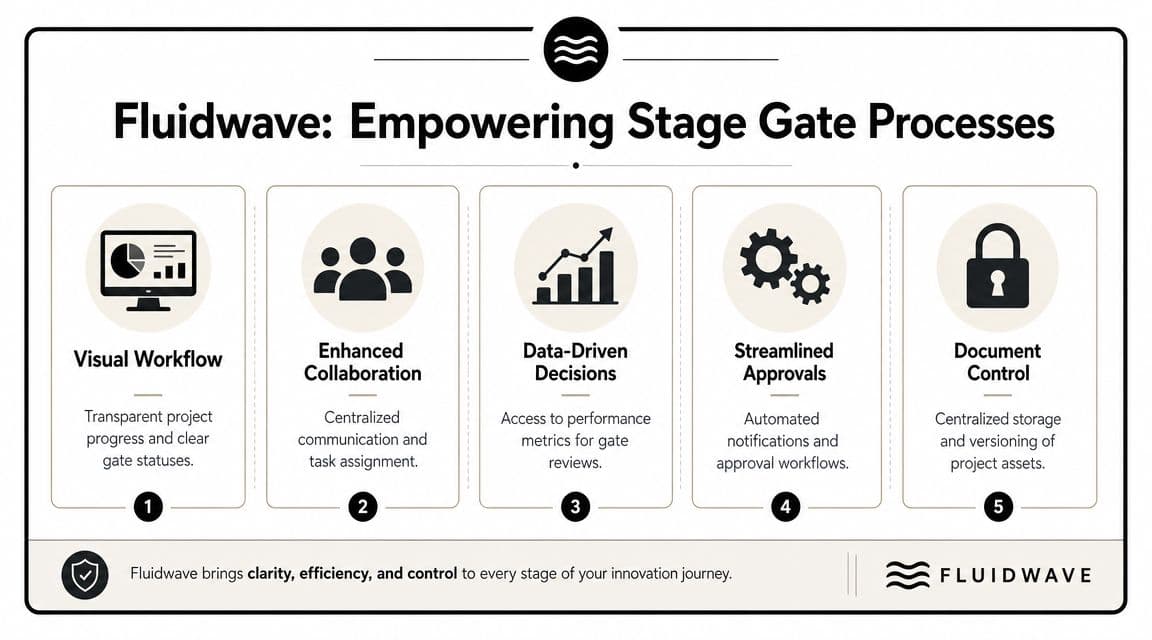
A stage gate model only works when people can see the work, the evidence, and the pending decisions in one place. If gate deliverables live in scattered documents, comments are buried in email, and status updates depend on chasing people, the process gets heavier every month.
That's where a digital workflow tool changes the experience from theory to daily practice.
Map stages visually
A Kanban board is a natural fit for stage gate work. Each column can represent a stage, with cards moving only when gate criteria are met. That gives leaders an immediate view of where projects are stuck, where reviews are coming up, and which initiatives are piling up in the same part of the process.
Checklists also matter more than people expect. A reusable checklist for each gate keeps deliverables consistent across teams. If you need a fast way to standardize those artifacts, this guide on how to make a template is a practical starting point.
Use delegation to keep gates moving
One of the quiet reasons gate reviews bog down is that project leads end up doing too much administrative assembly. They chase updates, gather files, summarize notes, and organize evidence instead of analyzing what it means.
A platform that supports delegation helps here. Research tasks, document prep, data gathering, and follow-up actions can be assigned clearly so the project lead stays focused on judgment and decision readiness.
Centralize the evidence
The best digital setup does three things well:
- Shows project status clearly: Everyone can see which stage a project is in and what's blocking movement.
- Organizes gate deliverables: Files, checklists, comments, and approvals stay tied to the work item.
- Improves review quality: Gatekeepers see the same information, in the same place, before the meeting starts.
That doesn't remove the hard calls. It removes the friction that stops people from making them.
Is the Stage Gate Process Right for You
The stage gate process is a strong fit when the cost of getting it wrong is high. That usually means major product launches, complex cross-functional initiatives, regulated work, expensive technical development, or any project where late failure would hurt the business.
It's a poor fit for small routine tasks, minor feature tweaks, or low-risk internal improvements. In those cases, formal gates can create more overhead than value.
The useful middle ground is to apply the principle, not always the full ceremony. Define a few real decision points. Require evidence before major commitments. Give someone authority to stop weak work early. Scale the formality to the stakes.
That's what experienced teams eventually learn. The stage gate process isn't valuable because it's strict. It's valuable because it makes decisions visible, deliberate, and harder to avoid.
When you use it that way, it stops being a bureaucratic framework and becomes what it should be: a practical system for disciplined execution.
If you want a cleaner way to run structured projects without burying your team in admin, Fluidwave can help. It gives you visual workflows, reusable templates, task delegation, and collaborative tracking that fit naturally with a stage gate approach, especially when you need both control and speed.
Focus on What Matters.
Experience lightning-fast task management with AI-powered workflows. Our automation helps busy professionals save 4+ hours weekly.