Build an effective professional growth plan for 2026. Get actionable advice on goal setting, skill development, and tools to accelerate your career.
April 3, 2026 (6mo ago)
Achieve Your Professional Growth Plan for 2026
Build an effective professional growth plan for 2026. Get actionable advice on goal setting, skill development, and tools to accelerate your career.
← Back to blog
A professional growth plan is more than just a document—it's the blueprint for your career. Think of it as a personal business plan that outlines exactly where you're going, the skills you need to get there, and the specific milestones you'll hit along the way. It’s about being intentional, not just reacting.
Why a Growth Plan Is Your Career GPS for 2026

Let's be real: "winging it" and hoping for a lucky break is a surefire way to get left behind in today's market. Waiting for the perfect opportunity to land in your lap is a passive, risky game. A professional growth plan flips the script, putting you in the driver's seat of your own career.
No serious business would ever launch a product without a strategy, market research, and clear objectives. Why should your career—your biggest asset—be treated any differently? A well-defined plan gives you a tangible advantage, whether you’re aiming for a promotion, trying to scale your business, or landing high-value clients.
Gaining an Edge in a Competitive Market
As we move through 2026, the need for proactive career management has never been clearer. While the job market is holding steady, the competition for top roles is fierce. You can't just coast on your current qualifications anymore.
Recent economic forecasts tell the story. The Fourth Quarter 2025 Survey of Professional Forecasters projects a 1.9% annual real GDP growth for 2025, with job gains continuing into 2026 at a pace of 55,200 per month. In a climate of steady but moderate growth, it’s the professionals with a clear strategy who will seize the best opportunities. If you're interested in the numbers, you can explore the full findings from the Philadelphia Fed.
It's no longer enough to just be qualified. The people who are really getting ahead are the ones who have a plan—they're actively networking with industry leaders, volunteering for cross-functional projects, and constantly learning new, relevant skills.
The Real Cost of Stagnation vs The Reward of Growth
So, what’s really at stake here? Here’s a quick look at what you gain by having a plan versus what you risk by standing still in the current economic climate.
| Area of Impact | With a Growth Plan (The Upside) | Without a Growth Plan (The Risk) |
|---|---|---|
| Career Momentum | You actively create opportunities for advancement and are prepared when they arise. | You risk becoming stagnant, overlooked for promotions, and feeling stuck in your current role. |
| Skill Relevance | Your skills remain current and in-demand, making you a valuable asset to any team or client. | Your skill set can quickly become outdated, reducing your marketability and job security. |
| Professional Confidence | You have clarity on your direction and can make career decisions with conviction. | You may experience uncertainty, career anxiety, and a reactive approach to your professional life. |
| Income Potential | You position yourself for higher-paying roles, salary increases, and more profitable projects. | Your earning potential may plateau as you fail to acquire the skills that command higher compensation. |
Ultimately, a professional growth plan is about generating your own momentum. It gives you the power to build the career you actually want, one intentional step at a time, instead of just waiting to see what happens next.
Starting With an Honest Self-Assessment

Before you can chart a course for where you’re going, you have to know exactly where you stand. A meaningful professional growth plan starts with a brutally honest look in the mirror, moving beyond the polished version of yourself you present in performance reviews. It’s about building a roadmap based on who you are right now, not who you think you should be.
This isn’t an exercise in self-criticism. Think of it as an intelligence-gathering mission. The goal is to collect the raw data needed to build a plan that is not only effective but also realistic for you.
Identifying Your Strengths and Gaps
Let's start by mapping out your professional landscape. This is a personal inventory of your skills, habits, and the areas where you truly shine.
-
Hard Skills: What are your tangible, teachable abilities? Get specific. List the software you’ve mastered, the certifications you’ve earned, or the coding languages you know. This could be anything from proficiency in Salesforce to advanced data analysis in Python.
-
Soft Skills: These are the interpersonal skills that define how you work with others. Are you the person who can de-escalate a tense meeting? The one who spots the tiny detail everyone else missed? Think about the last project where you felt completely in your element and identify what you were doing.
-
Skill Gaps: Now, where are the weak spots? A vague sense of being "behind" is useless. Pinpoint the exact issue. Is it a lack of hands-on experience with the new AI-powered marketing tools that emerged in 2026? Or maybe the thought of public speaking makes your palms sweat.
This process gives you a clear picture of the solid foundation you already have and shows you exactly where you need to lay new bricks.
Understanding Your Unique Work Style
The most effective growth plans are tailored to how your brain actually works. Are you someone who thrives under the pressure of a hard deadline, or do you produce your best work when you have the creative freedom to explore?
Knowing your natural tendencies is everything. If you know you struggle with focus and organization, creating a plan that involves hours of unstructured research is setting yourself up for failure. A much smarter approach is to acknowledge this and build a system with bite-sized, concrete tasks. Recognizing these traits allows you to create a framework that supports your unique cognitive wiring. If you want to dig deeper into this, our article on what executive function is is a great resource.
Your self-assessment is the most critical step. A plan built on a fuzzy or inaccurate picture of your abilities will send you in the wrong direction, wasting time and energy on goals that aren't right for you.
Finally, to get a truly well-rounded view, ask for feedback. Go to a mentor or a trusted colleague—someone who will give it to you straight. Ask them directly: "When have you seen me at my absolute best?" and "What's one area where you think I could grow to be more effective?" This external perspective is invaluable, helping you complete a 360-degree picture of your professional self.
From Ambition to Achievement: Setting Goals That Stick
We've all been there. We set a big, ambitious professional goal, only to see it fizzle out a few weeks later. The problem usually isn't a lack of desire; it's a lack of clarity. This is where we move past the common trap of vague resolutions and build a plan for goals you'll actually feel driven to achieve.
You’ve likely heard of SMART goals, and while the framework is a solid start, making a goal truly stick requires more than an acronym. It’s about forging a real connection between your long-term vision and the concrete steps you take tomorrow.
Ditch the Vague Aspirations
Let’s be honest, a goal like "get better at project management" is setting you up for failure. It's too fuzzy. There’s no finish line, no way to measure progress, and it’s so broad that it just feels overwhelming.
Instead, you need to get specific enough that you can practically taste the victory. Think about what success actually looks and feels like. For example, instead of that vague goal, what if you aimed for this?
Successfully lead our Q3 client onboarding project, delivering it on time and 10% under budget, which results in a positive client kickoff and a testimonial for our website.
Now that is a goal you can sink your teeth into. It has a clear timeline (Q3), tangible metrics (on time, under budget), and a crystal-clear definition of success (a happy client and a testimonial). It’s a target you can actually aim for and hit.
To give your goals even more power, tie them directly to your company's larger objectives. When you can show how your own development helps the team, a client, or the bottom line, you're not just asking for time to learn—you're making a business case for your own growth.
The Power Duo: Performance and Learning Goals
A truly effective growth plan doesn’t just focus on outcomes; it also builds the skills needed to produce them. That’s why you need to balance two distinct types of goals: performance and learning. Think of it as having both a destination and a map.
They work together, but they serve different purposes:
-
Performance Goals: These are all about results. They are the "what" you will deliver. For example, "Increase my client retention rate by 15% over the next six months." This is a direct measure of your impact on the business.
-
Learning Goals: These are about building capability. They are the "how" you will improve. To support the performance goal above, you might set a learning goal like, "Complete a certification in advanced customer success management to master new retention strategies."
A McKinsey study found that a lack of career development is one of the top reasons people quit their jobs. By setting both types of goals, you’re creating your own path forward, which is incredibly motivating. For a deeper dive, experts at Chronus offer great insights into employee development plans.
When you combine these two, a powerful synergy happens. Your learning goals give you the know-how to crush your performance targets. Hitting those targets then proves your new skills are working. This dual approach ensures you’re not just busy, but are actively and measurably becoming better at what you do.
Putting Your Plan Into Action with the Right Tools
A goal without a plan is just a wish. This is the part where we get our hands dirty, turning those big ambitions into a real, actionable workflow you can tackle day in and day out. A professional growth plan is only as good as the system you use to execute it, and believe me, the right tools can make all the difference.
Think of your big goal as the destination. Your action plan is the turn-by-turn navigation that gets you there. A project management tool like Fluidwave can act as your GPS, breaking down that long journey into small, manageable steps.
Let's say your goal is to "Become a certified data analyst by December." Inside Fluidwave, you'd create a new project just for that. Then, you start breaking it down into tangible tasks:
- Research and compare the top three data analyst certification programs.
- Enroll in the one you choose and get all the course dates on your calendar.
- Block out two hours every Tuesday and Thursday for uninterrupted study.
- Finish the "Introduction to SQL" module by the end of this month.
Organize Your Workflow to Keep Things Clear
Once you have all those tasks laid out, how you organize them is everything. We all think differently—some of us need a simple checklist to feel in control, while others (like me) prefer a visual Kanban board to watch tasks physically move from "To Do" to "Done."
This is all about translating that ambitious energy into concrete progress.
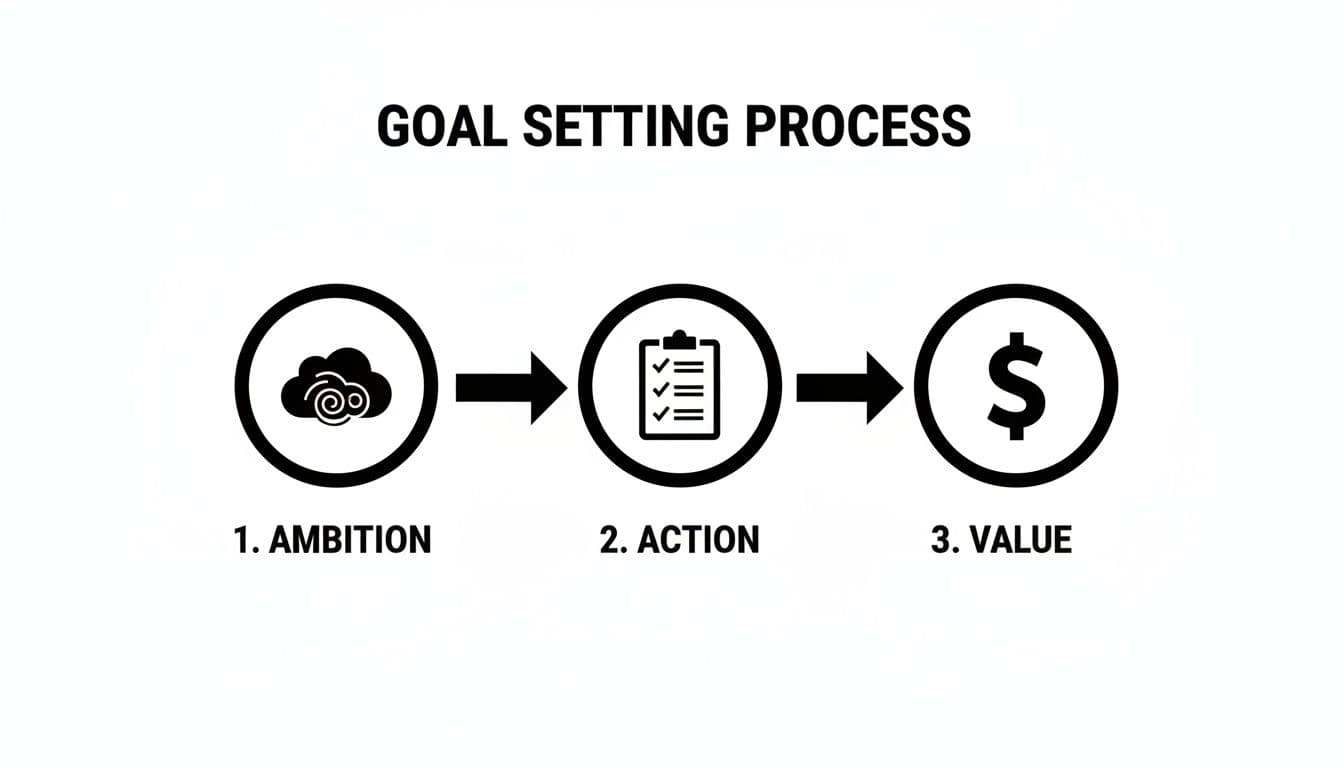
The point is, ambition on its own doesn't get you very far. It’s the consistent, tracked action that truly creates value and moves your career forward. If you want to dive deeper into this process, our guide on how to create an action plan is a great next step.
As you map things out, structured frameworks can be incredibly helpful. Using a 30-60-90 template, for instance, is a fantastic way to define your initial milestones, especially when starting a new role or tackling a major project.
Tracking Progress and Staying Accountable
So you've built a brilliant professional growth plan. The hard part's over, right? Not quite. The single biggest mistake I see people make is creating a fantastic plan and then letting it sit untouched. Momentum is your most valuable asset now, and maintaining it requires a system for tracking your progress and holding yourself accountable.
This doesn't need to be some complicated, time-sucking chore. Honestly, the simpler, the better. My go-to recommendation? A standing 15-minute appointment with yourself every Friday afternoon. Block it on your calendar. Use that time to review what you checked off the list this week and line up your priorities for the next.
Creating Your Accountability System
Let’s be real: motivation comes and goes. Accountability is what gets you across the finish line on those days when you'd rather do anything else. It's the secret ingredient that turns a document into tangible results.
One of the best ways to build this in is to find an "accountability buddy." This isn't just a friend who will nod along; find a colleague or mentor you respect, someone who isn't afraid to ask you the tough questions. Set up a quick monthly call to share your wins, troubleshoot roadblocks, and get an outside perspective.
Using a shared workspace is another great way to create that positive pressure. If your goals involve teamwork, manage them in a platform like Fluidwave. When your progress on a task is visible to others, it adds a natural layer of motivation. For a deeper dive into this, check out our guide on tracking project progress.
Adapting to Setbacks and Changes
Your plan will not be perfect. You'll miss a deadline, a task will be ten times harder than you anticipated, or your priorities will get completely upended. It's not just possible—it's guaranteed. The trick is to treat these moments as learning opportunities, not failures.
When you hit a snag, don't just push through. Pause and get curious. Was the timeline too aggressive? Did you lack a specific skill you hadn't planned for? Use that insight to make your plan smarter.
A successful professional growth plan is a living document. It should evolve with you, your career, and the market. Rigidity is its enemy; adaptability is its greatest strength.
This idea of continuous development is what separates thriving professionals from those who fall behind. In 2026, we’re seeing that companies championing structured growth are the ones attracting and keeping top talent. For example, some school districts with formal coaching programs have achieved 78% teacher retention rates—a powerful testament to the impact of structured support. The same principle holds true for any professional. A clear roadmap isn't just for getting from A to B; it's for identifying and closing skill gaps along the way. You can read the full analysis on teacher retention and professional development to see the data for yourself.
Every setback is a chance to refine your approach. Adjust the timeline, re-prioritize your actions, and get right back to it.
Answering Your Professional Growth Questions
Even the most ambitious professionals run into questions when building a growth plan. It's perfectly normal. In fact, anticipating these common sticking points is the first step to creating a plan that you'll actually stick with. Let's walk through the questions I hear most often.
How Often Should I Actually Look at My Plan?
Think of your growth plan as a dynamic guide, not a dusty document you file away. To keep it relevant, you need a consistent review rhythm. Here's a cadence that I've found works wonders for keeping momentum.
- A Quick Weekly Check-in (10–15 minutes): Look at your upcoming week. What's one small action you can take that aligns with your larger goals? This keeps your plan from feeling like a separate, daunting project and instead weaves it into your daily work.
- A Deeper Monthly Review (30–60 minutes): This is your chance to zoom out a bit. How did you track against last month's goals? What got in your way? Be honest here.
- A Full Quarterly Overhaul (1–2 hours): The market changes, your priorities shift, and new opportunities pop up. Every quarter, set aside time to seriously assess what’s working and what isn't. Your plan has to be as agile as your career.
Is a Growth Plan Just Another Name for a Performance Review?
Not at all. This is a critical distinction that trips many people up.
A performance review is almost always backward-looking. It’s your manager's formal assessment of your past contributions. Think of it as a report card on work you've already completed.
Your professional growth plan, on the other hand, is entirely forward-looking and self-owned. It's your proactive roadmap for building the skills and gaining the experience you need for the future you want. While a performance review can give you valuable data for your plan, the plan itself is your personal strategy for what's next.
How Can I Create a Growth Plan as a Freelancer?
For freelancers, a growth plan isn't a nice-to-have; it's a core part of your business strategy. Your personal development is directly tied to your business's health and ability to scale. The key is to link your learning goals directly to tangible business outcomes.
For example, if your goal is to command higher rates, a growth plan item might be: "Complete the advanced certification in programmatic advertising by Q3 to specifically target and land clients in the enterprise tech sector."
The biggest challenge for freelancers is accountability. Block out time in your calendar for learning and treat it like a client meeting you can't miss. Find a mentor, join a mastermind group, or simply partner with another freelancer to keep each other on track. For those who find themselves needing more structured guidance, working with a career coach can provide that crucial external accountability and expert direction.
How Do I Know if My Plan is Actually Working?
Measuring the return on your time and effort is essential. Otherwise, you're just busy, not productive. You need to track both quantitative and qualitative results to get the full picture.
- Hard Metrics: These are the numbers you can point to. Did you get a promotion or a salary increase? For freelancers, have you increased your hourly rate or landed 2-3 new clients in a higher-paying niche? These are clear, undeniable wins.
- Soft Metrics: These are just as important but are more about your professional well-being. Are you more confident leading meetings? Do you feel less stressed about your work? Is your work-life balance improving?
A truly successful plan delivers both a fatter wallet and a greater sense of purpose and confidence in your career.
Ready to turn your growth plan from a document into a reality? Fluidwave combines AI-powered task management with on-demand virtual assistants to help you execute. Build your roadmap, delegate the administrative work, and focus on developing the skills that will define your future. Get started for free at Fluidwave.
Focus on What Matters.
Experience lightning-fast task management with AI-powered workflows. Our automation helps busy professionals save 4+ hours weekly.