Learn a practical framework for defining & achieving your mid term goals. Get tips for professionals, neurodivergent minds.
June 1, 2026 (2mo ago)
Master Your Mid Term Goals Guide 2026
Learn a practical framework for defining & achieving your mid term goals. Get tips for professionals, neurodivergent minds.
← Back to blog
You probably have a rough picture of what you want. A better role. More control over your time. Stronger finances. A side project that's no longer stuck in notes, tabs, and half-finished docs.
What you may not have is a clean middle layer between today's tasks and that long-range vision. That's where many stall. They either stay buried in short-term admin, or they write ambitious goals that never turn into a plan anyone could realistically follow on a Wednesday afternoon.
Mid term goals fix that gap.
They're the bridge between direction and execution. They're long enough to matter, but close enough to manage. And for busy professionals, that middle layer is where real progress usually happens. Promotions are earned there. Portfolio shifts happen there. Savings habits become cash reserves there. Systems get built there.
The hard part isn't wanting more. It's choosing what deserves room in your life, then building a structure that survives stress, interruptions, and changing priorities.
Translating Vision into Concrete Mid-Term Goals
If you feel stuck, you probably don't need more ambition. You need fewer active priorities.
A lot of smart professionals carry around a crowded mental list of things they “should” do. Get the certification. Build the network. improve health. Save more. Fix the calendar. Launch the offer. Update LinkedIn. Mentor the team. Start therapy. Learn AI tools. None of these are bad ideas. The problem is trying to pursue all of them at once.

A widely used framework recommends keeping 3 to 7 medium-term goals per life area to stay focused without overload, and Gallup data highlighted in Motion's overview of medium-term goals notes that 72% of adults aged 35 to 54 are likely to set goals, which tells you this kind of planning is mainstream, not niche. If you want a broader way to separate work and life priorities, this guide to professional and personal goals is a useful companion.
Start with the ten-year picture, then shrink it
Don't begin with task lists. Begin with a rough future state.
Ask yourself:
- Career direction: What kind of work do you want to be known for?
- Lifestyle reality: What do you want your weeks to feel like?
- Money function: What does financial stability need to support?
- Personal capacity: What version of you can sustain this life?
Now compress that vision into a question with a shorter horizon: “What has to be true by next year for that future to become more likely?”
That question usually reveals better mid term goals than generic planning prompts do.
For example, if your ten-year vision is “I want more autonomy and higher-impact work,” your next mid-term target probably isn't “work harder.” It might be one of these:
- Build promotion readiness by taking ownership of cross-functional work
- Create career mobility by developing a portfolio and network in a target field
- Increase financial runway so you can make a role change without panic
- Reduce operational drag by putting repeatable systems in place at work and home
Use a simple filter before you commit
Most goals sound good in isolation. Mid term goals need to earn their place.
Run each candidate through this filter:
-
Does it change your trajectory or just your mood?
Some goals feel productive but don't alter anything important. A redesigned notes app setup may feel satisfying. It probably won't create a career shift. -
Does it solve a root constraint? Good mid term goals remove friction that blocks many other outcomes. A savings buffer, a management skill gap, or a broken calendar system are key areas.
-
Can you see evidence of progress?
If a goal can't produce milestones, it stays abstract too long.
Practical rule: If a goal can't be reviewed monthly without guesswork, it's still too vague.
Pick the few that carry weight
A strong list of mid term goals usually includes a mix of advancement, stability, and maintenance.
A useful pattern looks like this:
| Type | What it does | Example |
|---|---|---|
| Growth goal | Expands opportunity | Move into product management |
| Stability goal | Reduces risk | Build a stronger savings threshold |
| Capacity goal | Creates time or focus | Reduce recurring admin load |
| Personal foundation | Protects consistency | Rebuild sleep, routines, or health habits |
That mix matters. If every goal is ambitious and none support your capacity, you'll create a plan that looks impressive and fails under normal life conditions.
Mid term goals work when they connect a long-range identity to a near-enough commitment. Not “be successful.” More like “be ready for the next role, with proof.”
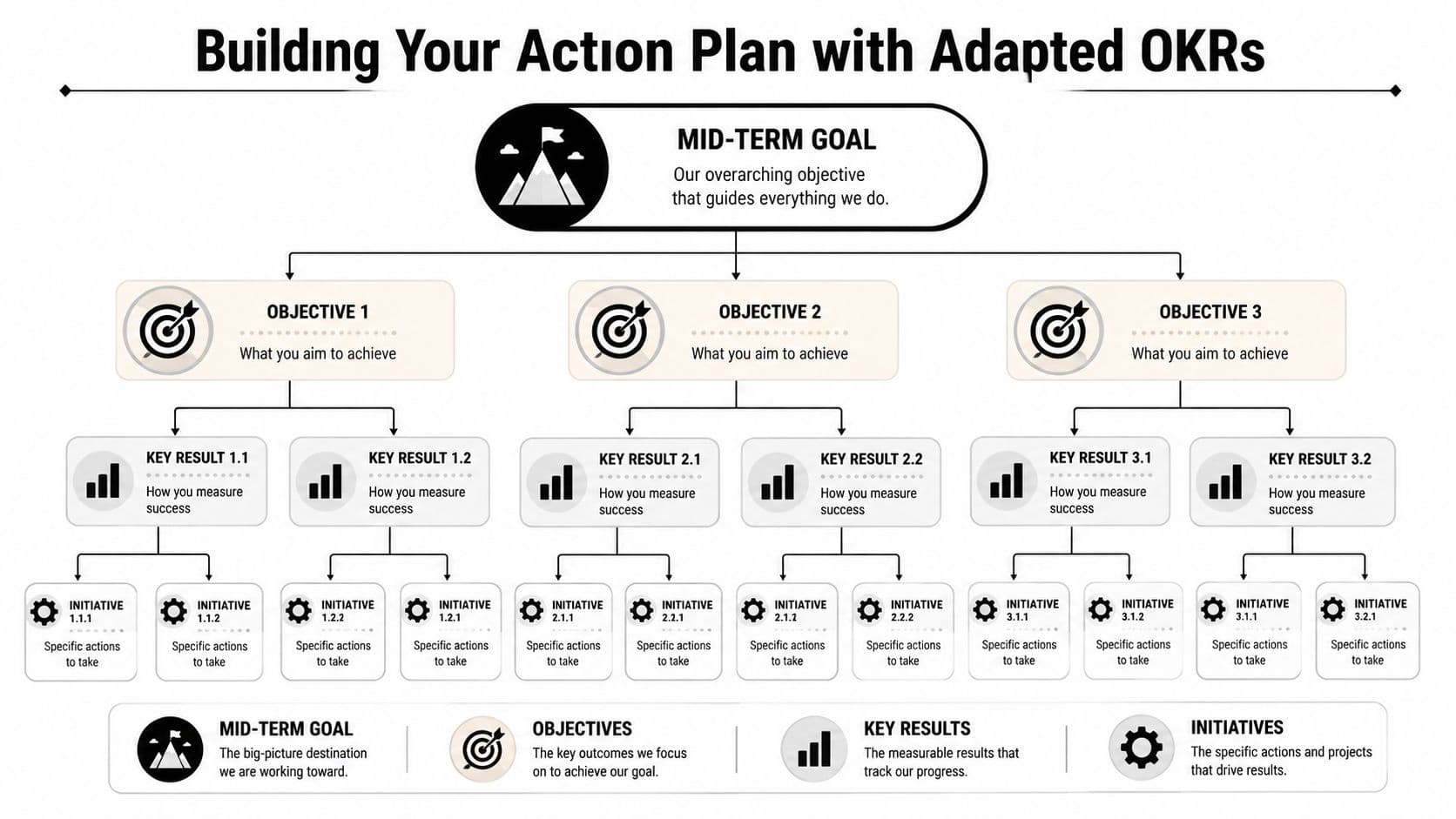
Building Your Action Plan with Adapted OKRs
Once you've chosen the right goals, don't drop them into a vague “plan” document and hope motivation carries the rest.
Use an adapted version of OKRs. Keep it simple. No corporate jargon. Just three layers:
- Objective means what you're trying to achieve
- Key Results mean how you'll know it's working
- Initiatives mean the actual projects and actions you'll run
This structure matters because it forces a distinction people often avoid. Activity is not progress. Busy calendars can hide weak results.
Write the objective in plain language
Your objective should sound meaningful without becoming poetic.
Good example: Transition into a product management role
Weak example: Become more strategic and fulfilled in my career
The first one is concrete. The second one is emotionally valid, but hard to execute.
If you need help turning broad intentions into something operational, this article on how to create an action plan gives a practical breakdown.
Choose proof, not effort
Key Results answer one question: “What would count as evidence?”
For the same career transition example, your Key Results might look like this:
- Complete a portfolio of relevant work samples
- Build relationships with people already in the target function
- Gain direct experience on product-adjacent projects
- Submit customized applications only after the first three are in place
Notice what's happening here. These aren't random tasks. They're proof points.
Research popularized from Gail Matthews' studies reports that people who write down their goals are about 42% more likely to achieve them, and that success can reach 76% for people who also add action commitments and weekly progress reviews, according to this summary of goal-setting findings from Gail Matthews' work. That's why written objectives and recurring review loops outperform “I'll keep it in my head.”
Here's a short explainer if you want a visual walk-through of goal planning in practice.
Build initiatives underneath each result
Initiatives are where your calendar starts to care.
For the Key Result “gain direct experience on product-adjacent projects,” initiatives might include:
- Volunteer for one discovery or roadmap-related project in your current role.
- Schedule informational conversations with internal product leaders.
- Rewrite one existing work deliverable in product language.
- Create a short case study from work you've already done.
This is the practical advantage of adapted OKRs. They stop you from writing lists filled with motion but no direction.
Most stalled goals don't fail because the person lacks discipline. They fail because the plan never distinguished outcomes from tasks.
Keep the structure light enough to use
If your system takes too long to maintain, you won't maintain it.
Use this test:
- One sentence for the Objective
- Three or four Key Results
- A short list of Initiatives under each
- A weekly review that asks, “What moved? What stalled? What needs to change?”
That's enough. More detail only helps if you'll revisit it.
Mid term goals need shape. OKRs give them shape without making your life feel like a quarterly board meeting.
Integrating Goals into Your Workflow with Fluidwave
A written plan is useful. A plan that lives where your work already happens is better.
Here's the difference in real life. A director I worked with had a solid multi-month goal: prepare for an internal move into a more strategic role. She had notes, a rough timeline, and good intentions. But the plan lived in three places. Some of it was in a doc, some in email flags, some in her head. Every week, she spent energy remembering what mattered.
That's the hidden tax. Not just doing the work, but reconstructing the plan over and over.
Turn each goal into a living project
What helped was moving each mid-term goal into one operational home.
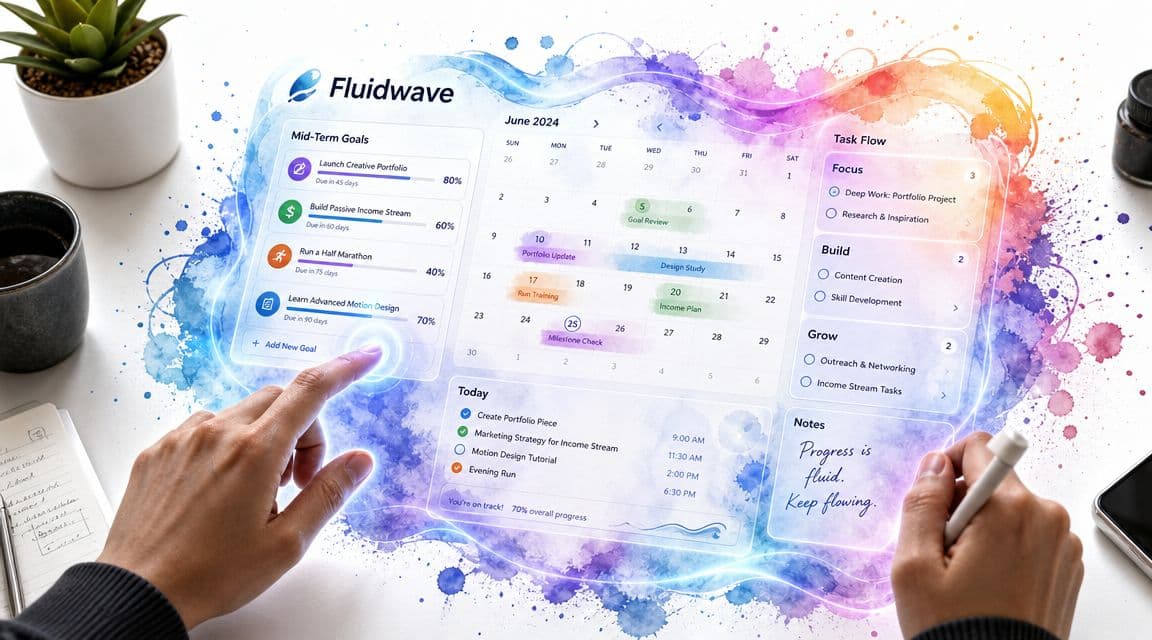
In Fluidwave, for example, you can set up a reusable project structure so the goal doesn't stay trapped in a planning document. One project holds the objective, milestones, tasks, due dates, and delegated work. The point isn't the tool itself. The point is reducing the number of places your brain has to check.
A clean setup often includes:
- One project per mid-term goal
- Sections for Key Results or milestones
- Task status columns such as To Do, Doing, Waiting, Done
- Calendar dates for decision points, not just deadlines
- Notes or links stored with the task instead of scattered elsewhere
Use different views for different decisions
Most professionals make the mistake of trying to manage every kind of thinking in one format.
That doesn't work well. A board is good for movement. A calendar is good for timing. A list is good for quick capture. A table is good for comparing ownership, status, and blockers.
Here's a simple breakdown:
| View | Best use | Common mistake |
|---|---|---|
| Kanban board | Seeing workflow stages | Treating all tasks as equally urgent |
| Calendar | Protecting milestone timing | Filling it with work that isn't time-specific |
| List | Fast task capture | Letting it become a dumping ground |
| Table | Reviewing status and owners | Overbuilding it into admin overhead |
When the system is set up well, your weekly review gets shorter. You're not asking, “What was I supposed to be doing again?” You're asking, “What is the next move that advances this goal?”
Build review into the workflow, not outside it
Here, most productivity systems break. They assume you'll remember to step back and reflect.
Busy people often won't. Not because they don't care, but because context-switching is expensive. So the review has to be part of the workflow itself.
A practical weekly check-in can be as simple as this:
- What moved forward this week
- What stayed stuck
- What should be deleted, delayed, or delegated
- What matters most next week
Weekly review question: Which task on this board would make the biggest difference if it got finished before Friday?
That question cuts through a lot of false urgency.
Lower the mental overhead
The best system isn't the most advanced one. It's the one that makes the next decision easier.
That often means fewer categories, fewer duplicate tools, and fewer “someday” lists pretending to be plans. If your mid term goals are real, they need a home inside your actual workflow. Not in a buried document you revisit only when guilt spikes.
A good setup creates something many high performers are missing: visible progress without constant mental juggling. That's what keeps goals alive during messy months.
Strategic Delegation to Accelerate Your Progress
A lot of professionals sabotage their own mid term goals by treating everything as personal responsibility.
That sounds disciplined. It isn't. It's often just control mixed with fatigue.
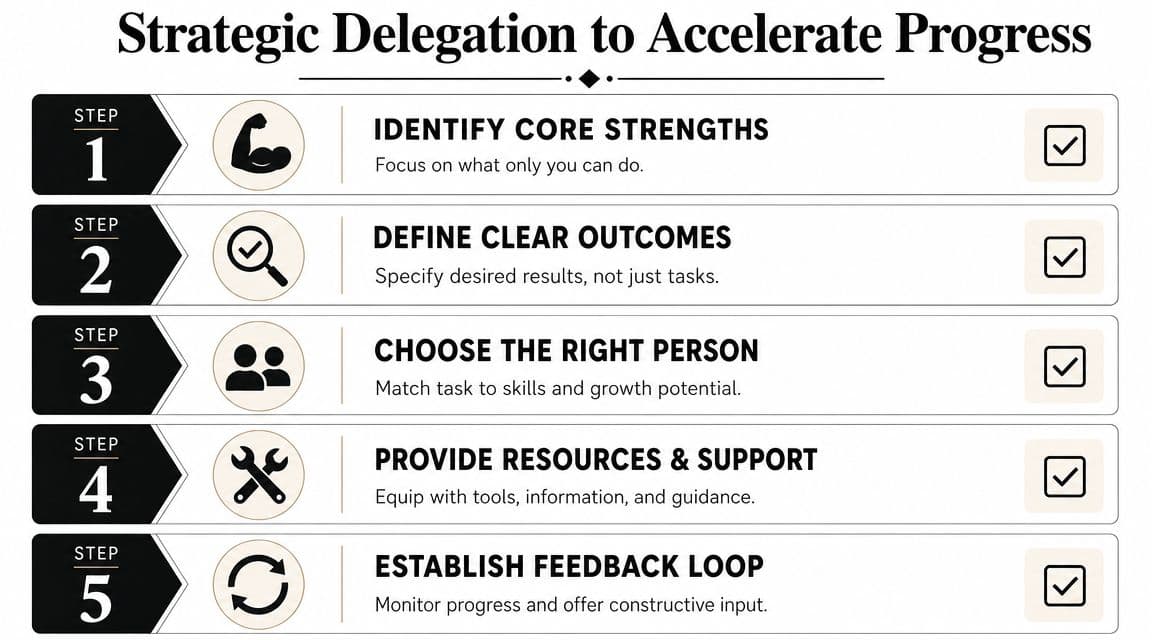
If your goals are ambitious and your days are already full, you need an effective approach. Delegation is one of the cleanest such approaches available. Not because it lets you avoid work, but because it protects your time for the work only you can do.
Audit your goal for low-judgment work
Look at any serious mid-term plan and separate tasks into two categories.
Tasks that require your judgment These include decisions, relationship building, creative direction, negotiation, and final review.
Tasks that require competence but not your unique brain These include research gathering, formatting, scheduling, document cleanup, transcript review, inbox triage, follow-up reminders, and preparing materials.
That second category is where progress often gets trapped. The work isn't hard enough to feel strategic, but it takes enough time to crowd out strategic work anyway.
Delegate outcomes, not vague chores
Bad delegation creates more work than it saves. Good delegation starts with clarity.
Use a brief like this:
- Context: Why this task matters
- Output: What “done” looks like
- Inputs: Files, links, examples, constraints
- Deadline: When you need it back
- Review standard: What you'll check before approving
For example, don't say, “Can you help with research?” Say, “Pull together a comparison of five certificate programs relevant to product roles, using tuition, format, time commitment, and application deadlines. Put it in a spreadsheet and flag anything that looks weak.”
That kind of instruction is fast to assign and easy to review.
Delegation works best when the other person can succeed without reading your mind.
Know what not to delegate
Some work looks annoying, but still belongs with you.
Don't delegate:
- Identity-defining decisions such as your career direction
- Trust-building conversations with managers, clients, or partners
- High-stakes judgment calls where nuance matters more than speed
- Final voice and positioning on thought leadership or personal branding
If the task shapes your reputation, values, or strategic direction, stay close to it.
Use delegation as a goal accelerator
A practical test is this: “If someone else handled the setup, prep, or admin, what higher-value work could I finish sooner?”
That answer tells you what to delegate first.
For a promotion-related goal, that might mean offloading meeting coordination, note cleanup, or presentation formatting so you can focus on stakeholder strategy. For a side business, it might mean delegating data entry, research, or upload tasks so you can spend your best hours on offer design, sales calls, or client delivery.
The strongest professionals I know don't win by doing everything themselves. They win by protecting attention for the few activities that compound.
Goal Setting for Neurodivergent and Busy Minds
A lot of goal-setting advice assumes a stable schedule, steady energy, and a brain that responds well to distant deadlines.
Many people don't have that setup.
If you're neurodivergent, overloaded, or both, traditional mid term goals can feel weirdly punishing. The advice is often too abstract when you need specificity, or too rigid when your real challenge is consistency under changing conditions. That's one reason generic planning guidance often misses the mark.
Indeed's career content has even described medium-term goals with conflicting ranges, from less than a year to 10 years, which shows how vague the category can become. A more useful framing from Indeed's discussion of medium-term goal examples is to tie the goal to tangible milestones such as skill acquisition or savings thresholds, instead of relying on an arbitrary calendar label.
Use milestone-based planning, not time-only planning
For a busy or easily overwhelmed mind, “achieve this in a year” often isn't enough structure.
A better frame is:
- What milestone proves this is moving
- What's the smallest visible next step
- What support keeps it from disappearing
Examples work better than theory here.
Instead of “build a stronger network,” use “schedule and complete a manageable number of relevant conversations, then capture key follow-ups.”
Instead of “get healthier,” use “establish one repeatable meal or movement routine that reduces weekday decision fatigue.”
Instead of “prepare for a career pivot,” use “create proof of readiness through a portfolio, sample work, or role-relevant experience.”
Make tasks dopamine-friendly
Some brains don't resist work because they're lazy. They resist work because the starting threshold is too high.
Break tasks into pieces that create visible closure:
- Shrink the start: “Open the document and write the header” is a real task.
- Name the friction: If a task is avoided, define whether the problem is ambiguity, effort, fear, or setup.
- Use visual completion: Boards, checklists, and progress markers help because they externalize momentum.
- Build short planning sprints: A shorter sprint often works better than forcing yourself to emotionally relate to a distant annual plan.
Here's the deeper shift. Mid term goals for neurodivergent professionals often work best as a sequence of short, reviewable campaigns. The direction stays stable. The execution stays flexible.
Create accountability without shame
Many people hear “accountability” and picture pressure, correction, or exposure. That's not the useful version.
Useful accountability is light, recurring, and specific. It might be:
- A weekly check-in with a colleague or friend
- A visible shared board with a manager or assistant
- A recurring review note you complete every Friday
- A body-double session where someone else works alongside you
Some readers may also benefit from more individualized support. If you want a practical companion resource, these specialist insights on ADHD and autism offer useful ways to think about structure, energy, and coping strategies in day-to-day life.
Your system doesn't need to look impressive. It needs to keep working when your energy, attention, or schedule changes.
Drop the all-or-nothing standard
This is the trap that ruins many otherwise good plans.
You miss a week, so the goal feels broken. You lose momentum, so the system gets abandoned. You change circumstances, so the original timeline feels like failure.
That logic is brutal and unnecessary.
For many busy and neurodivergent people, progress depends less on rigid consistency and more on reliable re-entry. Can you restart quickly after disruption? Can you reduce the shame gap between “off track” and “back in motion”? Can your goal survive real life?
That's the version worth building.
Your Path Forward Is Iterative Not Perfect
Strong mid term goals don't ask you to predict the future perfectly. They ask you to create a direction, choose a few meaningful commitments, and build a system that can adjust when life gets messy.
That's the actual pattern.
You translate vision into a short list of goals that matter. You turn those goals into evidence-based plans. You put the work inside your actual workflow. You delegate what drains time without needing your judgment. And you adapt the system to your brain instead of forcing yourself into someone else's template.
Three reminders are worth keeping close:
- Fewer goals usually create better progress
- Milestones matter more than slogans
- Review and adjustment are part of the process, not proof you planned badly
A lot can change over a mid-term horizon. Roles shift. Energy changes. Family demands expand. A good plan needs structure, but it also needs room to breathe.
If your current goals feel foggy, heavy, or disconnected from daily life, don't scrap the whole idea. Tighten the list. Clarify the milestones. Make the next step smaller. Then start again.
That isn't lowering the standard. It's how durable progress is built.
If you want one place to turn mid term goals into visible projects, track milestones, and hand off the admin work that slows you down, Fluidwave is worth a look. It combines task management with delegation, which makes it practical for professionals who need a system they'll use once the week gets busy.
Focus on What Matters.
Experience lightning-fast task management with AI-powered workflows. Our automation helps busy professionals save 4+ hours weekly.