Learn a proven framework to initiate a project: define scope, align stakeholders, and avoid common startup pitfalls.
January 16, 2026 (9mo ago)
How to Initiate a Project the Right Way: A No-Nonsense Guide
Learn a proven framework to initiate a project: define scope, align stakeholders, and avoid common startup pitfalls.
← Back to blog
So, you’ve got a killer project idea, the budget is approved, and everyone’s excited. Kicking things off should be the easy part, right? Time and again, leaders hit a wall before they even really start. The biggest, most overlooked hurdle today isn’t the plan or the funding — it’s finding the right people to actually do the work.
The Hidden Hurdle in Modern Project Management
You know the feeling. The project gets the green light, and the momentum is there. But then reality sets in. Who is going to own this? Who has the bandwidth and the specific skills to get it off the ground? Suddenly, that initial burst of energy just fizzles out.

Too many promising initiatives get handed to teams that are already stretched thin or don’t have the right expertise. This isn’t just a minor snag; it’s a fundamental flaw in how things get started. The modern business world moves way too fast for projects to be managed off the side of someone’s desk.
The Widening Talent Gap
Let’s be clear: the project management world is facing a massive supply-and-demand crisis. Globally, there are nearly 40 million skilled project professionals1, but that number isn’t keeping up. By 2035, some projections warn we could be short by as many as 29.8 million project experts2.
For an executive or a startup founder, this talent crunch is a serious threat. Trying to launch a project without dedicated, skilled leadership is a recipe for missed deadlines, blown budgets, and, ultimately, failure. It helps explain why a shocking 65% of projects fall short of their goals3.
We’re not just talking about finding someone with “project manager” in their title. It’s about securing the right kind of expertise to handle the complexities and drive the project forward from day one. Without that, even the best ideas die on the vine.
Why This Matters for Your Next Project
Acknowledging this talent gap is the first step toward a smarter approach. The old way of thinking — hire a full-time expert for every new initiative — is broken. It’s too slow and too expensive for most companies today.
A more realistic, nimble strategy is essential. This means rethinking how you build your project teams.
- Embrace flexible staffing. Bring in on-demand specialists or virtual assistants to manage specific phases or handle the organizational heavy lifting.
- Focus your internal team on what they do best. Let your experts concentrate on their core strengths while you outsource the administrative grind that bogs them down.
- Lean on the right tools. Use technology to automate repetitive tasks and create a single source of truth, taking the pressure off your people.
This isn’t just a nice-to-have; it’s a critical shift in mindset. It’s about creating a system that lets you launch projects confidently, knowing the operational details are covered so you can stay focused on the strategic vision.
Defining Your Project’s North Star
Before anyone writes a single line of code or creates the first task in a project plan, hit pause. The most critical question to answer right out of the gate is this: What are we actually trying to accomplish here?
It’s tempting to jump straight into the “doing,” but skipping this foundational step is like setting sail without a map. You’ll definitely be busy, but you’ll also be adrift. This is where you anchor your project in a clear, shared vision.
It all starts with defining the project scope. Think of this less as a document and more as a fence. It clearly marks what is in the project and, just as crucially, what is out. Without this boundary, you open the door to scope creep — those small, seemingly innocent requests that slowly but surely derail your entire initiative. Uncontrolled changes are a primary reason many projects fail4.
Let’s say your project is to build a new customer onboarding flow. The scope covers the UI design, the backend logic, and the CRM integration. When someone suggests adding a referral program midway through, that’s a classic example of scope creep. It might be a great idea, but it’s outside the fence you’ve built.
Set Goals That Actually Guide You
Once you’ve drawn the project’s boundaries, define what winning looks like. This is where SMART goals become your best friend. Vague ambitions like “improve customer satisfaction” sound nice but are practically useless for guiding a team.
A SMART goal gives everyone a concrete target to aim for.
- Specific: Instead of “improve onboarding,” try “Reduce customer support tickets related to onboarding by 25%."
- Measurable: The goal is tied directly to a hard metric—ticket volume.
- Achievable: Is a 25% reduction a realistic outcome from the new flow?
- Relevant: Does this actually support the larger business objective of increasing customer retention?
- Time-bound: Lock it in with a deadline, like “...within three months of launch.”
This kind of clarity turns a fuzzy idea into a tangible target. The entire team knows exactly what they’re working toward and can see how their work contributes to a real, measurable outcome.
Setting a clear North Star isn’t about creating rigid, unchangeable plans. It’s about establishing a powerful reference point for smart, agile decision-making. When a new idea pops up, the team can simply ask, “Does this get us closer to our goal?”
Secure Stakeholder Buy-In Early
A brilliant plan is worthless if the key people aren’t on board. One of your first moves should be to identify your stakeholders — anyone who has a vested interest in or will be affected by your project.
This group is bigger than you might think. It’s not just the executive who signs off on the budget. It includes the end users who will interact with the final product, the marketing team responsible for promoting it, and the support staff who will have to field questions about it.
Getting their buy-in isn’t a one-time presentation. It’s an ongoing conversation. You need to understand their needs, manage their expectations, and make sure the project’s goals align with what they need to succeed. This proactive alignment prevents a world of pain and friction later on, turning potential critics into your biggest champions.
For anyone specifically looking to get a software product off the ground, a founder's guide to launching a SaaS product provides a great deep dive into validation and building an MVP. At the end of the day, this foundational work — defining scope, setting clear goals, and aligning stakeholders — is what gives your project a fighting chance from day one.
Building Your Actionable Blueprint
Once you’ve set your project’s North Star, draw the map that gets you there. A great vision is the spark, but an actionable blueprint turns that vision into reality. This is where we get practical, breaking down those big, ambitious goals into a concrete plan your team can actually execute.
The first step is building a Work Breakdown Structure (WBS). It sounds more complicated than it is. Really, it’s just the process of taking a massive project and chopping it into smaller, more manageable pieces. Think of it like this: “Launch New Marketing Campaign” becomes content creation, ad design, platform setup, and performance tracking. Then, each of those gets broken down even further into specific, bite-sized tasks.
This hierarchy is the key to truly understanding the full scope of work. It helps you see how everything fits together, from the highest-level vision down to the most granular task.
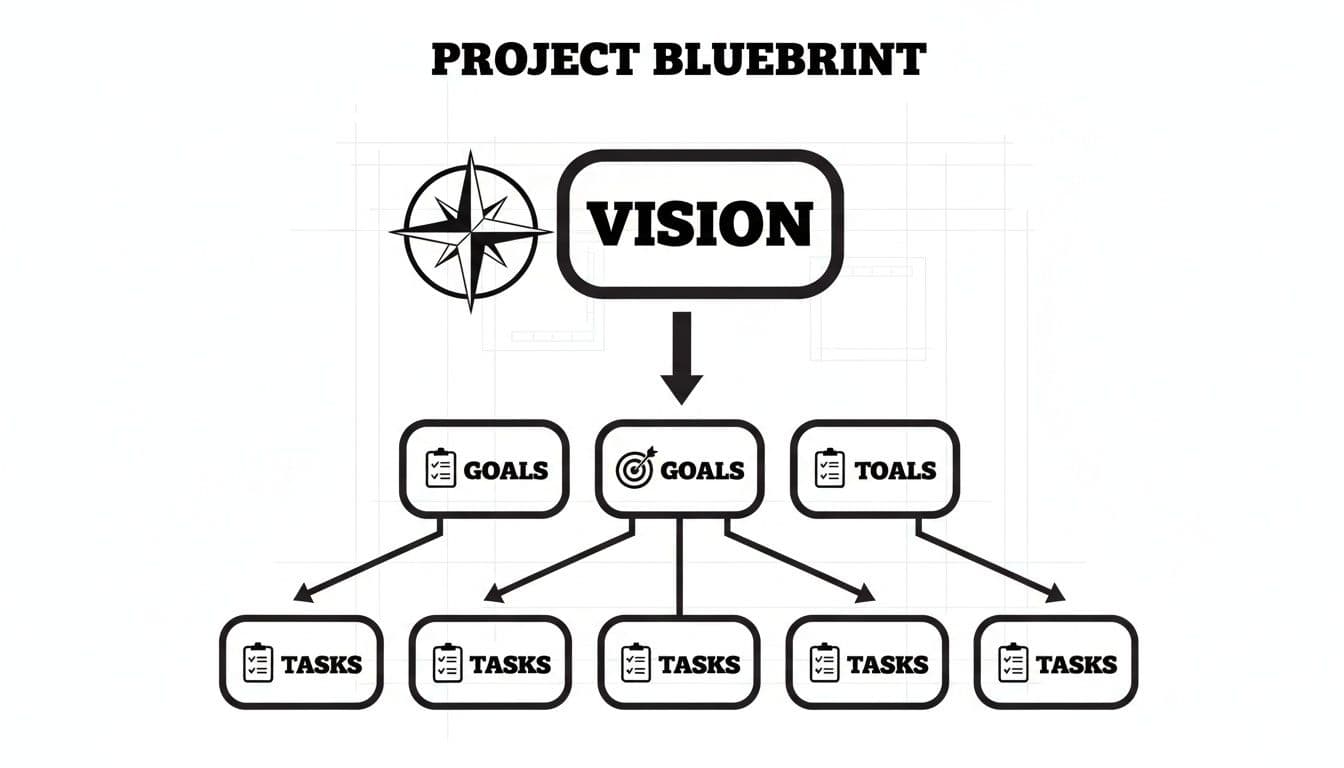
Following this top-down flow ensures that every single action directly supports a larger goal, which in turn serves the project’s ultimate purpose. It’s the best way to keep everyone pulling in the same direction.
From Tasks to Timelines
With a clear list of tasks, start putting dates on the calendar and setting milestones. This isn’t about plucking a deadline out of thin air. It requires a realistic look at the effort each task demands, especially factoring in dependencies — those tricky spots where one task can’t even start until another is finished.
Key milestones are your project’s signposts. They mark significant accomplishments, give the team something to celebrate, and keep motivation high.
- Milestone 1: Finalize all ad copy and creative assets.
- Milestone 2: Complete the technical setup of all advertising platforms.
- Milestone 3: Launch the campaign across all channels.
These milestones give everyone clear targets to aim for, making it easier to see if you’re on track or starting to drift. To see how all these pieces come together, check out our detailed guide on building a project outline example.
Essential Project Initiation Checklist
| Component | Key Question to Answer | Example |
|---|---|---|
| High-Level Goal | What is the single most important outcome we want to achieve? | “Increase qualified marketing leads by 20% in Q3.” |
| Key Milestones | What are the major checkpoints that signify progress? | “Complete landing page design; Finalize ad creative; Launch campaign.” |
| Task Breakdown | What are the specific actions needed for each milestone? | “Write copy for 3 ads; Design 5 banner variations; Set up Google Ads account.” |
| Timeline Estimate | How long will each major phase or milestone realistically take? | “Design phase: 2 weeks; Development phase: 3 weeks; Launch & test: 1 week.” |
| Dependencies | Which tasks cannot start until others are finished? | “Ad creative design cannot start until the copy is approved.” |
| Resource Plan | Who is responsible for what, and what tools do they need? | “Anna: Copy; Mike: Design; Fluidwave VA: Ad setup in Google/Facebook.” |
Nailing these down from the start prevents a world of headaches later on. It’s your safety net.
Visualizing Your Workflow
A list of tasks and dates is a decent start, but your plan truly comes to life when you can see it. Choosing the right visual tool can make a massive difference in team alignment and clarity.
When your team can see the plan, they understand it. Visual tools transform a static document into a dynamic, living guide that everyone can interact with and follow.
Kanban boards are fantastic for managing the day-to-day flow of work. They use simple columns like “To Do,” “In Progress,” and “Done” to give you an at-a-glance view of where everything stands. They’re incredibly flexible, which is perfect for teams that need to adapt to shifting priorities.
Gantt charts, on the other hand, are the go-to for mapping out complex schedules and dependencies. They lay everything out on a timeline, showing how tasks connect, overlap, and feed into one another. This is critical when you initiate a project with a tight, complex sequence of events. Building out this plan is a foundational business skill, and this guide on how to write a business plan offers a structured approach that applies here, too.
Assembling Your Team and Delegating with Confidence
A perfect blueprint is just a piece of paper until people bring it to life. A project’s real momentum comes from the team executing the plan and the clarity they have while doing it. Putting together the right group and assigning work effectively isn’t a science — it’s an art.

The first thing to do is map your project’s tasks to the specific skills needed to get them done. Forget job titles for a moment and think purely about capabilities. Do you need a graphic design wizard, a developer who knows a specific API, or an expert in running paid ad campaigns?
This skill-first mindset helps you see the gaps in your existing team. It forces you to be honest about your strengths and where you might need outside help.
Modern Delegation for Lean Teams
Not too long ago, a skill gap meant jumping into a long, expensive hiring process. That’s not the case anymore, especially when you initiate a project with a lean budget. The game has changed. Today, delegation is about being agile and bringing in expert help exactly when you need it.
This is where specialists and virtual assistants become your secret weapon. For instance, instead of hiring a full-time social media manager for a three-month campaign, delegate the setup and monitoring to an expert who does this kind of work day in and day out.
Delegation isn’t about offloading work you don’t want to do. It’s a strategic decision to place tasks in the most capable hands, freeing up your core team to focus on high-impact activities only they can perform.
This approach gives you access to top-tier talent without the overhead or long-term commitment of another full-time employee. It’s a model built for startups and lean teams that need to stay nimble.
The Art of the Clear Hand-Off
Great delegation comes down to one thing: absolute clarity. A vague request like “handle the social media ads” is a recipe for disaster. A successful hand-off means being incredibly specific and giving the person all the context they need to succeed.
A solid delegation brief must include:
- The Desired Outcome: What does “done” actually look like? Be crystal clear about the final deliverable.
- Key Constraints: What’s the budget? What’s the hard deadline?
- Essential Resources: Provide access to all necessary documents, brand guidelines, and logins right away.
- Communication Cadence: How and when will you check in? Set clear expectations for updates from the start.
Taking an extra ten minutes to write a detailed brief might feel like a chore, but it prevents hours of confusion and rework later. It empowers the person you’re delegating to and sets them up for a win, which ultimately keeps your project moving forward smoothly.
Choosing the Right Tech to Start Strong
In all my years of launching projects, I’ve seen one thing kill momentum faster than anything else: the wrong tools. The technology you pick at the start can either act as a launchpad or an anchor.
It’s tempting to default to what’s familiar, like a spreadsheet. But that’s a recipe for disaster once you’re juggling real-time collaboration and a web of dependent tasks. Moving past spreadsheets isn’t just an upgrade; it’s a necessary leap toward clarity, accountability, and speed.
Clunky, disconnected systems create friction. They force your team to spend more time managing the work about the work than actually getting things done. This is why a dedicated project management system isn’t a luxury; it’s a must-have from day one.
It’s Time to Move Beyond Spreadsheets
The market for project management software is projected to reach $12.02 billion by 20305. Yet, a staggering 77% of organizations are still trying to manage complex projects with spreadsheets and gut feelings, leaving only about 23% of teams using specialized tools built for the job6.
When companies finally shop for a platform, their priorities are clear: reliability, easy integrations, and a user-friendly design. The real challenge is finding one that truly delivers on all three.
This gap is where you can gain a serious edge. By adopting the right platform from the very beginning, you’re not just organizing tasks — you’re embedding efficiency into your team’s DNA.
What to Look for in a Modern PM Tool
The best platforms today are far more than digital checklists. They’re central hubs where your team can find its rhythm and stay in sync. And now, AI-powered features are taking this even further by intelligently sorting and prioritizing tasks, so everyone knows exactly what to work on next.
So, what should be on your must-have list?
- An Intuitive Interface: The tool has to feel natural. If it requires a week of training just to get started, your team will never fully embrace it.
- Seamless Collaboration: You need real-time updates, shared workspaces, and built-in communication to keep everyone on the same page, eliminating endless email chains.
- Powerful Integrations: Your PM tool can’t live on an island. It needs to connect with the other software your team relies on every day, from calendars to messaging apps.
- Flexible Views: Everyone works differently. A great tool lets you visualize progress in multiple ways — Kanban boards, lists, and calendars.
Choosing the right system will save you hundreds of hours and prevent the kind of miscommunication that can doom a project before it even gets off the ground. For a more detailed breakdown, see our task management software comparison.
Common Project Initiation Pitfalls to Avoid
I’ve seen enough projects go off the rails to know that most failures start right at the beginning. Getting the initiation phase right isn’t just about what you do; it’s about what you don’t do. Here are the common traps that even seasoned managers fall into.
One of the biggest project killers is unrealistic expectations. It’s easy to get swept up in the excitement of a new idea. Leadership might want to launch a sophisticated software feature in a single quarter, ignoring the engineering and testing lift required.
When optimism steamrolls reality, you’re setting your team up for burnout and missed deadlines. The only way to counter this is to anchor your plan in the real-world tasks you’ve mapped out in your Work Breakdown Structure, not just a date circled on a calendar.
Poor Communication and Vague Objectives
This one is subtle but deadly. It happens when everyone thinks they’re on the same page, but they’re all reading a different book. If your project’s goals are fuzzy, your team will inevitably work in different directions.
I once saw a marketing team burn their entire quarterly budget on a brilliant brand awareness campaign. The problem? The sales team was expecting a flood of immediate, high-quality leads. Both teams worked incredibly hard, but their efforts were completely misaligned because no one had defined what “success” actually meant for the project as a whole.
The most dangerous assumption in any project is that clarity is a given. It’s not. You have to fight for it. Clear, constant communication isn’t just a nice-to-have; it’s the foundation of the entire project.
Make your project charter the single source of truth and refer back to it constantly. Get all your stakeholders in a room (or on a call) during the initiation phase and don’t leave until everyone can articulate the project’s goals the same way. These early conversations are non-negotiable.
Spotting these issues early is crucial. There are many reasons why projects fail, and understanding them helps you build a more resilient plan from day one. For further reading, see Why Projects Fail.
Common Questions We Get About Kicking Off a Project
Even with the best playbook in hand, starting a new project always brings up questions. Here are clear answers to the questions we hear most often.
How Detailed Does the Initial Plan Really Need to Be?
Think of your initial plan as a roadmap, not a GPS with turn-by-turn directions. You need enough detail to get everyone on board and pointed in the same direction, but you also need room to navigate unexpected detours.
Focus on the big pieces: a clearly defined scope, solid SMART goals, the major milestones you need to hit, and who’s responsible for what at the outset.
What’s the One Mistake That Sinks Projects Early On?
Failing to secure genuine stakeholder alignment. Before work starts, make sure every influential person can answer: What problem are we solving? What does success look like? Who are we doing this for?
When Is the Right Time to Start Delegating?
Start delegating as soon as you have clearly defined tasks. Use your WBS to carve out self-contained work that’s perfect for handing off. Effective delegation depends on clarity.
Ready to kick off your next project with absolute clarity? Fluidwave gives you the tools and the talent to make it happen. Our platform combines smart task management with on-demand virtual assistants, so your projects start strong and finish even stronger. Delegate the details, automate your processes, and focus on hitting your goals.
Get started with Fluidwave for free.
Quick Q&A — Common User Questions
Q: What should I prioritize during project initiation?
A: Define the scope, set a clear North Star with SMART goals, secure stakeholder alignment, and build a Work Breakdown Structure.
Q: How do I prevent scope creep?
A: Treat scope like a fence: document what’s in and out, use your North Star to evaluate new requests, and require formal change approvals for additions.
Q: When should I use external specialists?
A: Bring them in when a task requires skills your team lacks or when you need temporary capacity without hiring full time.
1.
PM Wares, “Global Project Management Workforce Estimates,” https://pmwares.com.
2.
PM Wares, “Projected Project Management Talent Shortage to 2035,” https://pmwares.com.
3.
Standish Group, CHAOS Report (project performance and outcomes), https://www.standishgroup.com.
4.
Project Management Institute and industry analyses on scope creep as a common failure factor, https://www.pmi.org.
5.
Grand View Research, “Project Management Software Market Size, Share & Trends Analysis,” https://www.grandviewresearch.com/industry-analysis/project-management-software-market.
6.
Industry adoption studies on tool usage versus spreadsheets, including vendor and analyst reports, https://www.capterra.com.
Focus on What Matters.
Experience lightning-fast task management with AI-powered workflows. Our automation helps busy professionals save 4+ hours weekly.