Learning to prioritize isn’t just about managing a to‑do list; it’s about deciding what truly moves the needle. With simple frameworks and daily habits, you can stop reacting to every demand and make steady progress on the work that matters.
September 11, 2025 (1y ago) — last updated March 15, 2026 (7mo ago)
Prioritize Tasks: Master Your Workflow
Master task prioritization with simple frameworks (Eisenhower, ABCDE, MoSCoW), daily habits, and tools to reduce stress and boost productivity.
← Back to blog
How to Prioritize Tasks and Master Your Workflow
Summary: Learn how to prioritize your work with proven methods like the Eisenhower Matrix. Get actionable tips to manage tasks, reduce stress, and boost productivity.
Introduction
Learning to prioritize isn’t just about managing a to‑do list; it’s about deciding what truly moves the needle. With a few simple frameworks and daily habits, you can stop reacting to every demand, protect your focus, and make steady progress on the work that matters.
Why Effective Prioritization Is Your Secret Weapon

Does your day feel like a constant game of whack‑a‑mole? Every new email, meeting invite, and surprise task pops up, demanding immediate action. This reactive cycle keeps you from making meaningful progress on your most important goals. Many professionals report feeling overwhelmed when prioritization breaks down1.
The True Cost of a Disorganized Workflow
The fallout from poor prioritization goes beyond missed deadlines. A chaotic workflow erodes focus, damages work quality, and slows career growth. When everything feels like a priority, nothing truly is.
Common consequences include:
- Increased stress and burnout: Jumping between tasks without a plan is mentally exhausting.
- Reduced productivity: Spending prime hours on low‑impact work leaves important projects with only scraps of time.
- Poor decision‑making: It’s hard to think strategically when you’re constantly reacting.
The real problem isn’t a lack of time—it’s a lack of clarity. Structured frameworks create that clarity, turning chaos into a clear, actionable plan. A growing global conversation about evolving workplace skills and tools shows why prioritization matters now more than ever2.
Choosing Your Prioritization Framework
There’s no single perfect system. The best framework fits your work, your team, and your brain. Learn the principles behind a few proven models so you can pick the one that clicks—whether you need quick daily decisions or a plan for a large project.
The Eisenhower Matrix For Quick Decisions
For daily planning, the Eisenhower Matrix is a powerhouse. It filters tasks through two lenses: urgency and importance, helping you separate noise from real work.
- Urgent & Important (Do): Fires to put out now, like a client deliverable due today.
- Important & Not Urgent (Schedule): High‑value work that drives long‑term results—block time for these.
- Urgent & Not Important (Delegate): Noisy tasks others can handle—delegate when possible.
- Not Urgent & Not Important (Delete): Time sinks to remove from your workflow.
This matrix helps leaders and busy professionals decide where to invest energy at any moment. For more scheduling tactics, see our guide on powerful time-management techniques for work.
The ABCDE Method For Personal Task Lists
The ABCDE method brings order to a messy to‑do list by assigning hierarchy:
- A: Must‑dos—critical tasks.
- B: Should‑dos—important but less urgent.
- C: Nice‑to‑dos—no real consequence if skipped.
- D: Delegate—tasks others can do.
- E: Eliminate—cut these entirely.
Never start a 'B' when an 'A' is unfinished. This keeps your focus on high‑value work and is ideal for personal weekly planning.
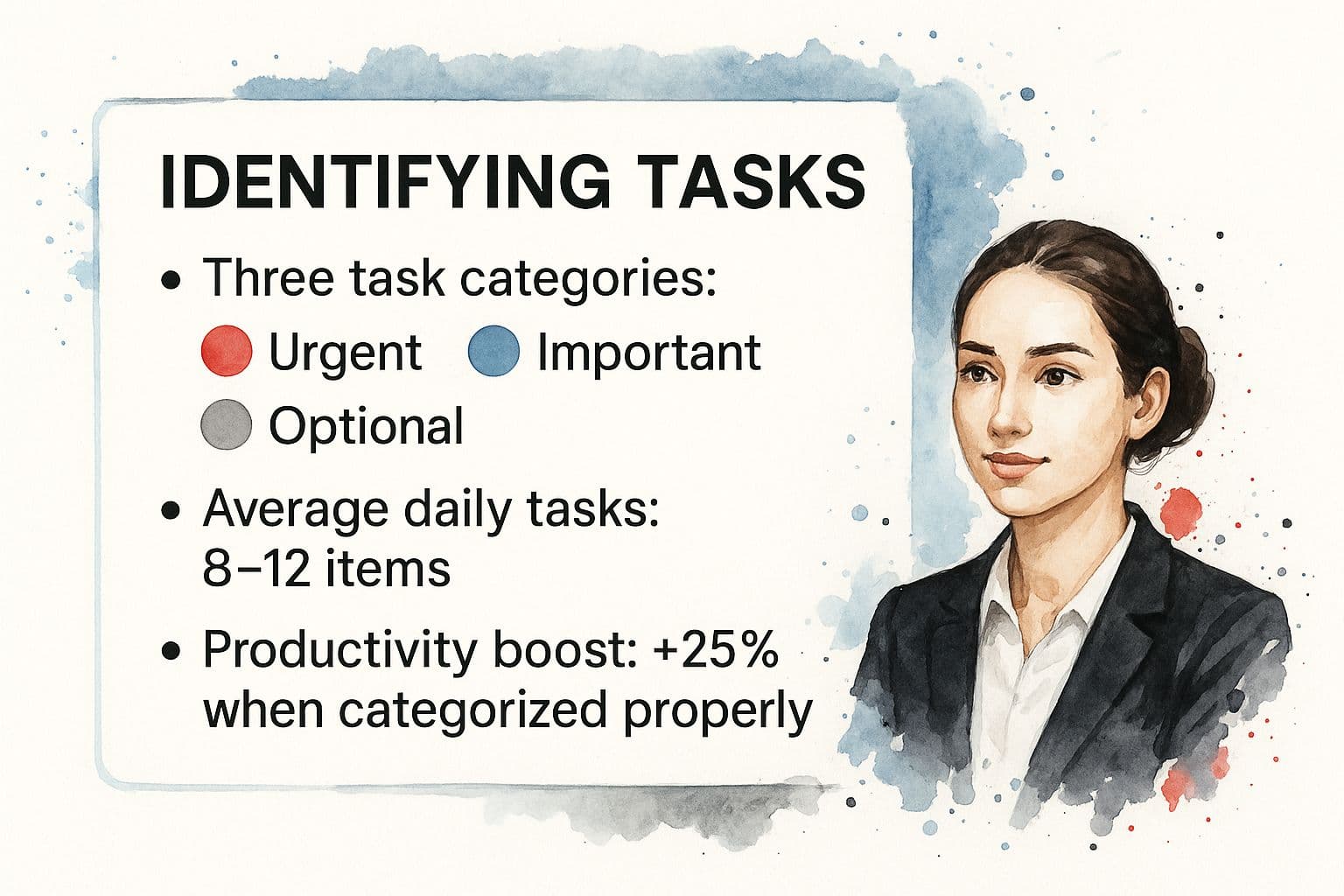
Some research suggests that structured sorting and clearer task definition can deliver notable productivity gains when consistently applied3.
MoSCoW Method For Team Projects
When priorities must be shared, the MoSCoW method aligns teams by sorting work into:
- Must‑Have: Core requirements without which the project fails.
- Should‑Have: Important features that aren’t critical for launch.
- Could‑Have: Nice-to-haves included only if time allows.
- Won’t‑Have: Out‑of‑scope items to prevent scope creep.
This framework is ideal for stakeholder alignment and preventing wasted effort.
Which Prioritization Method Is Right for You?
Match the tool to the job. Use the Eisenhower Matrix for daily triage, ABCDE for personal lists, and MoSCoW for team roadmaps. You might combine methods—Eisenhower for daily tasks and MoSCoW for quarterly planning—so long as the approach creates clarity and forward momentum.
| Framework | Best For | Key Benefit | Potential Drawback |
|---|---|---|---|
| Eisenhower Matrix | Daily and weekly individual tasks | Quickly separates urgent distractions from important work | Can oversimplify complex tasks with multiple dependencies |
| ABCDE Method | Long, personal to‑do lists | Creates a clear hierarchy for what to do next | Less effective for shared team priorities |
| MoSCoW Method | Collaborative projects | Aligns stakeholders and prevents scope creep | Requires consensus, which can take time |
Putting Prioritization Into Practice
Theory is one thing; habit is another. The real measure of any method is how it performs when things get hectic.
Start with a complete brain dump: every task, large or small. Then apply a framework. For example, a marketing team preparing a product launch lists everything from “Finalize ad copy” to “Coordinate with sales.” Sorting those items shows which tasks are immediate bottlenecks and which can be scheduled later.
From Large Projects to Actionable Steps
Vague items stall progress. Turn big projects into bite‑sized tasks. Instead of “Launch new website,” break it down:
- Write homepage copy
- Design product feature graphics
- Test mobile checkout
- Set up analytics tracking
Small, concrete actions create momentum and measurable progress.
Building a Daily Prioritization Habit
Consistency turns prioritization into a skill. A quick daily review—five to fifteen minutes at the start or end of your day—lets you reflect on accomplishments, spot new priorities, and set a clear focus for the next 24 hours.
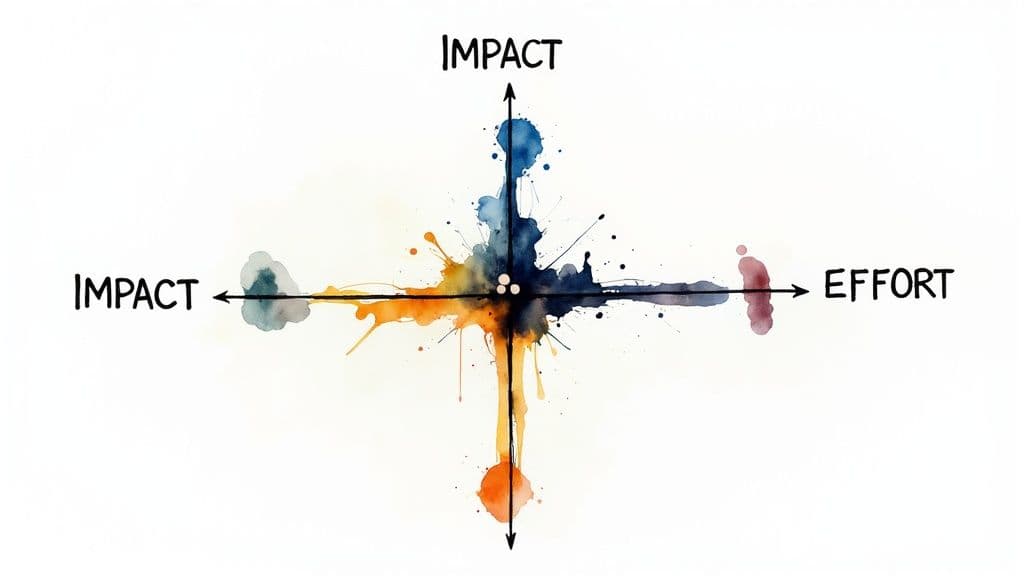
Visually separating tasks makes it obvious what to do, schedule, delegate, or delete.
Adapting When Priorities Shift
Plans change. When an urgent request appears, ask: “What will I stop doing to make space for this?” Framing new work as a trade‑off forces conscious choices and keeps your day from collapsing under unexpected demands.
Scaling Prioritization for Business Impact
Embedding prioritization across an organization turns busy teams into focused engines for growth. When daily tasks connect to strategic goals, every completed item becomes progress toward a larger outcome.
For example, a company that prioritizes sustainability will see product, marketing, and finance decisions shift to support that goal. Prioritization at scale helps align teams and resources to what truly matters.
Aligning Daily Tasks with Strategic Goals
Every major initiative needs a clear “why.” A logistics firm electrifying its fleet may face big upfront costs, but that decision supports long‑term goals like reduced emissions and regulatory readiness. Smaller tasks—from researching EV models to mapping charging points—then become direct contributions to strategy.
Making Strategic Financial Decisions
At the organizational level, prioritization requires tough financial choices. A startup might only be able to fund a few features in a quarter—leadership must prioritize what delivers the most customer value and revenue. Strong cash‑flow discipline ensures limited resources fund the highest‑impact initiatives. For more on this, see our related guide on cash flow management strategies.
Using Technology for Smarter Prioritization

Manual frameworks work, but modern tools can reduce cognitive load. AI and automation can sort tasks by deadline, dependencies, and strategic goals so you spend less time organizing and more time doing. Automating repetitive work is an easy first step to free up time for higher‑value tasks4.
Technology also helps reduce human bias: we naturally pick easier or more enjoyable tasks. Intelligent systems can keep your focus on what matters most and streamline delegation by suggesting reassignments for tasks that fall behind.
Businesses are increasingly adopting AI to boost efficiency and revenue growth expectations are rising among executives5. Platforms that combine automation with human coordination, like Fluidwave, help ensure important work stays visible and on track.
Common Questions About Getting Priorities Straight
What’s the Best Method When Everything Feels Urgent?
Use the Eisenhower Matrix to separate what truly needs immediate attention from what’s merely noisy. Focus first on tasks that are both urgent and important, and deliberately schedule time for important but not urgent work.
How Often Should I Revisit My Priorities?
Treat prioritization as a living system. A daily check‑in of 10–15 minutes is enough for most people. Teams should add a weekly prioritization meeting to align on objectives and avoid duplicated work.
How Do I Say “No” to New Tasks That Derail My Focus?
Decline gracefully by framing the conversation around capacity and trade‑offs: “I can help with that, but I’m finishing [Task X]. To take this on, I’d need to push that back. Are you comfortable with that change?” This clarifies consequences and invites collaboration.
Ready to stop managing tasks and start achieving goals? Fluidwave combines smart automation with skilled human assistance to handle the noise, so you can focus on high‑impact work. Get started for free today.
Quick Q&A: Prioritization Essentials
Q: How do I know which method to use? A: Match the method to the context—Eisenhower for daily triage, ABCDE for personal lists, and MoSCoW for team projects. Mix methods if it fits your workflow.
Q: What’s the simplest habit to improve prioritization? A: A daily 5–15 minute review to check progress, add new tasks, and set the day’s top priorities.
Q: How should I handle urgent interruptions? A: Treat new requests as trade‑offs—decide what to stop doing to make room. That conscious choice preserves your focus and prevents constant reactivity.
1.
Microsoft, “The Next Great Disruption Is Hybrid Work—Are We Ready?,” Work Trend Index (2021), https://www.microsoft.com/en-us/worklab/work-trend-index/hybrid-work.
2.
LinkedIn, “Global Talent Trends” (report and insights on skills and workplace shifts), https://business.linkedin.com/talent-solutions/blog/trends-and-research/2020/global-talent-trends.
3.
RescueTime and productivity research on planning and focus (insights on structured work and productivity gains), https://blog.rescuetime.com/.
4.
RingEden, “How to Automate Repetitive Tasks” (automation techniques to free up time for high‑value work), https://ringeden.com/blog/how-to-automate-repetitive-tasks.
5.
PwC, “CEO Survey and AI research” (executive expectations on AI and business impact), [https://www.pwc.com/
Focus on What Matters.
Experience lightning-fast task management with AI-powered workflows. Our automation helps busy professionals save 4+ hours weekly.