Feeling stuck? Learn how to get motivated at work by finding the real cause, breaking tasks into clear next steps, and setting fair goals.
October 27, 2026 (Today)
How to Get Motivated at Work: Practical Steps for 2026
Feeling stuck? Learn how to get motivated at work by finding the real cause, breaking tasks into clear next steps, and setting fair goals.
← Back to blog
Setting bigger goals, promising yourself a reward, and waking earlier won't fix a task list that doesn't fit into your working day. Most low-motivation days are workload or clarity problems before they're willpower problems.
If you're trying to figure out how to get motivated at work, start by identifying what makes the work difficult to begin. Then change that condition. A smaller commitment, a clearer handoff, or permission to stop doing something can be more useful than another productivity routine.
Work Out Whether You Need Motivation or a Lighter Load
You can care about your job and still struggle to open the document. That doesn't automatically mean you've lost your ambition. You may be exhausted, uncertain about the assignment, or trying to satisfy competing priorities that nobody has ranked.
Gallup's global figures put that experience in context: 20% of employees were engaged in 2025, while 40% experienced significant stress the previous day, according to its employee burnout guidance.
Adding goals or rewards won't resolve those different problems equally well. Before choosing a tactic, look for the pattern in your actual working week.
Stuck patterns and their first move
| Pattern | What it looks like | First move |
|---|---|---|
| Low energy | Flat even on easy tasks; sleep or recovery is off | Protect one recovery block and cut load for a week |
| Ambiguity | You cannot say what done looks like and reopen the same task | Write the next action and a completion condition |
| Skill gap | You avoid one specific kind of task while others feel fine | Ask for a worked example or short training before pushing harder |
| Interpersonal friction | Dread attaches to one person, meeting or handoff | Name the issue directly or change how the handoff works |
| Value misalignment | Work feels pointless even when you do it well | Tie the task to one outcome you care about or ask to change scope |
Notice the differences. If you can handle client conversations but keep avoiding spreadsheet analysis, investigate a skill gap rather than declaring yourself unmotivated. If your stomach tightens before a particular manager's meeting, a better timer probably isn't the answer.
Practical rule: Match the intervention to the obstacle, not to the productivity advice you happen to find first.
Check capacity before adding effort
Gallup's burnout guidance also reports rising burnout risk among employees working 45 or more hours weekly, especially when disengaged; among workers under 35 in that disengaged group, burnout reached 52%, compared with 11% among engaged younger employees working 30 to under 39 hours.
Those groups differ in both engagement and hours, so don't treat the comparison as a personal cutoff. Treat persistent exhaustion as a reason to examine workload, not demand greater discipline.
For practical help with the stress component, consider the work stress tips from Vancouver Counselling Clinic. If the immediate problem is an overflowing queue, use this guide to feeling overwhelmed at work to support a workload conversation.
Look back over the past fortnight and tally which pattern appeared most often. Start there, rather than trying every tactic at once.
How to Turn a Vague Task into a Clear Next Action
Clarity matters because you can't reliably execute an assignment you haven't defined. A task such as improve onboarding leaves you deciding what the task means every time you encounter it.
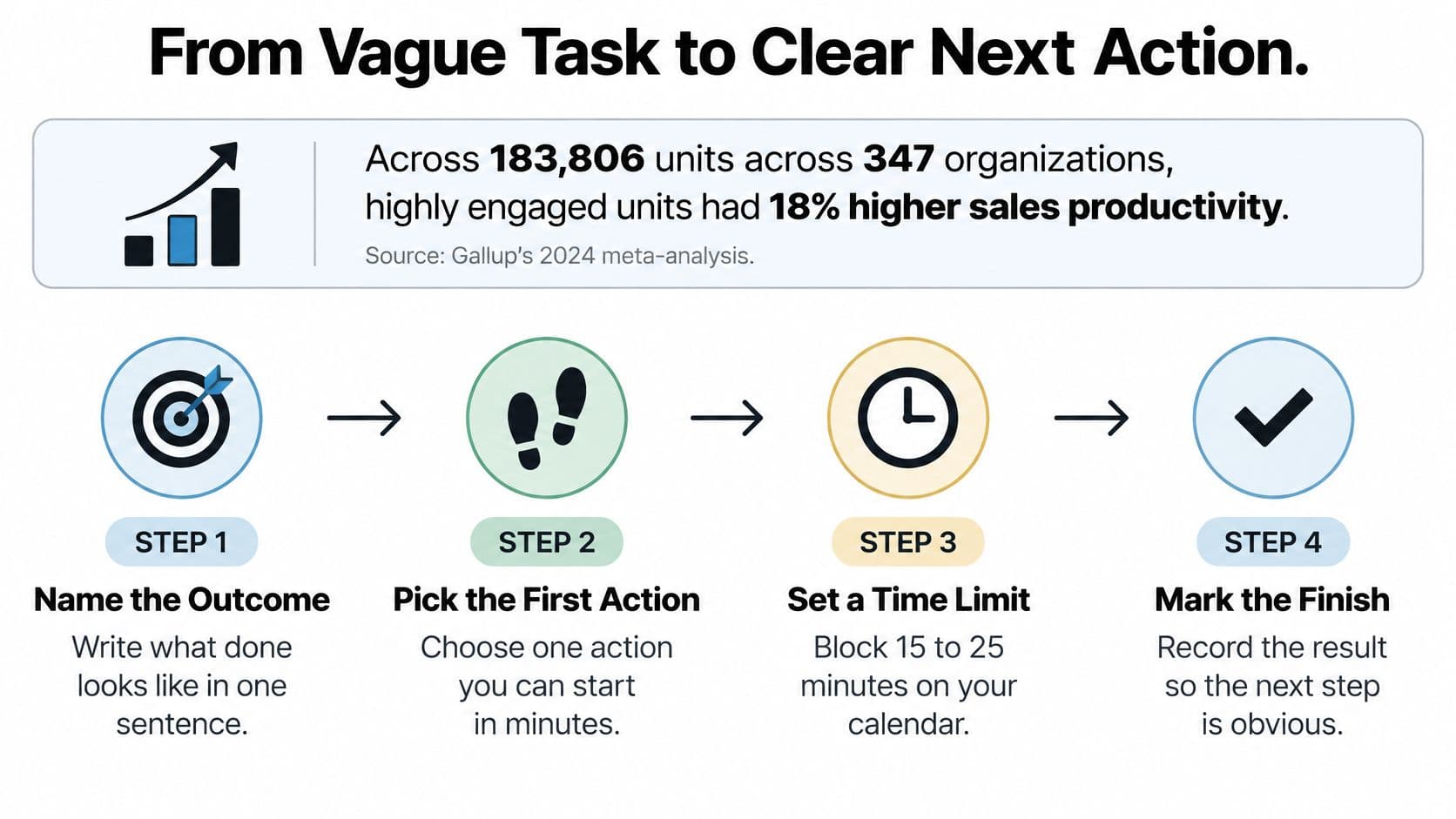
Gallup's 2024 engagement meta-analysis, covering 183,806 business and work units across 347 organizations, found that highest-engagement units had 18% higher sales productivity, 23% higher profitability, and 78% lower absenteeism than lowest-engagement units; Gallup also reported that only 46% of U.S. employees in 2024 strongly agreed they clearly knew what was expected of them, down from 56% in March 2020.
Those engagement comparisons don't prove that rewriting tasks causes higher profits. They do make a good case for treating execution conditions seriously, rather than treating morale as separate from how work gets done.
Write an assignment you can actually start
- Choose a near-term priority. For example, decide what deserves your next 90 minutes, not what you hope to accomplish all week. If everything seems urgent, ask the person assigning the work to rank the competing deliverables.
- Start with a physical action and a verb. Draft open questions for the vendor is usable; work on vendor issue still hides the decision.
- Define a checkable finish. Specify the artifact and its location: the draft is in the shared folder, with the budget table filled. Avoid completion conditions such as make good progress.
- Put a start time and a boundary around the effort. As a practical trial, choose a block of 25 to 60 minutes. Stop at the boundary to finish, renegotiate, or define the remaining work.
- Make the commitment visible. Put tomorrow's first action where you'll see it before your inbox. If someone depends on the result, tell them when to expect it.
The visual below condenses that process into a quick reference.
A worked example
Say a marketing analyst has improve onboarding emails on their list. They replace it with a bounded assignment: rewrite subject lines for the three onboarding emails, finish when the draft is in the campaign document, and allow 45 minutes.
In this scenario, the analyst starts within the hour because they no longer have to decide whether onboarding means copy, segmentation, design, or reporting. The whole project remains unfinished, but the immediate commitment is executable.
The clarity gap hasn't shifted much: Gallup's 2025 U.S. engagement update reported that 47% of employees strongly agreed they knew what was expected of them.
A usable next action names what you'll do, what you'll produce, and where you'll stop.
Micro-Tasks and Breaks That Restart Momentum
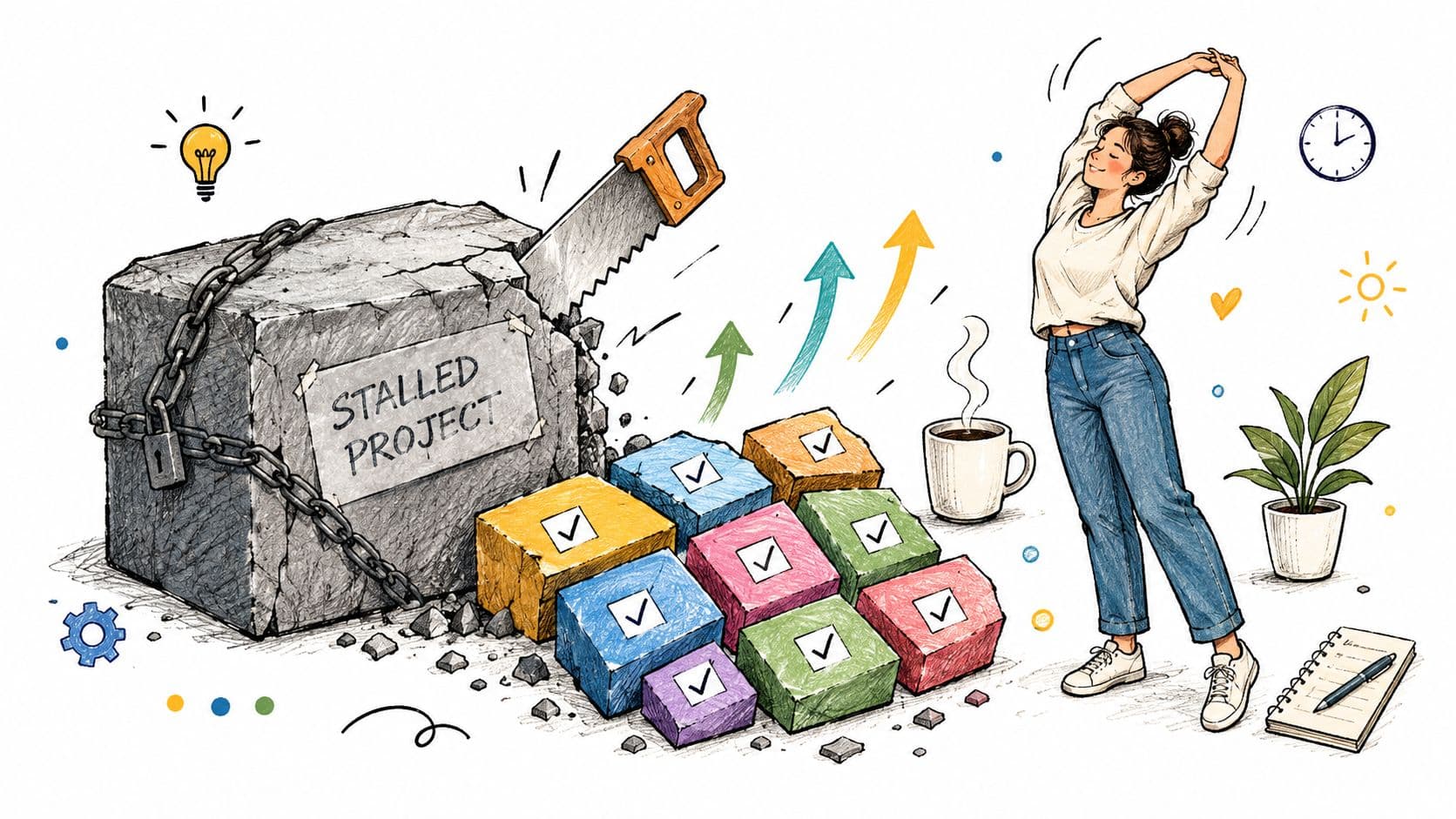
It's late afternoon. You've reopened the same presentation, adjusted the title, checked messages, and returned to the title. Pushing harder at the entire deck isn't helping; you need a smaller piece to finish.
The illustration captures the distinction between forcing a stalled project and changing how you approach it.
Make the afternoon smaller
For a trial routine, split the presentation into pieces that fit roughly 15 to 25 minutes: write the recommendation slide, fill the comparison table, or draft the closing paragraph. Start with the smallest useful output before opening another application.
A review of active-microbreak interventions identified six controlled trials with 232 participants supporting light activity breaks lasting two to three minutes every 30 minutes, with no observed negative effect on workplace productivity; it also cited an earlier study in which the error rate fell by 59% between pre-test and post-test conditions.
The productivity evidence was moderate, not conclusive. Use movement breaks as a fatigue-management experiment, not a promise that every pause will improve your output.
For a companion video during a planned pause, use the player below.
Keep the restart easy
- Make time visible. If ADHD makes it difficult to notice elapsed time, use a visible timer and keep only the intended output on a written note.
- Choose a break with an ending. Stand, stretch, or walk instead of opening an endless feed. These brain-break activities offer alternatives.
- Check for dread. If you're avoiding an uncomfortable recommendation rather than feeling tired, a break will only postpone the decision. Name the difficult part.
For help examining distractions around the work block, consider Optimal Native's advice for sustained attention.
Test the routine over a working week. Record what you intended to finish, what you produced, and whether restarting felt easier. Keep it only if it helps.
Goals Hard Enough to Pull Without Burning You Out
A bigger target doesn't automatically create more motivation. It can instead make the gap between your capacity and your commitments harder to ignore.
A meta-analysis of sport-related goal-setting interventions found that only moderately difficult goals produced a significant performance effect among easy, moderately difficult, and very difficult goals in the cited laboratory research; its broader review of 27 studies found specificity appeared in only 10 studies (37%) and difficulty in eight (30%), while more than a third of the empirical studies found specific goals weren't superior to vague do-your-best goals.
That's not a workplace prescription. It's a reason to be cautious about the claim that making every target more specific and more difficult will always help. The underlying measures weren't consistent enough to support such a simple rule.
Goal types compared
| Goal type | Example | When it fits |
|---|---|---|
| Vague intention | Do better on reports | Rarely useful; only as a starting label before you define the work |
| Specific but very hard | Write ten reports by Friday | Only with proven capacity, skills and clear support |
| Specific and moderately difficult | Finish two reports with one revision round by Friday | Default choice for most weeks |
| Process goal | Spend 45 focused minutes on reports each morning | Useful when the outcome depends on others or on approvals |
A process goal is particularly useful when you can't control approval speed. Commit to preparing a review-ready draft, not to making a stakeholder respond.
But don't use a process goal to avoid evaluating results indefinitely. Time spent is useful information; it isn't proof that the work is effective.
Check the commitment before accepting it
Ask whether you have the calendar space, the skills, and evidence from comparable work that the commitment is credible. Then ask whether you can check completion on Friday without debating what success means.
Capacity check: Lower the difficulty before you remove the completion condition.
If you need a structure for comparing approaches, use these goal-setting frameworks. If feeling stuck includes discouragement beyond the task itself, goal-setting guidance for adults feeling stuck from Be Your Best Self & Thrive Counseling, PLLC offers another starting point.
Delegate Routine Work and Ask for Better Support
Keep, delegate or automate
| Task type | Keep yourself | Delegate or automate |
|---|---|---|
| Decisions that need your judgment | Yes | No |
| Recurring admin such as scheduling, data entry or file naming | No | Automate or delegate |
| Research and first drafts from a clear brief | Review only | Delegate with a written brief |
| Sensitive client or team messages | Yes | No |
| Status updates and reminders | No | Automate |
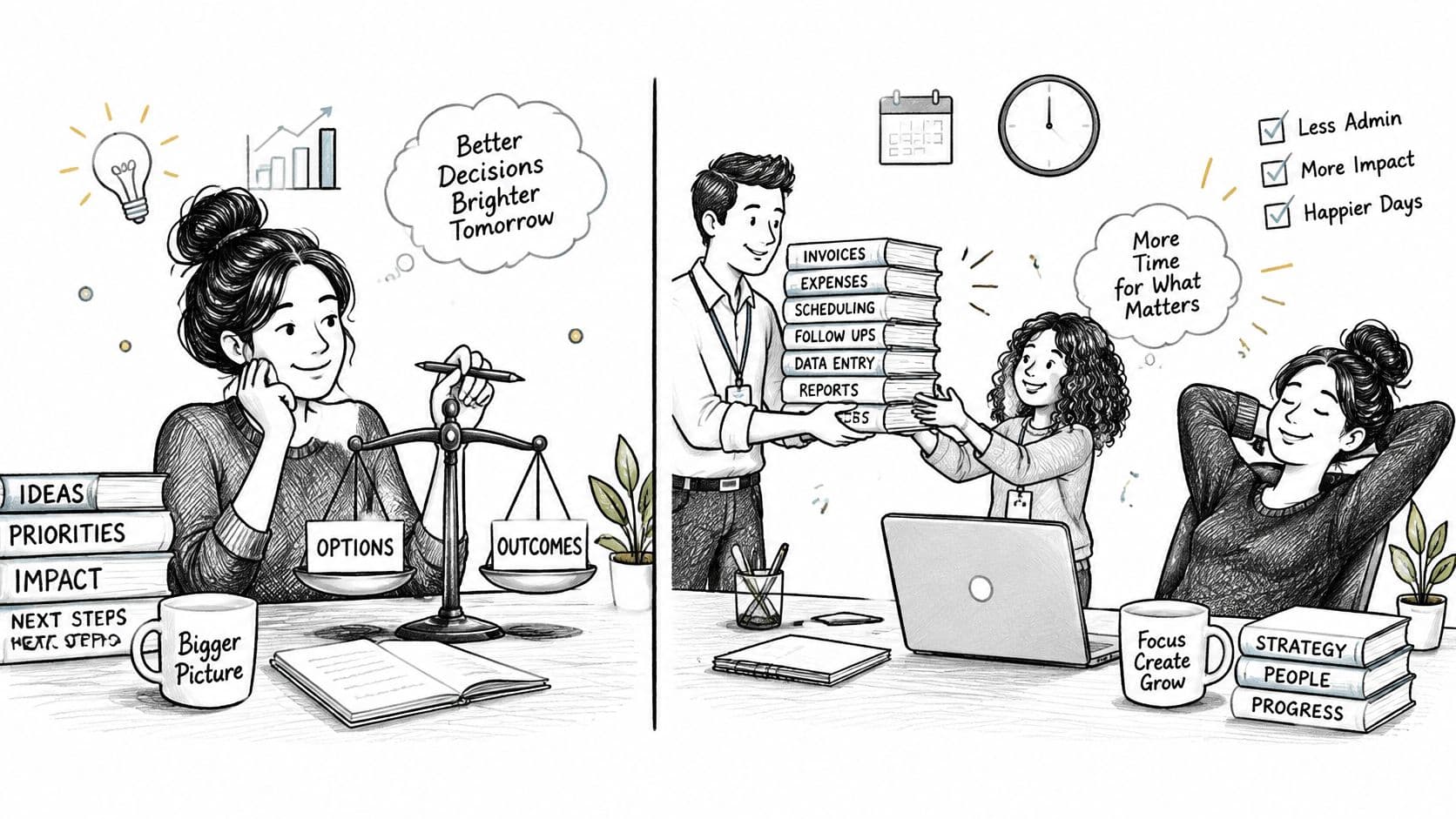
Motivation often drops when work that requires your judgment is buried beneath work that merely requires your attention. Sorting those tasks is more useful than trying to become enthusiastic about all of them.
Delegation has costs: briefing, checking, access management, and correcting misunderstandings. Keep sensitive communications and consequential decisions with the accountable person, and don't automate a process you haven't made reliable manually.
The illustration below contrasts administrative overload with a more deliberate allocation of attention.
Ask for a real choice
A meta-analysis of leader autonomy support, combining 72 studies, found a positive association between autonomy support and perceived competence, with ρ = .42 across 27 studies involving 11,636 participants.
Ask your manager for a concrete choice about method or order. For example, propose completing the analysis before the slide deck and agreeing on the recommendation before formatting begins. That's easier to evaluate than a broad request for more flexibility.
Gallup attributes approximately 70% of the variation in team engagement to managers in its 2024 State of the Global Workplace key insights. Treat the conversation as work design, not a request for a motivational speech.
Choose a tool after sorting the work
A shared checklist may be enough for a simple handoff. Calendar rules can handle recurring reminders without adding another platform.
Fluidwave is another option: it auto-prioritizes tasks across list, table, calendar, Kanban, and card views, and supports delegation to skilled virtual assistants on a pay-per-task basis. You pay only for completed work, don't need a subscription to delegate, and can use a free forever tier.
Write the brief and completion condition before handing anything over. Include the necessary files, constraints, deadline, and what requires your approval; otherwise, you'll transfer uncertainty rather than useful work.
Mark your current tasks keep, delegate, or automate. Choose a recurring administrative task for the first handoff, and include review time in your schedule.
Pick One Change to Test This Week
Meaning matters, but caring intensely about work doesn't give you unlimited capacity. You can believe in the mission and still need fewer commitments.
Gallup's U.S. research on purposeful work found that employees with strong work purpose were 5.6 times as likely to be engaged as those with low purpose, while 13% of the high-purpose group reported frequent burnout compared with 38% of the low-purpose group.
Purpose helps explain why you should do something. It doesn't resolve unclear ownership, constant interruptions, or a schedule without room to recover.
Check meaning and depletion separately
On Monday, try rating meaning and depletion separately on a scale from 1 to 5. These are personal tracking scores, not clinical measures.
- Low meaning, low depletion. Identify an outcome you care about, such as helping a customer make a sound decision. If you can't find a credible connection, discuss changing the scope.
- High depletion. Protect a real lunch break and set a hard stop time. Negotiate what won't fit rather than moving it into the evening without saying so.
- Enough energy, continued avoidance. Examine the task itself, including missing information, unfamiliar skills, or an unresolved conversation.
Choose a change that matches that diagnosis. Don't combine a new schedule, a new app, a harder goal, and a delegation experiment, because you won't know which helped.
Run a small test and review it
For a five-working-day test, record your starting energy from 1 to 5 and the number of tasks finished with a defined done state. Keep task sizes reasonably comparable so splitting a task into tiny fragments doesn't masquerade as better performance.
Set a Friday review. Ask whether starting became easier, whether you finished useful work, and what the change cost in coordination or effort. If energy didn't improve, reconsider the pattern you identified instead of tightening the routine.
Create a list in Fluidwave containing each open task, its next action, and its done condition, then review it on Friday. The free tier is enough for this test before you commit to anything more.
Fluidwave combines task organization, automatic prioritization, and pay-per-task delegation so you can separate work that needs your judgment from routine administration. Visit Fluidwave to build a manageable task list and test a clearer way to start your working day.
Focus on What Matters.
Experience lightning-fast task management with AI-powered workflows. Our automation helps busy professionals save 4+ hours weekly.