Wondering how do I think faster? Discover evidence-based cognitive exercises, decision shortcuts, & workflow hacks for faster mental processing.
April 9, 2026 (4mo ago)
How Do I Think Faster: Boost Your Mental Speed
Wondering how do I think faster? Discover evidence-based cognitive exercises, decision shortcuts, & workflow hacks for faster mental processing.
← Back to blog
You open your laptop to answer one message, then another thought cuts in. A half-finished proposal. A Slack reply you forgot. A calendar reminder. A tab you meant to read yesterday. By mid-morning, nothing is technically broken, but your mind feels sticky. You are reading the same sentence twice and taking too long to make ordinary decisions.
When people ask how do i think faster, this is what they mean. They do not mean becoming frantic. They mean getting back to clear, decisive, reliable thinking.
I work with busy professionals who often assume the problem is intelligence or discipline. It usually is not. More often, they are carrying too much unprocessed input, switching contexts too often, and relying on willpower when they need systems. Faster thinking comes from two moves working together. First, you improve the brain’s ability to hold and process information. Second, you reduce the amount of mental clutter competing for that capacity.
Quick thinking that lasts is built, not wished into existence. It comes from training working memory, protecting attention, using better decision frameworks, and offloading what your brain should never be storing in the first place.
Why Feeling Slow Is The New Normal
Many smart individuals do not feel slow because their brains are failing. They feel slow because their environment is noisy and their workload is fragmented.
A founder reviews hiring notes while fielding pings from investors. A project manager toggles between a spreadsheet, a voice note, and a team chat. A freelancer keeps ten client obligations in working memory because writing them down feels like one more task. By the end of the day, all three say the same thing: “I know I can think better than this.”
That feeling is valid. It is also fixable.
Slow thinking is often overloaded thinking
Mental speed is not just about raw intellect. It is about how much friction sits between stimulus and response. If your attention is split, your brain has to keep reloading context. If your task list lives in your head, your mind wastes energy rehearsing obligations instead of solving problems.
That is why some people seem sharp under pressure. They are not always smarter. They are often carrying less cognitive drag.
Key takeaway: Faster thinking is usually the result of better mental efficiency, not more mental force.
What changes performance
In practice, four levers matter most:
- Cognitive capacity: Your working memory determines how many moving parts you can actively handle.
- Attentional control: You need enough stability to stay with a problem long enough to solve it.
- Decision structure: Better mental models shorten analysis without lowering quality.
- Cognitive load reduction: The fewer open loops you carry, the faster your best thinking shows up.
When people chase quick fixes, they usually miss the last piece. They try to think faster while continuing to hold everything in their heads. That rarely works for long.
The better path is more sustainable. Train the brain. Protect attention. Use cleaner decision rules. Offload the mental junk.
Train Your Brain's Core Processing Speed
If you want a direct answer to how do i think faster, start with working memory. This is the part of cognition that lets you hold and manipulate information in real time. It is the mental workspace you use when comparing options, following a complex conversation, writing under pressure, or solving a problem without losing the thread.
When working memory is overloaded, thinking feels sluggish. You forget what you were about to say. You reread simple material. You miss connections that would normally be obvious.

Treat working memory like RAM
The simplest way to explain working memory is this: it functions a lot like a computer’s RAM. It is not your long-term storage. It is the temporary space where active processing happens.
When that space is limited, even bright people bog down. They are not incapable. They are crowded.
One training method that gets attention for a reason is dual n-back. A 2019 study in Psychological Science found that practicing dual n-back training for about 6.7 hours total improved fluid intelligence by 5-10 IQ points and made participants process information 30% faster in working memory tasks. For professionals, especially those with ADHD, this training can reduce cognitive lag by up to 40%.
That matters because faster thinking is often the byproduct of handling more information cleanly at once.
If you want a companion read on the broader skill of input handling, this guide on how to process information faster is useful because it pairs speed with comprehension rather than speed alone.
How to start dual n-back without making it a chore
Many individuals quit brain training for one reason. They make it too ambitious too early.
Use a lighter ramp:
-
Pick one app or tool and stick with it Do not bounce between platforms. The point is consistency, not novelty.
-
Train when your brain is not already fried Early morning works for some people. Mid-afternoon works for others. Late-night training after a draining day usually becomes sloppy.
-
Keep the sessions short enough to stay sharp Dual n-back only helps if you are engaged. Once you are guessing mechanically, quality drops.
-
Track friction, not just scores Notice whether meetings feel easier to follow, whether writing gets smoother, and whether prioritization feels less effortful.
A lot of professionals expect dramatic effects in a few days. That is the wrong mindset. Think of this as upgrading the quality of your internal workspace.
For a practical extension of this idea, the piece on working memory improvement strategies is worth reading because it connects training methods with daily execution demands.
What works and what does not
Some cognitive exercises build useful strain tolerance. Others are just digital busywork.
Here is the distinction I use with clients:
| Approach | What it tends to do |
|---|---|
| Dual n-back | Challenges active updating and mental tracking |
| Mental math under time pressure | Improves concentration for some people, but can become narrow |
| Memorization games | Can help recall, but often do little for real-time reasoning |
| Random “brain game” apps | Often feel productive without transferring well to demanding work |
The best training has two qualities. It stretches you slightly beyond comfort, and it maps to a real bottleneck in your work.
Add one more kind of speed training
Raw working memory is one side of the equation. Pattern recognition is the other.
Fast thinkers often get that way because they build libraries of familiar situations. That is why experienced operators spot problems early. They have seen related versions before.
You can train this deliberately:
- Review your own decisions: Look at past calls that went well and ask what cues were present early.
- Use brief scenario drills: For managers, that might mean sketching responses to likely team issues before they arise.
- Practice compression: Summarize a complex article, call, or meeting in three sentences.
That last exercise is underrated. If you cannot compress the signal, you probably have not processed it.
A quick visual primer can help if the concept still feels abstract:
The Trade-off Many Miss
Cognitive training works. But it is not magic. If you train hard and then spend the rest of the day drowning in interruptions, you blunt the gains.
The point is not to become a person who can endure more chaos. The point is to build more processing headroom, then protect it.
Practical tip: If a training method makes you feel more scattered, not more precise, stop treating effort as progress. Good cognitive training should feel demanding and clarifying, not noisy.
Master Your Attention and Environment
A stronger brain does not help much inside a chaotic setup. Attention is the gatekeeper. If you cannot hold it steady, your processing speed never gets a fair chance to show up.
That is why some people feel surprisingly sharp on a quiet Saturday morning and unusually dull on a crowded Tuesday. Their underlying ability did not change much. Their attentional environment did.
Meditation is attentional strength training
Mindfulness gets framed as stress relief, but for performance, the bigger benefit is control. It trains you to notice distraction earlier and return faster.

Research from the Journal of Experimental Psychology (2015) indicates that a short daily mindfulness meditation practice can accelerate reaction times and improve the brain's ability to process sequential information. This is critical for project managers and freelancers juggling multiple inputs. In addition, 72% of Fortune 500 executives now use mindfulness apps, linking the practice to 19% faster strategic decisions.
For busy professionals, the practical takeaway is simple. You do not need an elaborate ritual. You need a repeatable practice that reduces mental drift.
Build an environment that asks less from your brain
Many attention problems are environment problems.
If your phone is face-up, inbox open, and notifications active, your brain keeps performing micro-orienting responses. Even when you resist them, part of your attention has already moved.
The fix is often boring. That is why it works.
Try this combination:
- Single visible task: Keep only the current document or current task view open.
- Muted entry points: Silence nonessential notifications during focused work blocks.
- Friction for distractions: Put social apps behind an extra click or on a different device.
- Clear restart cues: Leave a short note at the end of a session so you can re-enter fast later.
If context switching is a major issue for you, this explanation of what is context switching is a useful read because it names the exact drag many professionals mistake for lack of focus.
Use structured focus blocks, not vague intentions
“Focus more” is not a method.
Structured focus works better because it reduces negotiation. You decide in advance how long you will stay with one task, what counts as a break, and what gets postponed.
I often suggest a simple deep-work rhythm:
| Work mode | Best use |
|---|---|
| Short focus block | Admin, email processing, light planning |
| Medium focus block | Writing, analysis, proposal work |
| Long focus block | Strategy, design, complex problem-solving |
The exact timing matters less than the rules around it. One task. No inbox. No chat. No “quick checks.”
Fast thinking needs less input, not just better concentration
There is a common mistake here. People think attention improves when they become more disciplined. In reality, it often improves when they reduce what attention has to manage.
A calmer visual field helps. A cleaner desktop helps. So does separating capture from execution. If a thought appears while you are working, write it down once and return to the task. Do not turn every remembered obligation into a new branch of activity.
Key takeaway: The brain moves faster when it stops reopening the same loops.
A daily minimum that is realistic
If you want a low-friction protocol, use this:
- Morning: Brief mindfulness practice before opening communication tools
- Midday: One protected focus block for your most cognitively demanding task
- Afternoon: A short reset walk or quiet pause before shifting into reactive work
That routine looks modest. It is enough to change how your day feels.
People searching for how do i think faster often expect a special trick. Attention rarely responds to tricks. It responds to conditions. Give it cleaner conditions and speed returns naturally.
Adopt Faster Decision-Making Frameworks
Thinking faster is not only about mental horsepower. It is also about reducing the number of bad paths your mind explores.
When a decision takes too long, one of two things is usually happening. You are missing a framework, or a bias is bending your judgment without your noticing.
Fast decisions still need guardrails
Daniel Kahneman’s distinction between fast, intuitive thinking and slower, analytical thinking is useful because it explains why speed can either help or hurt. Intuition is efficient when you have experience and clean signal. It is dangerous when you are reacting to noise, fear, or an irrelevant anchor. Structured debiasing earns its keep in such situations. Structured debiasing protocols can improve decision speed by 15-25% while increasing accuracy by 18-30%. Common errors like the 'anchoring' effect can bias outcomes by up to 40%, while the 'availability' heuristic can make us overestimate the probability of vivid events by 2-5x.
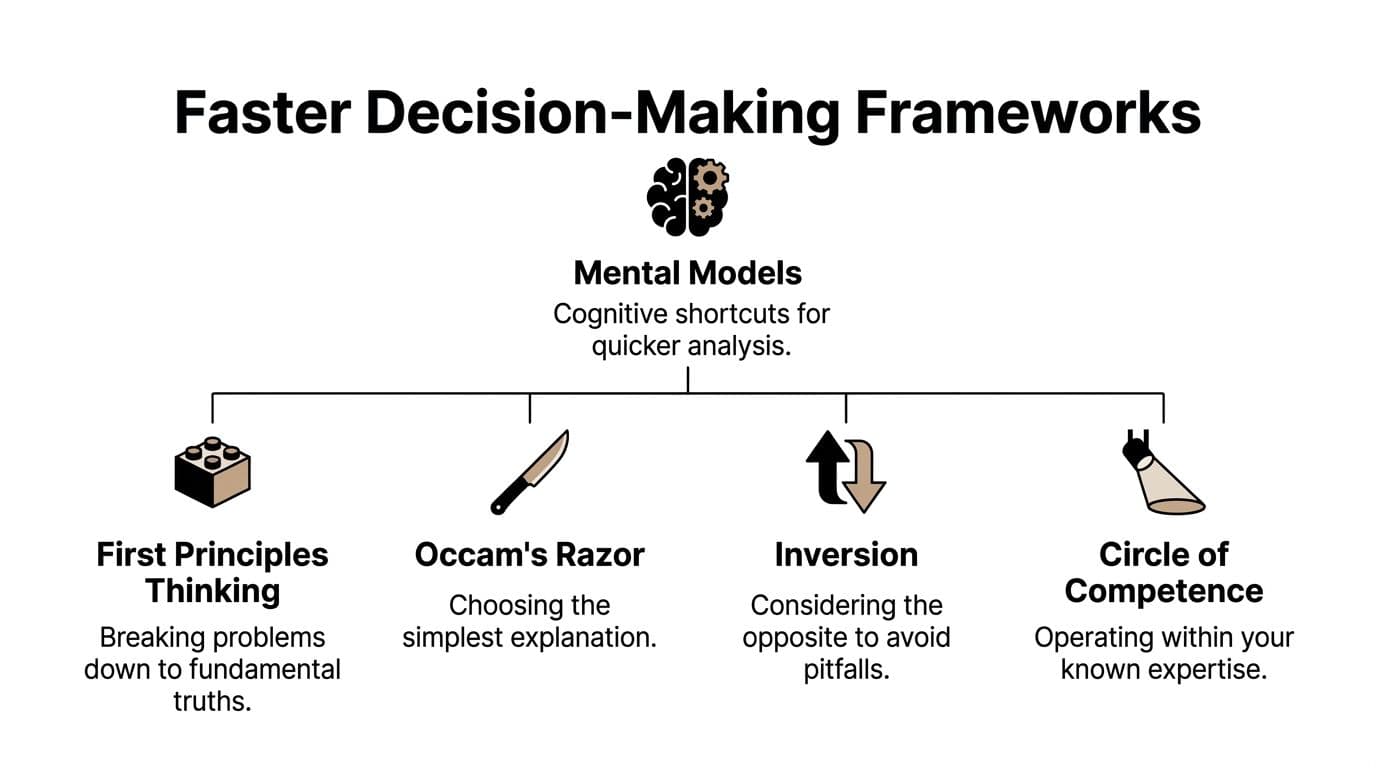
Four frameworks I trust under pressure
The best decision tools are compact enough to use in real life.
First principles thinking
When a situation feels messy, strip it down. Ask what must be true regardless of convention, opinion, or precedent.
This works well when teams inherit assumptions they have never tested.
Occam’s razor
If two explanations fit the facts, start with the simpler one.
This is not an excuse to be shallow. It is a way to stop manufacturing complexity when the obvious explanation is strong.
Inversion
Instead of asking how to succeed, ask what would make the result fail.
That shift exposes hidden risks fast. It is one of the cleanest ways to avoid preventable mistakes.
Circle of competence
Know where your judgment is strong and where it is thin.
People slow down when they operate beyond their understanding. They either overanalyze or bluff. Neither is useful.
A practical way to debias a decision
When a call matters, run a short check before committing:
-
What is anchoring me? Was I influenced by the first number, first opinion, or first framing?
-
What vivid example is distorting my estimate? Memorable events feel common even when they are not.
-
What would make this fail? A brief pre-mortem surfaces weak assumptions quickly.
-
What usually happens in comparable situations? Reference class thinking is less exciting than optimism, but usually more honest.
This takes minutes, not hours. And it often cuts wasted deliberation because you stop circling the same uncertain ground.
What does not work
I see three patterns repeatedly:
- Overtrusting gut feel in unfamiliar territory
- Asking too many people for input on reversible decisions
- Treating more analysis as proof of seriousness
More thinking is not always better thinking. Good frameworks narrow the field.
Practical tip: Save your slowest, most detailed analysis for irreversible decisions. For everything else, use a lightweight framework and move.
A useful standard for daily work
For ordinary decisions, I like a simple split:
| Decision type | Better approach |
|---|---|
| Reversible and low risk | Decide quickly with a basic checklist |
| Important but familiar | Use intuition, then verify one assumption |
| High stakes or novel | Slow down and run a fuller bias check |
This is how faster thinkers operate in practice. They do not sprint through every choice. They match the depth of thought to the nature of the decision.
Fuel Your Mind and Body for Optimal Speed
Mental speed sits on a biological base. You can use every framework in the world, but if your brain is underslept, overstimulated, dehydrated, or pulled in ten directions, performance drops.
Many ambitious people sabotage themselves in this area.
They are not optional.
Stop confusing stimulation with performance
Caffeine can help, but it is not the same as cognitive readiness. If you rely on it to mask poor recovery, you often feel more alert than you are.
Tea can be a useful middle ground because the stimulant load is often gentler than coffee, but it still pays to know what you are drinking. This guide to caffeine content in tea is handy if you want to use caffeine more deliberately instead of guessing.
The broader rule is simple. Use stimulants to support a solid system, not replace one.
Multitasking is not speed
A lot of professionals still believe they think faster when they keep several things moving at once. Usually they are just increasing internal noise.
According to this overview on thinking speed and neuroplasticity, multitasking creates a 40% cognitive slowdown and reduces efficiency by up to 25%. The same source notes that the brain’s biological think rate is fixed at about 1-2 discernments per second, and that rushing under pressure can degrade decision quality by 30-50%. It also notes that neurofeedback can yield 20-40% improvements in processing speed after 8-12 weeks for some users (mendi.io).
That tracks with what I see in practice. People do not speed up by compressing more tasks into the same minute. They speed up by reducing interference.
What helps the brain stay fast
You do not need a perfect wellness routine. You need the basics done consistently.
Sleep
Sleep is where mental cleanup happens. If you cut it short repeatedly, attention gets brittle and working memory loses range. Complex thinking then starts to feel heavier than it should.
Movement
Aerobic exercise and regular movement improve alertness and often make thinking feel more fluid afterward. You do not need a heroic workout. A walk before a demanding block of work can be enough to sharpen state.
Food quality
Stable meals support stable attention. Heavier, erratic eating patterns can leave you foggy, distracted, or crash-prone. Many individuals already know which foods make them think more clearly. They just ignore that knowledge when the schedule gets crowded.
A better standard than “push through it”
The performance mindset that works long term is not intensity at all costs. It is state management.
Ask better questions:
- Did I sleep enough to expect good judgment today?
- Am I trying to solve a hard problem while physiologically flat?
- Would a short walk, water, or food do more than another cup of caffeine?
The body is not separate from the mind. It is the operating condition for the mind.
Free Up Your Mind by Reducing Cognitive Load
This is the piece many individuals skip. It is also the one that changes the most.
You can train working memory, improve attention, and use better decision frameworks. But if your brain is still acting as a storage unit for reminders, follow-ups, errands, loose ideas, and half-made commitments, you will keep feeling slower than you are.
Fast thinkers are often not processing more. They are carrying less.

Your brain should not be your task manager
The mind is good at generating ideas, spotting patterns, and making judgments. It is not good at reliably holding dozens of open loops.
Yet that is how many professionals operate. They remember to email the contractor while in a meeting. They mentally track an invoice while writing a proposal. They keep replaying “don’t forget” thoughts because they do not trust their capture system.
That constant rehearsal burns bandwidth.
The first fix is externalization. Get tasks, ideas, and concerns out of your head and into a trusted system. If you need help starting, this guide on what is a brain dump is a practical place to begin.
Offloading is not laziness
Some people resist delegation and automation because they think high performers should keep everything under personal control. In reality, control and personal handling are not the same thing.
A sharp operator asks a different question: What requires my judgment, and what only requires completion?
That distinction changes everything.
Here is a useful filter:
| Type of work | Keep it or offload it |
|---|---|
| High-stakes decisions | Keep |
| Creative synthesis | Keep |
| Routine coordination | Offload |
| Scheduling and follow-up | Offload |
| Formatting, filing, and repetitive admin | Offload |
The goal is not to do less important work poorly. It is to stop spending elite cognitive effort on tasks with low impact.
Reduce open loops aggressively
Open loops slow thinking because they keep tugging at attention from the background.
You can lower that drag with a few habits:
- Capture immediately: If something matters, write it down once instead of rehearsing it mentally.
- Clarify next actions: “Plan launch” is vague. “Draft launch outline” is executable.
- Separate planning from doing: Do not keep reprioritizing in the middle of focused work.
- Review commitments daily: A short review restores trust in your system.
People often underestimate how much speed they gain from this alone. When the brain trusts that nothing important will be lost, it stops scanning for forgotten obligations.
Key takeaway: The fastest way to think faster is to stop asking your brain to remember what a system should hold.
Use tools that reduce friction, not add ceremony
A lot of productivity tools fail because they create maintenance work. If updating the system feels like a part-time job, people abandon it and return to mental clutter.
Good tools do three things well:
- Capture quickly
- Show what matters now
- Make delegation easy when ownership does not need to stay with you
That last point matters more than often acknowledged. Delegation is cognitive design. When another person or an automated workflow handles a repeatable task, you are not just saving time. You are shrinking background load.
What sustainable offloading looks like
In executive and founder work, the biggest gains usually come from recurring categories:
Administrative repetition
Calendar coordination, document cleanup, inbox triage, status chasing. These tasks create drag because they interrupt higher-order work without requiring higher-order thinking.
Processed information
Notes, summaries, and first-pass organization can often be prepared before you step in. Your role becomes review and decision, not raw collection.
Operational follow-through
A surprising amount of mental fatigue comes from keeping track of who owes what and when. Systems and assistants handle this better than memory does.
The emotional barrier is real
Some people know exactly what they should offload and still do not do it.
Usually the blockers are psychological:
-
“It’s faster if I do it myself.” Sometimes true once. Rarely true as a system.
-
“No one will do it my way.” Then define the standard once instead of redoing the task forever.
-
“I might forget something important.” That is the point of a trusted capture and review process.
Here, cognitive performance becomes operational maturity. You stop treating every task as a referendum on your competence.
A simple redesign for the next week
If you want results without overhauling your life, try this sequence:
- List every recurring task you touch
- Mark which ones require your judgment
- Create a home for everything else
- Automate what is rule-based
- Delegate what is repeatable but human
- Protect your best thinking hours for work only you can do
That is the unique angle many people miss when asking how do i think faster. The answer is not only inside the brain. It is also in the design of your workload.
If your calendar is fragmented, your task list is vague, and your obligations live in your head, even strong cognitive habits will struggle. But when the brain is trained and the load is lighter, mental speed stops feeling mysterious. It becomes a predictable outcome of better conditions.
If you want a system that helps you capture tasks fast, organize work clearly, and delegate routine execution without adding more overhead, take a look at Fluidwave. It is built for people who want more mental space for real thinking, not another layer of productivity theater.
Focus on What Matters.
Experience lightning-fast task management with AI-powered workflows. Our automation helps busy professionals save 4+ hours weekly.