How can i become more articulate - Want to know "how can I become more articulate"? Our guide reveals steps for vocal control, structuring thoughts, and tools
April 27, 2026 (4mo ago)
How Can I Become More Articulate: Clarity & Confidence
How can i become more articulate - Want to know "how can I become more articulate"? Our guide reveals steps for vocal control, structuring thoughts, and tools
← Back to blog
You know the feeling. You have the right idea in your head, then a meeting starts, someone asks for your view, and your answer comes out tangled. You reach for the point, add too much context, lose the thread, and finish with something weaker than what you meant.
A lot of people describe that as “I’m just not articulate.” That’s usually the wrong diagnosis.
Most professionals who ask how can i become more articulate don’t have a knowledge problem. They have a performance problem, a structure problem, or an overload problem. They know their work. They just can’t always package it cleanly under pressure.
Articulation is trainable. It’s not reserved for naturally polished speakers, extroverts, or people who always have the perfect phrase ready. The people who sound clear in rooms that matter usually rely on repeatable habits. They’ve trained their mouth, their pacing, and their thinking. They also know their limits. If they ramble when tired, freeze when anxious, or jump topics when overloaded, they build around that instead of pretending discipline alone will fix it.
First Understand Your Articulation Starting Point
The worst time to evaluate your speaking is right after a meeting you think you messed up. In that moment, people tend to judge themselves too broadly. They say, “I sounded stupid,” which isn’t useful and usually isn’t true.
Start with a diagnostic, not a verdict.
If you fumble in high-stakes conversations, there’s almost always a pattern underneath it. Maybe you speak too fast when challenged. Maybe your sentences start strong and trail off. Maybe you know the answer but can’t organize it quickly enough. Until you spot the pattern, you’ll keep using generic fixes for a specific problem.

Record normal speech, not your best speech
Don’t script a polished monologue. Record yourself in low-stakes conditions where your natural habits show up.
Use your phone and do any of these:
- Summarize an article: Read a news piece, close it, then explain the main point in your own words.
- Teach a simple process: Explain how your team ships a deliverable, handles client feedback, or prioritizes tasks.
- Describe a hobby: Talk about coffee brewing, running, gaming, gardening, anything you know well enough to explain without notes.
Keep each recording short. A few minutes is enough. The point isn’t endurance. The point is exposure.
Practical rule: If you only practice your “best” voice, you won’t fix the version of you that shows up in real conversations.
Listen for the errors that actually matter
When you play the recording back, avoid vague judgments. Listen for concrete issues.
Most articulation problems fall into a few buckets:
-
Verbal clutter
Filler words, repeated phrases, circular setups, and throat-clearing language. This includes “um,” “like,” “so basically,” and “what I’m trying to say is.” -
Weak delivery mechanics
Mumbling, rushed pacing, dropped sentence endings, flat tone, or inconsistent volume. -
Disorganized thought flow
Starting with background instead of the point. Taking detours. Answering three questions at once. Losing the original question halfway through. -
Cognitive overload signals
You know the material, but your working memory drops under pressure. You forget the next point, switch topics abruptly, or over-explain because you’re searching while speaking.
If that last category feels familiar, it helps to understand the executive function side of communication. Fluidwave’s explanation of executive function is useful because it frames these breakdowns as planning, prioritizing, and sequencing issues, not character flaws.
Use a baseline checklist
You don’t need a fancy rubric. You need a repeatable one.
After each recording, note:
| Area | What to check | What “better” looks like |
|---|---|---|
| Clarity | Can a stranger follow the point? | One clear takeaway |
| Pace | Do you rush difficult parts? | Steady, controlled delivery |
| Fillers | Where do they spike? | Fewer fillers during transitions |
| Structure | Do you answer directly? | Point first, details second |
| Voice | Do you fade at the end? | Sentences land cleanly |
This turns “I want to be more articulate” into something you can work on.
Start with one target, not five
Individuals often fail here because they try to fix everything at once. They decide to improve vocabulary, confidence, posture, filler words, storytelling, and persuasion in the same week. Then nothing sticks.
Pick one target for the next stretch of practice. If you ramble, work on structure. If people ask you to repeat yourself, work on enunciation and pacing. If you freeze in discussions, work on short response frameworks.
That’s how progress becomes visible. You stop treating articulation like a personality trait and start treating it like a skill stack.
Build Your Articulation Toolkit with Daily Drills
Articulate speakers don’t rely on inspiration. They rely on rehearsal that’s boring enough to work.
That matters because most advice in this area is too vague. “Read more.” “Slow down.” “Be confident.” None of that tells you what to do on Tuesday morning before work when your speech still feels messy. You need drills that train the mechanics of speaking and the thinking underneath it.
A useful place to start is deliberate practice. According to D16 Toastmasters on building articulation through structured practice, 70% of learners reduce filler words by 40% within the first four weeks of daily impromptu speech recording, and people who build in feedback loops report reaching a more intuitive flow after roughly 100 hours of practice.
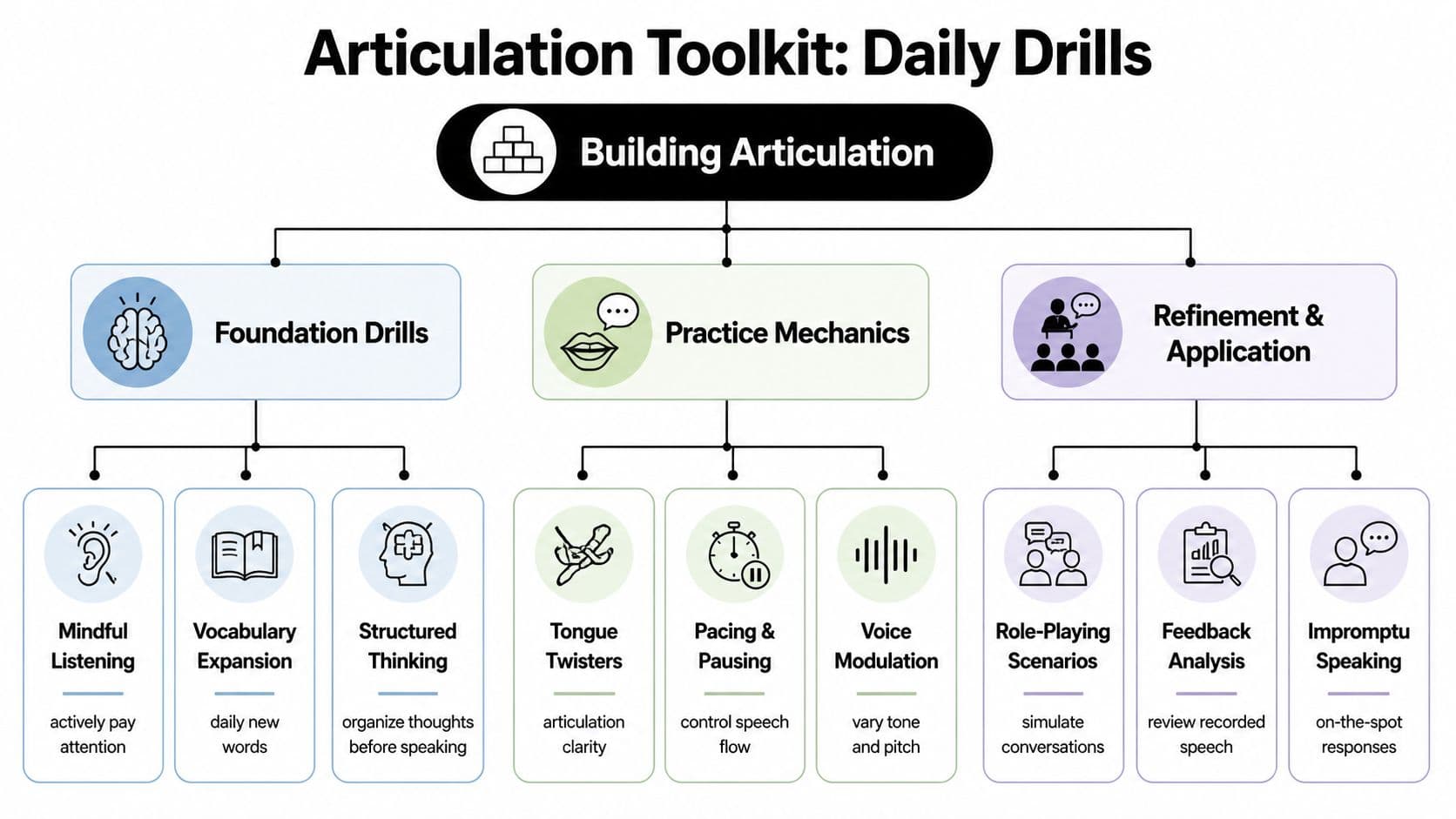
Train your mouth and voice
Some speaking problems are mental. Some are physical. If your mouth barely moves, your words won’t land cleanly no matter how smart the thought is.
Build a short daily vocal routine:
- Over-articulation reading: Read a paragraph aloud and exaggerate each syllable more than feels natural.
- Sentence-end control: Read ten sentences and make sure the final word is as audible as the first.
- Pace resets: Speak a short answer, pause, then repeat it more slowly without becoming flat.
- Projection practice: Speak to the back of the room, even if you’re alone.
One of the more practical references on this comes from VirtualSpeech’s guide to using statistics in speeches, which notes that speakers who slow delivery while citing numbers achieve 45% higher comprehension rates, and that integrating specific, sourced statistics increases persuasion by 35% on average. The broad lesson is simple. Pace is not cosmetic. Pace changes whether people can process what you said.
Build active vocabulary, not decorative vocabulary
A lot of people try to sound articulate by choosing bigger words. That usually backfires.
Articulation isn’t about sounding more academic. It’s about being easier to understand. You want a larger active vocabulary, meaning words you can use accurately and naturally under pressure.
That requires context, not memorization.
Try this approach:
- Pick one useful word a day: Not obscure. Useful. Words like “constraint,” “trade-off,” “sequence,” “friction,” “viable,” “ambiguous.”
- Write it in three sentences: One work sentence, one casual sentence, one explanation sentence.
- Use it in conversation the same day: The goal is retrieval, not recognition.
- Keep a “default replacements” list: Replace weak habits like “thing,” “stuff,” and “a lot” with more precise language.
Better articulation usually sounds simpler, not fancier.
Structure your thoughts before they leave your mouth
The biggest gains for busy professionals are made here.
If your ideas feel clear in private but messy in conversation, you probably don’t need more confidence. You need a structure you can use fast. My go-to for everyday workplace communication is PREP:
- Point
- Reason
- Example
- Point again
If someone asks, “Why should we delay this launch?” a scattered answer wanders through five concerns. A structured answer sounds like this:
Point: We should delay the launch.
Reason: The onboarding flow still creates confusion for first-time users.
Example: In testing, the same friction point keeps showing up when people try to complete setup.
Point: If we launch now, we’ll create avoidable support load and a weak first impression.
That’s not theatrical. It’s just clear.
If your real challenge is speed under pressure, this guide on how to think faster is helpful because it treats quick thinking as a skill built through simplification and pattern use, not as some inborn talent.
Use a weekly schedule you can repeat
You don’t need an elaborate program. You need a rhythm that survives busy weeks.
Here’s a practical template.
| Day | Focus Area (15-20 Minutes) | Example Exercise |
|---|---|---|
| Monday | Vocal clarity | Read aloud with exaggerated articulation and strong sentence endings |
| Tuesday | Thought structure | Answer three work questions using PREP |
| Wednesday | Impromptu speaking | Record a short response to a random prompt with no notes |
| Thursday | Listening and paraphrasing | Listen to a short talk and restate the argument in your own words |
| Friday | Vocabulary activation | Practice new words in short spoken examples |
| Saturday | Real-world simulation | Rehearse a meeting update, client answer, or presentation opener |
| Sunday | Review | Listen back to recordings and note one improvement area |
Keep the drills small enough to sustain
Individuals often overestimate how much practice they need in one sitting and underestimate what daily repetition can do.
You do not need marathon sessions. In fact, long practice blocks often create avoidance. Short drills win because they lower resistance. You can fit them before your first meeting, during a walk, or between work blocks.
The pattern that works is usually:
- small enough to start,
- specific enough to measure,
- frequent enough to become automatic.
Add feedback before you trust your own ears
Self-review matters, but it has limits. You’ll miss habits that listeners catch instantly. Build a simple feedback loop.
Ask a trusted colleague or friend to react to one recording and answer only these:
- What was clear
- What was hard to follow
- Where I sounded uncertain
That’s enough. Don’t ask for a full performance review. You want signal, not noise.
What doesn’t work
Some popular strategies waste time because they feel productive without changing actual speech.
Avoid these traps:
- Consuming endlessly: Watching speaker videos doesn’t replace speaking.
- Memorizing scripts for normal conversations: It creates stiffness and panic when someone interrupts.
- Trying to remove every filler immediately: If you focus on sounding flawless, you’ll often sound less natural.
- Using “smart” words you don’t own yet: You’ll hesitate, misuse them, or sound borrowed.
The best drills make your speech cleaner without making you sound rehearsed. That’s the line to watch.
Translate Practice into Real World Conversations
Practice alone is controlled. Meetings, interviews, pitches, and difficult conversations aren’t. Someone interrupts, changes the question, or asks for your view before you’re ready. That’s where articulation has to hold.
The shift is this. Stop thinking of a conversation as a place where you generate brilliance from scratch. Treat it as a place where you deliver prepared patterns flexibly.

Use story and data together
A lot of professionals lean too hard in one direction. They either sound dry because they only list facts, or they sound vague because they only tell stories.
The strongest communicators combine both.
A Harvard Business School summary of research on stories and memory found that people are 40-50% more likely to recall information over 24 hours when it’s presented as a narrative, and it notes that memorable communication correlates with 25% better funding success rates in startup pitch settings. The practical takeaway isn’t “be dramatic.” It’s “give the fact a human shape.”
Instead of saying, “The rollout created friction,” say, “On day two, our support lead flagged that new users were getting stuck at the same step, and that’s when we saw the pattern.” Same point. Better retention.
Prepare your BME before important conversations
For live speaking, I like Beginning, Middle, End because it prevents drift.
Before a meeting, write three brief lines:
- Beginning: What is the main point?
- Middle: What support matters most?
- End: What should the listener remember or do next?
This works especially well for status updates, objections, and recommendations.
If you’re asked a hard question, your answer doesn’t have to be long. It has to land. BME helps you avoid the classic mistake of starting in the middle, wandering through context, and ending without a conclusion.
If you can’t state your point in one line before the meeting, you probably won’t state it clearly during the meeting.
Rehearse for pressure, not perfection
A common mistake is rehearsing one polished version and assuming that’s enough. Real conversations are messy. Better rehearsal includes variation.
Try these drills before a high-stakes interaction:
- Record three versions of the same point: one short, one detailed, one conversational.
- Answer your own idea badly on purpose: then tighten it until it sounds clean.
- Practice interruption recovery: stop halfway through, then restate your point in one sentence.
- Prepare one example, one fact, and one conclusion: that gives you range without overloading your memory.
If public speaking itself is part of the problem, Model Diplomat’s public speaking guide is a useful companion because it focuses on delivery under audience pressure, not just theory.
Make your points easier to carry
People remember compact ideas. They don’t remember sprawling explanations with no spine.
A useful test is whether your answer contains a sentence someone else could repeat after the meeting. For example:
- “The issue isn’t effort. It’s sequencing.”
- “We don’t need more options. We need a clearer decision.”
- “The risk is less about quality and more about timing.”
These are not slogans. They’re anchors. Once you have one, you can expand with evidence and examples.
Here’s a useful speaking reset to practice with:
Know the trade-off in live communication
Highly articulate people are not always saying more. Often, they’re cutting more.
That means accepting a trade-off. In the moment, you may leave out an interesting side point to protect the main point. You may choose a simpler phrase over a more exact but clunkier one. You may pause instead of filling silence. Those choices can feel risky if you’re used to equating more words with more intelligence.
In real conversations, concise usually sounds more confident than exhaustive.
Navigate Brain Fog Anxiety and ADHD
A lot of articulation advice assumes your brain is calm, linear, and consistently available. For many people, that’s not reality.
Some days the issue isn’t knowledge or vocabulary. It’s brain fog, anxious overactivation, or ADHD-style overload. You know what you want to say, but the path from thought to speech gets crowded. Generic advice like “just slow down” can feel almost insulting when your brain is sprinting or stalling.

Generic speaking advice often fails here
The problem with standard articulation tips is that they focus on output while ignoring cognitive setup.
For the 4.4% of adults with ADHD, generic articulation advice often misses the mark. A source summarized by MasterClass on becoming more articulate notes that a 2025 Journal of Neurodiversity study found external accountability such as micro-task delegation boosted practice adherence by 62% for knowledge workers with ADHD.
That fits what many professionals already know from lived experience. When executive function is inconsistent, the challenge isn’t understanding what to do. It’s reliably initiating, sequencing, and returning to the task.
Externalize before you verbalize
If your thoughts get slippery under pressure, stop trying to hold everything in your head.
Use one of these before a meeting:
- A three-line note: main point, support, ask.
- A quick whiteboard map: question in the center, key branches around it.
- A voice memo draft: say the answer once privately before you say it publicly.
- A parking lot list: write down side thoughts so they stop hijacking the main thread.
For ADHD in particular, this kind of external scaffolding often matters more than another speaking trick. Time structure matters too. If that’s a recurring issue for you, this guide to time management for adults with ADHD is worth reading because communication practice tends to fail for the same reasons other routines fail.
Use anxiety management that fits the moment
When anxiety spikes, the goal is not to become perfectly calm. The goal is to become functional enough to stay coherent.
Try a short pre-speaking reset:
- Feel both feet on the floor.
- Exhale longer than you inhale for a few breaths.
- Say the first sentence of your point to yourself.
- Start with the conclusion, not the backstory.
That last step matters a lot. Anxious speakers often begin by circling the point because they’re trying to ease into it. That usually makes them sound less confident than they are.
Speak from the clearest sentence you have, not from the nervous buildup around it.
Respect medical and cognitive context
Sometimes “I can’t think clearly” isn’t just nerves or poor habits. Medication changes, sleep disruption, stress, or mood issues can all affect verbal clarity. If brain fog is new, intense, or tied to treatment changes, it makes sense to look at that directly instead of blaming your personality.
For readers dealing with medication-related fog, this Florida psychiatrist’s Wellbutrin fog guide offers a practical medical perspective on what to watch for and when to get support.
The bigger point is simple. If your brain is under strain, articulation training still helps, but it has to be compassionate and realistic. Smaller reps. More external supports. Less shame.
Create a System for Lasting Improvement
Motivation is unreliable. Calendar pressure, fatigue, and normal life will beat motivation most weeks. If you want to become more articulate for good, build a system that keeps working when enthusiasm disappears.
That means treating articulation like any other professional capability. You track it, schedule it, review it, and improve it in cycles. You don’t wait to “feel on.”
A useful reminder comes from Working Voices on becoming more articulate, which reports that among 500 professionals, consistent vocal precision training led practitioners to 92% “gravitas” scores compared with a 45% baseline for the untrained. The point isn’t the label. The point is that systematic practice changed how people were perceived.
Build a loop, not a streak obsession
A lot of ambitious people sabotage themselves by designing fragile routines. They create a perfect daily plan, miss two days, then abandon the whole thing.
A better system has four parts:
- Cue: attach practice to something that already happens, like your first coffee or your post-lunch reset.
- Action: keep the drill short and specific.
- Review: listen back or jot one note immediately after.
- Adjustment: decide the next focus area based on what happened.
That creates continuity without turning the process into a guilt machine.
Use different environments for different goals
Not every articulation workout should happen in the same context.
Use this split:
| Environment | Best for | Example |
|---|---|---|
| Solo practice | mechanics | articulation drills, pacing, recording |
| Written prep | structure | tightening your main point before a meeting |
| Live conversation | transfer | using PREP or BME under pressure |
| Feedback session | refinement | asking what sounded unclear or uncertain |
A significant issue is that people often stay in the safest environment too long. They get good at journaling, outlining, or practicing alone, then wonder why live conversations still feel hard. Transfer requires exposure.
Keep one scorecard
You do not need a dashboard full of metrics. Keep one page and track only what affects your speech most.
For example:
- Main issue this week
- One situation where I handled it better
- One recurring breakdown
- Next drill to run
That’s enough to create momentum. It also prevents the common problem of practicing randomly and hoping something improves.
Build accountability outside your own head
If you’ve ever promised yourself you’d practice and then let the week disappear, you already know the limit of self-managed improvement.
Use accountability that matches your personality:
- A colleague if you want direct workplace relevance.
- A speaking group if you need regular exposure.
- A friend with blunt ears if you want honest reactions without ceremony.
- A recurring calendar appointment if social accountability makes you resist.
What matters is consistency, not grandeur. The feedback loop should be light enough to keep using.
Protect your best speaking energy
Articulation isn’t only built in practice. It’s also protected by how you manage your day.
If you know you speak poorly when mentally scattered, don’t schedule your hardest conversations in the most fragmented hour you have. If you need ten quiet minutes before a client call to organize your thoughts, take them. If back-to-back meetings wreck your verbal clarity, stop pretending you can outperform your cognitive state.
That’s not weakness. That’s operational awareness.
Judge progress by clarity under pressure
A lot of people only notice improvement when they sound polished. That’s too narrow.
Better markers are:
- you answer faster without rushing,
- you recover more cleanly when interrupted,
- you need fewer words to make the same point,
- people ask fewer clarifying questions,
- you leave meetings feeling accurately represented.
That’s what lasting improvement looks like in working life. Not performance. Reliability.
If you want a practical way to support that consistency, Fluidwave can help you turn articulation practice into a real system instead of another intention that slips. You can organize short drills, set priorities, and delegate prep tasks so the admin around improvement doesn’t eat the energy you need for the actual speaking work.
Focus on What Matters.
Experience lightning-fast task management with AI-powered workflows. Our automation helps busy professionals save 4+ hours weekly.