Tired of goals that go nowhere? Download our free goal setting template, built on the SMART framework, to create an actionable plan for real success.
January 17, 2026 (9mo ago)
A Goal Setting Template to Turn Ambition Into Achievement
Tired of goals that go nowhere? Download our free goal setting template, built on the SMART framework, to create an actionable plan for real success.
← Back to blog
Goal-Setting Template to Turn Ambition into Action
Summary: Download a free SMART-based goal-setting template to turn vague ambitions into an actionable plan with measurable milestones.
Introduction
Tired of goals that go nowhere? Download our free SMART-based goal-setting template to turn vague ambition into a concrete plan you’ll actually follow. This template helps you break big objectives into manageable steps, measure progress, and set deadlines so momentum lasts.
A goal-setting template is a structured guide to help you define, plan, and track what you want to achieve. It turns a vague idea—like “grow the business”—into a concrete roadmap. Think of it as the framework that prevents goals from becoming forgotten resolutions.
Why Most Ambitious Goals Fall Short
We’ve all been there. You get a jolt of inspiration on Monday, set a bold new goal, and by Friday that initial fire has fizzled. It’s rarely about lack of ambition. The real problem is a lack of structure. Without a clear plan, even exciting goals are little more than wishful thinking.
A well-designed goal-setting template changes the game. It’s more than a document; it’s a strategic tool that forces you to think beyond the “what” and drill into the “how.” That clarity is what builds sustainable momentum.

Each stepping stone represents a small, manageable action that leads to a larger achievement, helping you avoid the overwhelm that makes us quit.
The Psychology of Unachieved Goals
Big, audacious goals are exciting, but they can also paralyze us. Their scale can trigger procrastination because our brains don’t know where to start. If you’ve felt that paralysis, our guide on how to overcome procrastination offers practical strategies to get moving. The secret is breaking a massive objective into a series of smaller wins.
This isn’t just theory; data supports it. A large-scale analysis of app user goals showed success rates drop as target difficulty increases: modest, incremental targets are far easier to reach than extreme goals.2
“A goal without a plan is just a wish.” A template provides that plan, giving ambition the structure it needs to survive dips in motivation and unforeseen challenges.
When you feel overwhelmed or lose focus, your template is an anchor: it reminds you what your very next step is, making it easier to regain footing and keep moving forward, one small victory at a time.
Introducing Your Actionable Goal-Setting Template
Knowing the theory is one thing; putting it into action is where results happen. To bridge that gap, we created a downloadable goal-setting template built around the proven SMART framework.3
The impact of having a structured plan is clear: a study from Dominican University found that simply writing down goals increased achievement, and adding action commitments within a structured template raised success rates substantially.1
Breaking Down the SMART Framework
Our template walks you through each part of SMART, prompting specifics so you build a realistic plan.
| Component | What It Means | Key Question to Ask |
|---|---|---|
| Specific | Vague goals don’t work. Be crystal clear about the target. | What exactly do I want to accomplish? Who is involved? |
| Measurable | You can’t improve what you don’t measure. Use tangible metrics. | How will I know when I’ve reached my goal? |
| Achievable | Stretch, but don’t overreach. Goals should be realistic with available resources. | Is this goal realistic with my current resources and time? |
| Relevant | Align the goal with bigger priorities so effort moves the needle. | Does this goal contribute to my larger objectives? Why now? |
| Time-bound | A deadline creates urgency and focus. | When will this be completed? What are the milestones? |
This framework isn’t about ticking boxes; it’s a way to make your efforts focused and effective.
Here’s a sharper look:
- S — Specific: Instead of “increase sales,” define “increase Q3 sales of Product X by 15% via targeted social campaigns.”
- M — Measurable: Choose metrics—website visitors, leads, revenue—so you can track progress.
- A — Achievable: Be honest—is the goal realistic with your resources? Realistic goals build momentum; impossible ones lead to burnout.
- R — Relevant: Ensure the goal supports long-term objectives. Visualize it with a project roadmap.
- T — Time-bound: Deadlines keep goals from getting lost in day-to-day tasks.
A strong template asks not only what you want to achieve, but how you’ll get there and why it matters.
This approach turns ideas into outcomes and helps you prioritize what to do first. For more on prioritization, see our guide on a project priority matrix template.
Putting Your Goal-Setting Template to Work
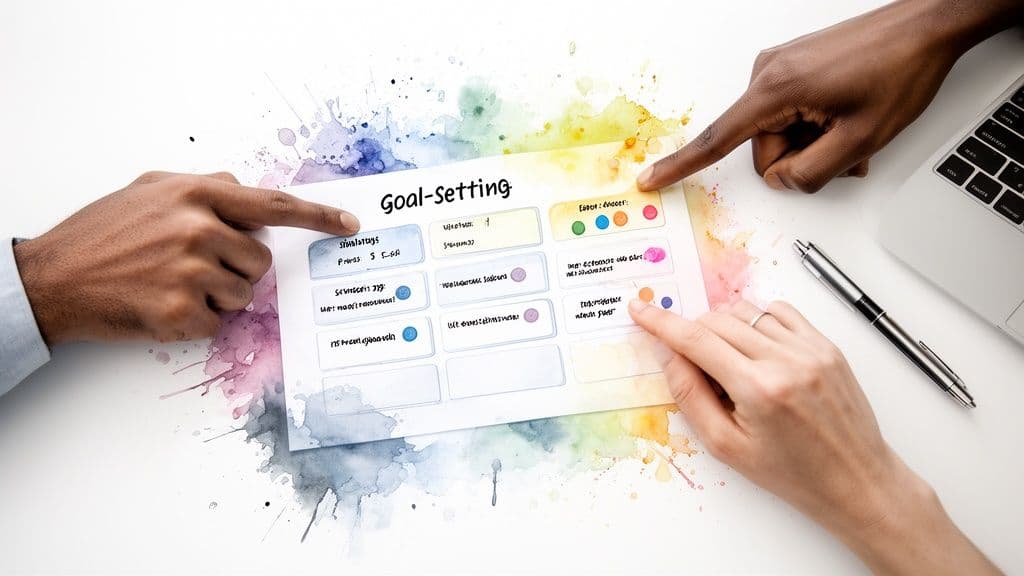
A template is a start; real progress comes from using it. Think of the template as a living guide, not a one-time form.
Scenario One: The Solo Entrepreneur Launch
Alex, a solo entrepreneur, wants to launch a new digital course. “Launch the new course” is vague and unhelpful.
Using the SMART template, Alex creates a clear plan:
- Specific: Launch “Productivity for Creatives” with video content, workbooks, a sales page, and a three-week promo campaign.
- Measurable: Enroll 100 students and generate $25,000 in the first month.
- Achievable: Alex has a 2,000-subscriber email list and validated demand.
- Relevant: The course diversifies revenue beyond coaching.
- Time-bound: Launch on October 1.
From there Alex sets milestones: outlines by July 15, recording by August 30, promotional emails scheduled by September 20. A big project becomes manageable.
Scenario Two: The Project Manager Deadline
Maria’s team must deliver a new billing feature. “Finish the billing feature” lacks clarity.
Using the template:
- Objective: Deploy automated invoicing to all paying customers by end of Q3.
- Key Result: Reduce manual invoicing errors by 95% and billing-related support tickets by 40% within 60 days of launch.
- Milestones:
- Backend complete by August 1.
- UI integration by August 20.
- Internal testing by September 10.
- Deploy September 30.
This structure lets Maria assign tasks, track progress, and spot delays early.
Scenario Three: The Department Head Initiative
David must “improve operational efficiency.” That’s too broad. He focuses on a specific pain point—too many meetings.
- Specific Goal: Reduce weekly time in recurring internal meetings by 25% across marketing and sales.
- Time-bound: Achieve by the end of Q4.
- Action Steps:
- Audit recurring meetings for value.
- Enforce a “no agenda, no meeting” rule.
- Train team leads on better facilitation.
- Use asynchronous updates for simple status reports.
Good planning is only half the battle; execution and the right skills matter. To improve follow-through, consider mastering executive functioning skills for adults.1
Making the Template Work for Your Brain
A template is a starting point, not a straitjacket. The best system is the one you’ll stick with. Adapt the template to fit how you actually work.
For some, a simple list is enough. For others, especially those with ADHD or neurodivergent traits, a visual, dynamic approach keeps engagement high and overwhelm low.
Making Goals Neurodivergent-Friendly
If your brain processes information differently, standard productivity advice can feel off. Build a system that honors your cognitive style.
Practical strategies:
- Break large tasks into tiny micro-tasks: “Open the doc,” “Write one headline,” “Find one testimonial.” Each small win builds momentum.
- Use visual cues: color-code, add icons, or emojis in your project tool so priorities pop and you can scan at a glance.
- Time-block: Replace an endless to-do list with focused calendar blocks like “Work on course outline, 45 minutes.”
The template should provide clarity, not confinement. If a step doesn’t work, change it until the system reduces friction for you.
Digital tools like Fluidwave let you switch views instantly: map milestones in a list, manage daily tasks on a Kanban board, and track progress visually.
Bringing Your Goals to Life with Digital Tools
A template gives a clear plan, but a document alone won’t produce results. Execution requires turning the plan into a living system.
Move goals into a dynamic tool and your objective becomes a project, action steps become tasks, and progress becomes visible. Kanban boards show flow from “To Do” to “Done,” while calendar views prevent overcommitment.
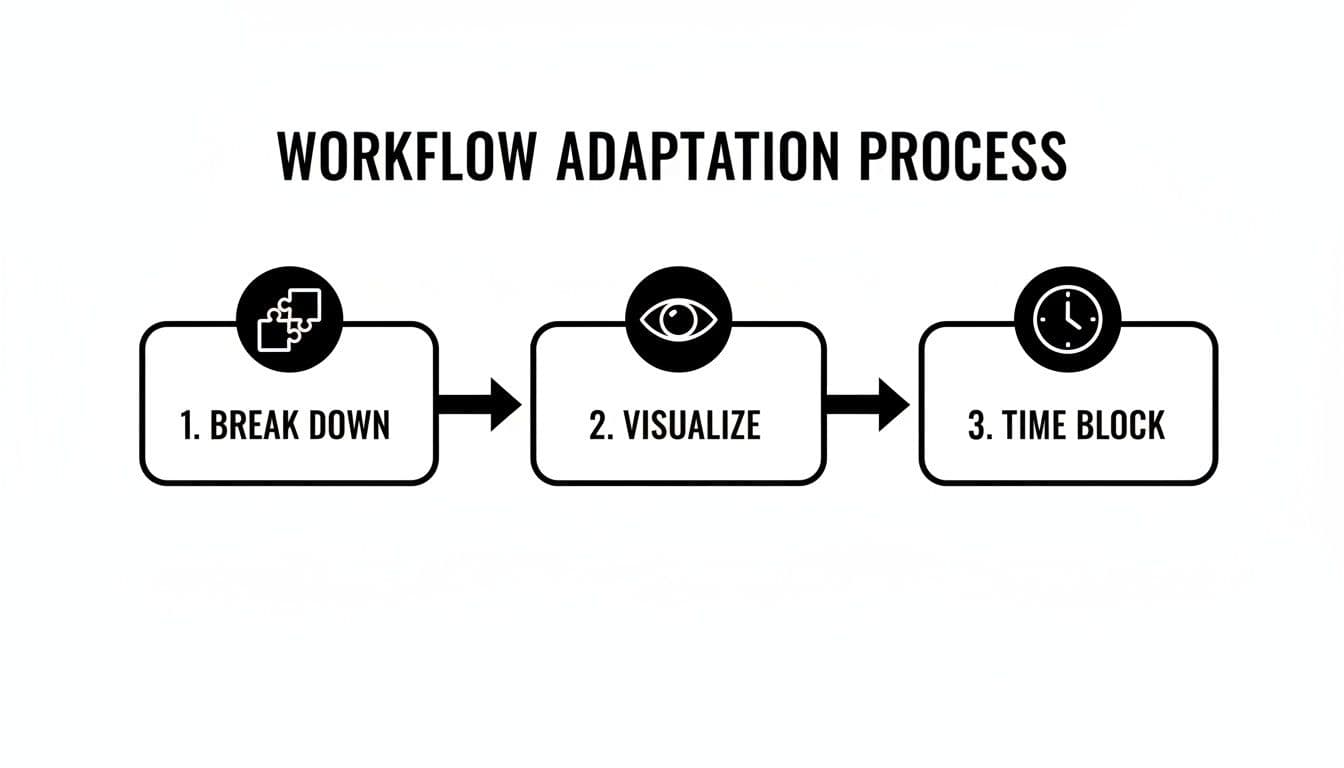
The workflow is simple: break the goal into pieces, visualize the work, then schedule with time-blocking. That moves you from planning to daily execution.
Tapping into Automation and Delegation
Modern project platforms do more than hold tasks; they help you work smarter. AI prioritization can surface high-impact tasks, which is helpful when task lists feel overwhelming.
Delegation is equally powerful. Hand off scheduling, preliminary research, or formatting so you can focus on strategic work that only you can do.
By delegating small tasks, you protect your focus and keep your attention on high-value activities that move the needle.
If you’re choosing a platform, see our task management software comparison to match features to your needs.
A Few Common Questions About Goal Setting
Even with a great template, you’ll hit roadblocks. That’s normal. The goal is a flexible system you improve as you go.
How Often Should I Review My Goals?
Consistency matters. For long-term goals that span quarters or a year, a monthly review is ideal: enough time to make progress, but soon enough to catch problems. For short-term goals, a weekly check-in—ideally Monday morning—keeps priorities aligned.
What If a Goal Is No Longer Relevant?
Pivoting isn’t failure; it’s strategy. Markets, priorities, and opportunities change. If a goal no longer fits, document why it’s no longer important so you learn from it, then use the template to set a more relevant objective.
Can I Use This Template for Personal Goals?
Absolutely. The same principles—clarity, measurement, accountability—apply to personal goals like training for a marathon or learning a language. Break the dream into small steps and track progress the same way.
Ready to turn goals into a dynamic workflow? Fluidwave combines goal planning with execution tools so progress becomes visible and achievable. Start for free on Fluidwave.
Frequently Asked Questions
Q: How do I make a vague goal actionable? A: Use the SMART template to add specificity, measurable metrics, realistic constraints, relevance to bigger objectives, and clear deadlines.
Q: How often should I check progress? A: Monthly reviews for long-term goals and weekly check-ins for short-term objectives keep momentum and let you correct course early.
Q: What if I get stuck or overwhelmed? A: Break tasks into micro-steps, use visual cues, time-block focused work, and delegate smaller tasks so you can stay on strategic priorities.
1.
Dominican University study on goal-setting and commitments: https://www.dominican.edu/academics/graduate/master-business-administration/goal-setting-study
2.
Analysis of goal difficulty and user success rates from app data: https://www.noom.com
3.
Origin and description of the SMART framework (Doran, 1981): https://en.wikipedia.org/wiki/SMART_criteria
Focus on What Matters.
Experience lightning-fast task management with AI-powered workflows. Our automation helps busy professionals save 4+ hours weekly.