Explore 10 examples of goals and objectives for work, with SMART templates, role-specific examples, and practical ways to track progress.
October 7, 2026 (Today)
10 Examples of Goals and Objectives for Work
Explore 10 examples of goals and objectives for work, with SMART templates, role-specific examples, and practical ways to track progress.
← Back to blog
“Be more productive” sounds ambitious, but it gives nobody enough information to act. Who owns the outcome? What does better look like? When should it happen, and what evidence will show that the work improved? The same problem affects “communicate better,” “take more initiative,” and “improve customer service.” Without a baseline, deadline, and observable result, these statements remain intentions rather than commitments.
A goal gives work direction, such as improving operational efficiency or building team capacity. An objective turns that direction into a measurable result with an owner, target, timeframe, and method. The SMART lens, specific, measurable, achievable, relevant, and time-bound, helps expose missing details. The Office of Personnel Management's SMART guidance also emphasizes that a useful goal should identify what's expected and how progress will be judged.
The following examples of goals and objectives for work are written for real planning conversations, performance reviews, team meetings, and daily workflows. Adapt the target to your baseline, assign one owner, and turn the first step into a task. A practical planning principle, also reflected in this leadership guide to Think and Grow Rich, is that intention becomes useful only when it directs repeated action.
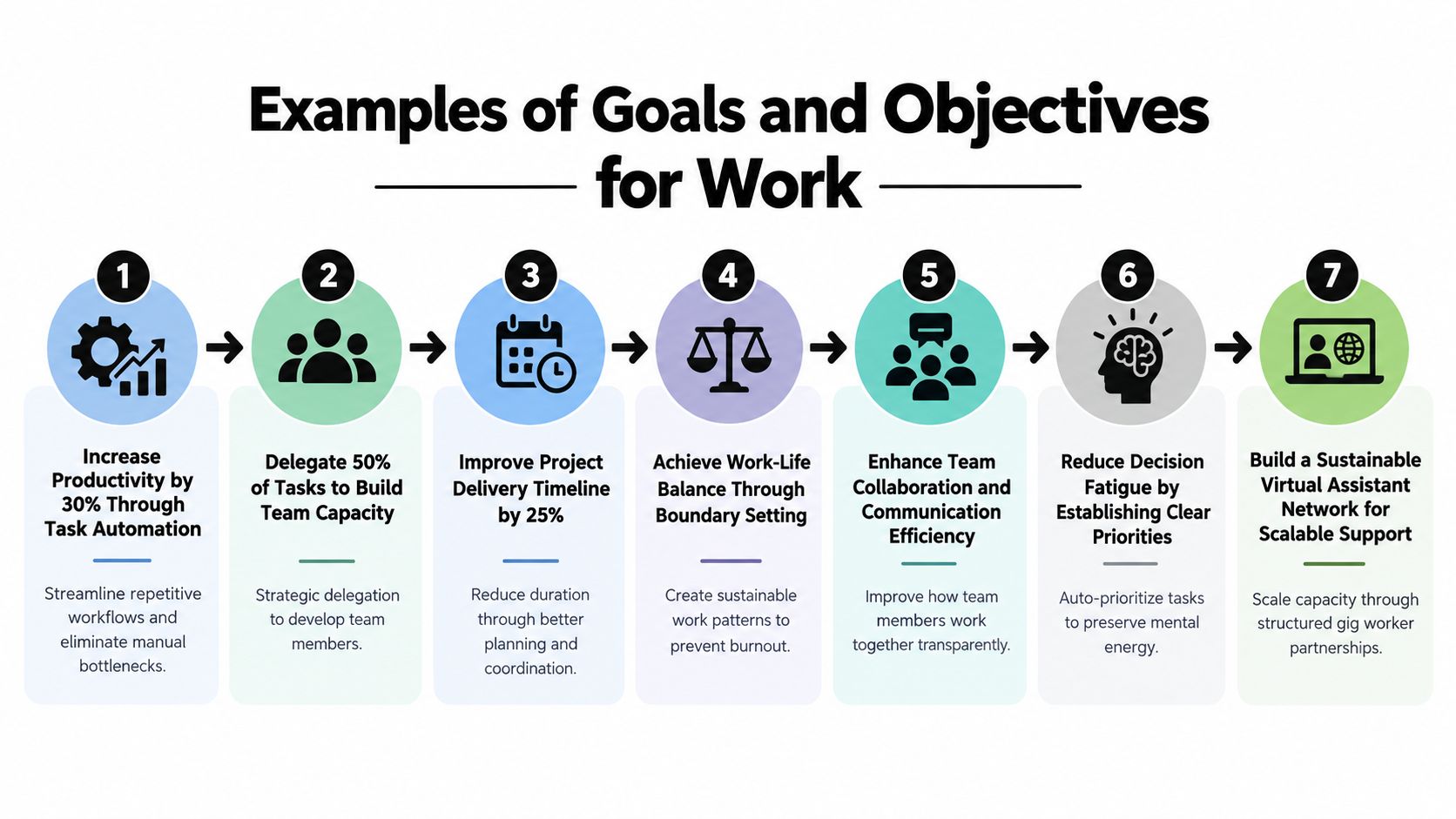
1. Increase Productivity by 30% Through Task Automation
Repetitive administration consumes attention long before it becomes visible as a major business problem. A marketing team may schedule email campaigns manually, a finance team may update invoice statuses by hand, and a project manager may spend the morning sorting tasks instead of resolving dependencies.
A copy-ready objective could be: “Increase productive output by 30% within the next quarter by automating recurring scheduling, status updates, and task-routing workflows, while maintaining the current quality standard.” Treat the percentage as a target to validate against your own baseline, not as a guaranteed result. Choose one primary measure, such as completed priority deliverables per week or administrative hours released, and pair it with a quality check.
Start by documenting the existing process. Automation built on an unclear process only makes confusion happen faster. Fluidwave's guidance on automating tasks can support the transition from repeatable steps to defined workflows.
Practical rule: Automate the handoffs that happen often, not the decisions that require judgment.
Use a weekly review to inspect failed rules, delayed inputs, and rework. Keep a distraction-free interface for the manual work that remains, and share small wins so the team sees automation as capacity creation rather than job replacement.
The target only matters if the freed capacity moves somewhere valuable. Redirect it to analysis, customer work, planning, or quality improvement. A productivity objective that produces more low-value output hasn't solved the underlying problem.

A finance lead could automate invoice intake and status notifications, while a project manager could route urgent work based on deadlines and dependencies. In each case, the useful objective names the process, the expected change, the review period, and the quality safeguard.
For an additional perspective on productivity and technology teams, see this guide to improving employee productivity.
2. Delegate 50% of Tasks to Build Team Capacity
Delegation fails when a manager treats it as dumping unwanted work. It works when the task has a clear owner, a defined result, enough context, and an appropriate level of authority. The person delegating should gain capacity, while the person receiving the work should gain practice, visibility, or a manageable responsibility.
A useful objective is: “Delegate 50% of eligible repeatable tasks within the next quarter, while maintaining agreed quality standards and reviewing acceptance and revision rates each week.” The target is a planning choice. Establish the baseline first by listing recurring tasks, their frequency, and the level of judgment they require.
Start with calendar coordination, research compilation, data entry, customer-service triage, or routine document preparation. Don't delegate a vague outcome such as “handle my admin.” Write a brief that includes the desired result, source materials, deadline, examples, and definition of done. Fluidwave's delegation guidance is relevant when a leader needs to separate suitable tasks from work that still requires personal judgment.
Make delegation a development system
An executive assistant can manage meeting logistics. A founder can route common customer questions to a virtual assistant. A product manager can delegate research compilation while retaining responsibility for the decision. A freelancer can hand off administration and protect time for client deliverables.
Review the first completed tasks closely, then reduce oversight as reliability improves. Track acceptance rate, revision rate, and cost per completed task, rather than measuring delegation by the number of tasks handed over. A cheap handoff that creates repeated corrections isn't capacity building.
Fluidwave supports task assignment and real-time visibility, including delegation to assistants on a pay-per-task basis. That model can help a lean team control spending, but leaders still need to budget for briefing, review, and relationship management. The objective succeeds when the work leaves the manager's queue without leaving the organization exposed.
3. Improve Project Delivery Timeline by 25%
A delayed project rarely has one cause. Dependencies arrive late, decisions remain unclear, low-value tasks stay in scope, and no one sees which blocked item is holding up the next stage. Improving delivery time requires more than asking people to work faster.
Write the objective as: “Improve the project delivery timeline by 25% by the end of the next planning cycle by mapping dependencies, removing non-critical work, and reviewing timeline risks weekly.” Compare actual completion dates with the original plan, and record why dates moved. Otherwise, the team may appear faster just because it keeps changing the plan.
A software team might shorten a delivery cycle by separating discovery, development, and review dependencies more clearly. A marketing agency could run copy, design, and approval work in parallel where the handoffs allow it. A product launch team might assign blocking research to a delegate while the core team resolves strategic decisions.
Use a visual workflow to identify where work waits. Fluidwave's project timeline guidance can help structure milestones, owners, and dependencies before the team commits to a date.
Protect the critical path
Review the project weekly with one question: what could prevent the next meaningful milestone? Remove tasks that don't affect the outcome, escalate blocked decisions, and assign dependencies to people who can act on them. A Kanban view can make queues and bottlenecks easier to see, while a calendar view helps expose deadline collisions.
Don't measure success only by elapsed time. Track delivery quality, rework, and stakeholder acceptance alongside the schedule. A faster project that produces corrections, missed requirements, or exhausted staff has transferred the cost rather than removed it.
Fluidwave can give project leads a shared view of tasks and progress, while delegation can clear routine blocking work. The important management decision remains scope. If the deadline is fixed, something else may need to be deprioritized.
4. Achieve Work-Life Balance Through Boundary Setting
Work-life balance is an operating constraint that defines how much work can be completed without turning every evening into overflow time. A useful boundary objective protects capacity while keeping service levels and quality intact.
Try this wording: “Reduce client response time from 48 hours to 24 hours by the end of Q3 while limiting active projects to five, delegating eligible administration, and reviewing workload assumptions each week.” The response-time target and project limit are examples, not universal standards. Adjust them to the role's service agreement, complexity, and available support.
Measure both output and strain. Track response time, active-project count, after-hours work, and missed commitments. Workload research consistently points to heavy demands, unclear expectations, and uneven distribution as common pressure points. State what will be stopped, capped, reassigned, or renegotiated before accepting more work.
Protect meeting-free blocks for strategic tasks. Set a daily task limit based on energy and complexity, define response windows, and use a shutdown ritual to close open loops. Fluidwave can provide a shared workload view that makes competing commitments visible and supports prioritization, delegation, and follow-through. The setup takes discipline, but it gives managers evidence before capacity is exceeded.

A boundary that exists only in your head will not guide colleagues. Tell stakeholders when you are available, what qualifies as urgent, and how to request exceptions. Some work will wait. That delay is preferable to accepting everything and delivering unpredictably.
5. Enhance Team Collaboration and Communication Efficiency
Teams don't usually need more communication. They need fewer unclear handoffs, better task context, and a shared understanding of who decides what. A collaboration objective should reduce coordination friction without creating another reporting ritual.
A practical wording is: “Improve cross-functional handoff quality during the next quarter by documenting owners, acceptance criteria, and next actions for every priority task, then reviewing unresolved blockers in a weekly team session.” Choose a supporting measure that fits the problem, such as decision turnaround, reopened tasks, or stakeholder-reported clarity. Don't use meeting count as a proxy for collaboration quality.
A remote software team might replace status-heavy standups with task-based updates. A marketing team can use a shared campaign view showing copy, design, approvals, and launch dependencies. A client-service group can require every handoff to include the client context, requested result, deadline, and known risk.
Make the work speak clearly
Use consistent task names and put relevant background in the task itself. A colleague shouldn't need to reconstruct the assignment from a private message, a meeting recording, and an old email. Archive completed projects so active views remain useful, and establish a short weekly review that focuses on decisions and blockers.
A shared workspace such as Fluidwave can give distributed teams table, list, calendar, Kanban, and card views of the same work. The value comes from agreeing which view answers which question. A calendar shows timing, a Kanban board shows flow, and a task description preserves context.

Don't confuse visibility with surveillance. Teams should help decide which indicators matter, and managers should use progress information to remove obstacles rather than interrogate activity. Clear communication makes work easier to review, but it doesn't eliminate the need for judgment.
6. Reduce Decision Fatigue by Establishing Clear Priorities
A crowded task list creates another job: deciding what deserves attention. The cost is highest for knowledge workers, people with ADHD, and professionals balancing different deadlines, dependencies, urgency levels, and cognitive demands.
A practical SMART objective is: “Reduce time spent choosing the next task during the next quarter by establishing priority rules based on deadline, business value, and dependency risk, then reviewing the system weekly.” Track progress with a short work log, fewer abandoned starts, or clearer weekly planning. A tidier task list alone does not prove that the system works.
Set the rules before pressure arrives. A client issue may outrank internal improvement work, while a dependency-blocking task may outrank a quick task that is easy to finish. A startup founder might limit active priorities to a small group of high-impact commitments instead of giving every request equal weight.
A system that labels every task urgent isn't prioritizing at all. It shifts the anxiety directly to the worker.
Use Fluidwave's focus view to narrow attention to the next meaningful task. Kanban columns, labels, and color coding can speed recognition when the team agrees on what each signal means. Automated sorting handles routine cases, while people review exceptions, competing deadlines, and trade-offs that require judgment.
Write the objective into a review or planning document as: “I will apply the agreed priority rules, review exceptions weekly, and record where deadline, value, or dependency risk changed the order of work.”
A weekly review keeps the system current without forcing a complete rebuild each morning. New deadlines, dependencies, or customer escalations may change the order. The goal is a reliable decision filter that preserves mental energy for requests no fixed ranking can resolve.
7. Build a Sustainable Virtual Assistant Network for Scalable Support
A virtual assistant network becomes useful when it operates as a system, not as a series of rushed requests. Entrepreneurs, consultants, freelancers, and startup founders often need flexible support before they need a permanent hire, but inconsistent briefs and unclear standards can erase the benefit.
A copy-ready objective is: “Build a reliable network of virtual assistants for recurring overflow work during the next planning cycle, with documented task templates, quality criteria, and predictable review steps.” Define reliability through accepted work, revision patterns, response quality, and cost against the available budget. Avoid promising a particular network size unless your workload justifies it.
Start with small, well-defined tasks such as scheduling, bookkeeping preparation, research compilation, or formatting. Give each assistant a complete brief and a realistic deadline. Review early work carefully, explain what needs to change, and retain people who consistently understand the standard.
Design for continuity
Create templates that explain the task, inputs, process, output, and definition of done. Document exceptions because assistants need to know when the normal process no longer applies. Keep two or more preferred contacts where continuity matters, but don't create unnecessary competition for work.
Pay fairly and promptly, and match the task to the assistant's skills. A low-cost handoff isn't successful if it requires extensive rewriting. Fluidwave's delegation features can help organize requests, budgets, timelines, and progress in one workflow.
The staffing agency automation guide offers a broader view of how structured systems can support staffing workflows. The practical lesson is simple: scale the process before scaling the volume.
A manager should remain accountable for sensitive information, final approvals, and customer-impacting decisions. Delegation increases capacity when the boundaries are explicit. It creates risk when responsibility is assumed to have transferred along with the task.
8. Master Personal Knowledge Management and Information Capture
Important information disappears when nobody records the context behind a decision. A product manager remembers why a feature was postponed, a consultant recalls which recommendation worked for a client, and a marketer knows which campaign assumption failed, but the wider team can't use that knowledge if it remains in memory or scattered messages.
Write the objective as: “Improve work knowledge capture during the next quarter by recording decisions, source context, and reusable lessons in the task system, then reducing the time needed to retrieve information for recurring work.” The measure could be search time, repeated questions, or the number of decisions that include a documented rationale.
Capture context when creating or closing a task, not weeks later. Use consistent names and tags, and record why a decision was made, not only what the team chose. Product teams can keep feature decisions in task histories. Legal professionals can organize case documentation, while marketing teams can record campaign learnings alongside deliverables.
Store information where work happens
A task history is more useful than a separate document that no one remembers to open. Link supporting files, note unresolved assumptions, and identify the person who can clarify an exception. Review and archive old work so the active workspace remains navigable.
Templates can prompt people to record the owner, decision, evidence, alternatives considered, and follow-up date. Don't turn every task into a miniature report. Capture enough context for another person to understand the work without recreating the original conversation.
This objective improves more than retrieval. Documented reasoning helps managers review choices, helps new team members learn, and prevents the organization from repeating the same investigation. The trade-off is setup time. A lightweight capture habit usually works better than a complex knowledge base that nobody maintains.
9. Develop Consistent Deep Work Blocks for Complex Problem-Solving
Complex work needs more than an empty task list. Engineers need uninterrupted time to solve difficult technical problems, designers need sustained attention for concept development, and writers need enough continuity to produce coherent work. Frequent notifications and fragmented meetings make that work harder to start and harder to finish.
A useful objective is: “Complete consistent protected deep-work blocks during the next quarter for priority analytical, creative, or strategic work, while tracking completed sessions and the quality of the resulting deliverables.” Begin with a block that fits the role, then adjust it based on evidence. A long calendar reservation isn't useful if urgent interruptions make it impossible to honor.
Schedule focus time like a client meeting. Tell colleagues when you're unavailable, turn off unnecessary notifications, and create a short ritual that signals the start of concentrated work. An engineer might protect morning coding time, while a strategist might reserve a recurring planning session before operational meetings begin.
Measure output, not just time
Track whether the session produced a meaningful next step, draft, decision, or resolved problem. Hours alone can reward sitting at a desk without progress. A short, well-prepared block may be more valuable than a longer session filled with context switching.
Fluidwave's focus-oriented views can limit the visible task choices during a work block. Keep only the relevant project and next action in view, then return to the wider task system when the session ends.
Build breaks into longer sessions and protect recovery time. Deep work isn't a justification for ignoring messages indefinitely, and it shouldn't become another performance quota. The aim is to create reliable conditions for work that cannot be completed well in fragments.
For people with ADHD or other cognitive differences, flexibility matters. Visual cues, clear definitions of done, and a fallback plan can make the objective measurable without demanding one universal productivity style.
10. Create Accountability and Transparency Through Progress Tracking
Progress tracking should expose problems early, not turn busyness into a performance target. A useful system shows outcomes, owners, blockers, and decisions, while leaving room for professional judgment. The work problem is usually unclear status: managers discover delays late, and employees hesitate to request help.
Use a SMART objective such as: “Improve delivery predictability during the next quarter by making priority work visible, reviewing blockers regularly, and tracking completion against agreed deadlines without using activity volume as the primary performance measure.” Measure on-time completion, overdue work, blocked-task duration, and quality acceptance. These indicators combine speed with whether the finished work meets the agreed standard.
A remote team might display milestones on a shared dashboard. An engineering team could track sprint commitments and unresolved dependencies. A client-service team could show pending approvals. Cross-functional groups can use shared calendars and task views to identify scheduling conflicts before they become missed commitments.
Copy-ready review wording: “I kept priority work visible, raised blockers during scheduled reviews, and adjusted commitments when scope changed. Next quarter, I will improve delivery predictability by reducing unresolved blockers and recording decisions against each milestone.”
Build trust into the review
Explain the tracking purpose before introducing it. Agree on which metrics matter, who can see them, and how managers will respond when work slips. Reviews should focus on blockers, decisions, and changed assumptions. If scope changes, record the change instead of treating the original estimate as a test of character.
Fluidwave's multiple views can make status, ownership, and deadlines easier to inspect. Managers can use that visibility to delegate suitable work, rebalance capacity, or escalate dependencies. Team members should help choose measures that represent meaningful progress.
The International Labour Organization's guidance on performance management emphasizes documented, job-related evidence and objectives agreed between employees and managers. Those practices make accountability less arbitrary. Tracking works fairly when people understand the standard and have a voice in setting it.
10-Point Work Goals Comparison
| Initiative | Implementation Complexity 🔄 | Resource Requirements ⚡ | Expected Outcomes 📊 | Ideal Use Cases 💡 | Key Advantages ⭐ |
|---|---|---|---|---|---|
| Increase Productivity by 30% Through Task Automation | Moderate, process mapping & setup required 🔄 | Medium, automation tools, config time ⚡ | ~30% productivity gain; ~4+ hrs/week recovered; fewer errors 📊 | Busy execs, knowledge workers, finance, marketing 💡 | High, measurable ROI, error reduction, frees time ⭐⭐⭐ |
| Delegate 50% of Tasks to Build Team Capacity | Low–Moderate, clear briefs & change management 🔄 | Low–Medium, pay-per-task assistants; documentation ⚡ | Leader bandwidth freed; scalable team capacity; mentorship opportunities 📊 | Entrepreneurs, founders, freelancers, lean teams 💡 | Medium–High, cost-flexible scaling, develops people ⭐⭐⭐ |
| Improve Project Delivery Timeline by 25% | High, dependency management and discipline 🔄 | Medium, project tools, coordination effort ⚡ | 25% faster deliveries; earlier time-to-market; improved cash flow 📊 | Project managers, product teams, agencies, construction 💡 | High, competitive speed, customer satisfaction ⭐⭐⭐ |
| Achieve Work-Life Balance Through Boundary Setting | Low–Moderate, policy + conversations to set norms 🔄 | Low, time-blocking tools, delegation support ⚡ | Reduced burnout; sustained productivity; improved wellbeing 📊 | Busy professionals, neurodivergent workers, parents 💡 | High, sustainable performance, better health & relationships ⭐⭐⭐ |
| Enhance Team Collaboration and Communication Efficiency | Moderate, standardize processes and training 🔄 | Medium, shared workspace, training time ⚡ | Fewer status meetings; faster decisions; higher satisfaction 📊 | Remote/distributed teams, cross-functional groups 💡 | High, transparency, reduced duplicated work, faster problem solving ⭐⭐⭐ |
| Reduce Decision Fatigue by Establishing Clear Priorities | Low, set criteria and trust system 🔄 | Low, prioritization rules, minimal tooling ⚡ | Faster task starts; less time choosing next actions; preserved focus 📊 | ADHD/neurodivergent, overloaded knowledge workers, founders 💡 | High, clarity, reduced cognitive load, quicker execution ⭐⭐⭐ |
| Build a Sustainable Virtual Assistant Network for Scalable Support | Moderate, vetting, onboarding, relationship mgmt 🔄 | Low–Medium, pay-per-task costs, templates, oversight ⚡ | On-demand capacity; predictable costs; flexible scaling 📊 | Freelancers, solo entrepreneurs, startups scaling support 💡 | Medium–High, scalable without hires, access to diverse skills ⭐⭐⭐ |
| Master Personal Knowledge Management and Information Capture | Moderate, habit change and consistent documentation 🔄 | Medium, time investment, structured tools ⚡ | Faster onboarding; institutional memory; better decisions 📊 | Product teams, consultants, legal, marketing teams 💡 | High, retained knowledge, reduced rework, improved decisions ⭐⭐⭐ |
| Develop Consistent Deep Work Blocks for Complex Problem-Solving | Moderate, scheduling norms and cultural buy-in 🔄 | Low, calendar control, distraction-free tools ⚡ | Higher-quality output; faster complex problem-solving; flow time 📊 | Engineers, designers, writers, strategists 💡 | High, deeper focus, creativity, reduced rework ⭐⭐⭐ |
| Create Accountability and Transparency Through Progress Tracking | Low–Moderate, dashboard setup and norms 🔄 | Medium, dashboards, reporting practices ⚡ | Better predictability; fewer status meetings; early risk detection 📊 | Remote teams, managers, cross-functional projects 💡 | Medium–High, natural accountability, improved resource allocation ⭐⭐⭐ |
Make the Goal Easy to Start and Easy to Review
A strong work objective doesn't need complicated language. It needs enough detail for two people to reach the same conclusion about what should happen, who owns it, and how progress will be judged. The most reliable format is practical:
Define the result. Start with the change you want to create, not the activity you plan to perform. “Improve communication” describes an ambition. “Reduce unresolved handoff questions by documenting the owner, deadline, context, and acceptance criteria for priority tasks” describes a result that a team can observe.
Add a baseline and deadline. A baseline shows where the work starts. A target shows the intended destination. A deadline creates a review point. The Locke and Latham goal-setting research synthesized nearly 400 studies, involving almost 40,000 participants from eight countries across 88 tasks. More than 90% of the studies found that goal setting affected performance, with specific and challenging goals generally outperforming vague “do your best” instructions when people had the capability, commitment, and resources to act.
Name one owner. A team may support the work, but one person should be accountable for moving the objective forward and raising problems. Shared responsibility without a named owner often becomes invisible responsibility.
Choose one or two meaningful metrics. Pair the main outcome with a safeguard when speed could damage quality. A response-time objective might also track rework. A delivery objective might include stakeholder acceptance. The Gallup workplace research synthesis connects engagement with outcomes including productivity, profitability, retention, quality, absenteeism, and safety, which is a useful reminder that output volume is not the whole definition of performance.
Turn the first action into a task. “Automate the workflow” is still too large. “Document the current invoice-intake steps and identify the recurring manual handoffs” gives someone a startable action. Add an owner, due date, source material, and definition of done.
Review the objective weekly, but don't treat the original wording as sacred. Check the baseline, inspect blockers, adjust priorities, and delegate work that another person can complete effectively. If the business changes, the role changes, or a dependency invalidates the plan, revise the objective with the manager rather than continuing toward an obsolete target.
Good goals also protect capacity. The objective should make clear what will be deprioritized when new work arrives, what assumptions need review, and when the team should escalate. A sustainable target is more useful than an ambitious promise that depends on overtime.
For accessible goal setting, define the outcome, next action, preferred work mode, intermediate checkpoint, and fallback plan. A person may produce the same result through focus blocks, visual milestones, written updates, or a different sequence of tasks. Measurability should clarify the result, not force everyone into one working style. The research on workplace accommodations and neurodivergent working practices supports attention to clear communication, prioritization, contingency planning, and flexible approaches.
Finally, keep goals connected to business outcomes and agreed evidence. The International Labour Organization's performance guidance emphasizes documented, job-related observations and participation by both employee and manager. That makes the review more consistent and gives the employee a meaningful voice in what success requires.
The practical test is simple. Can the owner start the first task today? Can the manager review progress without relying on impressions? Can the team change the plan when conditions change? If the answer is yes, the goal is ready to use.
Fluidwave helps turn workplace goals into actionable tasks with prioritization, multiple work views, automation, delegation to virtual assistants, and progress visibility. Create a goal, define the owner and deadline, and visit Fluidwave to organize the work that will move it forward.
Focus on What Matters.
Experience lightning-fast task management with AI-powered workflows. Our automation helps busy professionals save 4+ hours weekly.