Discover how business process improvement can transform your operations. Our guide covers Lean, Six Sigma, and AI-driven strategies to boost efficiency.
November 11, 2025 (10mo ago)
Unlocking Efficiency with Business Process Improvement
Discover how business process improvement can transform your operations. Our guide covers Lean, Six Sigma, and AI-driven strategies to boost efficiency.
← Back to blog
At its core, business process improvement** is just a systematic way of looking at how work gets done and asking a simple question: "Can we do this better?" It's all about identifying, analyzing, and refining the workflows your business relies on day in and day out. The goal is to make those processes more effective, more efficient, and ultimately, better for your customers and your team.
It’s less about massive, one-time overhauls and more about a continuous commitment to getting smarter about your operations.
Why Business Process Improvement Is No Longer Optional

Think about running a five-star restaurant. You couldn't get by with the chaotic, "everyone-for-themselves" workflow you see in a family kitchen during a holiday meal. It might get the job done once, but it’s stressful, wildly inefficient, and impossible to scale.
Yet, a lot of businesses operate exactly like that without even realizing it. They're held back by outdated, clunky, or undocumented processes that silently drain resources and frustrate everyone involved, from employees to customers.
Business process improvement (BPI) is the discipline that moves you from that operational chaos to intentional, repeatable success.
From Accidental Workflows to Intentional Systems
BPI is about taking a hard, honest look at your processes and asking, "Why do we do it this way?" followed by, "Is there a better way?" It’s a proactive approach designed to build robust systems that deliver consistent, high-quality results.
When you get this right, the benefits ripple across the entire organization:
- Slash operational costs by getting rid of wasted steps, materials, and time.
- Boost customer satisfaction by delivering products and services faster and with fewer mistakes.
- Improve team morale by removing frustrating roadblocks and giving people clearer, smarter ways to work.
- Become more agile and able to adapt quickly to market shifts and new opportunities.
Focusing on these areas is a direct path to a healthier bottom line. You can learn more about how this works by checking out our guide on what is operational efficiency.
Business process improvement turns firefighting into fire prevention. It frees up your team to focus on innovation and growth instead of just trying to keep up with a broken system.
The Accelerating Need for Optimization
The pressure to do more with less has never been higher. With today's digital tools and automation capabilities, having well-defined processes isn't just a good idea—it's a survival strategy.
The market data tells the same story. The workflow automation market was valued at $19.76 billion in 2023 and is on track to explode to over $45 billion by 2032. Companies are pouring money into this because they know that optimized processes are the engine of a true competitive advantage.
This explosive growth makes one thing crystal clear: BPI isn't just a trend. It's becoming the fundamental way successful organizations will operate from now on.
The Real-World Payoff of Optimizing Your Processes
It’s one thing to talk about business process improvement in theory, but what does it actually look like on the ground? The truth is, when you commit to fine-tuning how work gets done, the impact is real, measurable, and often game-changing.
Think about a logistics company tangled up in inefficient delivery routes. After a thorough process redesign, they manage to slash delivery times by 40%. Or picture a financial services firm where manual data entry was causing constant errors on loan applications; by moving to a smarter digital workflow, they cut those costly mistakes in half.
These aren't just hypotheticals. They're the kind of powerful, bottom-line wins that come from taking a hard look at your core operations.
Four Pillars of Value from BPI
When you invest in improving your processes, the returns show up in four key areas that directly fuel your company’s health and growth.
-
Drastic Cost Reduction: Every wasted minute, redundant step, or misused material is a leak in your budget. BPI acts like a plumber, systematically finding and fixing these leaks, whether that means simplifying a clunky approval chain or automating mind-numbing data entry.
-
Supercharged Productivity: Friction in your workflows is a productivity killer. When you smooth things out, your team is freed from wrestling with broken systems. They can finally stop wasting their days on frustrating, low-value tasks and focus their brainpower on the strategic work that pushes the business forward.
-
Superior Product and Service Quality: Inconsistent processes create inconsistent results—it’s that simple. By standardizing and improving how work gets done, you dramatically reduce the chances for errors and defects. This leads directly to higher-quality products and more reliable services, which is the very bedrock of a great reputation.
-
Unbeatable Customer Experience: In a crowded market, how you treat your customers is everything. Faster responses, fewer billing mistakes, and a seamless onboarding experience are all direct results of BPI. These improvements create loyal customers who not only stick around but also tell their friends about you.
The Financial and Operational Impact
The numbers don't lie. Companies that get serious about process optimization see significant financial gains. In fact, 21% save 10% or more on their operational costs. On top of that, automating workflows can slash errors by up to 70%—a massive win in detail-critical fields like finance or healthcare.
These improvements ripple outward, directly impacting the people you serve. Organizations that embrace automation see a 6.7% average increase in customer engagement. You can dig deeper into how business process management stats translate to real-world success.
The ultimate goal of business process improvement isn't just about making processes better—it's about making the business better. It's the engine that powers sustainable growth, profitability, and competitive advantage.
This shift has a profound effect on your team, too. Over 90% of IT professionals say that process automation frees up employees to concentrate on more complex, strategic work. This doesn't just boost their value to the company; it makes their jobs more engaging and satisfying. The benefits of an automated workflow extend far beyond just saving time—they help you build a smarter, more innovative, and more effective workforce.
Choosing Your BPI Toolkit: Popular Frameworks Explained
Stepping into business process improvement is a bit like walking into a workshop. You wouldn't use a sledgehammer to hang a picture frame, right? The same logic applies here. Every business challenge needs the right tool—or in this case, the right framework—to fix it properly. The good news is, you don’t need to adopt some monstrously complex system. It’s all about picking a philosophy that fits the problem you’re trying to solve.
Thankfully, there are several powerful, time-tested methodologies to guide you. Getting a handle on the core ideas behind major frameworks like Lean, Six Sigma, and Kaizen is the first step. This isn't about becoming a certified master overnight; it’s about matching the problem you have with the approach best designed to tackle it.
This infographic breaks down exactly what you stand to gain from BPI, showing how better processes directly boost your bottom line, productivity, and quality.
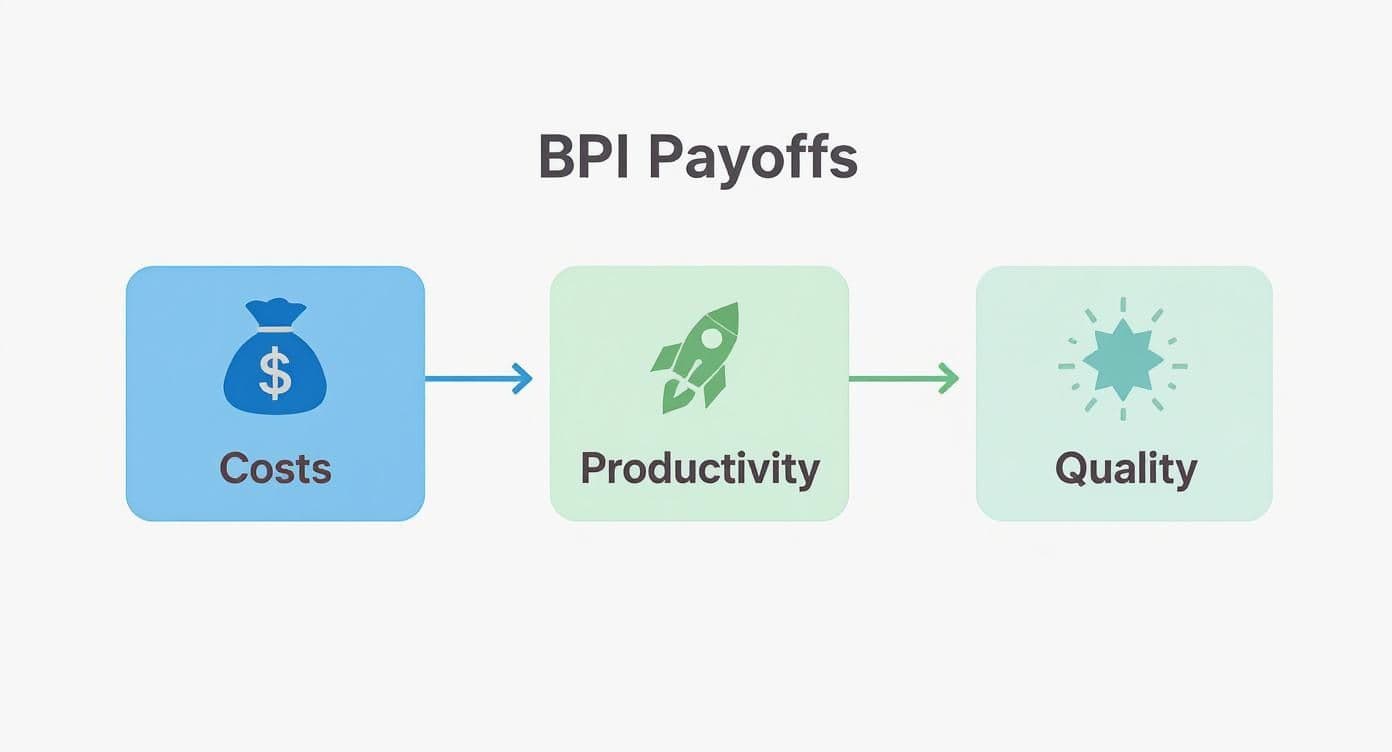
As you can see, these benefits all feed into each other. When you cut costs, you free up resources for quality initiatives, which in turn makes your team more productive. It’s a powerful cycle.
Lean: The Relentless Pursuit of Eliminating Waste
At its core, the Lean methodology is obsessed with one thing: maximizing value by eliminating waste. It got its start in manufacturing, but its principles apply just about anywhere. Think of any step in your workflow that doesn't add something the customer genuinely cares about—that’s what Lean calls waste.
Lean gives you a handy list of eight common types of waste to hunt down:
- Defects: Products or services that are wrong and need to be fixed.
- Overproduction: Making more of something before it’s actually needed.
- Waiting: Dead time where people or machines are stalled, waiting for the next step.
- Non-Utilized Talent: Not using the skills, ideas, and knowledge of your team.
- Transportation: Unnecessary movement of materials or products.
- Inventory: Excess stock that ties up capital and takes up space.
- Motion: Unnecessary movement by people, like walking across the office for a printout.
- Extra-Processing: Doing more work than the customer actually requires.
Lean is your go-to framework when your biggest headaches are delays, high operating costs, or general inefficiency. To get to the bottom of these issues, many teams use simple but powerful tools like the 5 Whys method to dig past the symptoms and find the true source of waste.
Six Sigma: A Data-Driven Quest for Near-Perfection
While Lean is all about speed and efficiency, Six Sigma is laser-focused on quality and consistency. The entire goal is to slash process variation until defects are practically a statistical impossibility—the specific target is fewer than 3.4 defects per million opportunities.
Imagine a coffee shop where every single latte is brewed to the exact same perfect standard. That’s the kind of consistency Six Sigma aims for. It’s a highly disciplined, data-heavy approach that uses statistical analysis to hunt down the root causes of errors.
Six Sigma treats business problems like science experiments. You form a hypothesis about what’s causing a defect, gather data to test it, analyze the results, and then implement a solution that’s backed by proof, not just a hunch.
This methodology is a perfect fit for complex problems where the cause of the issue is a mystery. If you're struggling with high error rates, customer complaints about quality, or inconsistent service, Six Sigma provides the rigorous tools you need to diagnose and fix the problem for good.
Kaizen: The Art of Continuous Small Improvements
Kaizen is less of a project-based framework and more of a company-wide mindset. The word is Japanese for "good change," and its philosophy is beautifully simple: everyone, everywhere, should always be looking for small ways to make things better.
Instead of waiting for a massive, disruptive overhaul, Kaizen empowers employees at every level to make small, incremental tweaks to their own workflows every single day. It’s about creating a culture of constant, gentle refinement.
Think of it this way: Lean or Six Sigma might be used to redesign an entire production line (a big project). Kaizen, on the other hand, is the daily practice of a line worker suggesting a better way to organize their tools to shave three seconds off each task. Those seconds add up. This philosophy of visualizing work and seeking constant flow is why Kanban best practices are such a natural fit for teams embracing Kaizen.
This approach is fantastic for building momentum and getting your whole team engaged. It works best when you want to build a proactive culture where improvement isn't just a manager's job—it's part of everyone's.
To make it easier to see how these frameworks differ, here’s a quick side-by-side comparison.
Comparing BPI Methodologies
| Methodology | Primary Focus | Best For | Core Principle |
|---|---|---|---|
| Lean | Speed and efficiency | Eliminating delays, reducing operational costs, and removing non-value-added steps. | Remove waste to maximize value. |
| Six Sigma | Quality and consistency | Solving complex problems with unknown causes, reducing defects, and minimizing process variation. | Use data to eliminate defects and variation. |
| Kaizen | Incremental improvement | Building a culture of continuous improvement, engaging employees, and making small, ongoing changes. | Small, continuous changes create major improvements over time. |
Ultimately, you can even mix and match principles from each. The key is to understand what each tool is designed for so you can pick the one that will deliver the best results for your specific situation.
Your First BPI Initiative: A Practical Action Plan
Moving from theory to action is where BPI truly comes to life. Getting your first project off the ground might seem daunting, but it doesn't have to be a massive, company-wide shakeup. In fact, the most successful BPI journeys often start small with a single, well-chosen pilot project.
The trick is to pick a process that is both manageable and meaningful. You're looking for an area where a clear, decisive win can build momentum and show everyone else what’s possible. Think of it as a strategic first move, not the final destination.
Here's a straightforward, five-stage roadmap to take you from identifying a problem to celebrating a real, measurable success.
Stage 1: Map the Current Process
Before you can improve anything, you need a crystal-clear picture of what’s happening right now. I’m not talking about what you think is happening or what the old training manual says should be happening. This is the mapping stage, and the goal is to create an honest, visual blueprint of the current workflow.
Get the people who actually do the work every day in a room. Their on-the-ground knowledge is pure gold. Using a whiteboard or simple flowchart software, walk through every single step, decision, and handoff from start to finish.
The key here is total honesty. Document the workarounds, the frustrating bottlenecks, and all the informal steps people take just to get the job done. This “as-is” process map becomes your single source of truth—the foundation for everything that comes next.
Stage 2: Analyze the Workflow for Pain Points
With your “as-is” map in hand, you can put on your detective hat. This analysis phase is all about pinpointing the specific areas of friction, waste, and inefficiency. Look for the common culprits that gum up the works or introduce errors.
Start asking the tough questions:
- Where are the bottlenecks? Find the steps where work piles up and just sits there.
- Which steps are redundant? Look for duplicate data entry or approval loops that go in circles.
- Where do errors happen most often? Pinpoint the exact moments where things go wrong.
- What tasks add no real value? Challenge every step by asking, “Does this actually matter to the customer?”
Focusing on these pain points helps you prioritize where you can make the biggest impact.
Your goal isn't to find blame; it's to find opportunities. The process map should illuminate systemic issues, not individual shortcomings. This shift in perspective is crucial for getting team buy-in for the changes ahead.
Stage 3: Redesign for a Smarter Future
Now for the creative part. Using your analysis, it’s time to design the “to-be” process—a smarter, leaner, more efficient version of the original. This should be a collaborative brainstorming session focused on eliminating the pain points you uncovered.
Could you automate a tedious manual step? Can you simplify a complex approval chain down to a single person? Is there a way to combine two separate tasks into one? Don't be afraid to challenge the old "we've always done it this way" mindset.
The outcome should be a new process map that is visibly simpler, faster, or more reliable. This new design is your blueprint for change.
Stage 4: Implement the New Process
A brilliant plan is worthless without solid execution. This stage is where you roll out the redesigned process to the team. Start with clear communication, explaining not just what is changing, but more importantly, why it's changing.
Provide any training people need on new tools or procedures and make sure everyone understands their new role. For a first BPI initiative, it's smart to run the new process as a limited pilot. This gives you a chance to test it in a controlled environment, gather feedback, and iron out any kinks before a wider rollout.
Stage 5: Monitor Performance and Sustain the Gains
Business process improvement isn't a one-and-done event. Once the new process is live, you have to monitor its performance to prove that the changes are actually working.
Track the same key performance indicators (KPIs) you were looking at before you started, like cycle time, error rates, or customer satisfaction. This data gives you hard proof of your success and builds a powerful case for your next BPI project.
Continuous monitoring also helps you catch any backsliding into old habits. It’s what ensures the gains you’ve made become a permanent, positive part of how your organization operates, turning a single project into a lasting improvement.
How AI Is Supercharging Process Improvement

A quick look at a modern tool like Fluidwave shows just how far we've come. The platform is designed to make process management visual and straightforward, helping teams organize and delegate work without getting lost in a sea of complexity.
For decades, improving a business process relied on human observation, manual data collection, and frankly, a good deal of educated guesswork. It worked, but it was slow and limited by what we could physically see and track. Now, artificial intelligence is here, and it's acting as the ultimate accelerator. BPI is no longer a one-off project; it’s becoming a continuous, intelligent function of the business.
AI doesn't just make things faster—it completely changes the nature of the work. Imagine trying to spot one tiny hiccup in a workflow that handles thousands of transactions every single day. For a person, it’s a classic needle-in-a-haystack problem. For an AI, it’s just another dataset to analyze.
Uncovering Hidden Inefficiencies with Process Mining
One of the most potent applications of AI in BPI is process mining. Think of it as an MRI for your company's operations. Instead of gathering a team to map out a process on a whiteboard, process mining tools dig into the digital footprints your systems already create—timestamps, user logs, and transaction data—to build a perfectly accurate map of how work actually flows.
This technique cuts through the assumptions and shows you the reality of your workflows, complete with all the unofficial shortcuts, bottlenecks, and workarounds that never appear in the official handbook. It's a massive leap forward for pinpointing the true source of delays and waste.
From Reactive Fixes to Predictive Insights
Another huge shift is moving from being reactive to proactive. Traditional BPI often feels like firefighting; you’re always responding to problems after the damage is done. AI-powered predictive analytics flips that script entirely.
By sifting through historical data to find patterns, AI models can forecast trouble before it arrives.
- An AI might flag a potential supply chain bottleneck based on shipping data and weather forecasts.
- It could predict a spike in customer support tickets, giving you time to bring in extra help.
- It could even identify which sales deals are most likely to stall, prompting a manager to step in.
This kind of foresight allows you to prevent problems from happening in the first place, which is a much smarter way to run a business. A major driver here is AI automation, which is fundamentally changing how companies handle complex, multi-step processes.
With AI, business process improvement is no longer about looking in the rearview mirror to see what went wrong. It’s about looking ahead through the windshield to see what’s coming and adjusting your course accordingly.
Intelligent Automation and Task Orchestration
Beyond just analyzing data, AI is also taking an active role in running BPI projects. Modern AI-driven platforms can automate the grunt work, like assigning tasks to the right people based on their skills and current workload. They offer real-time dashboards to track progress, making sure every improvement initiative stays on course and hits its deadline.
This AI-guided orchestration is quickly becoming the norm. In fact, a recent survey found that 56% of businesses are already using AI to refine their operations. What’s more, a PEX survey revealed that 100% of respondents are at least piloting AI for automation. The trend is clear: intelligent platforms are the future of managing workflows and optimizing how work gets done.
At the end of the day, AI acts as a force multiplier for proven frameworks like Lean and Six Sigma. It takes care of the heavy lifting—the data crunching and pattern recognition—so your team can focus on what they do best: making smart, strategic decisions that create real, lasting change.
Common Questions About Business Process Improvement
Diving into a business process improvement project for the first time naturally kicks up a lot of questions. It's smart to want clarity before you start tinkering with the way your team gets things done. This section is here to tackle the most common roadblocks and points of confusion that pop up when a company decides to get serious about optimization.
Think of this as your quick-start guide. We'll give you straight, clear answers to help you navigate those initial hurdles, from winning over your leadership to figuring out where on earth to begin. The idea is to build your confidence and clear away any hesitation so your first BPI project gets off to a flying start.
How Do I Get Leadership Buy-In For a BPI Project?
The secret to getting leaders on board is to speak their language, and that language is almost always results and return on investment (ROI). Don't get bogged down in the technical weeds of process maps and workflow diagrams. Instead, frame your pitch around the tangible business outcomes they actually care about: saving money, growing revenue, and keeping customers happy.
Start by zeroing in on a problem that is both highly visible and a major source of pain. This could be anything from a frustratingly slow customer onboarding process to frequent, costly mistakes in production. The key is to then put a number on it. How much money is this problem costing the company? How many staff hours are being wasted? How is it affecting customer churn?
Frame your business process improvement project not as an operational exercise, but as a direct solution to a pressing financial or strategic problem.
With the problem clearly defined and quantified, propose a small-scale pilot project with specific, measurable, and time-bound goals. For example, aim to "reduce customer onboarding time by 25% within the next 90 days." A successful, contained pilot serves as undeniable proof that this works, making it infinitely easier to get the green light for bigger projects down the road.
What Is the Difference Between BPI and BPR?
That’s a great question, and the distinction is crucial. The easiest way to think about it is like renovating your kitchen versus tearing down the entire house to build a new one from scratch.
Business Process Improvement (BPI) is the renovation. It’s all about making smart, targeted, and incremental enhancements to the processes you already have. The goal is to make things better, faster, or cheaper without completely reinventing the wheel. It's about achieving continuous, steady gains.
Business Process Reengineering (BPR), on the other hand, is the teardown. This involves a radical, fundamental rethinking and redesign of core processes from the ground up to achieve dramatic, breakthrough results. BPR is a high-risk, high-reward strategy that’s usually saved for moments of major organizational change when small tweaks just won't cut it.
Which BPI Methodology Should I Start With?
The right methodology depends entirely on the specific problem you’re trying to solve. There’s no single right answer, but you can let the nature of your challenge be your guide.
- Start with Lean if your main issue is waste. If you're wrestling with long delays, bloated costs, or a workflow cluttered with unnecessary steps, Lean’s laser focus on eliminating everything that doesn't add value is the perfect place to begin.
- Start with Six Sigma if your biggest challenge is quality. If your business is fighting inconsistency, high error rates, or defects in your products or services, the rigorous, data-driven approach of Six Sigma is your best bet for digging out and fixing the root cause.
It’s also worth noting that many companies get fantastic results by blending the two into a “Lean Six Sigma” approach. This allows them to attack both efficiency and quality at the same time, giving them the best of both worlds.
How Do We Measure the Success of a BPI Project?
You can't prove success if you never defined what it looks like in the first place. Measurement isn't an afterthought in BPI; it's a critical step you take right at the beginning. The key is to establish clear baseline metrics for the process you plan to improve before you change a single thing.
First, figure out the Key Performance Indicators (KPIs) that truly matter for that specific process. Some of the most common ones include:
- Cycle Time: The total time it takes to complete a task from start to finish.
- Error Rate: The percentage of outcomes that have defects or need to be redone.
- Customer Satisfaction: Typically measured with metrics like Net Promoter Score (NPS) or feedback surveys.
- Operational Costs: The direct costs tied to running the process, like materials and labor.
Once you’ve made your improvements, you keep tracking those exact same KPIs. The difference between your "before" and "after" numbers is your hard evidence of success. This data-backed proof is absolutely essential for demonstrating ROI and building the case for your next improvement initiative.
Ready to stop wrestling with chaotic workflows and start building a more efficient, productive team? Fluidwave is an AI-driven task management platform designed to simplify your operations. Create, organize, and automate your tasks with ease, and delegate work to skilled virtual assistants only when you need them. Take control of your processes and discover a smarter way to work by visiting https://fluidwave.com.
Focus on What Matters.
Experience lightning-fast task management with AI-powered workflows. Our automation helps busy professionals save 4+ hours weekly.