A step-by-step guide to planning and running an effective all employee meeting. Learn how to engage your team and turn outcomes into tracked tasks. For 2026.
April 8, 2026 (5mo ago)
All Employee Meeting Playbook: Plan, Run & Act
A step-by-step guide to planning and running an effective all employee meeting. Learn how to engage your team and turn outcomes into tracked tasks. For 2026.
← Back to blogYou know the scene. The all employee meeting ends, people drop off Zoom or walk out of the room, and for about five minutes everyone feels informed. By the next morning, half the company remembers the headline, a quarter remembers the priority, and almost nobody knows what they are supposed to do differently.
That is why so many all-hands feel bigger than they are. They create motion, not momentum.
I have run these meetings in small companies where everyone could fit in one room and in larger organizations where one update had to land across time zones, functions, and very different job realities. The pattern is consistent. The meeting itself is rarely the core problem. The failure usually shows up afterward, when leaders confuse visibility with execution.
A good all employee meeting should do three things at once. It should clarify what matters, reinforce trust, and trigger action people can track. If it only does the first two, it is a broadcast. If it does all three, it becomes an operating rhythm.
Why Most All-Employee Meetings Fail
Most all employee meetings do not fail because attendance is low. They fail because the organization treats the event as the finish line.
That is a costly mistake. These meetings are not side activities. They are one of the most expensive recurring forums in the business. 81% of surveyed companies report that more than half of employees attend all-employee meetings, 34% run them monthly, 27% run them quarterly, and 62% keep them to exactly one hour according to the 2023 all-employee meeting report from Shallot Communications. The same source notes that the typical employee spends 392 hours annually in meetings, costing organizations $29,000 per employee each year in productivity.
That should change how leaders think about the format.
The common failure pattern
A weak all employee meeting usually has a familiar shape:
- Too many messages: Leadership tries to cover everything, so nothing stands out.
- No decision spine: Updates are shared, but nobody says what is changing.
- Performance instead of leadership: Presenters focus on sounding polished instead of being useful.
- No ownership after the close: Tasks are implied, not assigned.
I have seen companies put enormous effort into slides, transitions, speaker notes, and executive prep, then send a vague recap email that says “great discussion” and “more to come.” That is not follow-through. That is a polite form of organizational amnesia.
The actual standard for success
The right question is not “Did people like the meeting?”
The pertinent questions are tighter:
- Did people understand the few priorities that matter now?
- Did managers leave with language they can reuse?
- Did teams get decisions, not just context?
- Did anyone capture the work that now needs to happen?
A strong all employee meeting reduces ambiguity. A weak one creates a temporary feeling of alignment that disappears as soon as people reopen their inboxes.
The organizations that get this right do not treat the meeting as an HR ritual or a communications task. They treat it as a leadership instrument. That means fewer topics, sharper choices, and a ruthless bias toward what happens next.
If you want a practical rule, use this one. Every major segment in the meeting should answer at least one of these questions: What do we know now? What do we need people to believe? What do we need people to do?
If a segment answers none of them, cut it.
Your Pre-Meeting Blueprint for Success
A calm, effective all employee meeting is usually built several days earlier. Chaos on the day is almost always a planning failure.
Two facts matter here. 59% of unproductive meetings stem from a lack of a clear agenda distributed in advance, and lack of clear executive ownership is a primary reason 70% of employee engagement strategies fail to deliver business impact, based on the figures cited in Notta’s meeting statistics roundup. Those two problems show up together more often than leaders admit. No clear agenda means no clear story. No owner means nobody protects the story.
Start with one objective
Do not begin with slides. Begin with one sentence.
By the end of this meeting, employees should:
- Know something important
- Feel something important
- Do something important
You do not need all three at equal weight every time. A crisis update leans hard into clarity and confidence. A quarterly meeting may lean into business context and recognition. A post-reorg meeting may focus on trust and operational next steps.
What fails is the vague objective. “Keep everyone informed” is not an objective. It is an excuse for overloaded agendas.
A stronger objective sounds like this:
- Employees understand the new priority for the next quarter.
- Managers leave ready to answer team questions.
- Everyone knows which two behaviors matter most this month.
That single sentence should shape everything else.
Build an agenda that tells a story
Most bad agendas are lists. Good agendas have sequence.
The order matters because people are trying to answer three questions while they listen: What is happening? Why does it matter? What does this mean for me?
A useful structure is:
-
Context first Open with what changed, what matters now, or what the company is solving.
-
Signal the big takeaway Say the central message plainly. Do not make people infer it from slide twelve.
-
Support it with evidence or examples Use updates, wins, customer stories, team highlights, or hard choices.
-
Name what happens next Many meetings collapse at this point. If nothing changes after the meeting, people notice.
If your company already uses a communications planning process, I like adapting the discipline behind a project communications plan template before building the agenda. The point is not bureaucracy. It is making sure the audience, message, channel, owner, and follow-up are clear before anyone starts designing slides.
Assign roles before you assign speakers
Many teams treat “speaker” as the only role that matters. It is not.
A meeting runs better when you define operating roles:
- Lead facilitator: Keeps the narrative tight and prevents drift.
- Executive owner: Makes judgment calls on trade-offs and messaging.
- Timekeeper: Protects segment limits so the meeting does not cannibalize Q&A.
- Q&A wrangler: Groups similar questions and surfaces the hard ones.
- Tech lead: Owns audio, video, screen sharing, and backup plans.
- Chat moderator: Spots confusion in real time and flags patterns.
Presenters are usually focused on their own segment, so someone else needs to protect the audience experience.
Rehearse the transitions, not just the presentations
The rough spots in an all employee meeting are rarely the speeches. They are the handoffs.
One executive finishes early. Another cannot share their screen. The moderator forgets which questions were approved. Someone in the room starts a side conversation while remote attendees hear dead air. This is the stuff that makes a meeting feel amateur, even when the content is strong.
Run a full rehearsal that includes:
- Opening minute: The first impression sets the room.
- Every speaker handoff: Names, order, and timing.
- Audience interaction moments: Polls, Q&A, chat prompts.
- Screen-sharing sequence: Especially if multiple presenters are involved.
- Backup path: If one person drops, who takes over?
Rehearse for continuity, not perfection. Employees forgive small stumbles. They do not forgive confusion.
Use templates, but not without thought
Different meetings need different emphasis. The table below is a starting point, not a script.
| Meeting Type | Agenda Block & Timing | Purpose |
|---|---|---|
| Quarterly business update | 10 min company context, 15 min business performance update, 10 min strategic priority, 10 min team spotlight, 15 min Q&A | Give employees a clear read on where the business stands and what matters next |
| Crisis or major change update | 5 min direct opening, 15 min what changed, 15 min what it means for employees, 10 min manager guidance, 15 min Q&A | Reduce uncertainty and give people language they can repeat accurately |
| Culture and recognition meeting | 10 min leadership message, 20 min recognition and milestones, 15 min employee stories, 15 min open discussion | Reinforce values through visible examples, not slogans |
| Post-reorg alignment meeting | 10 min rationale, 15 min new structure overview, 15 min decision rights and working norms, 20 min Q&A | Replace rumor with clarity and reduce friction across teams |
What to cut before the meeting starts
The fastest way to improve an all employee meeting is to remove material that does not belong there.
Cut or rewrite:
- Department detail with no company-wide relevance
- Long slide reads
- Metrics without interpretation
- Recognition that turns into a roster
- Q&A that only takes safe questions
If a topic matters but does not need synchronous airtime, send it in writing. Live time should go to context, judgment, and questions people need leaders to answer.
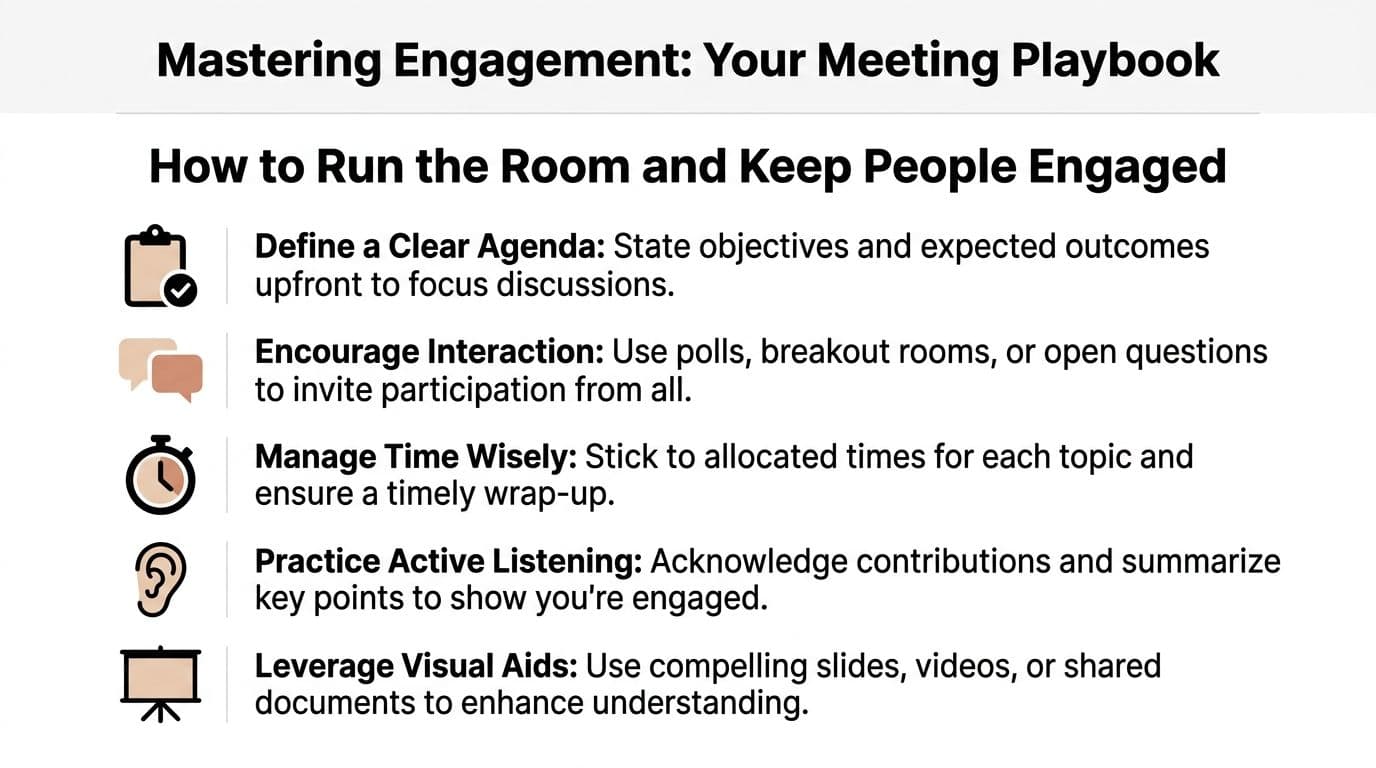
How to Run the Room and Keep People Engaged
The best-run all employee meetings feel alive without feeling chaotic. People know where the meeting is going, but it does not feel scripted to death.
That balance is harder than it sounds. Energy without structure becomes noise. Structure without any humanity becomes corporate theater.
Open like you mean it
A weak opening sounds like administration. A strong opening sounds like leadership.
Do not spend the first minutes on housekeeping unless there is a compelling reason. Start with the issue, the decision, the result, or the tension. People pay attention when they can tell the meeting matters.
A few opening moves that work:
- Name the reality: “This quarter was uneven, and we need to be honest about why.”
- State the priority: “Today is about one thing. How we focus the company for the next stretch.”
- Give people a lens: “As you listen, pay attention to what changes for your team.”
That is enough to create focus.
Keep the middle moving
The middle section is where attention drops. The room starts to drift because updates begin to sound interchangeable.
You can prevent that by changing the mode every few minutes. Not with gimmicks. With contrast.
Use a mix of:
- Short executive commentary instead of long monologues
- Live polls for quick sentiment checks
- Employee spotlights that show the work behind the strategy
- Chat prompts for low-friction participation
- Visuals that simplify, not decorate
I also like a visible clock for speakers. It keeps the pace honest. If you want a broader operating checklist for meeting mechanics, this guide on how to run effective meetings covers many of the basics teams often skip.
Make Q&A worth staying for
Bad Q&A feels staged. Worse, it teaches employees that candor is cosmetic.
Good Q&A needs three things. First, collect questions from more than one channel. Second, group duplicates so leaders answer themes, not just individual wording. Third, let at least some uncomfortable questions stay uncomfortable.
If the answer is “we are not ready to share that yet,” say that cleanly. Employees can handle boundaries better than they can handle spin.
The fastest way to kill trust is to invite questions and then answer only the harmless ones.
One practical trick works well. Have the moderator summarize the issue before the executive answers. That helps the room hear the true concern and keeps defensive responses in check.
Include people who are usually left out
Many all employee meetings reveal who they were built for.
Deskless and frontline workers make up 80% of the global workforce, 55% of non-office workers feel overlooked, and 86% of employees say not everyone is heard equally in company-wide communications, according to O.C. Tanner’s research on engaging offline employees. If your all employee meeting only works for laptop-based staff with calendar control, it is not company-wide. It is headquarters-wide.
That means changing both access and content.
What inclusion looks like in practice
- Mobile-first access: If people are not sitting at desks, the stream and follow-up have to work on phones.
- Shift-aware timing: If the live slot excludes part of the workforce, offer a clean replay or manager-led relay.
- Role-relevant examples: Frontline teams disengage when every example comes from corporate functions.
- Short follow-up summaries: A simple recap from direct managers often lands better than a long replay link.
I have seen leadership teams say they care about inclusion while running every company-wide meeting at a time that only suits office staff. Employees notice that contradiction immediately.
Recognition that feels real
Recognition should not be filler. It should explain what good looks like.
The best examples are specific. What did the person or team do? Which value or behavior did they model? Why should the rest of the company pay attention?
That gives recognition operational value. It turns applause into pattern-setting.
Mastering the Hybrid All-Employee Meeting
Many leaders still talk about hybrid as if it is a compromised version of a “traditional” meeting. That mindset causes most of the problems.
Hybrid is not a temporary workaround. In practice, it is the default. 86% of meetings include remote participants, 72% of workers report losing time to tech issues in hybrid formats, and 65% say meetings hinder their ability to complete core work, based on the figures compiled by Archie’s meeting statistics overview. The issue is not that hybrid cannot work. The issue is that many companies still run it as an in-room meeting with a remote audience watching from the margins.
Stop treating remote attendees like spectators
The biggest hybrid mistake is subtle. Everyone says the meeting is for the whole company, but the room dynamics tell a different story.
You see it when:
- side conversations happen in the room
- laughter follows something remote people could not hear
- one ceiling mic picks up only half the comments
- the camera shows a room, not a speaker
- Q&A defaults to whoever has physical presence
That setup turns remote participants into viewers, not participants.
Build for parity, not convenience
You do not need a television studio. You do need intentional setup.
A well-designed room should make the remote employee experience feel deliberate. That usually means reliable mics, clean camera angles, readable shared visuals, and one person actively watching the digital side of the room.
I have found it useful to study examples of conference rooms that are built around interaction rather than just display. This automation touchscreen AV conference system is a good reference point because it shows how control, switching, and usability can be designed into the room instead of patched together ad hoc.
A few practical standards help:
- Use individual or well-zoned microphones so remote people can hear actual voices, not room echo.
- Frame speakers intentionally rather than relying on a distant fixed camera.
- Share content digitally even when people in the room can see the screen.
- Assign one moderator to remote participation so chat and raised hands are not ignored.
Set hybrid norms out loud
Technology matters. Culture matters just as much.
If you want one meeting instead of two parallel experiences, establish explicit rules:
- Repeat in-room questions before answering
- No sidebars that exclude remote participants
- Use the same Q&A channel for everyone
- State when cameras are expected and when they are optional
- Offer asynchronous access when time zones make live attendance unreasonable
This short video gives a helpful visual primer on hybrid meeting setup and facilitation choices:
One more point matters. Do not overcorrect by forcing everyone into a stiff, overmanaged format. Hybrid still needs warmth. You can welcome people by location, invite remote voices first on key questions, and use the chat as a contribution channel instead of a side stream.
When hybrid works, nobody talks about “the room” and “the remote group.” They talk about the meeting.
Turn Talk into Tracked Action After the Meeting
The value of an all employee meeting is either realized or wasted at this stage.
Most organizations stop at communication. They send notes, maybe a replay link, and assume the message will cascade through the business. It usually does not. At best, pieces of it survive in manager meetings and hallway conversations. At worst, teams make up their own interpretation and move in different directions.
That is why I treat post-meeting workflow as part of the meeting itself.
Low employee recognition and feeling unheard are linked to an 18% drop in productivity, and 34% of employees would rather quit than voice concerns, according to the data referenced in this discussion of post-meeting disengagement and follow-through. The same source argues that this kind of purposeless drift is countered when meeting outcomes are tied directly to workflows. That matches what I have seen in practice. People disengage when leaders ask for attention but do not create visible next steps.
Capture decisions, not just notes
Meeting notes are often too passive to be useful. They describe what was said, but not what now needs to happen.
A better post-meeting record has four parts:
- Decisions made
- Actions required
- Single owners
- Deadlines or review points
Without all four, teams fill the gaps themselves.
For example, “Improve onboarding” is not an action item. “People Ops drafts a revised onboarding checklist for manager review” is an action item. The difference is ownership and specificity.
Convert outcomes into work immediately
The handoff from discussion to execution should happen fast. If you wait a week, the meeting becomes an archive instead of an operating tool.
I like a simple rule. Within a day of the all employee meeting, every concrete action should live in the same system where the team already tracks work. Not in someone’s notebook. Not in a buried recap doc. Not in a Slack thread that disappears.
A clean process looks like this:
- Tag strategic decisions during the meeting
- Translate each decision into tasks
- Assign one owner per task
- Add due dates or review checkpoints
- Group related work by initiative
- Share the task list with leaders and managers
If your team needs a practical model for structuring this handoff, an action plan framework is a useful starting point because it forces the basic questions of owner, timeline, and scope.
If no one owns the next step by name, the organization has not decided to do it yet.
Build a visible follow-up rhythm
The strongest all employee meetings create a short operational tail after the event. Not months of reporting. Just enough rhythm to prove the meeting changed something.
That can include:
- Manager cascade notes with clear talking points
- A leadership tracker for cross-functional actions
- A short progress update in the next team or department meeting
- A check on open commitments before the next all employee meeting
Here, many executives also need discipline. Once the meeting is over, they move to the next issue. Everyone else is still trying to process the current one. Leaders need to stay with the consequences of what they said.
Distinguish communication tasks from implementation tasks
One thing I see often is a follow-up list full of communication work. Send recap. Post recording. Share slides. Those are support tasks. They are not the business result.
You also need implementation tasks:
- Which policy changes now need drafting?
- Which customer messages need updating?
- Which manager questions need answering?
- Which systems, docs, or workflows must change?
Separating those two categories helps teams avoid the illusion of completion. Sending the recap does not mean the organization acted on the message.
Give managers something usable
Managers are the bridge between company-wide language and day-to-day work. If they leave the all employee meeting with only broad messaging, they will improvise.
Give them:
- Three key points to reinforce
- Questions they should expect from their teams
- Known unknowns leaders are still working through
- Actions their team should take now
That makes the post-meeting cascade more consistent and more honest.
Measure the meeting a week later
I do not mean a vanity pulse on whether people “enjoyed” it.
I mean asking:
- What actions were assigned?
- Which ones are underway?
- Where is there confusion?
- What are managers hearing repeatedly?
That is the true scorecard. A great all employee meeting is not the one with the strongest applause or the most polished slides. It is the one that produces visible movement in the week that follows.
From One-Off Event to Company Heartbeat
The mature way to run an all employee meeting is to stop treating it like a standalone event.
It is part of a larger operating cycle. Leadership clarifies priorities. The company hears the same core message at the same time. Managers translate that message locally. Teams convert it into work. Leaders then revisit progress, remove blockers, and repeat the cycle.
That is how a meeting becomes a company heartbeat instead of a calendar obligation.
What the rhythm looks like
A healthy cycle is simple:
- Plan with purpose
- Run the meeting with focus
- Turn the outcomes into owned work
- Check whether the work is moving
- Use the next meeting to reinforce or adjust
That rhythm is what creates consistency.
If you want a broader lens on why this matters, this piece on alignment in business is useful because it frames alignment as an operating discipline, not just a communications outcome. That is exactly the shift many companies need.
The standard is progress, not polish
I have seen scrappy meetings with imperfect slides create more traction than highly produced events that ended in silence. Employees do not need a show. They need clarity, relevance, and evidence that leadership means what it says.
The strongest all employee meeting usually has these traits:
- people know why they are there
- leaders sound direct, not rehearsed beyond recognition
- the agenda reflects current reality
- managers leave with usable guidance
- actions are visible after the meeting
Judge the meeting by what changed a week later. That is where alignment becomes operational.
Run enough of these well and people start to trust the format. They know it is the place where the company gets honest, sets direction, and closes the gap between talk and execution. That trust is hard to build and easy to lose. It is worth protecting.
If your team wants help turning meeting decisions into clear, delegated, trackable work, Fluidwave is built for exactly that. It combines AI-driven task organization with human virtual assistant support, so you can move from all employee meeting notes to real execution without losing momentum.
Focus on What Matters.
Experience lightning-fast task management with AI-powered workflows. Our automation helps busy professionals save 4+ hours weekly.