Discover if an AI life coach is right for you in 2026. Explore benefits, compare to human coaches, & see how AI boosts productivity & supports ADHD.
June 20, 2026 (3mo ago)
AI Life Coach: Your 2026 Guide to Productivity & Support
Discover if an AI life coach is right for you in 2026. Explore benefits, compare to human coaches, & see how AI boosts productivity & supports ADHD.
← Back to blog
You've probably had this day recently.
You start with a reasonable plan. Finish the proposal. Reply to the two important emails. Block time for strategy. Maybe even squeeze in exercise, family time, and the vague promise you made to yourself about “working on personal growth.”
By noon, the day is running you instead of the other way around. Slack is noisy. Your task list has become a guilt list. The bigger goals, career direction, confidence, habits, burnout, focus, keep getting pushed behind whatever feels urgent.
That's where an AI life coach starts to make sense. Not as some mystical replacement for human judgment, and not as therapy dressed up in startup language. Used well, it's a practical support tool for reflection, decision-making, and follow-through.
Is an AI Life Coach the Partner You're Missing
A lot of professionals don't need more information. They need a system that helps them slow down long enough to notice what's off, ask sharper questions, and convert good intentions into next actions.
That gap is why AI coaching keeps showing up in real workflows. It's not just a novelty anymore. One AI life coach service says it has coached over 500,000 people and is available free, online, 24/7, with no login or app required, while another provider reports an 85% rate of AI-generated action plans on its platform, which points to real use beyond casual chat and into structured planning and accountability, according to TextMei's overview of AI life coaching.
For busy people, that matters. The biggest bottleneck in self-improvement usually isn't insight. It's access. Human coaches work on calendars. Your spiral about priorities tends to happen on Tuesday at 10:40 p.m.
What the overwhelm actually looks like
A founder might open an AI coach because revenue anxiety is bleeding into sleep.
A team lead might use one after noticing every week feels reactive, even though they're working hard.
A freelancer might ask for help untangling a familiar mess: too many active projects, no clean boundary between work and life, and a task manager full of items that are technically organized but mentally impossible to start.
Those aren't edge cases. They're normal modern knowledge-work problems.
The best use of an AI life coach isn't motivation. It's interruption. It breaks autopilot.
That's the part people underestimate. A decent AI coach can catch fuzzy thinking fast. It can reflect your own words back to you, spot contradictions, and keep asking until “I want more balance” turns into something operational.
Where the tool earns its place
An AI life coach is most useful when you need support in moments that are too small for a formal session but too important to ignore.
That includes:
- Decision friction when you can't tell whether a project is important or just loud
- Routine drift when habits fall apart and you need a reset without a lot of ceremony
- Emotional clutter when you're not in crisis, but you are definitely not clear
- Goal translation when the objective sounds meaningful but still doesn't generate action
If you've ever ended a week thinking, “I was busy, but I'm not sure I moved anything important,” you're exactly the kind of person who might benefit from this category.
What an AI Life Coach Is and How It Works
The simplest way to think about an AI life coach is this. It's a conversational system that acts like a structured mirror.
A journal helps you dump thoughts. A coach helps you examine them. An AI life coach tries to do both, while keeping track of your patterns over time.
The core loop
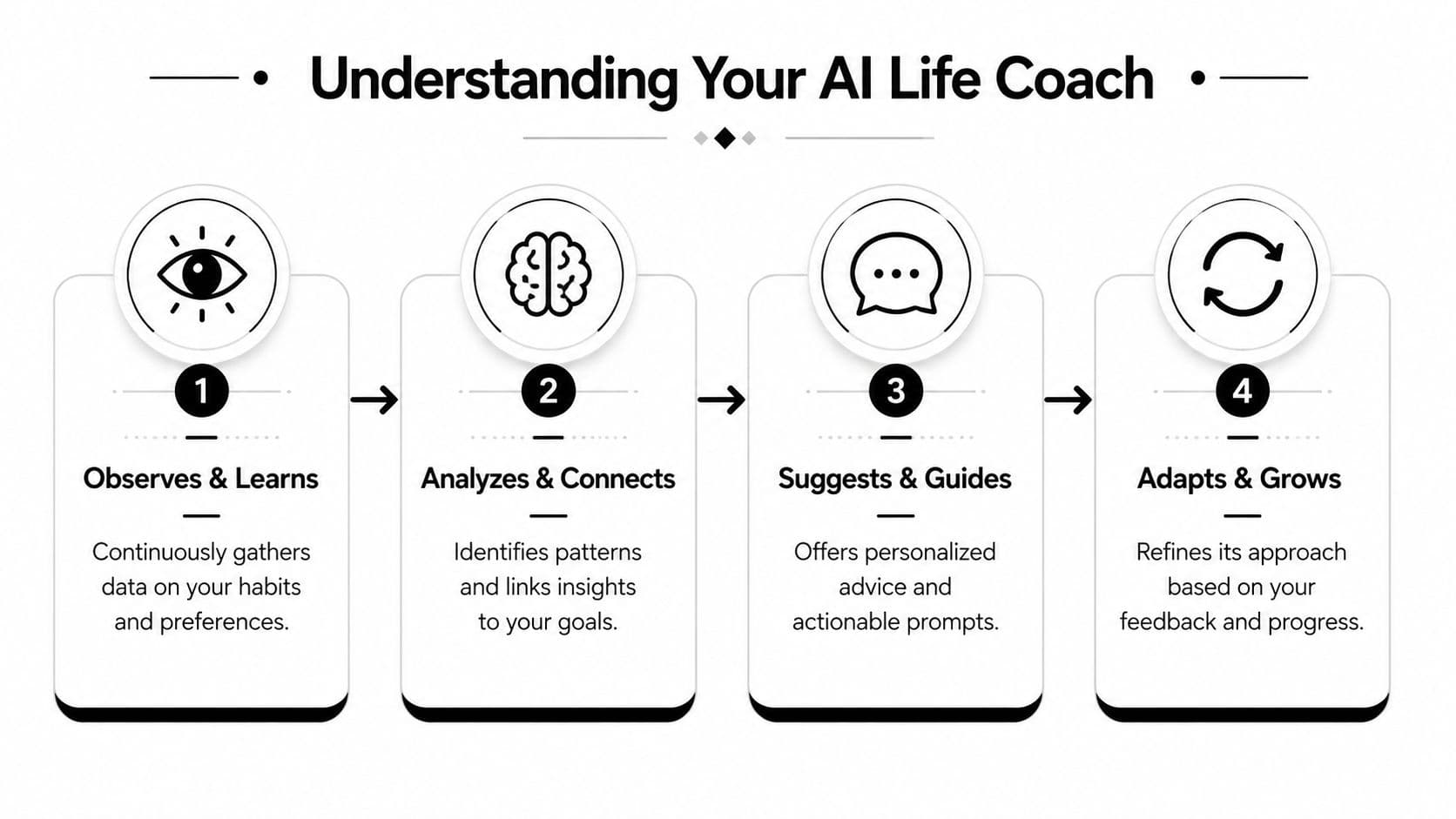
Under the hood, these systems rely on a hybrid NLP plus machine-learning loop. Natural language processing interprets open-ended user input, and the model uses prior interactions to personalize future guidance. That matters because the system gets more useful when it can retain your goals, preferences, and recurring patterns across sessions instead of treating every conversation like a blank slate, as described in TNM Coaching's explanation of AI life coach systems.
In practice, that means the tool can do things a generic chatbot often doesn't do well:
- Track continuity across multiple conversations
- Notice repeated obstacles instead of reacting to a single prompt
- Adjust prompts based on your previous responses
- Stay anchored to your stated goals rather than drifting into generic advice
If you already understand the difference between a basic chatbot and a more capable assistant, this guide to AI personal assistants gives useful context for where an AI coach fits.
What it feels like in daily use
A strong AI coach doesn't just answer questions. It asks better ones.
You might type, “I'm behind on everything.” A weak system responds with generic productivity tips. A better one starts narrowing the field. Behind on what. What's time-sensitive. Which obligation carries actual consequence. Which item are you avoiding because it's unclear, not because it's hard.
That narrowing process is where the value lives.
Practical rule: If the tool keeps giving broad advice that could apply to anyone, it isn't coaching you. It's content marketing in chat form.
What it is not
It isn't a therapist. It isn't a manager. It isn't a substitute for moral judgment, lived experience, or human care.
It's also not magic. If you feed it vague inputs, dip in once a month, and ignore every follow-up prompt, you won't get much from it.
What works is consistency. A few focused check-ins beat dramatic, one-off conversations. The system becomes useful when it has enough context to reflect your own patterns back to you with some precision.
That's why the best AI coaching experiences feel less like asking a machine for answers and more like working with a patient, organized thinking partner that never gets tired of helping you clarify what matters.
Real-World Wins with AI Coaching
The biggest misconception about AI coaching is that it's mainly for inspirational conversations. In real life, its value shows up in much messier places: unfinished goals, mental overload, inconsistent routines, and the gap between knowing what to do and doing it.
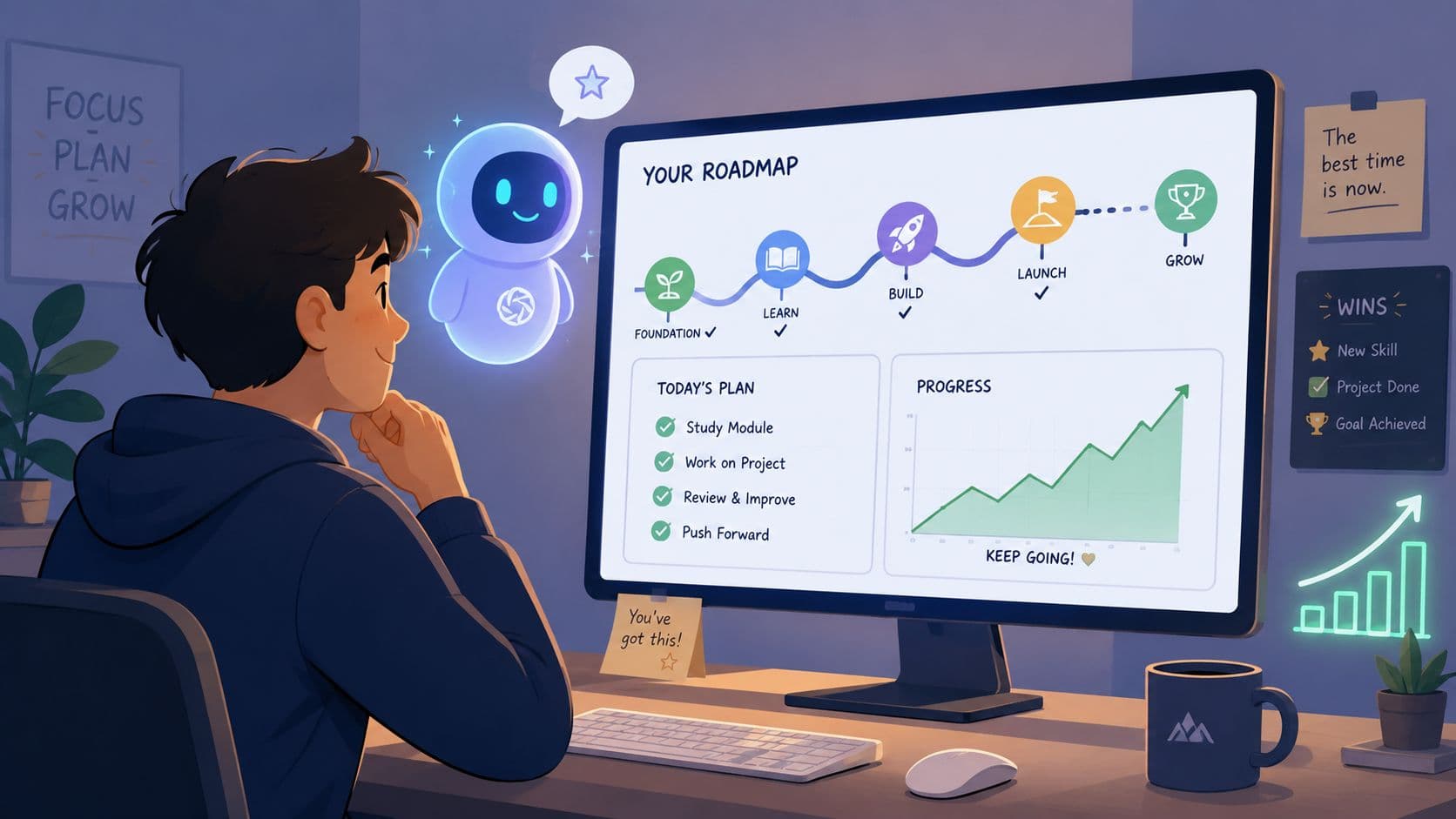
A stronger implementation uses goal-tracking analytics, behavioral analysis, and adaptive questioning. It asks one focused question at a time, surfaces limiting beliefs or decision friction, and turns reflection into concrete next steps. That's why serious AI coaching products lean on accountability, routines, and periodic review instead of just spraying advice, as outlined by Rocky.ai's life coach framework.
Turning vague goals into usable plans
A lot of professionals set goals that sound respectable and produce nothing.
“Grow the business.” “Get healthier.” “Become more consistent.” “Fix my work-life balance.”
Those statements aren't wrong. They're too broad to act on.
An AI life coach is often helpful at this exact point because it keeps slicing. What does “grow the business” mean right now. More leads. Better conversion. Cleaner positioning. More follow-up. Fewer distractions. Once the target gets specific, the work becomes visible.
Here's what good coaching usually does in this situation:
- It shrinks the scope so the goal fits the current season, not your ideal future self
- It exposes hidden blockers like unclear ownership, fear of outreach, or perfectionism
- It creates immediate actions instead of leaving you with a motivational summary
That's more valuable than generally expected.
Better support for overloaded brains
People with ADHD, executive function challenges, or chronic overwhelm often don't need more pressure. They need less cognitive load.
A solid AI coach can help by reducing the number of decisions happening at once. Instead of asking, “How do I fix my whole life,” it can ask, “What's the smallest useful move before lunch?” That style works because it lowers activation energy.
I've found that AI coaching is especially good for people who freeze when a task becomes emotionally noisy. The coach can help separate the actual task from the story around the task. Sometimes “write the report” is really three different problems: define the outline, find the missing data, and tolerate the discomfort of making imperfect decisions.
When someone says they're procrastinating, they're often not avoiding work. They're avoiding confusion, uncertainty, or self-judgment.
That's where adaptive questioning helps.
Here's a short look at the kind of scenarios where AI coaching tends to work well:
| Use case | What the AI coach helps with |
|---|---|
| Big personal goal | Clarifies what success means now and identifies the next concrete move |
| Productivity slump | Surfaces bottlenecks, competing priorities, and avoidant patterns |
| ADHD-friendly planning | Breaks work into smaller steps and reduces decision overload |
| Habit rebuild | Prompts regular check-ins and reinforces a simple review rhythm |
A quick visual example can help make that real:
What doesn't work as well
AI coaching falls flat when users expect it to rescue them with generic encouragement. It also struggles when the issue requires deep emotional nuance, conflict mediation, or serious mental health support.
And some people bounce off the format. If you hate typing, dislike reflective prompts, or resist any system that asks you to slow down and answer genuinely, the tool may feel annoying instead of helpful.
Still, for day-to-day productivity, accountability, and self-observation, this is one of the more practical uses of AI I've seen.
Choosing Your Coach AI vs Human
The wrong question is “Which is better?”
The right question is “Better for what?”
AI and human coaching solve different problems well. If you compare them, the choice becomes less ideological and more operational.
A controlled study of the AI-powered life coach 1440 tested the system against traditional human coaching in three groups and evaluated performance across seven categories including goal achievement, satisfaction, and perceived support. In the reported results, 1440 outperformed the apples-to-apples human transcript comparison in all seven categories, with statistically significant improvement at p < 0.05 in every category except approachability. The study also reports significant gains in effectiveness and communication, and the authors conclude that AI coaching can be a scalable alternative for personal development and professional growth, according to the 1440 coaching study published via Oxford Brookes University's repository.
That result surprises people. It should also be interpreted carefully.
Where AI usually wins
AI coaching is hard to beat on speed and consistency.
You can use it the moment you notice resistance, indecision, or drift. It doesn't need scheduling. It won't forget prior context if the product handles memory well. It can also keep your check-ins structured, which matters for people who need repetition more than inspiration.
AI is especially strong when you need:
- Immediate access during the exact moment a problem appears
- Low-pressure reflection without worrying about being judged
- Frequent nudges to review goals, habits, and unfinished commitments
- A structured thought partner for planning and prioritization
Where humans still have the edge
A human coach can hear the hesitation in your voice. They can catch what you're avoiding without you having to type it out perfectly. They can challenge you with intuition, lived experience, and relational presence.
That matters in situations involving identity, grief, career reinvention, conflict, or emotional complexity. A human can also detect when you're performing competence instead of telling the truth.
A human coach works with your words, your tone, your body language, and the story under the story. AI mostly works with what you explicitly give it.
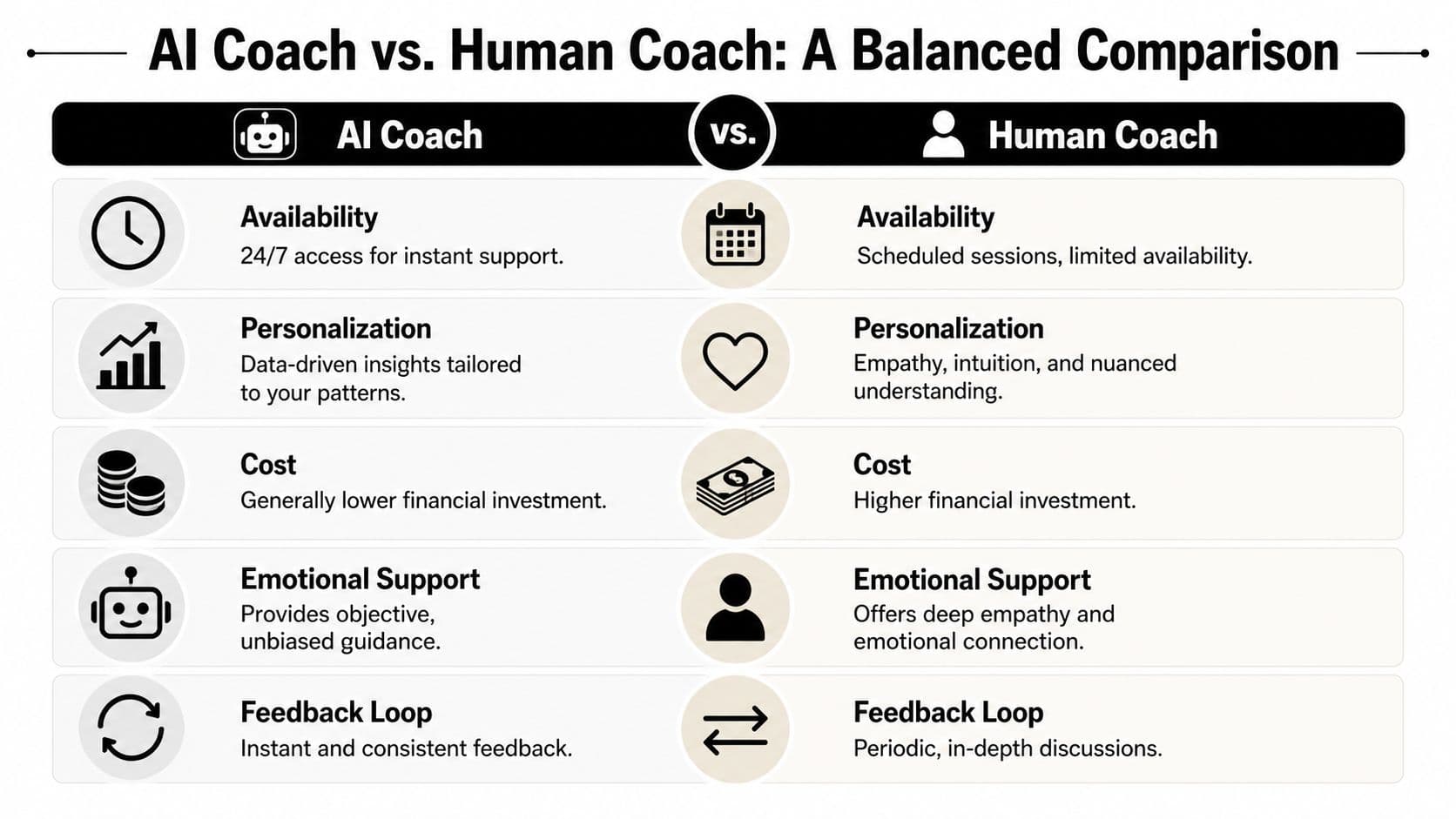
AI Coach vs. Human Coach A Comparison
| Factor | AI Life Coach | Human Life Coach |
|---|---|---|
| Availability | Available on demand, often anytime | Usually limited to scheduled sessions |
| Personalization | Pattern-based personalization from prior inputs | Nuanced personalization shaped by empathy and lived interaction |
| Cost | Often lower or easier to access | Usually a bigger financial commitment |
| Emotional support | Steady, nonjudgmental, objective style | Deeper emotional attunement and relational support |
| Feedback loop | Fast and frequent | Slower, but often more layered and contextual |
| Best fit | Daily check-ins, structure, reflection, accountability | Complex transitions, emotional nuance, deeper interpersonal work |
The most practical answer
For many professionals, the best setup isn't AI or human. It's AI first, human when needed.
Use the AI coach for daily maintenance. Let it help you catch patterns, draft plans, and stay honest about what you're avoiding. Bring in a human when the issue needs depth, emotional reality, or higher-stakes interpretation.
That hybrid model respects what each tool is good at. It also prevents the common mistake of expecting one format to do everything.
From Insight to Action with Your AI Coach and Fluidwave
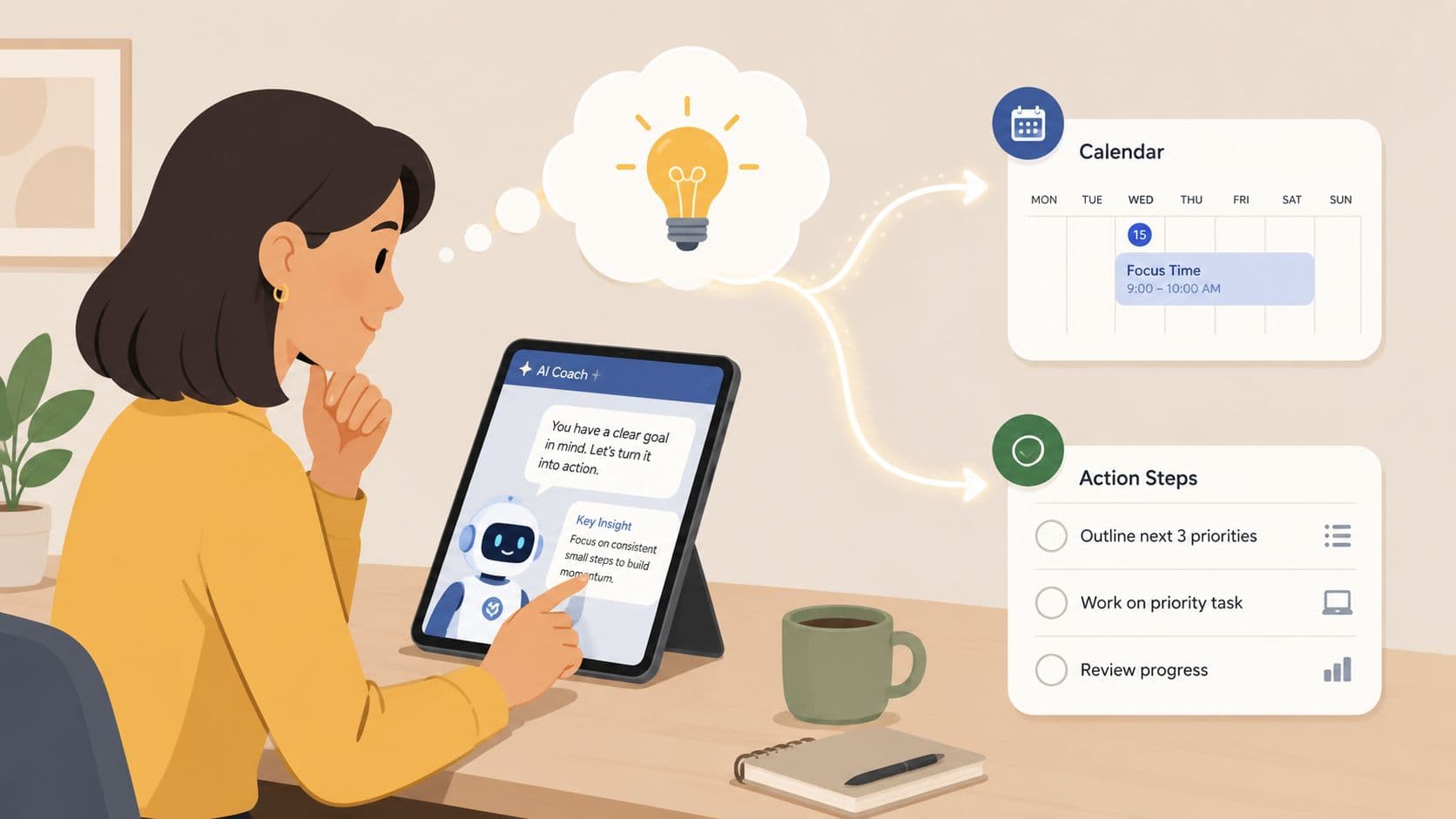
The most common failure point in AI coaching is simple. You get a useful insight, feel briefly energized, and then nothing changes because the advice never enters a system that can carry it forward.
Reflection without execution fades fast.
The handoff that most people skip
A practical workflow starts by treating the AI coach as a thinking layer, not the entire operating system.
When the coach helps you clarify something important, don't leave it in chat. Move it into a task system immediately. If you're exploring options, this roundup of AI productivity apps is useful background for choosing where those next steps should live.
The move from insight to action should be mechanical. No drama. No waiting for motivation.
A simple workflow that actually sticks
Here's the version I recommend for busy professionals.
-
Use the AI coach to define one concrete outcome
Don't end the conversation at “I need better balance” or “I want more focus.” Push until the outcome is clear enough to schedule. “Leave work by a set time three days this week” is workable. “Be more present” isn't. -
Turn that outcome into a project
Create a project in your task manager, not a note buried in a journal. The project should answer one question: what has to happen for this change to become visible in real life? -
Break it into embarrassingly small tasks
Many smart people self-sabotage here. They create tasks that are still too big to start. “Fix onboarding” is not a task. “List current onboarding steps.” “Draft revised first email.” “Review friction points from recent clients.” Those are tasks. -
Assign a review rhythm
Insight decays without review. Add a recurring checkpoint to revisit the plan, check progress, and decide whether the goal was wrong or the execution was weak.
What that looks like in practice
Say your AI coach helps you realize you're not behind on everything. You're avoiding a single high-friction project that keeps contaminating the rest of the week.
A useful setup might look like this:
-
Project name
Launch revised client proposal process -
First actions
Define proposal stages
Draft base template
Review last three stalled deals
Create follow-up checklist -
Review prompt
What blocked progress this week, lack of time, lack of clarity, or avoidance?
That last line matters. It keeps the coaching alive inside the workflow.
Working rule: Every useful coaching insight should end as a project, a task, or a calendar commitment. If it doesn't, it was just an interesting conversation.
When to delegate instead of think harder
Another practical move is noticing when the blocker isn't mindset. It's capacity.
Some tasks don't need deeper reflection. They need to get done by someone competent. Administrative cleanup, research collection, formatting, scheduling, inbox support, and follow-up prep often fall into that category.
That's where a hybrid system becomes useful. Let the AI coach help you identify what matters, what's stuck, and what should happen next. Then decide which tasks require your judgment and which ones should be delegated to a human assistant.
This is the part many productivity systems miss. They help you organize work, but not redistribute it. If your calendar is full and your brain is already taxed, better insight alone won't save the week. Better allocation might.
The Smart Way to Adopt AI Coaching
AI coaching works best when you use it like a power tool. Useful, efficient, and worth respecting.
The danger isn't that the tool exists. The danger is using it casually with personal information, leaning on it for decisions it shouldn't own, or confusing frequent conversation with meaningful progress.
What to check before you commit
Before you adopt any AI life coach, ask a few plain questions.
-
Privacy first
What does the product say about data handling? Can you delete your history? Can you export it? If the answers are hard to find, that's already an answer. -
Memory with boundaries
Persistent context can make coaching better, but only if you're comfortable with what the system retains. Decide what kinds of personal details you do and don't want inside the tool. -
Role clarity
Are you using this for planning, reflection, and accountability? Good. Are you expecting it to replace therapy, medical care, or serious relationship advice? That's a bad handoff. -
Behavior change over chat volume
More conversations don't automatically mean better outcomes. Track whether the tool helps you make cleaner decisions, finish meaningful work, and notice patterns sooner.
A healthy way to use it
The smartest users don't ask the AI to run their lives. They use it to improve their own judgment.
That mindset also shows up in adjacent productivity work. If you want a thoughtful example of how people are using AI systems for coding efficiency without handing over all agency, Iwo Szapar's piece is worth reading. The same principle applies here. The tool should sharpen your process, not become your personality.
You can also build better habits around AI use by tightening your workflows. This guide on how to use AI for productivity is a practical companion if you want your experiments to stay grounded in real work.
Don't ask, “Can this tool coach me?” Ask, “Does this tool help me act better, decide faster, and stay honest?”
That question filters out a lot of hype.
If you choose carefully, keep the role narrow, and move insights into a real execution system, an AI life coach can become a useful part of your week. Not because it knows you better than you know yourself, but because it helps you notice what you already know and do something with it.
If you want a better bridge between planning and execution, Fluidwave is worth a look. It combines AI-driven task management with human virtual assistants, so you can turn coaching insights into organized projects, prioritize what matters, and delegate the work that shouldn't stay on your plate.
Focus on What Matters.
Experience lightning-fast task management with AI-powered workflows. Our automation helps busy professionals save 4+ hours weekly.