Struggling with focus and follow-through? Learn a practical ADHD task management system to capture, prioritize, and complete tasks without the usual overwhelm.
June 29, 2026 (3mo ago)
A Practical ADHD Task Management System That Works
Struggling with focus and follow-through? Learn a practical ADHD task management system to capture, prioritize, and complete tasks without the usual overwhelm.
← Back to blog
You open your task list to get your day under control. Instead, your stomach drops.
There are emails you meant to answer yesterday, a project that feels too big to touch, three follow-ups you keep avoiding, and a pile of small admin tasks that somehow take up more mental space than the important work. Everything feels urgent. Nothing feels startable. So you do what a lot of smart, capable people with ADHD do when the system stops making sense. You bounce between tabs, rewrite your list, and hope clarity shows up on its own.
It usually doesn't.
Good ADHD task management isn't about becoming more disciplined. It's about building a system that takes pressure off your working memory, reduces the emotional friction around starting, and makes the next action obvious. The system that tends to work looks less like "try harder" and more like capture, prioritize, plan, execute, and delegate.
Why Most Task Management Fails for ADHD Brains
Most productivity advice assumes the problem is motivation. It treats missed deadlines, avoidance, and half-finished plans as evidence that you need more grit. That framing hurts people with ADHD because it mistakes a system mismatch for a character flaw.
A 2024 arXiv study found that adults with ADHD face task management challenges "not due to a lack of willpower, but because of emotional and relational" factors, with shame, perfectionism, and fear of judgment acting as major paralysis triggers. That lines up with what many adults discover only after years of self-blame. The hardest part often isn't knowing what to do. It's dealing with what the task means emotionally.
If you've been trying to make sense of late diagnosis, masking, or why ordinary planning tools never seemed to fit, this guide on understanding adult ADHD gives useful context. A lot of task difficulty makes more sense once you understand how ADHD affects regulation, not just attention.
Why standard systems fall apart
Traditional systems often ask you to do several executive function jobs in your head at once:
- Hold everything mentally instead of capturing it somewhere reliable
- Estimate time accurately without support
- Prioritize abstractly when several tasks feel equally loud
- Start cleanly even when the task carries shame or uncertainty
That's a heavy lift for anyone. For ADHD brains, it can become a shutdown point.
A better approach starts by externalizing the load. If you're not familiar with how those cognitive skills work day to day, this overview of executive function is a useful foundation.
You don't need a stricter personality. You need fewer decisions between "I should do this" and "I'm doing the first visible step now."
What tends to work instead
The systems that stick usually share a few traits:
| What fails | What works better |
|---|---|
| Long undifferentiated to-do lists | Clear daily limits and visible next actions |
| Self-criticism as motivation | Low-friction structure |
| Perfect plans made once | Ongoing adjustment |
| Doing everything yourself | Strategic offloading |
That shift matters. ADHD task management improves when the system carries more of the weight than your memory, mood, or motivation does.
Build a Brain Dump You Can Actually Trust
The first rule is simple. Stop using your brain as a storage device.
A brain that's trying to remember every task, idea, errand, and loose end doesn't have much capacity left for focus. Mental clutter creates background stress, and that stress makes starting harder. The point of a brain dump isn't to become organized in one sitting. It's to create one trusted place where unfinished thoughts can land.

The technique matters because it reduces the activation barrier. The brain dump method helps people write every sub-step of a task before organizing it, which lowers the barrier to getting started by identifying the single next physical action.
What a trusted capture system looks like
Your capture system needs to be boring in the best way. Fast. Always available. Easy enough to use when you're tired, distracted, or in the middle of something else.
A good inbox has these features:
- One main entry point so tasks don't end up split across notebooks, email drafts, sticky notes, and your head
- Very low friction so you can add "call dentist" and "draft Q3 proposal" with the same ease
- No sorting at capture time because organizing too early often turns capture into avoidance
- A review habit so the inbox stays trustworthy
If you want a deeper breakdown of the method itself, this guide to a brain dump is a useful companion.
How to do the dump without overcomplicating it
Set a timer and empty your head onto a page or into a digital inbox. Don't rank. Don't tidy. Don't decide what's realistic yet.
Write down:
- Open loops like bills, emails, appointments, forms, repairs
- Work deliverables including half-defined projects
- Micro-reminders like "send file" or "reply to Sam"
- Mental noise such as ideas, worries, things you're afraid to forget
Then go back and convert vague entries into physical actions.
"Fix website" becomes:
- open homepage on desktop
- note three broken elements
- message developer
- upload revised copy
"Prepare presentation" becomes:
- open old deck
- duplicate template
- write title slide
- list three points for section one
Practical rule: if a task doesn't begin with a verb you can physically do, it probably isn't ready.
What not to do
A brain dump fails when people turn it into a planning system, a journal, and a prioritization session all at once. Capture first. Decide later.
It also fails when the inbox multiplies. One notebook for home, one app for work, one notes app for ideas, one email folder for reminders. That setup feels flexible at first, but many ADHD adults stop trusting it because retrieval becomes another task.
The goal is psychological relief. You should be able to think, "I don't need to keep rehearsing this. It's in the system."
Decide What Matters Now Not Everything
Once you've captured everything, a new problem shows up. The list is complete, but it's still too loud.
Many ADHD task management systems become unusable. They ask you to score tasks, color-code ten categories, and maintain a perfect priority model. That's too much thinking at the exact moment you need less. The useful move is to cut prioritization down to two decisions: what matters most, and what belongs today.
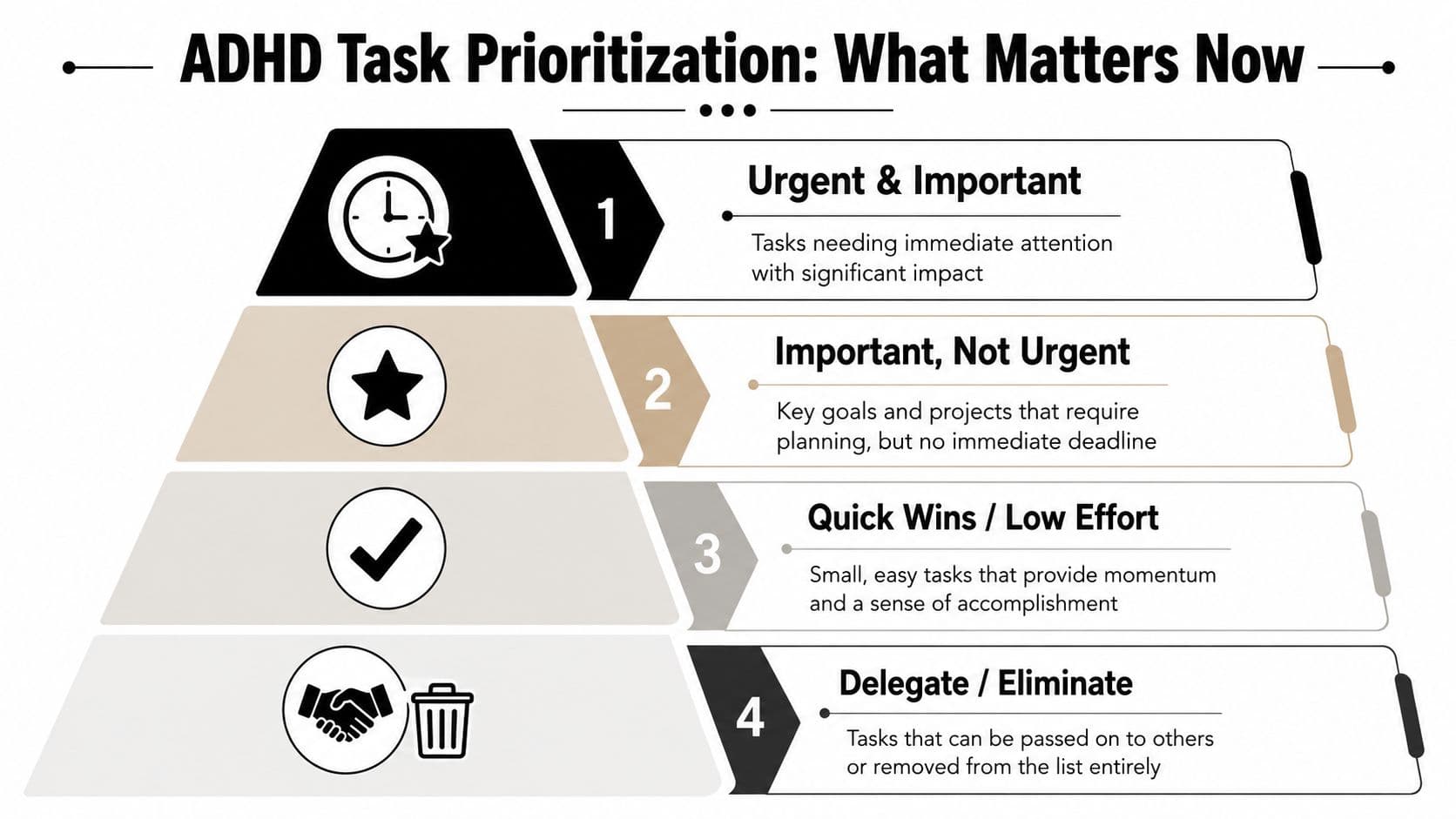
A simple visual hierarchy helps. This one keeps the decision process short enough to use.
Step one, sort the master list by weight
Before you make a daily plan, glance through your full list and place each task into one of four buckets:
- Urgent and important. Deadlines, commitments, issues with real consequences.
- Important but not urgent. Work that matters but doesn't scream yet.
- Quick wins or low effort. Small tasks that reduce friction fast.
- Delegate or eliminate. Work that doesn't need your brain, or doesn't need doing at all.
This is basically a simplified Eisenhower filter. It works well for ADHD because it keeps you from treating every item as equally pressing.
A useful check is to ask, "If I only moved one meaningful thing today, what would actually lower pressure?" That answer usually belongs near the top.
Step two, build a finite day
The 1-3-5 Rule gives a clear daily ceiling: one big task, three medium tasks, and five small tasks, for exactly nine items. That limit matters because it prevents decision fatigue and cognitive overload.
Individuals with ADHD don't struggle because they wrote down too little. They struggle because the list demanded twelve hours of perfect focus.
Here's the practical version:
| Task size | What belongs here | Example |
|---|---|---|
| Big | The task that would make the day feel meaningful | finish proposal draft |
| Medium | Important progress tasks | review notes, send invoice, book meeting |
| Small | Admin, follow-ups, tiny maintenance | reply to one email, upload file, confirm appointment |
Place your one big task from the urgent or important bucket. Pull your medium tasks from what supports that work. Then choose small tasks that either create momentum or remove background noise.
After you've seen the framework, it's easier to spot it in action:
What usually goes wrong
The common trap is filling the nine slots with tasks that are still vague.
"Work on marketing" is not a daily task. "Continue planning launch" is not a daily task either.
A daily list should contain actions that are visible and finishable. If an item could take an undefined amount of time because it isn't broken down yet, it doesn't belong on today's list in that form.
A realistic list is an accessibility tool. An ambitious list can become a guilt machine.
This is the point where many professionals do better with tags, views, or separate lists for big, medium, and small work. The method matters less than the constraint. Your day needs edges.
Turn Vague Goals into Tiny Actionable Steps
Procrastination often starts with a task that's too foggy to enter.
"Plan vacation." "Finish report." "Sort finances."
Those aren't tasks. They're containers. A task has a visible starting point. If your brain keeps sliding away from something, the first fix isn't motivation. It's shrinking the entry point until your nervous system stops reading it as a threat.
The two-minute approach helps here. According to ADHD Specialist, breaking larger tasks into subtasks that can be completed in two-minute intervals reduces overwhelm, and using the first 15 minutes of a work session to batch quick tasks can create immediate momentum.
A concrete example with plan vacation
Take "plan vacation." That phrase hides a dozen different jobs. Pull them apart until each one becomes physically obvious.
You might end up with:
- open notes app
- list possible dates
- check passport location
- search train prices for one route
- text travel partner two date options
- open hotel map
- save three options
- compare cancellation policies
- book first night only
Notice what's different. None of those steps asks you to "plan a vacation." They ask you to do one small thing your hands can start right now.
Use the first fifteen minutes for traction
The opening minutes of a work block matter because they decide whether you enter the session or avoid it.
Try this pattern:
- Minute one to five. Pick three tiny tasks you've been postponing.
- Minute six to ten. Finish the easiest one completely.
- Minute eleven to fifteen. Set up the first step of the larger task.
This works because completion changes the emotional tone of the session. You stop entering from a position of dread and start from movement.
If the first step still feels heavy, make it smaller. "Open the file" counts. "Write the first sentence" counts. "Name the folder" counts.
A useful test for every task
Run each task through this filter:
| If the task says... | Rewrite it as... |
|---|---|
| review finances | log into bank account |
| write proposal | open proposal template |
| clean office | clear top of desk |
| prepare for meeting | write three bullet points |
That level of detail can feel almost silly. It's supposed to. ADHD brains often start once the ambiguity drops. Tiny steps aren't childish. They're operational.
Use Time as a Tool Not a Tyrant
Many adults with ADHD don't hate planning because they're lazy. They hate it because time has often felt punitive.
Deadlines arrive too fast. Simple tasks somehow absorb a whole afternoon. Transitions take longer than expected. You plan optimistically, miss the mark, and then use the miss as evidence that planning itself doesn't work. But time isn't the enemy here. Invisible time is.
The goal is to make time concrete enough that you can work with it.
Add buffers before you need them
ADHD-friendly time planning works better when you assume your first estimate is incomplete. Elevating Minds Psychiatry recommends adding a 50% buffer time to every task estimate, and notes that visible timers can improve adherence to schedules by up to 40%.
That means if you think a task will take an hour, block ninety minutes. Not because you're bad at time, but because setup, transitions, interruptions, and re-entry are part of the task.
Many calendars become more useful than to-do lists. A task on a list still feels abstract. A task with a protected block has shape.
If you want a practical walkthrough, this article on time blocking for ADHD is worth reading.
Use short work sprints
You don't need to trap yourself in marathon focus sessions. Short, finite rounds tend to be easier to begin.
The Pomodoro pattern is one option:
- 25 minutes of focused work
- 5 minutes away from the task
- A longer break after four rounds
Some people do better with ten, fifteen, twenty, or thirty minute intervals. The exact length matters less than the fact that the work period is visible and limited.
A visible timer changes the task from "stay focused until you're done" to "work until the bell." That's a very different emotional demand.
What time planning should look like in real life
A useful daily plan might look like this:
| Time block | Purpose |
|---|---|
| 9:00 to 9:15 | quick admin and setup |
| 9:15 to 10:45 | big task with built-in buffer |
| 10:45 to 11:00 | transition and reset |
| 11:00 to 11:30 | follow-ups or low-effort tasks |
| 1:00 to 2:00 | second focus block |
Notice what's included. Not just work, but reset time. Transition time. Space to recover if one block slips.
Time blocking should reduce anxiety, not create a stricter version of it.
What doesn't work for most ADHD adults is pretending every hour will be clean, linear, and interruption-free. A humane schedule leaves room for being a person.
When and How to Wisely Delegate Tasks
Some tasks don't need better planning. They need to leave your plate.
This is the part most ADHD advice skips. It stays focused on self-management, as if the answer is always a more refined personal system. But strategic delegation is often one of the most effective accommodations available to busy professionals. It protects executive function for the work only you can do.

A simple do defer delegate filter
Picture a founder who dreads weekly expense reports. Every Friday the same thing happens. Receipts are scattered, the task feels annoying rather than difficult, and the resistance spills over into the rest of the afternoon. The problem isn't ability. It's drag.
Use this filter:
- Do when the task requires your judgment, voice, or decision-making
- Defer when the task matters but doesn't fit within the current limited focus budget
- Delegate when the task is repetitive, document-heavy, process-based, or outside your strengths
Expense reports, inbox triage, research gathering, scheduling, data entry, and formatting work often land in the third group.
How to delegate without creating more work
Bad delegation fails because the handoff is vague. The other person has to guess what done looks like, and now you have a second project: managing confusion.
A clean handoff includes:
-
The outcome
"Submit a categorized expense summary for this week." -
The inputs
Receipts, bank exports, naming conventions, deadline. -
The rules
Which categories to use, what to flag, what not to submit without checking. -
The deliverable
Spreadsheet completed, receipts attached, open questions listed separately. -
The review point
When you'll check progress or answer questions.
That same founder can take a recurring task that causes dread and turn it into a repeatable brief. Once the instructions exist, the task stops consuming startup energy every week.
Where a platform can help
Some professionals manage this with email, shared documents, and chat. Others prefer one place that holds both the task and the handoff. Fluidwave combines task management with access to virtual assistants on a pay-per-task basis, so a user can create the task, define the budget and timeline, and monitor progress within the same workflow.
That's useful when delegation needs to be part of the system, not a separate administrative burden.
Delegation isn't avoidance when you're removing low-value friction and protecting high-value focus.
The hard part for many ADHD adults is permission. They assume they should be able to do everything themselves if they were just organized enough. In practice, wisely offloading recurring, draining work often makes the whole system more stable.
Building a Flexible System That Finally Sticks
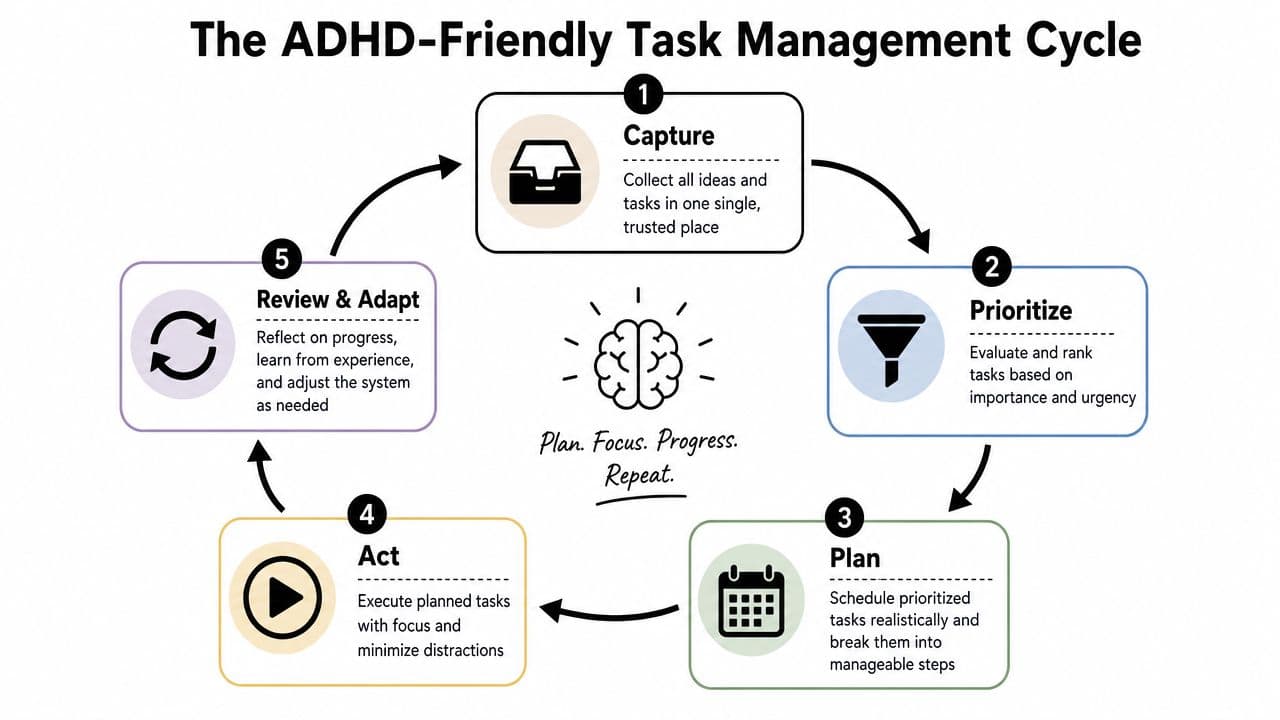
A working system isn't a straight line. It's a loop you return to.
You capture what's competing for your attention. You prioritize what matters now. You plan in a way that's realistic. You act on the smallest clear step. You delegate what doesn't belong with you. Then you review and adapt.
The part that makes it sustainable
A rigid system often works for a few days, then collapses the first time your energy drops or your week changes shape. That's why flexibility matters so much in ADHD task management. In Focus First notes that 75% of ADHD adults struggle when systems don't adapt to fluctuating capacities, which makes dynamic prioritization a critical need.
That can look like having different modes for different days:
- High-energy mode for demanding thinking, meetings, writing, strategy
- Low-energy mode for admin, follow-ups, maintenance, handoffs
- Recovery mode for bare-minimum essentials and reset tasks
Review without self-attack
A weekly review doesn't need to be elaborate. It just needs to answer a few honest questions:
- What got done?
- What stayed stuck?
- Which tasks were too vague?
- What should be delegated, dropped, or broken down further?
- What kind of week am I heading into?
The point isn't perfection. It's recalibration.
A system finally sticks when it earns your trust. Not because you follow it flawlessly, but because it helps you restart quickly, with less shame and less friction each time.
If you want one place to capture tasks, organize priorities, and hand off selected work to a virtual assistant, Fluidwave is worth exploring. For many people with ADHD, the missing piece isn't another list. It's a workflow that supports both focus and offloading, so the system carries more of the burden than your brain has to.
Focus on What Matters.
Experience lightning-fast task management with AI-powered workflows. Our automation helps busy professionals save 4+ hours weekly.