Опануйте матрицю пріоритетності дій, щоб розставляти пріоритети для завдань з високим впливом і низькими затратами зусиль та підвищити продуктивність практичними кроками.
October 15, 2025 (11mo ago) — last updated March 7, 2026 (6mo ago)
Опануйте матрицю пріоритетності дій для розумного встановлення пріоритетів
Опануйте матрицю пріоритетності дій, щоб розставляти пріоритети для завдань з високим впливом і низькими затратами зусиль та підвищити продуктивність практичними кроками.
← Back to blog
Master the Action Priority Matrix for Smart Prioritization
<!-- Ця стаття використовує практичну, зручну для читача структуру з оновленими заголовками, оптимізованими для SEO, та вбудованими примітками -->
Overview
The action priority matrix is a simple tool for sorting tasks by two factors: potential impact and required effort. It acts as a filter that turns a messy to-do list into a clear, strategic roadmap. The goal is to work on items that actually move the needle, rather than spinning your wheels.
This guide uses practical steps you can apply today, whether you’re solo, in a small team, or part of a larger organization. For a hands-on example, explore the free Task Prioritizer on Fluidwave’s tools page.
Why Your To-Do List Feels Unproductive
Ever finish a long day and wonder what you actually accomplished? It’s common to equate constant activity with real progress. When every item on the list seems equally urgent, decision fatigue and overwhelm follow.
This mental fatigue has a name: cognitive overload1.
The problem isn’t a lack of effort—it’s a lack of strategic focus. Without a system, urgent but low‑value tasks often shout the loudest, crowding out work that fuels long‑term growth. This is precisely where the action priority matrix helps. For every task, ask:
- How much impact will this have on my goals?
- How much effort will this require?
Shifting from Activity to Achievement
Plotting tasks on a simple four-quadrant grid gives you an instant visual map of priorities. This separation helps you distinguish real priorities from distractions. If you’re looking to optimize your schedule further, this in-depth guide on time management for entrepreneurs offers valuable strategies: Time management for entrepreneurs.
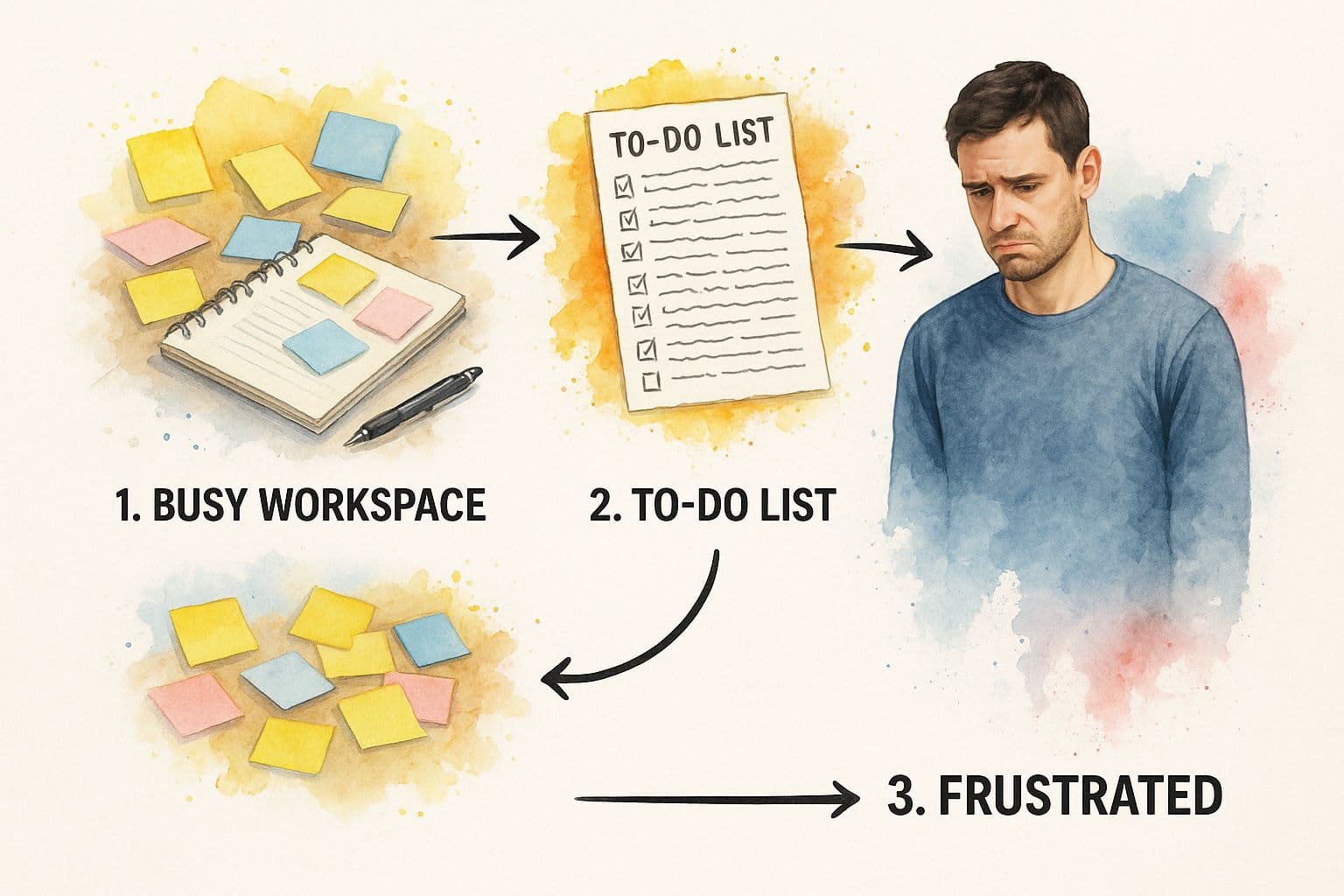
The image below captures the feeling of being overwhelmed by a chaotic workflow—the problem the matrix is designed to fix.
The Four Quadrants of the Action Priority Matrix
The power of the matrix comes from sorting tasks into four distinct categories. Each quadrant guides how to approach items inside it, removing guesswork from daily planning.
| Quadrant | Impact | Effort | Recommended Action |
|---|---|---|---|
| Швидкі перемоги | High | Low | Робити насамперед. Топ‑пріоритети, що дають великі результати за мінімальних зусиль. |
| Великі проєкти | High | High | Запланувати й розбити. Розбийте їх на етапи і внесіть у календар. |
| Дрібні задачі | Low | Low | Делегувати або відкласти. Якщо маєте вільний час — зробіть їх; інакше делегуйте. |
| Невдячні завдання | Low | High | Уникати або усунути. Сумнівайтеся в їхній цілісності та шукайте автоматизацію чи спрощення. |
Using this framework turns an overwhelming list into a manageable, strategic plan that your team can actually follow.
Building Your First Action Priority Matrix
Getting started is refreshingly simple. You don’t need fancy software—just a clear head and a willingness to be honest about what’s on your plate. The aim is to convert a long, stressful to-do list into a visual, strategic roadmap.
The first step? A brain dump. Get everything out of your head and onto a page or a document. Don’t worry about organization yet. List every task, project, and item—from “Draft Q3 marketing report” to “Finally fix that bug in the user login flow.”

Scoring Impact and Effort
With your master list in hand, score each task on two dimensions: impact and effort. A simple 1–10 scale works well, where 1 is low and 10 is high.
- Impact Score: How much does the task move the needle toward your goals? High (8–10) signals game‑changers; low (1–3) signals minor tasks with limited influence.
- Effort Score: How much will this drain resources (time, energy, budget)? High (8–10) indicates a major undertaking; low (1–3) suggests a quick win.
Be objective. If you’re scoring with a team, discuss and agree on the scores to minimize bias. This structured thinking pays dividends in complex projects. For example, a 2023 study in the South African railway industry used a similar scoring method to prioritize maintenance tasks, achieving a notable improvement in consensus and focus on critical initiatives2.
Plotting Your Tasks on the Matrix
Draw a four‑quadrant grid with axes labeled: vertical “Impact” (low at the bottom, high at the top) and horizontal “Effort” (low on the left, high on the right).
Place each task on the grid based on its scores. A task with impact 9 and effort 2 lands in the top‑left quadrant; a task with impact 8 and effort 8 sits in the top‑right quadrant.
Once you’ve plotted everything, you’ll have a powerful visual of your entire workload, neatly sorted into the four key categories: Quick Wins, Major Projects, Fill-Ins, and Thankless Tasks.
This isn’t just a pretty chart—it’s a dynamic decision tool. Tasks in the Quick Wins quadrant are your green light: low effort, high value.
Putting the Action Priority Matrix to Work in the Real World
The matrix’s beauty is its flexibility. It isn’t a rigid rulebook; it’s a tool teams can adapt to their context. What a marketing team calls “high impact” may differ from what an engineering team considers impactful.
Think about a university fundraising department. A task like “update the online donation form” could be a Quick Win, with only a few hours of work but a measurable lift in online donations. This is a classic case of low effort, high impact.

Different Environments, Different Priorities
Now imagine NASA on a Mars mission. A task like “designing a life‑support system” is undeniably high impact but also a monumental, multi‑year effort. It sits in Major Projects, demanding long‑term planning. Contrast that with a fast‑moving tech startup where shipping new features repeatedly creates Quick Wins and Major Projects, often with some debt along the way.
These scenarios illustrate a key point: impact and effort are relative to context. The action priority matrix shines when you define the axes to reflect your goals, resources, and constraints.
The matrix isn’t a one‑size‑fits‑all template. Its power comes from adapting the axes to your real work and recalibrating as conditions change.
Global Nuances and Adaptation
Organizations worldwide have embraced the matrix for different reasons. Globally, startups often treat rapid feature deployment as Quick Wins to drive growth, while larger enterprises emphasize high‑impact updates such as security patches. This diversity highlights the need to tailor the matrix to your situation. About 3 of companies recalibrate their criteria regularly to stay aligned with evolving capabilities and markets.
Avoiding Common Pitfalls with the Action Priority Matrix
The matrix is powerful, but teams often misapply it. Here are the common traps and how to avoid them:
- The most frequent mistake is treating the matrix as a one‑and‑done exercise. Priorities shift with new data and roadblocks; the matrix should be a living guide that reflects current reality. If it’s not, you’ll be chasing yesterday’s problems instead of today’s opportunities.
- Misjudging effort and impact is another pitfall. Bias and optimism can skew scores toward Quick Wins. Ground your process in data, involve cross‑functional input, and decompose large tasks into smaller pieces for accurate scoring.
Practical Improvements and Internal Linking
To embed prioritization into your daily workflow, connect the matrix to your project management system. Whether you use Asana, Trello, or Fluidwave, mirror the four quadrants with tags or custom fields and build a priority dashboard for at‑a‑glance visibility. See Fluidwave’s free online Task Prioritizer for a hands‑on demonstration of these principles in action.
The goal is to build a workflow around your priorities, not just categorize them. When the matrix is embedded in your digital tools, prioritization becomes a daily, collaborative habit.
Setting Up Your Digital Workspace
Here’s a practical setup:
- Create Four Quadrant Labels: Quick Win, Major Project, Fill‑In, and Thankless Task.
- Tag Every Task: During intake or weekly planning, assign the right label based on impact and effort.
- Build a Priority Dashboard: Use your tool’s filtering or board view to show four columns—instant visibility of where things stand.
If you’d like to experiment, try Fluidwave’s free online Task Prioritizer: https://fluidwave.com/tools/task-prioritizer.
The aim is to weave priorities into your daily toolset, turning prioritization from a one‑off meeting into a living practice.
Your Priority Review on Autopilot
Digitizing the matrix enables routines and reminders that keep priorities current. Create a recurring weekly task called “Matrix Review” so the team reassesses scores, updates plans, and celebrates completed work. This simple habit prevents the matrix from becoming stale and ensures decisions stay smart.
The matrix moves from a diagram on a wall to a living, breathing guide that informs daily choices and long‑term strategy.
Q&A: Quick Answers to Common Questions
How often should I update my matrix?
There’s no magic number, but treat the matrix as a living guide. A weekly review works for most teams; in fast‑moving environments, consider a daily huddle around the matrix to stay aligned.
What if my team disagrees on scores?
Disagreements are normal and productive. Define scales together, bring data to the table, and appoint a neutral facilitator to help reach consensus. This keeps scores meaningful and actionable.
Can I apply the matrix to personal goals?
Absolutely. The impact‑versus‑effort lens works for home projects, fitness plans, and personal productivity. Quick Wins for personal goals include meal prepping; Major Projects might be saving for a down payment; Fill‑Ins could be organizing a junk drawer; Thankless Tasks could be researching services without a plan to buy.
Ready to stop juggling tasks and start prioritizing with intelligence? Fluidwave combines the action priority matrix with AI‑powered automation and on‑demand virtual assistants. Turn your to‑do list into a clear roadmap for success. Get started for free at Fluidwave.
1.
Footnotes in Chicago style appear here as endnotes. For example, cognitive overload is a well‑documented concept discussed in cognitive science literature and summarized in accessible online resources. See Fluidwave.
2.
“Action Priority Matrix” in productivity literature and case studies; see LarkSuite.
3.
Global adoption and adaptation patterns of prioritization frameworks are discussed in industry reports and articles. See https://www.larksuite.com/en_us/topics/productivity-glossary/action-priority-matrix.
Зосередьтесь на тому, що має значення.
Відчуйте блискавичне управління завданнями за допомогою AI-процесів. Наша автоматизація допомагає зайнятим професіоналам економити 4+ годин на тиждень.