Master virtual assistant hiring in 2026! This guide covers job posts, screening, contracts, onboarding, & delegation workflows for success.
July 19, 2026 (2mo ago)
Virtual Assistant Hiring: Your Complete 2026 Guide
Master virtual assistant hiring in 2026! This guide covers job posts, screening, contracts, onboarding, & delegation workflows for success.
← Back to blog
You're probably reading this because work has started leaking into everything. Your inbox is noisy, your calendar is a mess, small tasks keep interrupting deep work, and every time you think “I need a virtual assistant,” you hit the next problem. What do you delegate? Where do you find someone good? How do you avoid spending weeks hiring the wrong person?
That's where most virtual assistant hiring goes sideways. People hire from stress, not from clarity. They post a vague job, skim too many applications, choose someone who seems pleasant, then wonder why the relationship feels heavy instead of helpful.
A good VA can take meaningful weight off your plate. A bad hire creates a new management job. The difference usually comes down to role design, screening, onboarding, and whether you're hiring for hours or for outcomes.
Laying the Groundwork Before You Hire
Monday starts with 14 unread emails marked urgent, three meetings that should have been one, and two hours gone to rescheduling, follow-ups, and digging for files. That does not automatically mean you need a full-time assistant. It usually means your work is poorly sorted.
The first fix is a task audit. For one week, capture what you do. Pull from your calendar, sent mail, Slack, project boards, and browser history. I have seen founders swear they spend their time on strategy, then discover they are burning ten hours a week on scheduling, status chasing, and rewriting the same instructions.

Separate owner work from support work
A simple filter helps. Ask three questions about each task: Does this require my judgment? Does it require my authority? Does it repeat often enough to hand off?
Use that filter to sort work into three buckets.
- Owner work: strategic calls, pricing decisions, sensitive team conversations, final sign-off on high-risk client work
- Support work: inbox triage, calendar management, research prep, CRM updates, meeting notes, follow-ups, travel planning, file organization
- Later delegation: customer escalations, writing in your voice, process redesign, vendor negotiation, or anything else where context and nuance matter more than speed
This matters even more for people with neurodivergent work patterns. If context switching drains you, the right VA should remove interruptions, not add another stream of pings. In practice, that often means assigning pay-per-task work with clear definitions, deadlines, and done states instead of asking someone to “be available” for vague admin help.
If you are not sure what belongs on your side of the desk, use this delegation skills quiz. It is a quick gut check. A lot of failed VA hires start with unclear delegation, not bad talent.
Turn a messy task list into a real role
A vague brief attracts vague applicants. A clear brief attracts people who can spot process gaps, estimate effort, and tell you where your instructions are weak.
Start with outcomes, not personality traits.
| Outcome | What success looks like |
|---|---|
| Inbox triage | Important emails flagged, low-value messages archived, drafts prepared for review |
| Calendar management | Meetings scheduled within your rules, buffers protected, conflicts resolved before they hit you |
| Research support | Short summaries delivered in your format, with links and next-step recommendations |
| Admin follow-through | Recurring tasks completed on time without reminders |
That structure works well inside task systems such as Fluidwave, where work can be assigned as discrete tasks with rules, due dates, and recurring instructions. It also protects you from a common mistake. Hiring someone for “general support” sounds flexible, but it usually creates confusion, slow handoffs, and too many check-in messages.
If you expect candidates to present themselves clearly, ask for the same discipline in their application materials. Some will need help doing that well, and resources that explain how to get your resume noticed by recruiters can improve the pool you review.
Set the budget before you shop
Budget gets easier once the role is concrete. A VA handling recurring admin on a pay-per-task basis should be priced differently from someone managing executive operations, setting up automations, or handling client-facing work.
Cost is a real advantage, but cheap hiring creates expensive messes. According to Prialto's overview of virtual assistant pricing and value, companies often use VAs to reduce overhead compared with full-time in-house support while keeping flexibility in how work is assigned and scaled (Prialto virtual assistant pricing). That only works when the task design is clear and the communication load stays low.
I would rather pay more for a VA who follows rules, documents edge cases, and closes loops than save a few dollars on someone who needs constant rescue. The wrong hire does not just waste money. It clogs your task system, breaks trust in delegation, and makes you hold onto work you should have handed off months earlier.
Write the role first. Then price the work. Then start looking.
Sourcing and Attracting Top Talent
Where you look changes what kind of hiring problem you'll have. Some channels give you volume. Some give you speed. Some give you more control. None gives you perfect candidates by default.
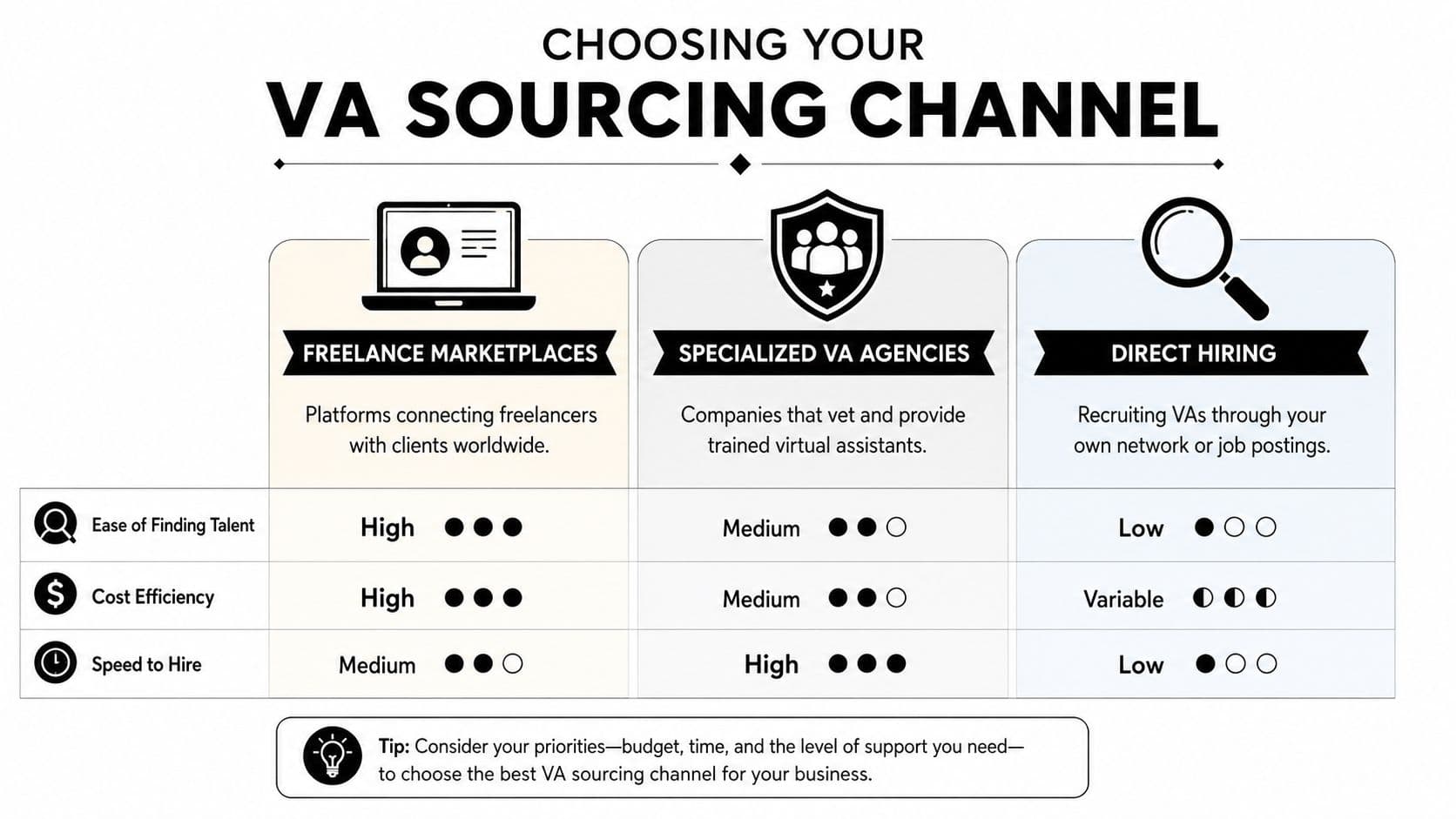
The three main channels
Here's the practical version.
| Channel | What it's good for | Main downside |
|---|---|---|
| Freelance marketplaces | Fast access to a huge pool for project or task-based work | High noise, inconsistent vetting |
| Specialized VA agencies | Faster matching and more structure | Less control over sourcing and often higher cost |
| Direct hiring | Strong fit if you want a long-term operator | Slowest path and most work on your side |
Freelance marketplaces work well when you know exactly what you need and can write a tight brief. They're useful for pay-per-task delegation, trial projects, and specialized one-off support. The trap is volume. You'll get many applicants who can talk about the work but can't perform it.
Specialized agencies make sense when speed matters and you don't want to build the screening machine yourself. You're paying for pre-vetting and process. That can be worth it if your own time is the expensive bottleneck.
Direct hiring through LinkedIn, referrals, and your network tends to produce the strongest long-term matches, especially for executive assistant style roles. It also requires patience, clear systems, and better interviewing discipline.
Expect noise and design for it
The funnel is brutal. The end-to-end conversion rate for virtual assistant hiring is 0.141%, or roughly 1 hire for every 708 applicants, which is why screening has to be deliberate, not casual (VA hiring funnel data).
That number surprises first-time hirers. It shouldn't. The role title is broad, barriers to applying are low, and many candidates use generic applications.
So your job post has to do two things at once. It needs to attract capable people and repel everyone else.
A job post should filter. If everyone feels invited, you wrote marketing copy, not a hiring brief.
Write a post that pulls in operators
Good candidates look for signs that you know how to delegate. They want clarity on tools, turnaround standards, communication style, and what “good” looks like.
Use a headline with a real scope:
- Executive VA for calendar, inbox, and follow-up systems
- E-commerce VA for customer support and order issue resolution
- Research and admin VA for founder with fast-moving schedule
Inside the post, include:
- Primary outcomes: what they'll own by week two or week four
- Tools: Google Workspace, Slack, Notion, ClickUp, Airtable, HubSpot, or whatever you use
- Communication cadence: async-first, daily check-in, same-day response window, video only when needed
- Trial expectations: paid sample task, turnaround time, format requirements
- Application instruction: ask for a short Loom, a specific example, or a customized response
One useful trick is to ask candidates to submit a concise summary instead of a long cover letter. If they need help understanding how recruiters read application materials, this breakdown on how to get your resume noticed by recruiters is also useful from the candidate side, and it helps you understand what polished applicants are optimizing for.
The best applicants usually sound calm, specific, and observant. They don't just say they're organized. They show you how they organize work.
Conducting Interviews and Practical Skill Tests
Resumes are weak evidence. Virtual assistant hiring improves fast when you stop treating interviews like the main event and start treating them like a setup for a realistic paid test.
I've seen this go wrong in a very predictable way. A founder hires a candidate after a pleasant interview, assigns a vague “trial,” then gets frustrated when the result is messy. The candidate didn't fail the job. The employer failed the test design.
A bad trial versus a useful one
A bad trial sounds like this: “Help organize my inbox and improve my workflow.”
That instruction creates too much ambiguity. The candidate has to guess your priorities, your voice, your tolerance for risk, and how much initiative you want.
A better trial is narrower:
- Inbox trial: categorize 25 sample emails into reply now, delegate, archive, and waiting. Draft responses for five.
- Scheduling trial: book three meetings using stated time windows, buffer rules, and timezone constraints.
- Research trial: produce a one-page summary on five podcast booking opportunities with contact details, audience fit, and next steps.
- Content support trial: format a blog draft in Google Docs, extract key points, and draft three social post options.
Those tests mirror actual work. They also show whether the candidate follows instructions, asks smart questions, and delivers in a clean format.
What to assess in the interview
Keep interviews short. You're looking for judgment, communication, and self-management.
Listen for these things:
- Clarity: can they explain how they approach a task without rambling?
- Initiative: do they wait for exact instructions, or do they propose reasonable next steps?
- Tool fluency: can they use the stack you use, or learn adjacent tools quickly?
- Process thinking: do they document what they do so the work becomes repeatable?
One of the most important modern screens is AI literacy. AI-augmented virtual assistants handle 37% more tasks per hour than non-AI-assisted counterparts, so it's worth testing whether a candidate can use tools like ChatGPT well, not just claim familiarity (AI-augmented VA productivity research).
Don't ask, “Do you use AI?” Ask, “Show me how you'd use ChatGPT to turn this messy voice note into an action list, a client-ready email draft, and a task summary.”
Build a micro-test around your real workflow
For fragmented work, especially if your days are chaotic, a microtask approach works better than a broad assignment. Generate a few realistic sample tasks and judge output quality, speed, and communication consistency. A tool like the Fluidwave microtask generator can help you turn fuzzy responsibilities into testable assignments without overcomplicating the process.
A strong candidate doesn't just finish the task. They reduce friction. They label files clearly, note assumptions, and flag edge cases without making every small issue your problem.
Pay for trial work. That signals professionalism, and it gives you cleaner data than unpaid “samples” ever will.
Navigating Pricing Models and Contracts
The pricing model you choose affects behavior. That's why a lot of virtual assistant hiring problems are really packaging problems.
If you pay hourly, you're buying availability. If you pay a retainer, you're buying dedicated capacity. If you pay per task, you're buying outputs. None is universally better. The right one depends on how your work shows up.
When hourly pricing works
Hourly works when task volume changes week to week and you expect ongoing back-and-forth. It also works early, when both sides are still learning scope.
The downside is predictable. You can drift into “just one more thing” management, where the assistant is busy but you still feel unsupported. Hourly arrangements need clear task boundaries, approval rules, and reporting habits.
When retainers make sense
Monthly retainers fit roles with stable support needs, like executive admin, customer support coordination, or recurring operations. You get consistency, and the VA can plan around your cadence.
Retainers become inefficient when your workload is fragmented. If you have bursts of delegation followed by silence, you can end up paying for unused capacity or inventing work to fill the hours.
Why pay per task is getting more practical
Pay-per-task delegation is a better fit for many founders, freelancers, and neurodivergent professionals. Some days you need “schedule these meetings, clean this spreadsheet, draft this follow-up.” Other days you need nothing.
That model is especially useful when your bottleneck is task switching, not headcount. You're not hiring someone to sit in a block of time waiting for requests. You're defining a result and paying for completed work.
Here's a simple decision view:
| Pricing model | Best for | Watch out for |
|---|---|---|
| Hourly | Ongoing support with shifting priorities | Scope drift |
| Monthly retainer | Predictable recurring workload | Paying for idle capacity |
| Pay per task | Fragmented workflows and outcome-based delegation | Poorly defined tasks |
For budgeting, rates vary by role complexity and geography. The broader market also mixes human assistants with AI tools, so clarify what you're buying. Some industry estimates place the global virtual assistant services market between $5.3 billion and $8 billion in 2025, and that variation exists partly because definitions differ on whether AI assistants are counted alongside human VAs (virtual assistant statistics overview).
What the contract needs to say
Keep the agreement simple and unambiguous.
- Scope of work: define recurring tasks, excluded tasks, and approval thresholds.
- Payment terms: state the pricing model, invoicing cadence, and what counts as completed work.
- Confidentiality: include NDA language if they'll touch client data, finances, or internal documents.
- Access and security: specify approved tools, password-sharing method, and revocation process.
- Exit terms: include notice periods, immediate termination conditions, and who owns work product.
If you want a quick sense of whether delegation will pay off for your workload, a delegation ROI calculator can help pressure-test the math before you commit.
Mastering Onboarding and Delegation Workflows
Most bad VA relationships don't fail in the interview. They fail in the first two weeks, when expectations are implied, access is messy, and communication style starts grinding on both sides.
That risk is bigger than many people think. Mismatched communication styles are a primary driver of failure in VA relationships, causing over 60% of projects to derail, which is why structured onboarding and workflow documentation matter so much (discussion of communication mismatch in VA relationships).

The first-week checklist
A new VA shouldn't have to reverse-engineer your business from scattered messages. Give them a real operating environment.
- Set communication rules early: define where urgent requests go, where routine tasks live, and when they should interrupt you.
- Grant access carefully: use a password manager, role-based permissions, and a simple access sheet showing what they can touch.
- Document one core workflow first: inbox, scheduling, lead follow-up, or research formatting. Start with the task they'll repeat most often.
- Give examples of finished work: show a good summary, a good draft, a good client follow-up, a good meeting brief.
- Decide how proactive you want them to be: some executives want suggestions; others want tight execution only. Say it directly.
If your assistant has to guess your tolerance for detail, urgency, or initiative, they will guess wrong at least once.
Build a system, not a chat thread
Slack is useful. Email is fine. Shared docs help. But delegation breaks down when work lives across too many places with no single source of truth.
Use one task system where assignments, deadlines, context, and status are visible. For pay-per-task workflows, that matters even more because each handoff needs a clean brief and a visible definition of done. In practice, teams often use ClickUp, Asana, Trello, or a more delegation-focused setup such as Fluidwave, which combines task management with human assistant support on a pay-per-task basis.
For visual learners, this walkthrough is a useful reference during setup:
Onboarding for neurodivergent workflows
This part gets ignored in most hiring advice. Communication style isn't just a personality preference. It affects cognitive load.
If you're ADHD-driven, easily context-switched, or prone to overwhelm, tell your VA exactly what helps:
- Do you want concise updates or detailed ones?
- Should they batch questions or send them immediately?
- Do you prefer checklists, Loom videos, or written summaries?
- Should they propose priorities when everything feels equally urgent?
The best onboarding documents include a “how to work with me” page. Not fancy. Just honest. It saves a lot of friction.
A VA becomes useful when they can operate without repeatedly pulling you out of focus. That only happens when the workflow is documented and the communication style is explicit.
Tracking Performance and Growing the Relationship
Two months in, a VA can look busy and still create drag. Tasks get done, but you still have to check everything, answer avoidable questions, and re-explain priorities. That is the point where many hires stall out.

Track outcomes, not keystrokes
Good performance tracking answers one question. Is this person giving you time back in a way you can trust?
For a pay-per-task model, that means measuring output at the task level. Look at whether the brief was followed, whether the task met the definition of done, whether follow-up was needed, and whether the handoff reduced your cognitive load or added to it. For neurodivergent professionals, that last point matters more than standard productivity advice admits. A technically correct task can still be a bad result if the update style breaks focus, creates decision fatigue, or arrives in five scattered messages instead of one clean summary.
Useful review points include:
- Turnaround quality: did the completed task leave your plate, or come back for repair?
- Communication fit: were updates clear, timely, and easy for you to process?
- Reliability: did they meet deadlines and raise blockers early enough to protect the deadline?
- Judgment growth: are they spotting obvious next steps without waiting for permission?
- System discipline: did they keep task status, notes, and files updated in the same place the work lives?
A short weekly review works well. I prefer ten to fifteen minutes with concrete examples pulled from actual tasks. Vague praise does not help, and vague frustration creates defensiveness.
Move from task taker to operator
The best VA relationships grow because ownership grows. The early phase is simple execution. Later, the assistant starts handling repeatable functions with less intervention and better judgment.
That usually happens in three stages:
-
Execution stage
They complete defined tasks accurately and on time. -
Ownership stage
They run a recurring function such as calendar coordination, inbox triage, expense follow-up, or customer support handoffs. -
Operational stage
They improve the system itself. They catch bottlenecks, update SOPs, flag patterns, and suggest better ways to route work.
That progression is common enough that broader market reporting has tracked steady growth in virtual assistant adoption among businesses, as noted earlier. The more useful takeaway is not the adoption number. It is the pattern. Owners who get the most value stop treating the VA as a pair of hands and start assigning outcomes with clear boundaries.
A VA becomes strategic when they stop asking what to do next and start pointing out what should change.
That shift does not happen from loyalty alone. It happens because you share context, reward sound judgment, and give the assistant a system where they can see priorities, dependencies, and closed-loop feedback. If you use a task hub such as Fluidwave for pay-per-task delegation, review the data inside the workflow itself. Which tasks get reopened? Which categories always need clarification? Which assignments are finished without any follow-up from you? Those patterns show whether the relationship is maturing or just staying busy.
If months pass and you are still acting as the routing layer for every small decision, fix the ownership gap directly. Rewrite the scope. Tighten the brief. Define approval limits. Decide which problems they should solve without asking, which ones need a recommendation first, and which ones still belong to you.
That is how a VA starts buying back real attention, not just checking off tasks.
Focus on What Matters.
Experience lightning-fast task management with AI-powered workflows. Our automation helps busy professionals save 4+ hours weekly.