Elevate your projects with our guide to project management communication. Learn the frameworks, tools, and strategies to drive clarity and team alignment.
March 6, 2026 (7mo ago) — last updated March 9, 2026 (7mo ago)
Unlocking Success with Project Management Communication
Elevate your projects with our guide to project management communication. Learn the frameworks, tools, and strategies to drive clarity and team alignment.
← Back to blog
When we talk about poor project management communication, we're not just talking about a missed email or a vague comment. We’re talking about a fundamental breakdown in how information moves—or, more often, fails to move—between your team, your stakeholders, and leadership. It’s the chasm between what one person says and what another person actually understands, and honestly, it's where projects go to die.
Think of communication as the project's circulatory system. When it’s healthy, information flows freely, delivering what’s needed to keep every part of the project alive and moving. When it gets clogged up, the entire system starts to fail.
The High Cost of Poor Communication
Let's get one thing straight: most projects don't fail because of some technical glitch or a wonky budget spreadsheet. They fail because of people problems, and communication breakdowns are right at the top of that list. When your team isn't on the same page, the fallout spreads through every project phase, turning clear objectives into total chaos.

This isn’t some minor hiccup. It’s one of the biggest reasons projects fail. Dismissing communication as a "soft skill" is a dangerously expensive assumption. It’s not soft; it’s the core operational discipline that separates a smooth, successful project from a stressful, chaotic one.
The Real-World Consequences
When communication goes sideways, the results are as predictable as they are painful. I've seen it happen more times than I can count. Vague instructions lead to a developer spending a week building the wrong feature. A lack of clear status updates makes stakeholders nervous, and they start to micromanage everyone. These aren't just hypotheticals; this is the daily grind for far too many teams.
This broken flow of information almost always leads to the same things:
- Missed Deadlines: When no one is clear on who does what by when, or how their work affects others, tasks stall. Before you know it, your timeline is completely shot.
- Bloated Budgets: Rework is the silent budget killer, and it’s almost always born from miscommunication. Every single time a task has to be redone, you're burning through time and money.
- Frustrated Teams: Nothing demoralizes a great team faster than constant confusion, feeling unheard, or being blindsided by last-minute changes they never saw coming.
The financial hit is staggering. Research from the Project Management Institute (PMI) shows that poor communication is a contributing factor in 56% of all project failures. That’s a massive drain on resources, costing companies billions every year.
Shifting How You Think About Communication
To really get why this matters, you have to look past the symptoms and understand the root cause. The problem isn't just about sending more emails or scheduling more meetings—that often just adds to the noise. You can see how the principles apply everywhere by reading about the high cost of poor communication, even in different fields like sales.
The real goal is to build a system for clarity. It’s about creating a reliable, predictable flow of information that cuts through the static. When you get this right, everyone knows their role, understands the project's goals, and has the context they need to do their best work without needing their hand held.
Understanding the Foundations of Project Communication
Great project communication isn't just about blasting out emails and status updates. It’s about being the architect of your project's information flow. Think of yourself as designing a system that gets the right message to the right people at exactly the right time. This isn't about following some rigid, textbook formula—it's about thinking strategically before the first task is even assigned.
To build this system, you have to get back to basics. Forget the corporate jargon for a minute and focus on four simple but powerful questions: Who, What, When, and How. Answering these honestly and thoroughly creates a communication backbone that can support your project from its chaotic beginnings to its successful conclusion.
The Who and What of Communication
First things first: you need to map out every single person or group with a stake in your project. This sounds simple, but I’ve seen more than one project stumble right here. Your audience is never just one big group; it’s a collection of different people with wildly different expectations.
- Project Sponsors: These are the folks funding the project. They need the 30,000-foot view. Are we on budget? Are we on schedule? What are the biggest risks? They don’t have time for the nitty-gritty details.
- Key Stakeholders: Think department heads or client-side managers. They need to know how the project’s progress and milestones will affect their own teams and how it all fits into the bigger business picture.
- Your Core Team: These are the people in the trenches. They need clear instructions, detailed context for their tasks, and an open channel to ask questions and solve problems as they pop up.
Once you know your 'Who,' the 'What' becomes much clearer. The information you share has to be tailored. Sending a sponsor a dense, technical bug report is just noise. Likewise, giving a developer a high-level budget summary is pretty useless. Matching the message to the audience isn't just a nice-to-have; it's a fundamental rule of effective communication. Honing this ability is a skill in itself, and it’s always worth learning how to improve communication skills in the workplace to connect better with everyone involved.
The When and How of Your Message
With your audience and their needs sorted out, you can focus on timing (When) and delivery method (How). This is where you have to make a conscious choice between two main modes of communication.
Synchronous Communication is anything that happens in real-time. We’re talking about video calls, face-to-face meetings, or a quick chat in Slack. It’s immediate and interactive, making it perfect for brainstorming, hashing out a complex problem, or making a critical decision on the spot.
Asynchronous Communication happens on everyone’s own time. This is your emails, updates in a project management tool, recorded videos, or formal status reports. It’s deliberate, documented, and the best choice for non-urgent updates and keeping a clear record of progress.
A classic mistake is picking the wrong mode for the job. We’ve all been in that meeting that absolutely could have been an email. On the flip side, trying to resolve a sensitive, complex issue over a long, disjointed email thread is a recipe for frustration and misunderstanding.
The 'How' is all about choosing the right channel. A solid communication plan specifies which tool is used for which purpose, so there’s no confusion. For instance:
| Communication Type | Best Channel | Why It Works |
|---|---|---|
| Urgent Issue | Instant Message or Call | Gets an immediate response for time-sensitive problems. |
| Task Update | Project Management Tool | Keeps all context with the work and creates a perfect paper trail. |
| Weekly Progress | Email or Documented Report | Provides a formal, comprehensive summary for stakeholders. |
| Team Brainstorm | Video Conference | Allows for the free-flowing exchange of ideas in real time. |
By being deliberate about the who, what, when, and how, you shift from just reacting to messages to strategically guiding the conversation. This foundation turns information from a source of chaos into your project's most powerful tool for driving progress.
How to Build a Practical Communication Plan
Knowing the theory behind great communication is one thing, but actually making it happen on a busy project is a whole other ballgame. The bridge between idea and execution is your communication plan. Think of this not as some formal document that collects dust, but as a living playbook for your project's information flow.
A solid plan cuts through the noise and ambiguity. It proactively answers the big questions before they derail your team, preventing information overload and endless email chains. Instead of everyone guessing, you create a single source of truth that keeps the entire project aligned and focused.
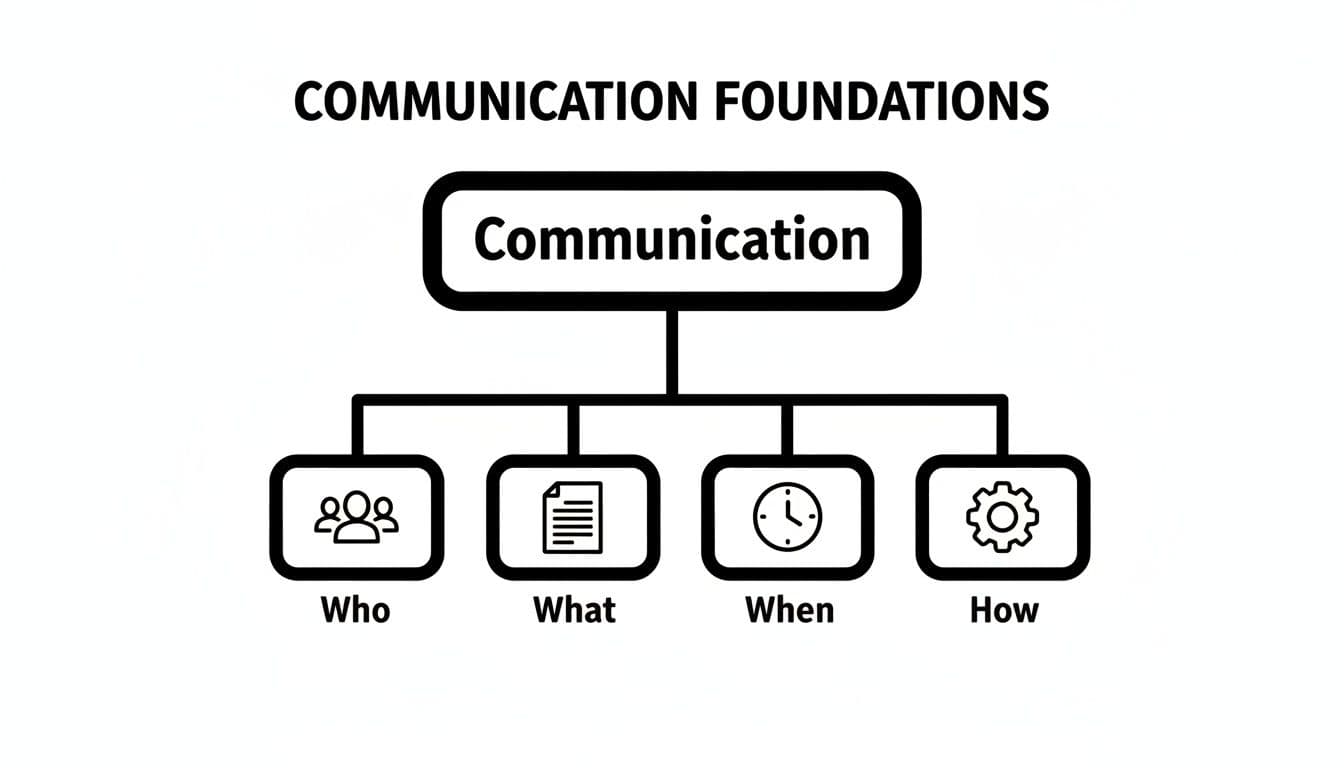
This simple visual breaks it all down. A successful plan really just comes down to answering these four core questions. Get these right, and you've built a powerful system for keeping everyone in the loop.
First, Identify Your Stakeholders (The "Who")
Before you can say anything, you have to know who you’re talking to. The first move is always to map out every single person, team, or group with a vested interest in your project. Don't just jot down names—really think about their role, their influence, and what they care about.
Your stakeholder list will typically include people like:
- The Project Sponsor: This is the executive who champions the project and holds the purse strings.
- Your Core Team: The developers, designers, writers, and other specialists doing the day-to-day work.
- Department Heads: Leaders from other parts of the business whose teams might be affected by your project’s outcome.
- External Clients or End-Users: The very people you’re building this for.
One of the most common missteps I see is forgetting a key stakeholder early on. It seems small, but it can cause massive headaches and roadblocks down the line. Be thorough.
Second, Define What They Need to Know (The "What")
Okay, you've got your "who." Now it's time to figure out the "what." Blasting everyone with the same generic update is a recipe for getting ignored. It’s just noise.
Instead, put yourself in their shoes. What does each group actually need to know to feel confident and do their job? For instance, your sponsor cares about high-level progress, budget risks, and major timeline shifts—not the bug your team fixed yesterday. That developer, on the other hand, needs those specific technical details, not a summary of the project's financials.
A great communication plan matches the information to the audience, ensuring every update is relevant, valuable, and immediately useful.
Here's a simple template to start mapping this out. This Stakeholder Communication Matrix is the backbone of a strong plan.
Stakeholder Communication Matrix Template
Use this template to map stakeholder roles to their communication needs, channels, and frequency, forming the backbone of your project communication plan.
| Stakeholder Role | Information They Need | Best Communication Channel | How Often to Communicate |
|---|---|---|---|
| Project Sponsor | High-level status, budget, risks, key decisions needed | Email summary; Bi-weekly meeting | Weekly email; Bi-weekly sync |
| Core Project Team | Daily tasks, priorities, blockers, technical details | Fluidwave, Daily stand-up | Daily |
| Department Heads | Project impact on their teams, key milestones | Monthly email update; As-needed meetings | Monthly |
| External Client | Overall progress, demo schedules, feedback requests | Formal weekly report; Scheduled video calls | Weekly |
Filling this out forces you to think strategically about every message you send, which is a total game-changer for project efficiency.
Third, Choose the Right Channels (The "How")
With your "who" and "what" sorted, the next piece of the puzzle is the "how." In a world overflowing with apps, it’s tempting to use everything for everything. That's a direct path to chaos. A smart plan designates specific tools for specific jobs.
A simple, effective setup might look like this:
- Project Management Platform (like Fluidwave): Make this your command center for all task-related updates, discussions, and files. It keeps conversations connected to the actual work.
- Instant Messaging (Slack, Teams): Use this for genuinely urgent, quick questions that need a fast response.
- Email: Reserve this for more formal communication—official announcements, stakeholder reports, or anything going to an external client.
- Video Calls (Zoom, Google Meet): These are perfect for weekly team syncs, brainstorming sessions, or critical kickoff meetings where face-to-face interaction matters.
When you establish these rules, you're training your team on where to find information and where to ask for it. The amount of time and confusion this saves is huge.
Finally, Set a Clear Cadence (The "When")
The last step is establishing the "when." A predictable rhythm for communication builds incredible trust and helps everyone manage their expectations. If your stakeholders know a summary report lands in their inbox every Friday afternoon, they're far less likely to ping you on Wednesday asking, "How's it going?"
Document this cadence clearly in your plan. You might land on a schedule like:
- Daily stand-ups for the core development team.
- Weekly summary emails for your main stakeholders.
- Bi-weekly steering committee meetings with sponsors and leadership.
- Monthly all-hands updates to keep the wider organization informed.
The right frequency depends entirely on your project's pace and your stakeholders' needs. For a deeper dive and a template you can use right away, check out our guide on building a project communications plan template.
Following these four steps will turn your communication from a reactive scramble into a proactive strategy that helps drive your project to success.
Best Practices for Effective Team Messaging
Even the best communication plan falls apart if the messages themselves are a mess. The real test of your communication strategy isn't the document sitting in a shared drive; it's the quality of the day-to-day messages you and your team send.
Good messages build momentum. They’re clear, concise, and get people to act. Bad ones, however, create confusion, trigger endless follow-up questions, and can bring a project to a screeching halt. This is especially true for remote and hybrid teams, where you can't just rely on body language or a quick chat by the coffee machine to clear things up.
Write for Action, Not Just for Updates
The most common mistake I see in team messaging is vagueness. We’ve all gotten that cryptic message loaded with jargon and fuzzy requests that leaves you wondering, "What do they actually want from me?" Your goal should be to write messages that are impossible to misinterpret.
Before you hit send, ask yourself one simple question: “What do I need the reader to know or do?” If you can't answer that in a single, clear sentence, the message isn't ready.
Let’s look at a classic example of how a small shift in wording can make a world of difference.
Before: The All-Too-Common Vague Update
"Hey team, just wanted to check in on the Q3 launch. There are some issues with the latest designs and we need to get them sorted out. Let me know what you think."
This message creates work instead of clarifying it. What “issues”? Which “designs”? It forces the team to become detectives just to figure out the next step.
After: A Clear, Actionable Request
"Hi Design Team, I've reviewed the V2 mockups for the new user dashboard. The data visualization component isn't matching the client's feedback from last Tuesday's call. Specifically, we need to change the bar graphs to line charts. Could you please provide an updated version by EOD tomorrow, Thursday, so we can stay on track for our Friday deadline? The feedback document is attached for reference."
See the difference? It’s specific, it gives context, it names who’s involved, and it provides a direct call-to-action with a deadline. It respects everyone's time by getting straight to the point.
Essential Techniques for Remote and Hybrid Teams
For remote teams, ambiguity is the project killer. When you're working across different time zones and locations, you have to be extra intentional with how you communicate. This is a non-negotiable skill for project managers at the top remote companies, where clear messaging is the glue holding everything together.
- Over-Communicate Context: Don't assume people know what you're talking about. Link to the relevant document, task, or previous conversation. Give them the breadcrumbs.
- Be Explicit with Deadlines: "ASAP" or "by end of day" means different things to different people. Be crystal clear: "By 5:00 PM EST on Friday, October 25th."
- Use Visuals: A quick screenshot with annotations or a short screen recording can explain a complex problem in 30 seconds, saving you 15 minutes of typing.
- Write with Empathy: Tone is easily lost in text. Reread your message and ask if it could be misinterpreted as abrupt or demanding. Remember, there's a person on the other end of the screen.
A core principle of strong project management communication is to always write for your audience. Empathy isn't just a soft skill; it's a strategic tool that prevents misunderstanding and fosters a more collaborative team environment.
Message Templates for Common Scenarios
You don't need to reinvent the wheel every time. Having a few go-to templates handy will save you time and keep your communication consistently clear. Feel free to adapt these to fit your team's style.
- Project Kick-Off Announcement
Subject: Kick-Off: [Project Name]
Team,
Welcome to the official kick-off for the [Project Name] project! Our goal is to [state the main objective in one sentence].
The project brief, timeline, and stakeholder list are all in our shared [Fluidwave/Project Tool] space here: [Link]
Our kick-off meeting is scheduled for [Date] at [Time]. Please review the brief before the call. Let's get started!
- Status Update
Subject: Weekly Status Update: [Project Name] - [Date]
Here’s where we stand this week:
- What We Accomplished: [List 2-3 key achievements]
- What’s Next: [List top 2-3 priorities for next week]
- Blockers: [List any issues hindering progress and who is needed to resolve them]
The detailed project board is always up-to-date here: [Link]
- Risk Alert
Subject: URGENT: Risk Identified for [Project Name] - [Specific Feature/Milestone]
Hi [Relevant Stakeholder(s)],
I'm flagging a critical risk to our [milestone] deadline. The third-party API we rely on is experiencing outages, which has blocked our development team for the past 24 hours.
Impact: This puts our launch date of [Date] at risk.
Proposed Solution: [Suggest a clear plan, e.g., "We need to decide whether to wait or build a temporary workaround."].
I’ve scheduled a 15-minute call at [Time] to make a decision.
Using Technology to Your Advantage
In modern project management, you can have the most brilliant plan and the clearest messaging, but without the right tools, you're fighting an uphill battle. It’s the technology that brings your strategy to life. Otherwise, even the best-laid plans get swallowed by a black hole of endless email threads, siloed chat apps, and documents no one can ever seem to find.
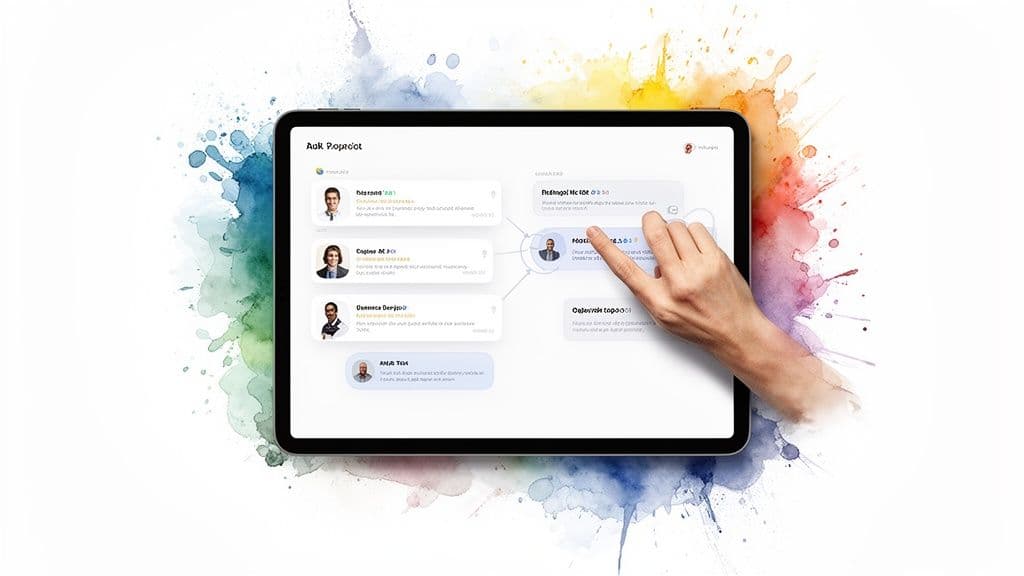
This is what project communication should look like: a seamless interaction within a single, organized hub. Instead of conversations happening in a dozen different places, everything is connected directly to the work itself.
The biggest evolution I've seen in my career is the shift away from a patchwork of separate apps toward truly integrated platforms. Teams used to juggle one tool for chat, another for tasks, and a third for files. Today, high-performing teams operate from a central command center. This isn't just about convenience; it stops the constant "sync-up" meetings and ends the frustrating hunt for information.
Creating a Single Source of Truth
The real goal of any project management tech is to establish a single source of truth. This is the one place—the central, trusted repository—where anyone, from the project sponsor down to a new hire, can instantly see the real-time status of any task, decision, or conversation.
Think of it this way: your project is a living story. Every task, file, and comment is a part of that story. When those pieces are scattered across inboxes and direct messages, no one ever gets the full picture. An integrated platform like Fluidwave acts as the binding that holds the entire story together in one volume.
Here’s how that plays out day-to-day:
- Centralized Task Management: Every single task lives in one place, complete with its owner, due date, and all related discussions. No more archeological digs through email chains to figure out who's doing what.
- Real-Time Collaboration: Team members can drop comments and questions directly on tasks, getting feedback right where the work is happening. This creates a perfect historical record tied directly to the action.
- Automated Reporting: Forget manually cobbling together a status report every Friday. The platform can generate it for you based on actual progress, pulling data from completed tasks.
When you have a single source of truth, you reclaim all those hours lost to digging for information and re-confirming old decisions. That clarity gives everyone the confidence and autonomy to just get the work done.
Structuring the Work Itself
The best project management tools do more than just help you talk about the work—they help you structure the work. When you build your workflow into the platform, communication and accountability become baked right into your process. You stop managing conversations and start managing outcomes.
This is a game-changer for delegation. In a tool like Fluidwave, handing off a task is no longer just a verbal request or a quick message that can get lost. It's a digital handoff with an undeniable owner and a clear deadline. The system itself tracks everything, creating an environment where responsibility is crystal clear and follow-up is automatic.
For instance, when you use Fluidwave to delegate, you can:
- Create a specific task with a rich description and attach all the necessary files.
- Assign it to a team member or a virtual assistant with a firm deadline.
- Check progress on a shared dashboard, eliminating the need to constantly ask, "How's it going?"
This workflow does more than just assign work. It instantly communicates priority, gives all the necessary context, and sets a clear expectation for completion—all in one structured action. In fact, research shows that weaving AI and automation into these very workflows has massive potential, with some estimates pointing to $4.4 trillion in economic growth just from making these operations more efficient.
Ultimately, the right platform makes communication a natural, integrated part of getting things done, not a separate activity you have to manage. It ensures every conversation has a clear purpose, every task has a clear owner, and every person has the clarity they need to excel.
How to Measure and Improve Communication
You’ve set up your communication plan and established your channels, but how do you know if it’s actually working? Without a way to measure success, you’re just guessing.
Like any other part of your project, project management communication isn't a "set it and forget it" activity. It's a living system that needs to be monitored and fine-tuned. The good news is, you don’t need a complicated analytics dashboard to see the results. The proof is usually right there in your team’s day-to-day workflow.
Key Metrics for Measuring Communication Impact
You can track a few tangible indicators to get a real sense of whether your communication strategy is hitting the mark. These aren't just abstract ideas; they are real-world outcomes that show how well information is flowing.
Here are the key performance indicators I always keep an eye on:
- Reduction in Rework: When tasks are done correctly the first time, it's a sure sign that instructions were crystal clear. A noticeable drop in rework is one of the most powerful metrics for great communication.
- Fewer 'Urgent' Requests: A constant flood of "urgent" tasks often points to a breakdown in proactive communication. As your process improves, you'll see a shift from reactive fire-fighting to calm, planned work.
- Faster Issue Resolution: How quickly can your team spot a problem and get it solved? Good communication creates an environment where people feel comfortable raising flags early, and clear channels ensure the right experts are pulled in immediately.
- Increased Stakeholder Engagement: Are your stakeholders actively participating in meetings and giving you feedback on time? Or do you feel like you're constantly chasing them for an answer? Consistent, positive engagement means you're giving them the right information, at the right time, in the right format.
Think of your communication plan as a hypothesis. These metrics are the experiments that prove whether it's working. If rework is still high, perhaps your task handoffs are unclear. If stakeholders are disengaged, maybe your reports aren't hitting the mark.
Gathering Feedback with Team Retrospectives
Metrics tell you what is happening, but you also need to know why. This is where qualitative feedback comes in, and one of the best ways to get it is through regular team retrospectives.
These are informal meetings, often held after a sprint or a major milestone, where the team can openly discuss what's working and what isn't. To get right to the heart of communication, try asking pointed questions:
- "When did you feel most in-the-loop this past month?"
- "Was there a time you felt confused or lacked the information you needed to move forward?"
- "Are our daily stand-ups still useful, or have they become a chore?"
- "Is anyone feeling overwhelmed by notifications from a particular tool or channel?"
The goal here isn't to point fingers. It's about finding and removing friction in your information flow. Fostering a culture of open feedback is a critical part of effective project management and allows you to make small, continuous adjustments that add up to a huge impact over time. It turns everyone on the team into an owner of your communication process.
Frequently Asked Questions
Even with a perfect plan on paper, project management communication in the real world can get messy. Here are some answers to the tough, common questions project managers grapple with every day.
How Do I Communicate With a Difficult or Unresponsive Stakeholder?
We've all been there. You send an important email and... crickets. The first thing to do is stop assuming your method is their method. Try to match their preferred style. If they're ignoring your emails, maybe a quick direct message or a pre-scheduled 5-minute call is the way to go.
Sometimes, the most effective tactic is also the most direct. Just ask them, "What's the best way for me to keep you in the loop?" This shows respect for their time and gets their buy-in.
If their feedback is a critical blocker and they're still not responding, you have to shift gears. Document every attempt you've made to connect, then bring the issue to the project sponsor. It's crucial to frame this not as a complaint about the person, but as a serious risk to the project's timeline and success.
What Is the Best Way to Manage Communication Across Time Zones?
When your team is spread across the globe, a single source of truth isn't just a nice-to-have; it's a necessity. Your project management platform needs to be the undisputed hub for every update, decision, and file. This gives everyone the freedom to catch up on their own schedule without feeling out of the loop.
For those rare meetings that absolutely must happen live, try to find that small sliver of overlapping work hours. Always, always record the session for those who couldn't make it.
A non-negotiable step here: After any meeting, post a summary of the key decisions and action items in your central tool. This simple habit ensures no one gets left behind. And when you set deadlines, always use a universal format like UTC to avoid any confusion.
My Team Is Drowning in Notifications. How Can I Fix This?
Constant pings and alerts are a classic sign of broken communication workflows. If your team is overwhelmed, it means your communication plan either isn't clear or isn't being followed. The first step is to gently but firmly reinforce the purpose of each channel. For example: chat is for urgent, immediate needs only, while all task-related updates belong in the project tool.
Also, encourage everyone to use threads in your chat apps. It’s a simple change that keeps conversations organized and prevents channels from becoming a chaotic free-for-all. The biggest win, though, comes from building a culture where people document updates in one central place. When the team trusts that they can check a single dashboard at their own pace, the constant need for "FYI" messages simply melts away, protecting everyone's deep work time.
Ready to stop the notification overload and build a single source of truth for your team? Fluidwave combines task management with clear delegation and a distraction-free design to put your project communication back on track. Get started with Fluidwave today.
Focus on What Matters.
Experience lightning-fast task management with AI-powered workflows. Our automation helps busy professionals save 4+ hours weekly.