Unpack the managing vs leading debate with real-world scenarios. Learn how to switch between roles to boost team performance and achieve your goals.
April 4, 2026 (4mo ago)
Managing Vs Leading: Which Hat to Wear and When
Unpack the managing vs leading debate with real-world scenarios. Learn how to switch between roles to boost team performance and achieve your goals.
← Back to blog
It all boils down to a fundamental distinction: managers focus on executing tasks and maintaining order, while leaders inspire people and drive change. Folks often say that management is about climbing the ladder of success with efficiency, but leadership is about making sure that ladder is leaning against the right wall.

The Real Difference Between Managing and Leading
People use the words "manager" and "leader" interchangeably all the time, but they're really two different sides of the same coin. You absolutely need both for a healthy organization, but they represent pretty distinct mindsets and skill sets. Getting this right isn't just about being picky with words; it's a practical guide for anyone responsible for a team’s success.
The groundwork for this conversation was laid way back in 1977 when Abraham Zaleznik published a now-famous article in the Harvard Business Review. He argued that managers focus on "doing things right" by sticking to processes, while leaders are more concerned with "doing the right thing" by pushing a vision forward. Thinkers like John Kotter built on this, explaining that you need management for stability and leadership to navigate the inevitable currents of change.
A Clearer View of Each Role
In practice, management creates that much-needed predictability. It’s the force that wrangles complexity, making sure projects hit their deadlines, budgets are respected, and day-to-day operations run like a well-oiled machine. A manager’s world is filled with questions of "how" and "when."
Leadership, on the other hand, is all about producing meaningful change. It’s about charting a course, getting everyone to pull in the same direction, and giving them the motivation to push through challenges. A leader is always asking "what" and "why." Too often, people in management roles get so bogged down in the daily grind that they manage tasks instead of leading people, which is a massive missed opportunity.
“Management is a set of processes that can keep a complicated system of people and technology running smoothly. The most important aspects of management include planning, budgeting, organizing, staffing, controlling, and problem-solving.” – John P. Kotter, Author and Professor
The table below breaks these distinctions down for a quick side-by-side comparison. It's also worth exploring the specific duties of a team leader, as that role is a perfect example of where management and leadership have to intersect.
Managing Vs Leading At a Glance
This table offers a high-level look at the core functions and mindsets that separate the two disciplines.
| Attribute | Manager Focus | Leader Focus |
|---|---|---|
| Core Function | Administer and organize | Innovate and inspire |
| Primary Goal | Predictability and order | Change and movement |
| Mindset | How and when | What and why |
| Approach | Controls systems and processes | Influences and trusts people |
| Time Horizon | Short-term and near-term | Long-term and future-oriented |
| Outcome | Efficiency and stability | Growth and development |
While they approach work from different angles, you can see how both are necessary. One provides the foundation, and the other builds upon it.
Core Behaviors in Action: Managers Plan, Leaders Inspire
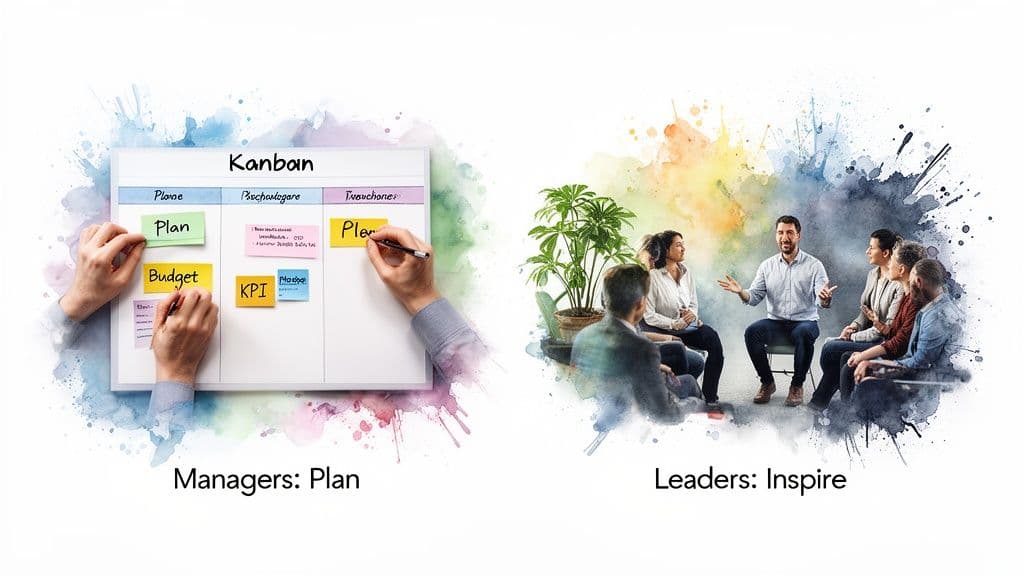
It’s easy to talk about management and leadership in abstract terms like "process" versus "vision." But where the distinction really hits home is on a Tuesday morning, with deadlines looming and a team looking for answers. This isn't just a theoretical debate; it's a practical reality that shapes how work gets done.
The world of a manager is often tangible and measurable. Their core behaviors are all about creating structure, making sure the intricate machine of work runs smoothly and on schedule. They break down big, ambitious goals into concrete steps and keep a close eye on progress.
The Manager: Architect of the Plan
Picture a marketing manager tasked with a new product launch. Her focus is squarely on the "how" and "when," and her daily actions are grounded in execution.
- Organizing Workflows: She maps out the entire campaign on a Kanban board, assigning specific tasks and deadlines for everything from content creation to ad placement. Everyone knows what they're responsible for.
- Setting Budgets: She carefully allocates funds for ad spend, contract writers, and design work, making sure the project doesn't go over budget.
- Tracking KPIs: She’s constantly monitoring key performance indicators (KPIs) like web traffic, lead generation, and initial sales. This data informs her next move and fuels her progress reports to stakeholders.
These behaviors are all about corralling complexity and minimizing risk. They ensure the team's efforts are perfectly coordinated, resources are spent wisely, and the project hits its targets. Without this kind of diligent management, even the most brilliant strategy can quickly fall apart.
The Leader: Champion of the Cause
A leader’s core behaviors, on the other hand, are often less tangible but have a profound impact on long-term success and morale. If the manager builds the project plan, the leader builds the team that believes in it. Their focus is on the "why" and the "who."
Leaders work to create an environment where people feel motivated, connected to a mission, and secure enough to do their best work. They don't just hand out tasks; they cultivate commitment.
- Articulating a Vision: A leader consistently reinforces why the product launch matters. They connect the team’s daily grind to the company's broader mission, showing them how their individual contributions fit into a much bigger picture.
- Fostering Psychological Safety: They intentionally build a culture where team members can voice concerns, admit they made a mistake, or propose a wild idea without fear of being shut down. This is where innovation and proactive problem-solving come from.
- Coaching for Growth: Instead of just checking on task status, a leader talks about career goals. They help people find opportunities to stretch their skills within the project, turning a simple campaign into a meaningful growth experience.
These actions build a resilient, engaged team that doesn't just follow instructions—it takes ownership. The effect is massive. In fact, Gallup's research consistently finds that managers account for at least 70% of the variance in employee engagement scores.
The most effective professionals don't choose one over the other; they master both. They know when to architect a meticulous plan and when to inspire the team to believe in that plan. They provide both the map and the compass.
Goals and Outcomes: The Compass vs. The Map
Beyond the day-to-day behaviors, the biggest difference between a manager and a leader is where they're trying to go. One is an expert at navigating known terrain with precision, while the other is focused on discovering new territory entirely. It's the classic distinction between having a detailed map and trusting a compass.
Management is all about delivering predictable results in the near term. The goals are concrete, measurable, and built around stability and efficiency. A manager's job is to bring order from complexity, making sure the team reaches a predetermined destination on time and on budget.
The Manager’s Finish Line: Hitting the Mark
For a manager, the finish line is always in sight and clearly defined. Their goals are operational, tactical, and centered on optimizing what’s happening right now.
- Quarterly Sales Targets: Ensuring the team meets or smashes its revenue goals for Q2.
- Project Deadlines: Launching that new software feature by the end of the month without any critical bugs.
- Budget Adherence: Cutting operational costs by 5% over the next six months without sacrificing quality.
These outcomes are the lifeblood of a healthy business. They keep the lights on, the stakeholders happy, and the operational engine humming. When strong management is in place, abstract strategies become real wins. In fact, companies with rock-solid management practices see 30–50% higher profits—a direct result of sharp planning and resource allocation that turn vision into daily reality. You can get a deeper look at how these processes drive success in this detailed analysis from McKinsey.
The Leader’s Horizon: Charting a New Course
Leaders, on the other hand, are concerned with a much more distant and often undefined horizon. They aren’t trying to maintain the status quo; they're trying to create a new one. The outcomes they chase are transformative, focused on long-term growth, even if it means introducing a little short-term chaos.
A manager gives people a map to follow a pre-planned route. A leader gives them a compass and the confidence to navigate an unmapped wilderness, trusting them to find a better destination.
This is the core of the managing vs. leading dynamic. While the manager ensures the current journey is a success, the leader is asking if it’s the right journey to begin with.
The outcomes leaders are after are often harder to pin down on a quarterly report but are absolutely essential for future survival and success.
- Driving Innovation: Fostering a culture that produces an industry-disrupting product, even if it means pulling resources from a currently profitable (but stagnant) one.
- Navigating Market Shifts: Guiding the organization through a tough pivot because of new technology or a fundamental change in customer behavior.
- Cultivating Future Talent: Investing heavily in mentoring to build the company’s next generation of leaders, which is the ultimate key to long-term resilience.
In the end, you need both. A compass without a map can lead to a chaotic and directionless wander. But a map without a compass might guide you perfectly to a place that’s no longer relevant.
Your Situational Playbook For Managing And Leading
Knowing the definitions of managing and leading is just the start. The real skill is knowing which hat to wear and when. The most effective people in charge don't lock themselves into one style; they have the situational awareness to switch between them, blending the structure of management with the inspiration of leadership.
This isn't about picking a default mode. It’s about building a flexible playbook. Some situations cry out for the steady, directive hand of a manager. Others demand the visionary, empowering touch of a leader. Learning to read the room—and the challenge—is the first step to making the right call.
When To Manage: When The Path Is Clear
A management-first approach works best when the goal is well-defined, the process is repeatable, and the biggest risk is poor execution. In these moments, stability and predictability are your greatest allies. Your job is to stamp out ambiguity and get everyone moving in the same direction, with precision.
Think about bringing a new person onto your team. They aren't looking for a grand speech about the company's five-year vision on day one. They need a clear, structured path to get up and running.
- Scenario: Onboarding a new team member.
- Primary Approach: Manage.
- Key Actions: Give them a detailed 30-60-90 day plan. Schedule training with key colleagues and set up clear, weekly milestones. The goal here is to build their competence and confidence through a predictable, supportive structure.
Or consider when a crucial project starts missing deadlines. Panic doesn't help, but a clear-headed manager can turn things around.
- Scenario: A high-stakes project is falling behind schedule.
- Primary Approach: Manage.
- Key Actions: This is where you roll up your sleeves and diagnose the problem. Dig into the project plan, find the bottlenecks, reallocate resources if needed, and lay out the immediate next steps for every person on the team. It’s not the time for a motivational talk; it’s time to get the train back on the rails.
This simple framework helps clarify the choice: if the goal is predictable and near-term, you default to managing.
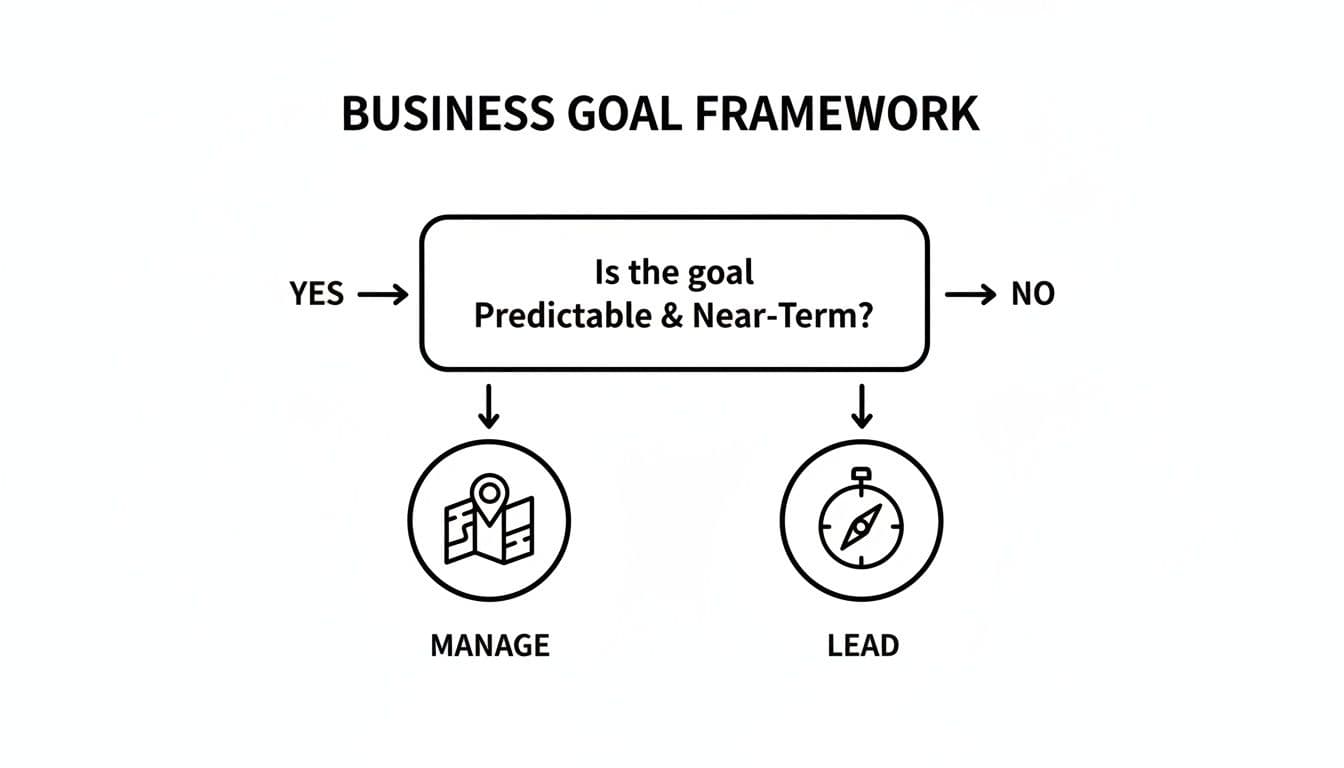
As the visual shows, management gives you the map when the destination is known. Leadership gives you the compass when you're exploring new territory.
When To Lead: When The Future Is Uncertain
This is where you step up as a leader—when you’re navigating uncertainty, change, and the very real human emotions that come with them. When the path forward is foggy or the team’s spirit is sagging, a detailed project plan is far less valuable than a compelling reason to keep going. Your job is to build belief.
Imagine your team just suffered a major blow, like losing a key client or watching a product launch fall flat. Morale is shot.
- Scenario: The team's confidence is shaken after a major setback.
- Primary Approach: Lead.
- Key Actions: First, acknowledge the disappointment and give people a safe space to talk about what happened. Then, you reframe the failure as a critical learning moment and powerfully connect their work back to the bigger mission. You’re not just fixing a problem; you’re restoring belief and resilience.
A leader’s most critical function in a crisis isn't to have all the answers, but to rally the team with the conviction that they can find the answers together.
The same goes for when you need to drive a fundamental change in direction.
- Scenario: The company needs to make a strategic pivot toward a new, unproven market.
- Primary Approach: Lead.
- Key Actions: Start with the "why." You have to paint a vivid, convincing picture of the future you’re trying to build. Before you get into tactics and spreadsheets, you need to appeal to your team's ambition and purpose to get them excited about the journey. You have to win hearts before you can direct hands.
When to Flex Your Style: A Scenario-Based Guide
To make this even more practical, here’s a quick-reference guide. Think of it as a playbook for common workplace challenges, helping you decide whether to lean into your management skills or your leadership instincts.
| Scenario | Primary Approach | Key Actions to Take |
|---|---|---|
| Launching a new, complex feature with a tight deadline | Manage | Break the project into small tasks, assign clear owners, set up daily stand-ups, and track progress relentlessly. The focus is execution. |
| Merging two teams with different cultures post-acquisition | Lead | Create a shared vision for the new team. Facilitate workshops to establish new norms and values. Focus on building trust and psychological safety. |
| Navigating a budget cut and re-prioritizing projects | Blend of Both | Lead by explaining the "why" behind the cuts with transparency. Manage by working with the team to meticulously re-plan the work and resources. |
| A star employee seems disengaged and their performance is dipping | Lead | Have an empathetic one-on-one. Ask open-ended questions to understand what’s driving the change. Reconnect their work to their career goals. |
| Implementing a new company-wide software system (e.g., CRM) | Manage | Develop a clear implementation plan, provide comprehensive training, set adoption metrics, and offer technical support. The goal is seamless adoption. |
| The team is burned out after a long, intense project | Lead | Acknowledge their hard work and celebrate the win. Insist on them taking time off. Protect their time from new requests to allow for recovery. |
This table isn’t about rigid rules, but about recognizing the dominant need in any given situation. The best leaders see these moments clearly and adjust their style to give their team exactly what it needs to succeed.
Developing Your Leadership Skills As a Manager

So, you're a great manager and you're ready to become an influential leader. The good news is that leadership isn't some innate personality trait—it’s a skill you can build through practice. The transition is all about making small, consistent shifts in how you communicate, delegate, and focus your energy.
It really starts with evolving your mindset from directing to coaching. A manager often defaults to telling someone what to do and how to do it. A leader, on the other hand, asks the kind of questions that guide a person to figure it out for themselves, building their critical thinking and ownership along the way.
From Directing to Coaching
The next time a team member comes to you with a problem, resist the urge to give them the answer right away. Instead, try asking powerful, open-ended questions during your one-on-ones or in the moment.
- "What's your initial take on how to solve this?"
- "What obstacles do you foresee with that approach?"
- "What support do you need from me to move forward?"
This simple change starts to transform you from a problem-solver into a thinking partner. Getting familiar with the core characteristics of a good coach is an excellent way to ground yourself in this new approach.
From Process-Focused to People-Focused
The next big shift is moving your primary attention from processes to people. Yeah, managers have to be concerned with workflows and metrics—that’s part of the job. But leaders make a deep, conscious investment in the individuals doing the work. This means carving out protected time for meaningful conversations that go beyond simple status updates.
Your one-on-ones should be about the person, not just the project. Ask about their career goals, the challenges they're facing, and what parts of their work truly energize them. This personal investment is what builds the trust and loyalty that form the bedrock of true leadership.
A manager sees a team as a resource to complete a project. A leader sees a project as a resource to develop a team.
This shift in perspective gets right to the heart of the managing vs. leading distinction. It's about seeing daily tasks as chances for mentorship and growth. Of course, this approach takes time, which is often a manager's most precious resource.
Create Time to Lead by Automating Management
One of the biggest hurdles to leadership is getting buried under the sheer volume of management tasks. It's almost impossible to find time for strategic thinking and mentoring when your day is a blur of scheduling, progress tracking, and putting out fires. This is where automation can be a real game-changer.
By using tools to handle routine management work, you free up the mental space and calendar time to focus on high-impact leadership activities. Today’s data-driven environment also offers unique opportunities. A study of over 200 managers revealed that 78% use analytics tools to make faster, more accurate decisions, effectively merging management precision with leadership foresight.
Finally, start practicing delegation with a leadership mindset. This isn't just about getting a task off your plate; it's about empowering someone with a new responsibility. For a deeper dive into this, read our guide on delegation. A true leader frames delegation as an opportunity for someone else's growth, not just a transfer of work.
How to Master Both Roles With Fluidwave
Knowing the difference between managing and leading is one thing. Actually balancing both in the middle of a hectic workday is a completely different beast. This is where your tools stop being a simple convenience and become a core part of your strategy. We built Fluidwave to be that strategic partner, helping you nail the fundamentals of management so you have the space to truly lead.
The distinction is crucial. As one researcher put it, managers create "circles of value" by organizing work, while leaders create "circles of influence" by inspiring a shared vision. For anyone juggling both roles, a platform like Fluidwave tames the daily chaos, clearing a path for you to do your most important work. You can explore more about this foundational manager-leader distinction and its effect on team performance.
Reinforce Your Management With Intelligent Tools
Great leadership stands on a foundation of solid management. Fluidwave gives you the practical tools to build that foundation, making sure nothing falls through the cracks. It’s designed to handle the "how" and "when" of execution, so you can maintain control without drowning in administrative details.
- AI-Driven Prioritization: The platform's intelligence helps you cut through the noise by automatically sorting tasks by importance. This removes the daily guesswork and keeps your energy focused on what will make the biggest impact.
- Versatile Project Views: Whether you’re a visual thinker or a list-maker, you can organize projects your way. Instantly switch between Kanban boards, calendars, and traditional lists to get a clear picture of progress. You can even use shared to-do lists to give your whole team a single source of truth.
By automating routine organization and scheduling, Fluidwave gives you back hours every single week. This isn’t just about getting more done; it's about reclaiming your time.
Build Your Leadership Capital
That reclaimed time is what we call leadership capital. It’s the currency you can reinvest in the activities that define great leadership: mentoring your team, exploring new strategies, and communicating the "why" behind the work. When your management systems are humming along in the background, you finally have the mental space to look toward the horizon.
Fluidwave doesn’t just manage your tasks; it manages the burden of management, converting saved administrative hours into strategic leadership opportunities.
This is how you shift from overseeing projects to inspiring people. With that extra time, you can hold more meaningful one-on-ones, coach your direct reports on their career growth, and step back to analyze the market instead of just tracking milestones.
Fluidwave also provides another powerful way to build that capital: smart delegation. You can assign complex management functions—not just simple to-dos—to skilled virtual assistants right inside the platform. Imagine handing off budget tracking, competitor analysis, or report generation to a capable professional. This allows you to step away almost entirely from certain managerial duties, freeing you up to concentrate on high-impact, forward-thinking leadership. You get all the benefits of expert management without it consuming your schedule, so you can focus on steering the ship.
A Few Lingering Questions
Even after laying it all out, a few practical questions always pop up. The line between managing and leading can feel blurry when you're in the thick of it, so let's clear up some of the most common points of confusion.
Can You Be a Great Leader Without Good Management Skills?
Honestly, it’s tough. A leader full of brilliant, world-changing ideas will quickly find themselves stuck if they can't organize people and resources to make those ideas a reality. Big-picture thinking without any structure often just devolves into chaos.
The truly effective leaders I've worked with either learn enough management skills to be effective or, more commonly, they're smart enough to partner with exceptional managers. They know that a vision is just a pipe dream without execution, so they make sure someone is there to "keep the trains running on time" while they're busy charting the course.
Leadership might chart the destination, but management is what actually builds the road to get there. A leader who ignores the road-building part of the journey will find their team stuck in the mud.
Which Is More Important for a Company's Success?
This is a classic debate, but it’s based on a false premise. It's like asking whether an engine or the wheels are more important to a car. You need both. One isn't better than the other; they are two different, equally critical functions.
Here’s a simple way to think about it:
- Management makes sure the business runs smoothly and profitably today. It’s all about maintaining stability, hitting targets, and creating predictable results.
- Leadership makes sure the business will still be around and thriving tomorrow. It’s the engine for innovation, navigating change, and inspiring the kind of growth that keeps you ahead.
Any healthy organization lives in that dynamic balance. Without solid management, you have chaos and inefficiency. But without strong leadership, you have stagnation—and you'll eventually get left behind.
What Is the First Step a Manager Should Take to Develop Leadership Skills?
Start with "why." This is the single most powerful shift you can make, and it’s the gateway from managing work to leading people.
Instead of just handing out tasks and due dates, take thirty seconds to explain the purpose behind the assignment. Connect the dots for your team.
For instance:
- The Manager-Only Way: "I need you to get this data analysis report done by Friday."
- The Leader-Infused Way: "Getting this data analysis done by Friday is a huge priority. The insights we find are going to directly shape our entire Q4 marketing strategy and tell us where we should—and shouldn't—invest our budget."
That small change does something profound. It builds a sense of shared purpose and shows people that their individual work has a real impact. It’s the first, foundational step in making that leap.
Ready to master both management and leadership? Fluidwave gives you the tools to automate management tasks and frees up your time to focus on leading your team. Start streamlining your workflow today.
Focus on What Matters.
Experience lightning-fast task management with AI-powered workflows. Our automation helps busy professionals save 4+ hours weekly.