Explore 8 powerful loci method examples. Master memory palace techniques to remember speeches, workflows, and more. Unlock your brain's potential!
June 26, 2026 (1mo ago)
Powerful Loci Method Examples to Master Your Memory
Explore 8 powerful loci method examples. Master memory palace techniques to remember speeches, workflows, and more. Unlock your brain's potential!
← Back to blog
Tired of Forgetting? Build a Memory Palace Today
Ever feel like your brain is a sieve, losing track of important tasks, project details, or even your grocery list? The problem usually isn't your memory. It's your filing system. You try to hold a deadline, a talking point for a meeting, three follow-ups, and the one thing you need from the store, and your brain treats them like loose papers in a wind tunnel.
That's where the Method of Loci earns its reputation. It turns places you already know into storage you can reliably revisit. The technique goes back to ancient Greece and later became central to classical rhetoric, but it still solves a modern problem: too much incoming information and not enough structure. If you've ever wondered why ADHD affects memory, that constant sense of mental interference is part of the picture, and spatial systems can help by giving information a stable home.
Among memory athletes, the method of loci is the dominant mnemonic strategy, and the familiar “memory palace” idea is still the core approach because the brain tends to retain images better than words through the picture superiority effect, as summarized in the Method of Loci overview. That sounds lofty. In practice, it means you stop hoping you'll remember and start placing information somewhere specific.
Here are eight loci method examples you can use.
1. The Roman Room (Cicero's Method)
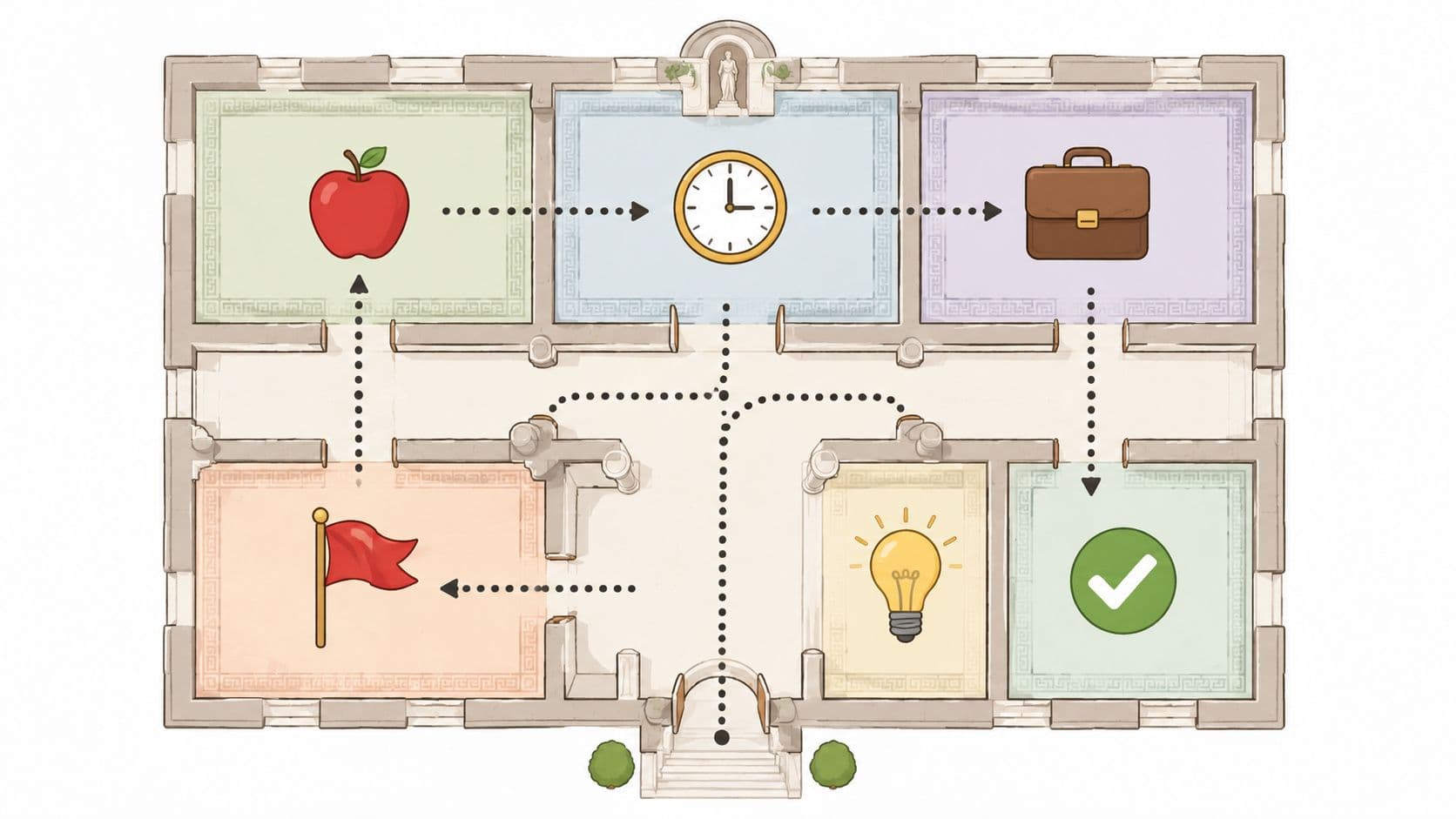
The classic version often yields the best results. Pick one familiar interior and walk it in the same order every time. A home office, apartment, or childhood bedroom usually beats a fancy imaginary palace because you already know the route without effort.
A simple starting structure is useful. One practical model uses exactly 10 loci in a strict, unidirectional sequence, often starting with places like the bed, closet, bathroom, hallway, stairs, living room, dining room, kitchen, and front porch, as described in this method of loci examples guide. That fixed order matters more than people think. When the order gets fuzzy, recall falls apart.
How to use it
Say you need to remember quarterly business goals.
- Bed: Revenue goal appears as a giant stack of invoices bouncing on the mattress.
- Closet: Hiring plan hangs as suits with name tags for open roles.
- Bathroom: Customer retention leaks from the sink because churn is “draining” the business.
- Hallway: Product launch timeline is painted as a race track.
- Stairs: Budget review climbs step by step.
That's one of the most practical loci method examples because it handles categories well. Rooms hold themes. Objects inside them hold details.
What works and what doesn't
What works is intimacy. Use spaces you know so well you can “walk” them half asleep. Start small. Five to 10 locations is enough.
What doesn't work is trying to be clever too early. Don't build a castle in your head if you can barely remember your own hallway. Don't use vague spots like “somewhere near the couch.” Use fixed anchors.
Practical rule: If you can't point to the locus instantly, it's not ready.
Troubleshooting
If you keep skipping a spot, your path is too loose. Redraw the route mentally and make it one-way only.
If the images fade, they're too polite. Distort them. A corn cob sleeping in your bed is easier to recall than “corn” placed neatly on a pillow, which matches the advice from this visual imageability explanation.
For professionals, I like pairing this with one visible digital system. If you want to test how much distraction is interfering with recall, take Fluidwave's focus quiz. The palace holds the structure. Your task app holds the live details.
2. The Journey Method (Method of Loci Variation)
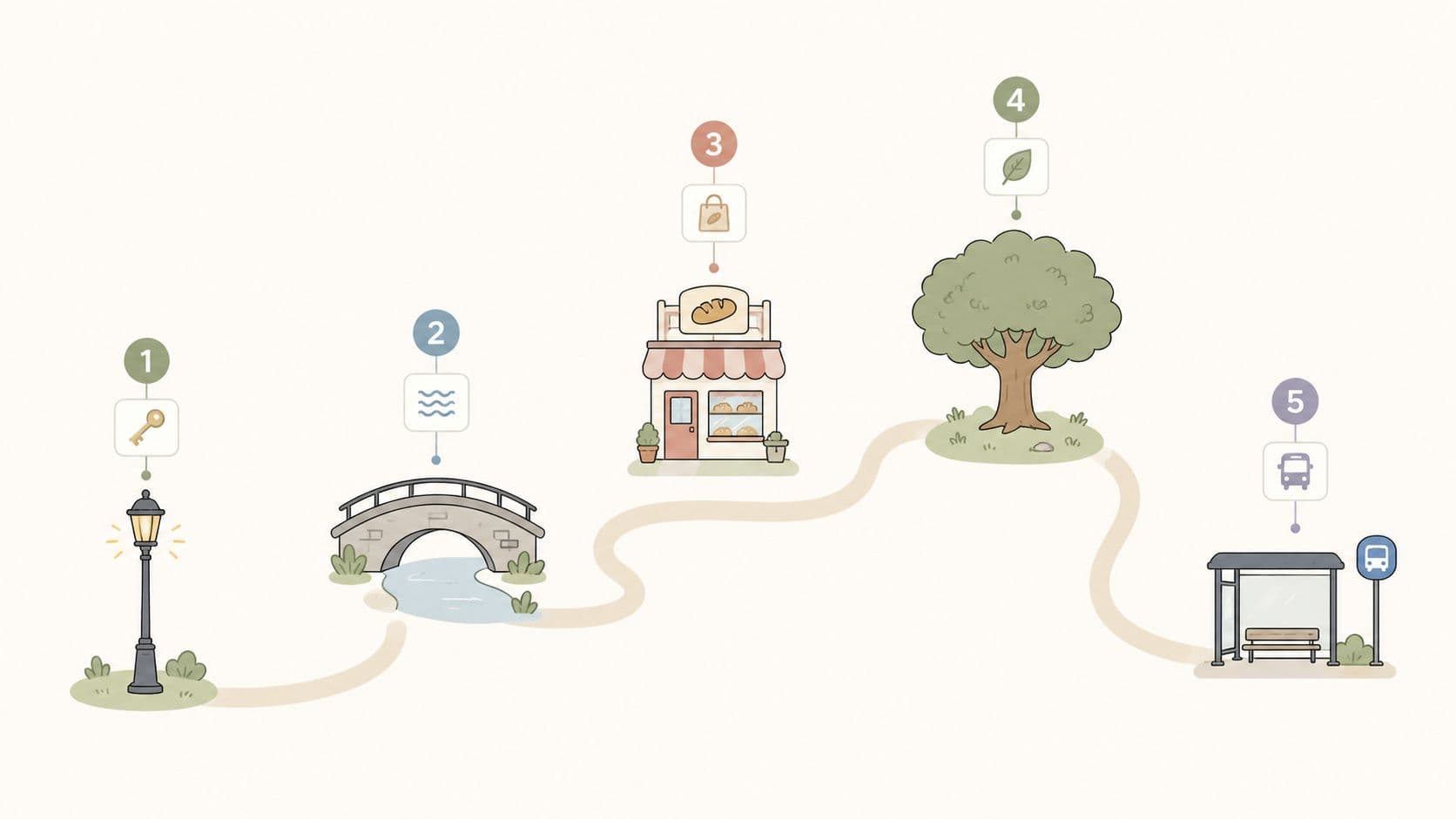
This variation is better when sequence matters more than category. A route forces progression. That makes it ideal for project milestones, meeting agendas, launch checklists, and anything with dependencies.
Your commute is usually the best candidate. Lamp post, bus stop, corner store, crosswalk, coffee shop, office entrance. Each landmark becomes a station in order.
A modern use case
Take a product rollout with five milestones:
- Street corner: Final copy approval. Giant red pen slashing across the road.
- Bus stop: Design handoff. Posters rip off the shelter walls.
- Bakery: QA testing. Croissants open and reveal bug reports.
- Crosswalk: Stakeholder sign-off. Executives hold stop signs.
- Office door: Launch email. The door blasts open with a notification sound.
This version is easier to retrieve under pressure because movement gives you momentum. You don't have to ask, “What comes next?” The route answers for you.
Why it sticks
A laboratory comparison of mnemonic techniques found the method of loci performed best for word recall when people had strong object imagery, and spatial imagery predicted how well they preserved serial order, according to this dissertation on mnemonic performance. That lines up with what I see in practice. People who naturally track places and routes often do better with journey-based palaces than with abstract note-taking.
Your route should feel boring in real life and vivid in memory. Familiarity handles the route. Absurd imagery handles the recall.
Troubleshooting
If two landmarks blur together, they aren't distinct enough. Swap one out. A “tree” is weak. “The leaning tree with the split trunk” works.
If your route changes every week, don't use it. A stable route beats a convenient one. And don't rush the mental walk. Match the pace you'd travel.
For project managers, this pairs well with calendar-based tracking. The route gives you order. The app tells you what changed since yesterday.
3. The Body Method (Peg System)
This is the emergency version. You always have it with you. It's limited, but that's why it's useful. The body method is excellent for today's top priorities, short speaking points, or a quick set of delegation reminders before a call.
Move top to bottom. Head, shoulders, chest, hands, stomach, thighs, knees, feet. Keep the order fixed.
A fast example
Let's say you need five priorities before a leadership meeting.
- Head: Budget revision. Coins raining onto your scalp.
- Shoulders: Team staffing. Two new hires sitting on each shoulder arguing.
- Chest: Client escalation. A red siren flashing on your shirt.
- Hands: Contract approval. Your hands are covered in giant signatures.
- Stomach: Vendor payment. Your stomach growls cash register sounds.
This works because the body is easy to scan. You don't need a whole palace when the list is short.
Trade-offs
The upside is portability. The downside is capacity. Don't force a long workflow into a tiny system. Once you push beyond a short list, you'll feel interference fast.
This also helps people who struggle to generate elaborate buildings on command. The body gives you built-in anchors. That said, if you dislike body-based imagery or it creates sensory discomfort, skip it. Not every method suits every nervous system.
Troubleshooting
If recall feels weak, the images probably aren't interacting enough with the body part. “A task on my hand” is vague. “My hand turning into a rubber stamp that slams approvals” is memorable.
If yesterday's list keeps intruding, clear it intentionally each morning. I like a reset image. Shower the whole body in white paint, then wash it off.
Short list, high urgency, no paper handy. Use the body method.
This is one of the most practical loci method examples for busy people because it's immediate. No setup. No walking route. Just rapid placement and retrieval.
4. The Alphabet Method (Alphabetic Pegging)
This one sits just outside the pure spatial tradition, but it blends well with loci work. You assign a stable image to each letter, then attach information to those pegs. A for apple, B for bicycle, C for cat is the beginner version. Personal images work better than textbook ones.
I like this method for delegated tasks, contact lists, and procedures where alphabetical order already exists.
How to make it useful
Suppose you manage team updates for people named Alex, Ben, Chloe, Dana, and Ethan.
- A: Alex becomes an astronaut fixing a delayed report.
- B: Ben rides a bicycle carrying a sales deck.
- C: Chloe's cat shreds the draft proposal.
- D: Dana drums on an overdue invoice.
- E: Ethan cracks eggs over a product roadmap.
That gives you a quick retrieval ladder without needing a building. If you already organize names or accounts alphabetically, the fit is natural.
Where people go wrong
They choose dead images. “A equals apple” only works if your apple is doing something dramatic. Make it rotten, giant, singing, exploding, or dripping neon juice.
The other mistake is changing pegs too often. Stability matters. Once B is bicycle, don't make it balloon next week because it sounds fun.
Troubleshooting
If the system feels arbitrary, spend time making the alphabet yours. Use people, brands, movie characters, or recurring objects you know well.
If you need more capacity, you can layer another structure on top of it. In advanced use, some people combine alphabet pegs with a palace. The peg gives identity. The locus gives placement.
This method isn't as spatially rich as a Roman Room. But it's flexible, fast, and good for administrative memory. For many professionals, that's enough.
5. The Story Method (Narrative Chaining)
Some people don't think in rooms. They think in scenes. If that's you, a story chain can work better than a strict palace, especially for workflows that already feel like sequences of cause and effect.
A team handoff, client onboarding, or campaign launch often makes more sense as a narrative than as isolated objects in a kitchen.
One way to build it
Say you need to remember the sequence for a chaotic project rescue.
Your account manager is the hero. The designer is carrying a stolen briefcase. The developer is hacking a vault. Legal arrives on a motorcycle with contracts on fire. Finance parachutes in with the budget at the last second.
Now the workflow has a plot: brief received, assets fixed, technical issue resolved, approval secured, budget released.
That's messy on paper. In story form, it's memorable.
What makes this work
Emotion and absurdity do heavy lifting here. The more the scenes surprise you, the more likely you are to keep them. This style works especially well for people who remember films, conversations, and social situations more easily than lists.
A lot of professionals already do a weak version of this by saying, “First this went wrong, then legal jumped in, then finance blocked it.” The stronger version is deliberate and visual.
If a workflow already feels like a movie in your head, don't force it into a hallway.
Troubleshooting
The biggest risk is drift. Stories mutate. If your chain changes every time you retell it, you'll lose precision.
Fix that by keeping a handful of anchor scenes in a stable order. I also recommend retelling the chain out loud before you check your task manager. If you want a quick read on whether you're building the kind of systems that support growth, try Fluidwave's learning and growth quiz.
Story chaining isn't the best choice for dense hierarchical detail. But for motion, conflict, and sequence, it's excellent.
6. The Palace of Nested Rooms (Hierarchical Architecture)
A flat memory palace breaks down fast once you start managing layered work. One client account has three campaigns. Each campaign has assets, approvals, deadlines, and post-launch review notes. If all of that sits in one hallway, retrieval gets sloppy.
Nested rooms solve that problem by matching the structure of the work itself. Use one large location for the top level, then assign smaller spaces for projects, teams, or workstreams inside it.
A practical setup
Use one main building for the company or portfolio. Then map hierarchy in a fixed order.
- Lobby: Operations
- Second floor: Sales
- Third floor: Marketing
- Fourth floor: Product
Inside Marketing, give each room a single function. The campaign room holds launch work. The analytics room holds reporting. The brand room holds messaging. Then place task-level details on objects inside each room. The desk can hold copy tasks. The window can hold channel strategy. The bookshelf can hold performance review notes.
That structure scales well because it mirrors how project tools already group information. Portfolio, project, task, subtask. Department, team, initiative, deliverable.
How to build it without overcomplicating it
Start with three levels:
- Building: company, client portfolio, or business unit
- Room: team, project, or workstream
- Object: task, note, risk, or next action
Stop there at first.
Advanced users often add a fourth level, such as drawers inside a desk or shelves inside a bookcase, but that only helps if recall is already stable at the first three levels. In practice, I've found that people lose speed before they lose capacity. They technically stored the information, but retrieval takes too long to be useful in a meeting.
Where this variation helps most
This is one of the strongest loci method examples for knowledge work with real hierarchy. It fits annual planning, multi-team projects, content operations, and any workflow where details roll up into larger buckets.
It also works well for digital systems. If your task manager already separates projects, tasks, and subtasks, mirror that structure mentally. If you need to check whether your current setup is clean enough to support that kind of memory system, take Fluidwave's organization quiz for workflow structure.
Troubleshooting
The common failure is overbuilding. People create seven floors, twelve rooms, and a naming scheme they can't hold in their head. Start smaller and earn complexity.
If rooms blur together, change the architecture aggressively. Make Sales a polished glass office. Make Product a workshop with exposed brick and tools on the wall. Distinct visual style cuts down interference.
Field note: If your org chart is fuzzy, your palace will be fuzzy too.
One more trade-off matters. Nested palaces are excellent for classification, but slower for rapid sequence recall than a simple journey route. Use them when structure matters more than speed.
7. The Calendar Palace (Temporal-Spatial Hybrid)
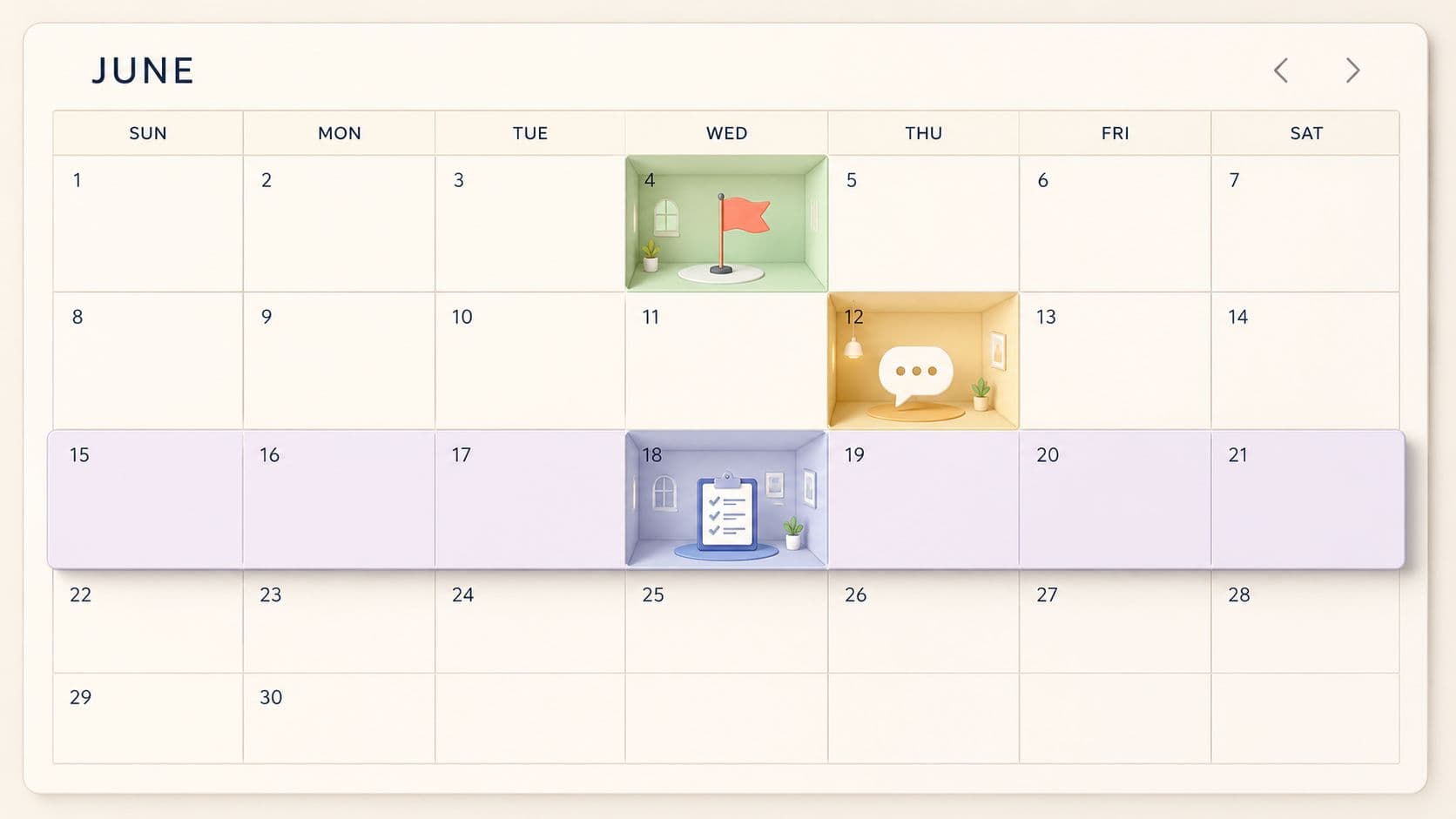
Deadlines don't just live in space. They live in time. The calendar palace solves that by mapping information onto days, weeks, months, or quarters.
This is useful for anyone whose memory problem isn't “what are my tasks?” but “when does each thing matter?”
A practical setup
Use the days of the week as fixed loci.
- Monday: leadership check-in
- Tuesday: client proposal
- Wednesday: hiring interviews
- Thursday: product review
- Friday: invoicing and follow-ups
Then place one vivid image on each day. For monthly planning, each week can become a “room” and each day an object inside it.
This hybrid works because it reinforces chronology. You're not just recalling the task. You're recalling its place in time.
Why this format fits modern work
A virtual reality study built around the Method of Loci showed that participants learned the technique with under 15 minutes of training and remembered up to 90% of a 20-item list in correct order after a single session, compared with 60% for visual imagery alone, according to this VR memory palace study. The main practical takeaway isn't that you need VR. It's that location plus order creates a stronger scaffold than imagery alone.
Calendar palaces do exactly that. They add temporal order to spatial anchors.
Troubleshooting
If your timeline changes often, don't encode volatile details too early. Put milestones in the palace, not every micro-task.
If days feel too abstract, give each one a stable visual identity. Monday might be a steel desk. Friday might be a golden receipt printer. Distinct markers make retrieval faster.
This method is especially useful for people who already live inside calendar views and deadline-driven planning.
8. The Template Palace (Modular Reusable System)
This is the version I use most for recurring work. You build one reliable structure, then refill it for each new cycle. Weekly planning. New client onboarding. Standard launch sequence. Board meeting prep.
The appeal is speed. Once the palace is stable, setup gets lighter.
How to run it
Pick one familiar structure and assign permanent meanings to the loci.
- Front door: intake
- Hallway: review
- Desk: execution
- Window: feedback
- Kitchen: follow-up
- Porch: closure
Now every new project runs through the same sequence. Different images, same route.
This is one of the best loci method examples for managers because recurring workflows are where memory systems save time.
The real trade-off
Reuse is efficient, but it's also where interference starts. If old images linger, you'll mix clients, weeks, or project cycles.
That's why I recommend an explicit clearing ritual. Sweep the rooms. Repaint the walls. Turn off the old scenes before loading the next set.
Neuroimaging research on memory athletes has shown increased activation in the hippocampus, parahippocampal cortex, and retrosplenial cortex when using the method of loci, discussed in this review of memory athlete neuroscience. In plain English, this technique recruits real navigation and memory systems. That's also why stale palaces can feel “sticky.” Your brain treats places seriously.
Troubleshooting
If ghost images keep intruding, stop reusing that palace for high-stakes material. Build a fresh one.
If you support neurodivergent users, be careful with rigid assumptions. Existing guidance often underexplains how attention fragmentation or sensory overload can disrupt classic loci practice, a gap discussed in this paper related to spatial memory challenges. In practice, I've found some people do better with shorter routes, stronger sensory cues, and looser modular chunks instead of one long march through space.
For repeatable workflows, though, the template palace is hard to beat.
8 Loci Method Variants Comparison
| Method | Complexity 🔄 | Resource Requirements 📊 | Speed & Portability ⚡ | Expected Effectiveness ⭐ | Ideal Use Cases & Key Advantages 💡 |
|---|---|---|---|---|---|
| The Roman Room (Cicero's Method) | High 🔄, significant mental mapping time | Low 📊, no tools; time & spatial visualization | Medium ⚡, slower setup, highly scalable | ⭐⭐⭐⭐⭐, excellent for large, hierarchical info | Ideal for organizing multi-project priorities; leverages spatial memory, combines well with platform views |
| The Journey Method (Method of Loci Variation) | Medium 🔄, route planning and ordering | Low 📊, familiarity with route; time to place landmarks | Medium-High ⚡, easier to extend and update | ⭐⭐⭐⭐, strong for sequential workflows | Best for ordered steps, project timelines; dynamic and easier to modify than fixed palaces |
| The Body Method (Peg System) | Low 🔄, minimal setup, simple sequence | Minimal 📊, no external resources, relies on imagery | High ⚡, immediate and always-available | ⭐⭐⭐, ideal for short lists (5–15 items) | Perfect for daily priorities and quick recall; highly portable but limited capacity |
| The Alphabet Method (Alphabetic Pegging) | Medium 🔄, build and learn A–Z pegs | Low–Medium 📊, initial time to create vivid anchors | Medium ⚡, reusable and flexible once learned | ⭐⭐⭐⭐, scalable to 26+ items | Good for categorizing people/items alphabetically; works well for unordered lists |
| The Story Method (Narrative Chaining) | Medium-High 🔄, creative construction of narratives | Low 📊, time and imagination required | Medium ⚡, slower to encode, easy to replay | ⭐⭐⭐⭐, strong for interrelated, complex info | Suited to project narratives and team dynamics; emotional hooks improve retention |
| Palace of Nested Rooms (Hierarchical Architecture) | Very High 🔄, complex multi-level design and maintenance | Medium-High 📊, significant setup time and visualization skill | Low–Medium ⚡, slow to create, powerful once established | ⭐⭐⭐⭐⭐, ideal for enterprise-scale complexity | Best for executives managing nested teams; mirrors organizational hierarchies and supports deep drill-downs |
| The Calendar Palace (Temporal‑Spatial Hybrid) | Medium 🔄, map time into space and maintain updates | Low 📊, alignment with calendar and routine reviews | Medium ⚡, effective for deadlines but requires upkeep | ⭐⭐⭐⭐, excellent for deadline-driven work | Ideal for time-sensitive projects and distributed teams; reduces need to constantly check calendars |
| The Template Palace (Modular Reusable System) | Medium 🔄, design template and clearing rituals | Low–Medium 📊, initial blueprint and discipline to reset | High ⚡, fastest to redeploy for recurring work | ⭐⭐⭐⭐, efficient for repeated project cycles | Great for recurring workflows and teams using templates; consistent and time-saving but risk of cross-fill confusion |
From Ancient Rome to Your Daily Workflow
At 9:00 a.m., the day still looks manageable. By 11:30, you have three shifting priorities, a meeting to lead, two follow-ups you cannot forget, and a half-finished task buried under open tabs. That is the point where a loci system stops being a memory trick and starts acting like working infrastructure.
The method lasts because it gives information location and order. In practice, that matters less for party tricks and more for ordinary pressure. A coach uses it to keep client talking points straight. A manager uses it to walk into a 1:1 without rereading notes. A founder uses it to hold the shape of a project while the details keep changing in software.
The eight variations in this guide are not interchangeable. They solve different problems, and choosing the wrong one creates friction fast. The Roman Room handles categories cleanly. The Journey Method is stronger for sequence. The Body Method is fast when you need a short list available immediately. Nested rooms hold hierarchy well. Calendar palaces suit deadline-heavy work. Template palaces are efficient for recurring workflows, but only if you reset them consistently between uses.
There is a trade-off. Loci systems work best when the material can be turned into strong images. Concrete items are easy. Abstract ideas need translation. If you need to remember "alignment," "strategy," or "trust," build a visible scene for each one. Give it motion, conflict, or exaggeration. Plain images fade. Strange images stick.
This also is not limited to memory competitors. With practice, people can improve at it, including adults who assume they are "bad at memory." I have seen the same pattern repeatedly. Once someone stops trying to memorize words directly and starts placing vivid scenes in stable locations, recall improves and confidence follows.
Mainstream advice often breaks down at that point because work is not static. Projects change. Deadlines move. People interrupt. Notes get revised. Real life is messier. The practical answer is a hybrid system. Use the palace for structure, priority, sequence, and recall under pressure. Use your digital tools for status, collaboration, and anything that changes by the hour.
That is also why I recommend pairing this with understanding retrieval practice techniques. A palace you never revisit is hard to trust in a live meeting. A palace you actively recall becomes dependable.
Start small. Use one room. Set five loci. Place today's highest-value information there, not everything. Walk the route twice, then recall it without checking your notes.
Do that for a week. You will start noticing the same shift I see with clients. Less mental scrambling. Faster recall. Better follow-through.
Fluidwave gives that system a practical second half. You can hold priorities, sequences, and talking points in a memory palace, then use Fluidwave to manage the changing details across list, table, calendar, Kanban, and delegated workflows. That combination works well for busy professionals because your brain keeps the structure while your workspace handles the moving parts.
Focus on What Matters.
Experience lightning-fast task management with AI-powered workflows. Our automation helps busy professionals save 4+ hours weekly.