Learn how to improve work productivity with proven strategies: diagnose bottlenecks, ruthlessly prioritize, and leverage automation to reclaim focus.
January 25, 2026 (7mo ago) — last updated April 18, 2026 (5mo ago)
Improve Work Productivity: Quick Wins to Grow Output (improve work productivity)
Learn how to improve work productivity with proven strategies: diagnose bottlenecks, ruthlessly prioritize, and leverage automation to reclaim focus.
← Back to blog
Boost Work Productivity: Quick Wins That Deliver
Summary: Practical strategies to boost work productivity: find time sinks, prioritize ruthlessly, and use automation and delegation to reclaim focus.
Introduction
That nagging feeling of being busy all day but having little to show for it usually means your system is broken, not you. Start by diagnosing where your time and energy are leaking, then apply targeted fixes—prioritization, focused work blocks, and simple automation—to get real results fast.
Pinpointing Where Your Productive Hours Go
We’ve all ended a long day feeling drained while the most important tasks remain untouched. This reactive cycle—answering notifications, jumping between apps, and putting out small fires—leaves no room for the deep, focused work that moves the needle. It’s a symptom of a workflow with a few hidden leaks.
The first step is a simple productivity audit. You don’t need complex spreadsheets or minute-by-minute tracking—just a few days of honest observation to identify the real culprits.
Identifying Your Biggest Time Sinks
Time sinks are low-value activities that quietly consume your focus. Common offenders include:
- Constant context switching: Every jump from email to Slack to your project tool forces your brain to refocus and kills momentum.
- Decision fatigue: Dozens of small, low-impact choices drain mental energy you need for strategic work.
- Unstructured meetings: Back-to-back meetings without clear agendas or outcomes can eat entire days.
Think of a startup founder I worked with who was drowning in admin—manually creating invoices, scheduling social posts, and chasing paperwork. Those tasks felt like "work," but they didn’t grow the business. Spotting that was the lightbulb moment; automation and delegation created immediate capacity.
The goal is to stop guessing what’s wrong and start knowing what to fix. A clear diagnosis is half the battle.
Quick Fixes You Can Implement Today
Small tweaks deliver fast wins and build momentum for bigger changes. Try these now:
Task batching
Group similar tasks into dedicated time blocks. Check email two or three times per day, make all calls in one sit-down, or handle expense reports in a single afternoon. Batching reduces context switching and helps you enter flow.
The two-minute rule
If a task takes two minutes or less, do it immediately—reply to a quick email, forward a document, or confirm a meeting. This prevents tiny tasks from piling up into mental clutter and overwhelm. 3
Once you’ve located your time sinks, take back control by making smarter choices and protecting your attention. Being productive isn’t about grinding longer; it’s about prioritizing the work that truly matters.
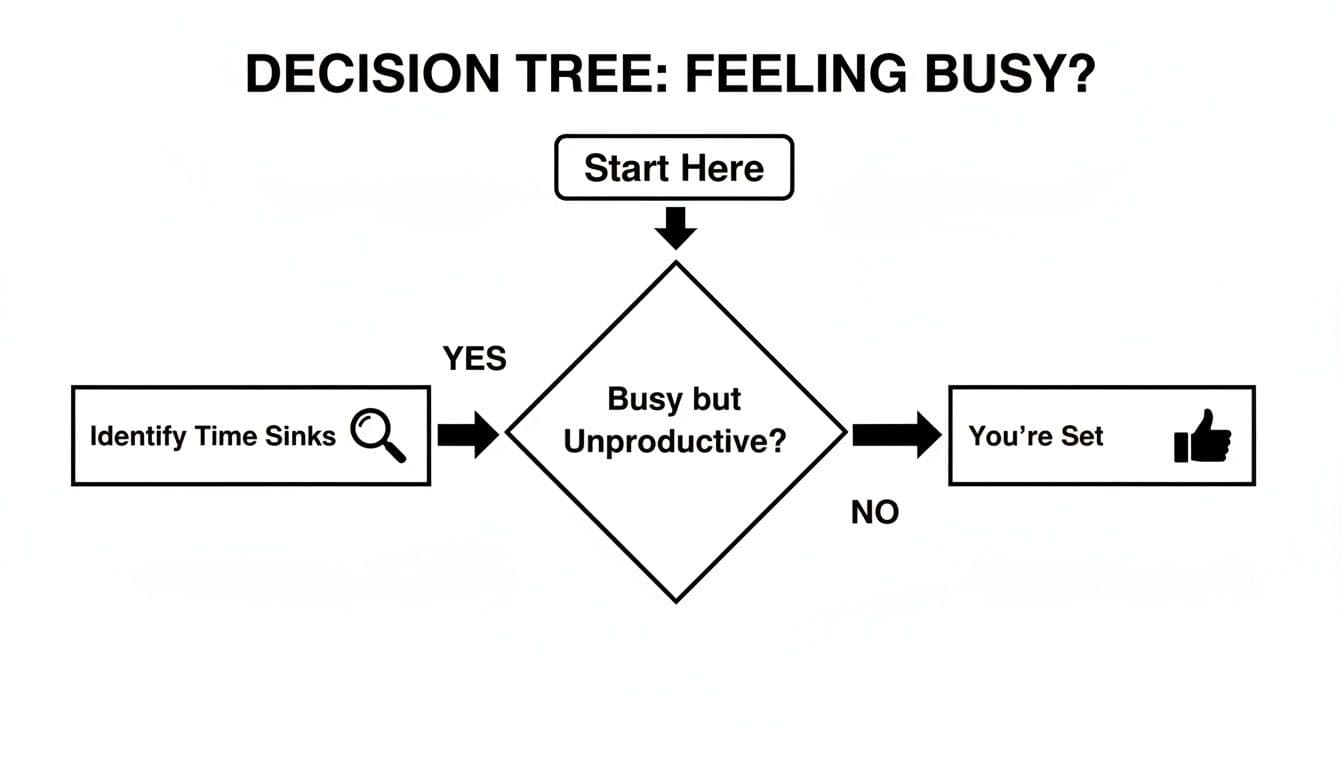
If you’re constantly in motion but not making progress, diagnose your time sinks first—only then can you move forward effectively.
Finding Your Prioritization Framework
Relying on gut instinct to pick the next task is a recipe for chaos. Use a proven system to make objective decisions about your to-do list. Which framework fits depends on your role, team, and how you think—experiment to see what sticks.
Prioritization Frameworks at a Glance
| Framework | Best For | Key Principle | Quick Tip |
|---|---|---|---|
| Eisenhower Matrix | Leaders juggling strategic and operational work | Separate by urgency and importance to focus on high-impact tasks | If your "Do First" quadrant is always full, schedule more time for strategic work |
| 80/20 Rule | Sales, marketing, anyone with disproportionate results | 80% of results come from 20% of effort | Review last month: what 2–3 activities drove the biggest wins? |
| MoSCoW | Product teams with fixed deadlines | Categorize features as Must, Should, Could, Won’t | Reserve "Must" for non-negotiable items only |
Each system helps you move from reactive firefighting to proactive investment of attention.
Engineer Your Day for Deep Focus
A prioritization plan only works if you have time and space to execute it. Deep work—the ability to focus without distraction on cognitively demanding tasks—is where breakthroughs happen. Flexible work arrangements can significantly improve productivity and focus time, according to recent industry data.1
Here’s how to build your focus fortress:
- Block your time: Schedule appointments with your most important tasks. A 90-minute block labeled “Draft Q3 Marketing Strategy” is a powerful commitment.
- Silence the noise: Turn off nonessential notifications and set up a channel for true emergencies.
- Signal your status: Use Slack or Teams statuses like “Deep work until 2 PM” to manage expectations.
Practical Focus Strategies for Neurodivergent Minds
Standard productivity advice often falls short for people with ADHD or other neurodivergence. Build a system that works with your brain’s wiring:
- Get visual with Kanban: Tools like Trello give a visual progress flow; moving a card to "Done" delivers a satisfying dopamine hit.
- Use micro-deadlines: Break big projects into tiny steps with short deadlines to reduce overwhelm and increase momentum.
Using Automation and Delegation to Get More Done
Highly productive people focus on high-impact work and offload the rest through automation and delegation. This frees mental bandwidth for strategy, creativity, and connection. AI and automation tools are already helping many workers save time and improve quality of work, according to recent reports.2
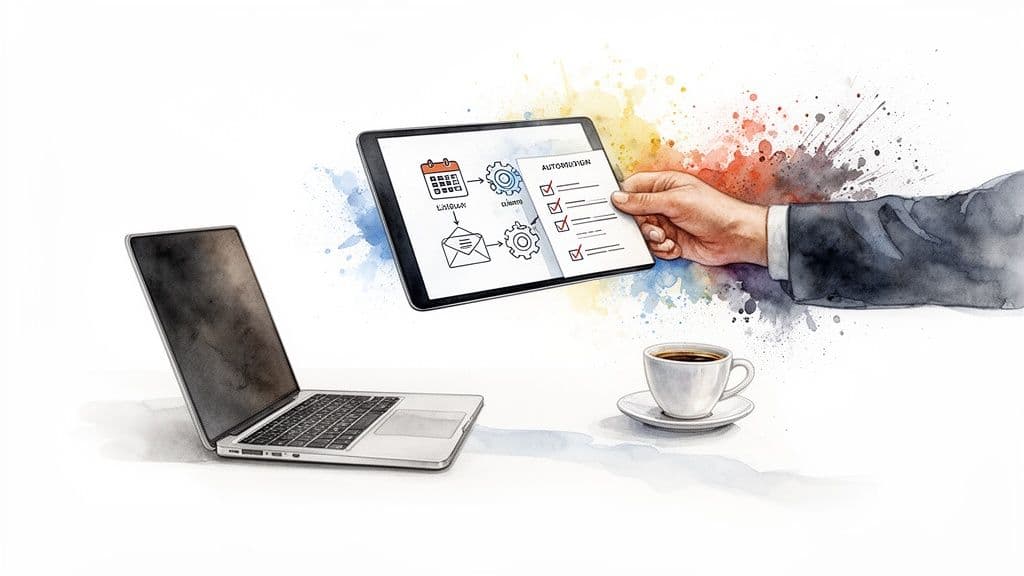
Let Technology Handle Repetitive Work
Identify high-frequency, low-complexity tasks and automate them. Modern tools make it easy to create simple "if this, then that" workflows that eliminate mindless clicking and repetitive manual work.
Simple automation recipes to start with:
- Automate your inbox: Use rules to sort newsletters to a "Read Later" folder or flag top-client emails.
- Streamline scheduling: Use a tool like Calendly to stop the endless back-and-forth.
- Connect your apps: Use Zapier or Make to move data between tools automatically.
The Art of Smart Delegation
Delegation is about communicating the desired outcome, setting clear expectations, and trusting others to deliver. You don’t need a full-time hire—pay-per-task virtual assistants or contractors can handle well-defined projects.
How to delegate effectively:
- Write crystal-clear instructions: Be specific about deliverables, scope, and format.
- Set budget and timeline: State fixed price or hourly budget and a clear deadline.
- Provide resources: Give access to the tools and documents they’ll need.
- Offer constructive feedback: Review results and explain any changes for future improvements.
Optimizing Your Team’s Collaboration and Communication
Individual hacks are helpful, but team productivity multiplies when collaboration is intentional. The foundation is a single source of truth: a central place where all project information lives so team members stop hunting through email chains and chat threads.
Modern project platforms offer multiple views—Kanban, calendar, list—to match different work styles. This reduces friction and keeps everyone aligned. Our platform, Fluidwave, supports these perspectives so teams can stay coordinated without duplicating effort.
Cutting Through Digital Noise
Set clear communication protocols as a team:
- Use instant messaging for quick, urgent questions.
- Use email for formal updates and anything requiring a record.
- Use your project management tool for task-specific updates and files.
These boundaries reduce constant pings and protect deep work.
Rethinking Meetings and Embracing Asynchronous Work
Ask before scheduling: could this be an email, a shared doc, or a project update? Many meetings can be replaced with asynchronous updates, which let people respond thoughtfully when it fits their schedule and protect focus time.
When meetings are necessary, keep them short, agenda-driven, and outcome-oriented.
Getting collaboration right has a massive economic impact—low engagement costs the global economy billions—so investing in better communication pays off at scale.5
How to Sustain Productivity Without Burning Out
High output in short bursts is one thing; sustaining it without burning out is another. The secret is protecting your energy with habits that support long-term performance.

The Power of Strategic Breaks
Work in focused sprints with short breaks to prevent cognitive overload. The Pomodoro Technique—25 minutes of work followed by a five-minute break, with a longer break after four cycles—helps maintain sharpness and productivity.4
Setting Firm Boundaries
With remote and hybrid work blurring lines, you must protect your off-hours:
- Define your work hours and stick to them.
- Disable work notifications when off the clock.
- Create a dedicated workspace to help mentally switch off.
A simple end-of-day shutdown ritual—clear your desk, jot tomorrow’s top priorities, and close your laptop—signals your brain it’s time to stop.
Your Weekly Productivity Reset
Block 30 minutes each week to review:
- What went well? Repeat those practices.
- What didn’t? Identify roadblocks without judgment.
- What one change will you try next week? Make it concrete.
This weekly habit keeps you refining your system instead of repeating the same mistakes. Also consider reasonable workplace adjustments to support mental health, which underpins long-term productivity.
Common Questions and Practical Answers
How do I handle back-to-back meetings?
Audit your calendar before accepting invites. If a meeting lacks a clear agenda or goal, decline or request details. Shorten meetings where possible and block dedicated "no meeting" time for focused work.
What if I’m constantly interrupted?
Set and communicate boundaries: use status indicators for deep work, create an urgent-channel for real emergencies, and use noise-canceling headphones as a visible signal you’re focused.
My to-do list is overwhelming—where do I start?
Pick one task. If everything feels urgent, apply a prioritization framework like the Eisenhower Matrix to find the Important-but-Not-Urgent items that drive long-term results. Use quick wins (two-minute tasks) to build momentum.
Ready to stop juggling tasks and start mastering your workflow? Fluidwave combines smart automation with on-demand virtual assistants to help you focus on what truly matters. Try Fluidwave today and reclaim your productive hours.
Frequently Asked Questions (Q&A)
Q: What’s the fastest way to find where my time is wasted?
A: Run a short productivity audit for a few days—note how long common activities take and where interruptions occur—then fix the top one or two time sinks immediately.
Q: Which is more effective: automation or delegation?
A: Both are complementary. Automate repetitive digital tasks first, then delegate work that needs human judgment but not necessarily your direct input.
Q: How do I protect focus time on a busy team?
A: Schedule and communicate protected focus blocks, set team-wide norms for communication, and favor asynchronous updates when possible.
1.
Microsoft Work Trend Index: research and insights on hybrid work and productivity. https://www.microsoft.com/en-us/worklab/work-trend-index
2.
Productivity statistics and AI impact on work from MyHours: https://myhours.com/articles/productivity-statistics-2025
3.
Getting Things Done and the two-minute rule (David Allen): https://gettingthingsdone.com/what-is-gtd/
4.
The Pomodoro Technique by Francesco Cirillo: https://francescocirillo.com/pages/pomodoro-technique
5.
Gallup research on employee engagement and global economic impact: https://www.gallup.com/workplace/349484/state-of-the-global-workplace-2023.aspx
Focus on What Matters.
Experience lightning-fast task management with AI-powered workflows. Our automation helps busy professionals save 4+ hours weekly.