Feeling overwhelmed? This guide shows you how to stay organized with practical strategies for your digital and physical life to reclaim your focus.
October 7, 2025 (3mo ago)
How to Stay Organized and Boost Your Productivity
Feeling overwhelmed? This guide shows you how to stay organized with practical strategies for your digital and physical life to reclaim your focus.
← Back to blog
It really comes down to two things: knowing what you need to do and having the mental space to actually do it. The problem for most of us isn't a shortage of fancy apps or planners. It’s the constant wave of distractions and the sheer mental exhaustion that stops us from using those tools in the first place.
Why Staying Organized Feels Impossible Right Now
Ever have those days where you're busy from morning to night but feel like you got nothing done? You're definitely not alone. The modern workday, with its constant pings, hybrid schedules, and overflowing inboxes, can make organization feel like a battle you’re destined to lose. It’s way too easy to just stare at the digital mountain of tasks and alerts until you’re completely paralyzed.
That overwhelmed feeling is very real. Constantly switching from one task to another puts a heavy strain on your brain, draining your mental reserves. Every tiny choice you make—which email to open first, what project to tackle next—chips away at your focus. This is a huge contributor to what experts call decision fatigue, a state where the quality of your decisions gets worse and worse the more you have to make.
You can learn more about how to combat this in our deep-dive here: https://fluidwave.com/blog/what-is-decision-fatigue
The Real Cost of Clutter
A disorganized workspace—whether it's physical or digital—does more than just look messy. It has a real, measurable impact on your stress levels, the quality of your work, and even your free time. When you’re constantly hunting for a file or scrambling to remember a deadline, you lose that crucial sense of being in control.
The truth is, organization isn’t some innate talent people are born with. It's a skill you can learn. It’s all about building simple, repeatable systems that clear out the mental friction and let you focus again, one small win at a time.
To really get to the bottom of it, it helps to understand how our environment affects our state of mind. Many people find that exploring the principles of decluttering for mental health provides a powerful new perspective on the whole process.
Conquer Your Digital Workspace First
Forget about the paper stacking up on your desk for a minute. The real battleground for modern chaos is your digital workspace. It's where the bulk of our work actually happens, and getting it under control delivers the biggest and most immediate win. When your digital environment is organized, you eliminate that constant, low-grade friction of searching for files, which makes finding what you need second nature.
Let's start with your file storage, whether you live in Google Drive, Dropbox, or just the folders on your computer. The goal here is a simple, intuitive folder structure that you can use everywhere. Don't overcomplicate it; a system is only good if you actually use it.
Create a Simple Folder System
I’ve found that a basic three-folder system is the most effective starting point. The real magic is in its consistency—you replicate this same setup across all your platforms, which helps the habit stick.
-
Active Projects:** This is for everything you're working on right now. Give each project its own subfolder to keep all the related documents, spreadsheets, and notes in one tidy spot.
-
Reference: Here’s where you put materials you don’t need every day but can't toss. Think company handbooks, brand guidelines, useful templates, or old project reports. It's your digital filing cabinet.
-
Archive: As soon as a project is well and truly done, move its entire folder here. This is key to keeping your 'Active Projects' folder clean and focused, so you're only looking at what's relevant today.
This simple structure is your best defense against the "Desktop" folder becoming a digital junk drawer filled with hundreds of stray files.
Your digital desktop should be treated just like a physical one—a clear space for what you're currently focused on, not a permanent storage locker. A cluttered screen leads to a cluttered mind, constantly pulling your attention in a dozen different directions.
Finally, make it a recurring event. Block out 30 minutes on your calendar every other Friday for a "digital reset." Use that time to do the little things that prevent chaos from creeping back in. Unsubscribe from newsletters you delete without reading, clear out your downloads folder, and remove old apps from your phone.
For those recurring digital chores, you can even find ways to automate tasks and keep your space organized with much less hands-on effort.
The Art of Prioritizing What Truly Matters
A clean digital workspace is a great first step, but real productivity comes from organizing your actions, not just your files. We've all seen those endless to-do lists; they're a classic recipe for burnout because they treat a minor email and a critical project deadline as equals. The secret to staying organized isn't about doing more—it's about consistently doing the right things first.
Making that shift from simply being "busy" to being truly effective requires a framework for deciding what deserves your attention right now. This is where prioritization methods come in. They aren't complex systems, just simple mental models to help you cut through the noise.
Choosing Your Prioritization Method
Two of the most popular and effective methods are the Eisenhower Matrix and the "Must, Should, Could" framework. The Eisenhower Matrix is brilliant for sorting tasks by urgency and importance, forcing you to decide what needs immediate action versus what can be scheduled, delegated, or even ignored.
If you're curious, you can see how it works in the real world in our guide: Eisenhower Matrix with practical examples.
This infographic gives a great visual of how to filter your tasks and make sure the most important ones actually land on your calendar.
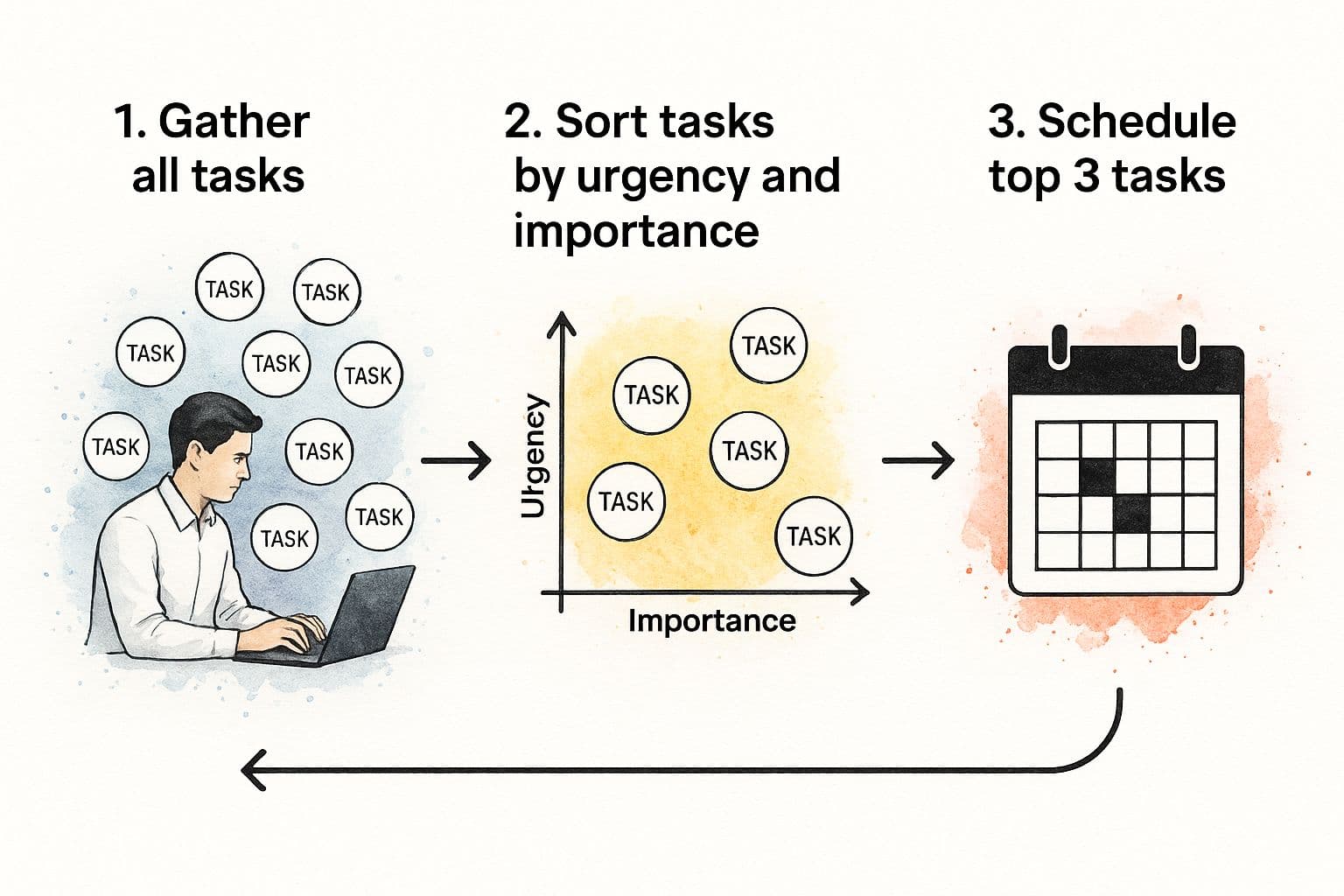
As you can see, out of a dozen potential tasks, only a select few are true priorities that deserve a dedicated time slot.
To help you decide which approach fits your style, here’s a quick comparison.
Comparing Prioritization Methods
| Method | Best For | How It Works |
|---|---|---|
| Eisenhower Matrix | Strategic planning and distinguishing between what's truly important and what's just loud. | You categorize tasks into four quadrants: Do, Decide, Delegate, and Delete, based on their urgency and importance. |
| Must, Should, Could | Daily task management and quick, intuitive decision-making. | You group tasks into three simple buckets: Must-dos (non-negotiable), Should-dos (important but not critical), and Could-dos (nice to have). |
Ultimately, both methods help you think more critically about your to-do list instead of just diving in.
Without clear priorities, productivity plummets. It’s no wonder only 21% of employees feel engaged at their jobs, leading to an estimated $438 billion in lost productivity each year. It’s a clear sign that much of the work being done isn't aligned with what actually moves the needle.
For anyone trying to keep multiple plates spinning, learning how to manage multiple projects without getting overwhelmed is essential, and it all starts with solid prioritization.
The goal of any prioritization method is to make your decisions intentional. Instead of reacting to the loudest notification, you're proactively choosing where to invest your most valuable resource—your attention.
Designing an Environment That Fosters Focus
True organization goes way beyond a tidy desk—it's about deliberately setting up your surroundings for deep work. Your physical and digital spaces have a massive impact on your ability to concentrate. Instead of constantly reacting to the chaos, you can build an environment that guards your most valuable resource: your attention.
This is more important than ever. The modern workday is a minefield of interruptions. Research has found that the average office worker gets interrupted roughly every three minutes. What’s worse, it takes an average of 23 minutes to fully get back on track after each distraction. That constant context-switching is a colossal drain on productivity. You can dig into more workplace productivity research to see just how deep the rabbit hole goes.
Build Your Fortress of Focus
Carving out a dedicated workspace is a game-changer, even if it's just one specific corner of your dining table. This physical boundary trains your brain to associate that spot with concentration, signaling that it's time to get down to business the moment you sit down. A cluttered or multi-purpose area just sends mixed signals and invites distraction.
But it's not just about the physical setup; it’s also about managing the expectations of those around you.
An organized environment is one where your focus is treated like a tangible asset. This requires clear communication about when you're available and, just as importantly, when you’re not available for non-urgent matters.
A great way to do this is by setting up "focus hours." Block off dedicated time in your shared calendar and let your team know the deal. For example, you might designate 9:00 AM to 11:00 AM as your deep work block, telling colleagues you'll only respond to genuine emergencies during that window.
Use Technology to Block Out the Noise
While technology is often the source of our distractions, it can also be your best defense. Don't just rely on sheer willpower to stay on task. Use tools to build a wall against the digital noise that constantly pulls at your attention.
Here are a few practical strategies you can put into action right now:
- Silence Non-Essential Notifications: Take a few minutes to audit your phone and computer settings. Do you really need a banner and a sound for every single email or social media mention? Be ruthless and disable everything that isn't absolutely critical to your immediate work.
- Embrace 'Do Not Disturb' or Focus Modes: Most modern operating systems have powerful focus modes built right in. You can customize them to allow notifications only from specific people or apps during your designated work blocks, silencing everything else.
- Install a Website Blocker: If you find yourself mindlessly drifting to news sites or social media, use a browser extension to block access to them during your working hours. It’s a simple but surprisingly effective trick.
By actively taking these steps, you're removing the temptation to multitask before it even arises. This makes it infinitely easier to stay organized and committed to the work that truly matters.
Building Organizational Habits That Actually Stick
Getting organized is a great first step, but let's be honest—staying organized is the real mountain to climb. It’s all too easy to let things slide when a chaotic week hits. The secret isn't about achieving a state of perfect, permanent order. It's about building resilient habits that become second nature, stopping that slow, creeping mess from taking over your life again.
This is where you shift from a one-time cleanup project to a sustainable daily practice. Real, lasting organization is built on small, consistent actions, not on those massive, once-a-year overhauls. The aim is to weave these behaviors into your life so they feel as automatic as brushing your teeth.
Link New Habits to Old Routines
One of the most powerful psychological tricks for making a new behavior stick is something called habit stacking. The idea is simple: you link a new habit you want to form with a routine you already do without thinking. By piggybacking on an existing trigger, you don't have to rely on willpower or phone reminders.
Here’s how this looks in the real world:
- When you finish your morning coffee, take five minutes to glance at your top three priorities for the day.
- Before you shut down your computer for the day, spend just three minutes dragging files off your desktop into their proper folders and closing out old browser tabs.
- The moment you drop your keys on the counter, sort through the day’s mail instead of letting it become a paper monster.
The genius of this technique is its simplicity. You’re not trying to magically find more time in your day; you’re just attaching a new, productive action to a moment that’s already there.
The Power of a Weekly Review
Another absolute game-changer for staying on top of things is the weekly review. This is your dedicated, non-negotiable time—even just 20-30 minutes on a Friday afternoon or Sunday night—to hit the reset button on your systems and map out the week ahead.
What does this look like in practice? During your review, you can:
- Tidy up any stray notes or ideas you jotted down during the week.
- Scan your calendar for upcoming appointments and critical deadlines.
- Finally clear out that cluttered email inbox and your computer's downloads folder.
- Decide on your key goals for the coming week.
This simple ritual is incredibly effective. It's the safety net that ensures nothing important falls through the cracks, allowing you to walk into every Monday with a clear head and a sense of purpose. It transforms organization from a constant battle into a reliable, background habit.
Got Questions? We've Got Answers
Even the most organized people run into trouble sometimes. It's totally normal. Here are a few common questions I hear all the time when people are trying to build better, more lasting organizational habits.
What If I Get Overwhelmed and Fall Off Track?
First off, welcome to the club. It happens to literally everyone. The goal here isn't flawless perfection; it's about building a resilient system.
If a chaotic week throws your entire plan into disarray, don't sweat it. The key is not to view it as a total failure. Instead, just block out 30 minutes on your calendar for a "reset." Use that time to clean up your digital workspace, re-evaluate what's truly important, and get back to basics. Getting back on track is a skill in itself, and it’s arguably the most important one for long-term organization.
How Long Does It Take to Build These Habits?
Let's be realistic: building a new habit doesn't happen overnight. Research shows it can take anywhere from a few weeks to several months for a new routine to feel second nature.
The secret is to start small. Don't try to reinvent your entire life in one weekend. Just focus on one tiny routine, like a three-minute desktop cleanup at the end of the day. Once that feels automatic, you can add another.
The biggest mistake I see is people trying to change everything at once. Real, sustainable organization is built on small, consistent wins—not some massive, one-time overhaul. Success comes from layering one good habit on top of another.
Is a Digital or Physical Planner Better?
Honestly, this is all about what works for you. There's no single right answer.
Digital tools are fantastic for collaboration, setting automated reminders, and accessing your schedule from anywhere. On the other hand, a lot of people find that the physical act of writing things down in a paper planner helps them remember their commitments and feel more connected to their goals.
Don't be afraid to experiment and find your own groove. Many people I know thrive with a hybrid approach—using a digital calendar for meetings and a physical notebook for their daily to-do lists. The best system is simply the one you'll stick with.
Ready to stop juggling tasks and start getting things done? Fluidwave combines smart task management with on-demand virtual assistants to help you clear your plate and focus on what truly matters. Start organizing your life with Fluidwave today.
Focus on What Matters.
Experience lightning-fast task management with AI-powered workflows. Our automation helps busy professionals save 4+ hours weekly.