Are you ready to stop chasing every new productivity trend and start making real progress? This guide focuses on three proven pillars — smart automation, strategic prioritization, and empowering delegation — to help you work smarter, not harder. By simplifying your workflow and aligning tasks with impact, you can boost output while reducing stress.
September 20, 2025 (10mo ago) — last updated March 6, 2026 (4mo ago)
Improve Work Efficiency: Top Productivity Tips
Discover actionable strategies for automation, prioritization, and delegation to boost productivity and reclaim your day.
← Back to blog
Moving Beyond Busywork to Boost Efficiency

Sound familiar? Your day is packed, you’re constantly busy, but at the end of it all, you don’t feel like you’ve made any real progress. This is a common trap, often rooted in outdated workflows and the mental exhaustion of trying to juggle too many things at once.
The cost of this inefficiency is massive. Globally, employee engagement sits at a startlingly low 21%1. That widespread disengagement translates to a staggering $438 billion in lost productivity every year.¹
The "busywork" cycle is often fueled by habits we don’t even notice—reacting to every ping, sitting in directionless meetings, and grinding through manual tasks that a machine could easily handle.
The goal is to transform your workday from being reactive to being intentional. It’s about reclaiming your focus and directing your energy toward tasks that actually move the needle.
The Shift from Busy to Productive
To make this change, it helps to see what we’re moving away from and what we’re aiming for. This table contrasts common inefficient habits with the powerful, efficient alternatives we’ll get into.
| Common Inefficient Habit | Smart Efficient Alternative |
|---|---|
| Reacting to every notification | Time blocking for focused work |
| Manually managing routine tasks | Implementing smart automation |
| Treating all tasks as urgent | Prioritizing by impact and effort |
| Micromanaging delegated work | Delegating with clear outcomes and trust |
| Constant multitasking | Focusing on one high-value task at a time |
Seeing the two side-by-side really clarifies the path forward. It’s not about working harder; it’s about working smarter.
Common Workplace Inefficiencies
One of the biggest productivity killers is multitasking, or what experts call context switching. Every time you jump from an email to a spreadsheet and then to a team chat, your brain loses momentum and focus. You can learn more about the hidden costs of context switching 2 and how to fight back.
Other major drains on our time and energy include:
- Repetitive Manual Tasks: How many hours do we lose to data entry, scheduling, or pulling reports? These are perfect candidates for automation.
- Poor Prioritization: When everything feels urgent, you end up working on low-impact stuff while the most important projects get pushed back.
- Ineffective Delegation: Holding on to tasks too tightly—or not delegating at all—creates bottlenecks and stunts your team’s growth.
Getting a handle on these areas can pay off right away. For quick wins, you can discover a range of powerful productivity hacks for work that offer simple, effective adjustments. From there, this guide will help you build lasting systems for a more focused and productive workday.
Reclaim Your Day with Smart Automation
What if you could get back a few hours every week? Not by working faster, but by letting technology handle the monotonous tasks that eat away at your focus. That’s the real promise of smart automation. It’s not about buying complex software; it’s about strategically offloading the grunt work so you can concentrate on what really matters.
It's predicted that by 2025, 58% of employees will be using AI regularly to buy back time and sharpen their focus3. But here's the catch: technology can also be our biggest distraction. The average person gets interrupted every three minutes, and it can take over 20 minutes to get back on track. That’s why your automation efforts need to be precise and intentional. You can read more on how professionals are rethinking productivity in the workplace 4.
So, where do you start? The trick is to pinpoint the exact tasks holding you back. Just think about your daily grind. What are the little things you do on autopilot, over and over again?
I always suggest a simple 'task audit.' For one day, just jot down every repetitive thing you do—copying data, sending the same follow-up email, generating a weekly report. You’ll be surprised how quickly you find perfect candidates for automation.
This image lays out a great framework for setting clear, measurable goals for your automation efforts. It helps turn a vague idea into a concrete plan.
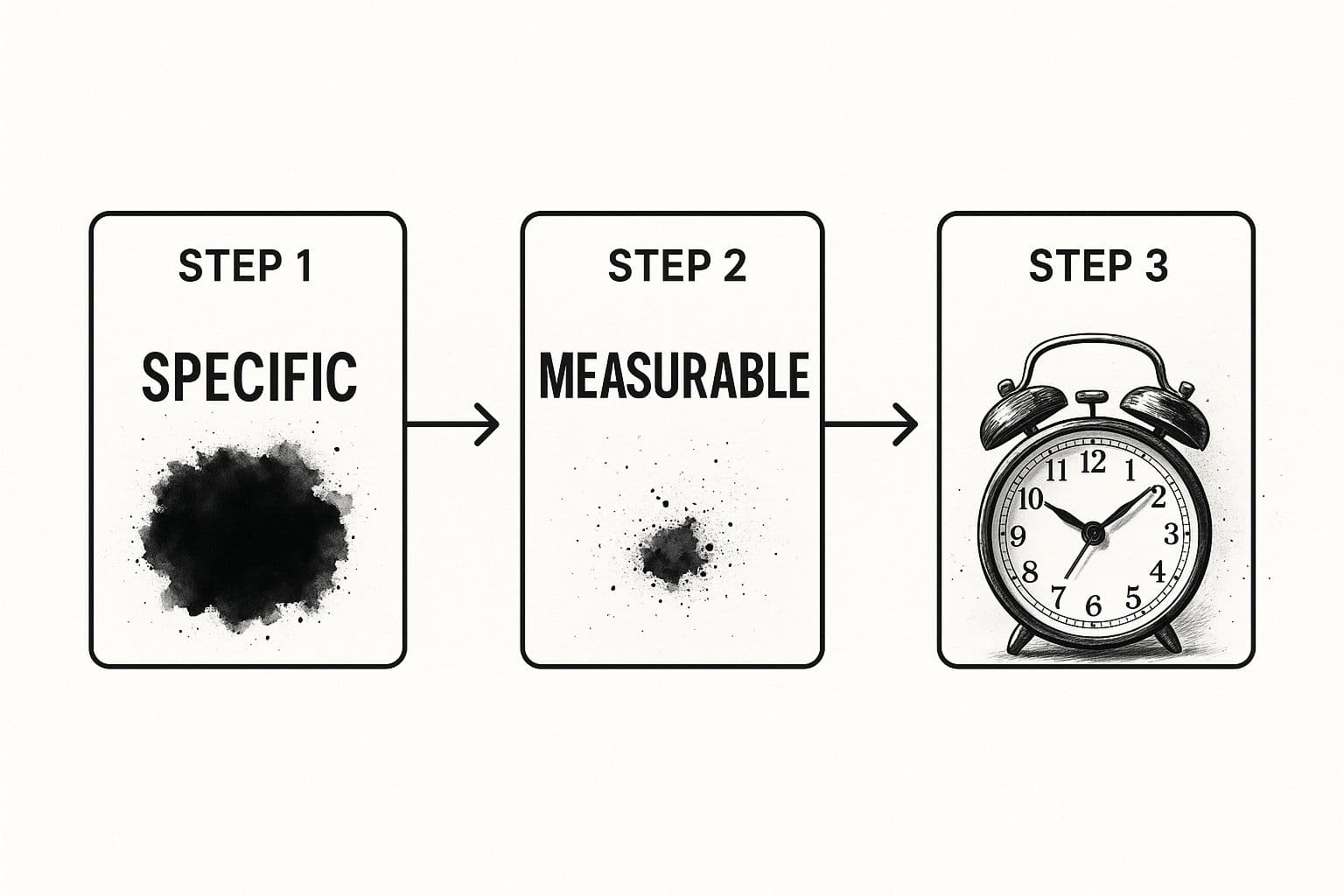
Following a process like this makes sure your goals are actionable, not just wishful thinking that never gets off the ground.
Find Your Automation Opportunities
Once you have your list of tedious tasks, you can start looking for the right tools to take them over.
- Marketing folks, listen up: Are you still manually entering every new lead from your website into a CRM? A simple workflow in a tool like Zapier can do that for you. It can create the contact, add a row to a Google Sheet, and ping your sales team in Slack, all in a split second. That alone could save you 30 minutes a day.
- HR managers know the pain: The back-and-forth email chain to schedule a single interview is a classic time-waster. Using a scheduling link from a tool like Calendly lets candidates pick a time that works for them, instantly adding it to both of your calendars. Problem solved.
These aren't massive, company-wide initiatives. They’re small, intelligent tweaks that compound into huge time savings. If you want to get into the nitty-gritty of finding and setting up these workflows, our guide on how to automate tasks is the perfect next step.
Prioritize Your Work to Magnify Your Impact
True effectiveness isn't about doing more; it’s about consistently doing more of the right things. When your to-do list feels like a runaway train, prioritization is the skill that separates the busy from the truly impactful. It’s how you cut through the noise and focus your energy where it actually counts.
One of the most battle-tested tools for this is the Eisenhower Matrix. It’s a simple but powerful framework that helps you sort tasks based on their urgency and importance. You can see how it works in different roles with these practical Eisenhower Matrix examples.
Think of a project manager staring down multiple deadlines. A critical bug threatening a client's go-live is clearly Urgent and Important—that’s a drop-everything-and-fix-it situation. But what about planning a future team lunch? That falls squarely into Not Urgent and Not Important, so it can be scrapped or pushed way out. This kind of quick sorting brings instant clarity.
Learn to Say No Strategically
A huge part of being efficient is protecting your time from low-value requests. I know saying “no” can be uncomfortable, but it's an absolute necessity if you want to stay focused on what matters. The trick is to decline gracefully without burning bridges.
Prioritization isn't a chore; it's a strategic advantage. It empowers you to take control of your workload and direct your efforts toward activities that deliver the greatest results.
Instead of a hard “no,” try framing your response around your existing commitments. It shifts the conversation from rejection to collaboration.
Here are a couple of phrases I’ve found work well:
- Offer an alternative timeline: “I can't get to that this week with the XYZ project deadline, but I'd be happy to look at it next Monday. Would that work for you?”
- Ask for help prioritizing: “That's an interesting idea. Right now, my focus is on completing A and B, which we agreed were top priorities. Can you help me understand where this new request fits in?”
This approach shows you're engaged and responsible, not just dismissive. You’re not just turning down work; you’re reinforcing your commitment to the most critical tasks, which in the end, helps everyone win.
Master the Art of Delegation and Empower Your Team

For a lot of leaders, the idea of delegation just feels like passing off work. But if you see it that way, you’re missing the point. Real delegation is a powerful tool for developing your team's skills and scaling your own impact.
It's easy to fall into the trap of doing everything yourself. You might worry about losing control or that the quality will dip. This thinking, while common, is a surefire way to create bottlenecks and stifle your team's growth.
The goal isn't just to assign tasks; it's to entrust responsibility and cultivate a sense of ownership. When you get this right, you free yourself up to focus on big-picture strategy. At the same time, you’re actively building your team’s confidence and competence. It’s a classic win-win.
How to Delegate the Right Way
To really unlock your team's potential, you have to understand How to Delegate Tasks Effectively. This means moving beyond simply handing off a to-do list item. You need to provide the full context—explain the “why” behind the task, what a successful outcome looks like, and how it all connects to the larger company goals.
Let's take a practical example. Instead of just telling a junior analyst to “pull the Q3 sales report,” delegate the entire process. Task them with gathering the data, analyzing the trends, and presenting their key findings.
Set up a few check-in points, but otherwise, give them the space to own the project from start to finish. This small shift turns a routine task into a genuine growth opportunity.
The impact of this approach is huge, especially when you consider that only 27% of managers report feeling engaged at work4. That's a massive problem, since those same managers influence about 70% of their team's engagement. Training leaders to coach and delegate is one of the most direct ways to boost overall efficiency.
Key Takeaway: Think of delegation as an investment in your team's future. It pays dividends by creating a more skilled, autonomous, and motivated workforce—which is the engine for real productivity and innovation.
Ultimately, great delegation builds a stronger, more resilient team where everyone is working at their highest potential. It stops being about what you can do and starts being about what the team can achieve together.
Design Your Workspace to Eliminate Distractions

We often underestimate just how much our environment—both physical and digital—dictates our ability to concentrate. A well-designed space can be the secret weapon that turns a day of scattered effort into one of focused, high-quality output. It's about making small, intentional adjustments that build a buffer against the constant pull of distractions.
Recent research drives this point home. A 2025 survey revealed that people working in human-centric environments are nearly three times more likely to perform better and stay with their jobs. This isn’t just a nice-to-have; your workspace is a powerful tool for getting better work done. You can dig into the full details on how workspace design influences productivity 5.
Create Your Focus Zone
The first move is to reclaim your schedule by time blocking. This isn’t just a fancy to-do list; it’s about proactively carving out dedicated, uninterrupted time for your most demanding tasks.
For example, you could block out a 90-minute slot every morning for “Deep Work on Project X.” During that time, everything else is off-limits. No email checks, no social media scrolling—just pure focus on the task at hand.
This simple act trains your brain and sends a clear signal to your colleagues that your focus is non-negotiable. It’s a surprisingly powerful way to guarantee your most important work gets the deep attention it deserves.
The goal is to create a true distraction-free zone where you can get into a state of flow. This is where your best, most efficient work happens.
Tame Your Digital Distractions
Your digital environment needs just as much attention as your physical one. Let’s be honest—the constant barrage of notifications is one of the biggest productivity killers out there.
Here are a few practical habits I’ve seen make a huge difference:
- Silence non-essential notifications. Do you really need a pop-up for every single email or social media mention? Probably not. Dive into your settings and disable anything that isn’t mission-critical.
- Set clear communication channels. Get your team on the same page. Maybe Slack is for quick, informal questions, while email is reserved for formal updates and client communication. This stops you from feeling like you have to monitor five different platforms all day.
- Organize your digital files. A clean desktop and a logical folder system aren’t just for aesthetics. They stop you from wasting precious minutes digging around for that one document you need.
Making these small tweaks drastically reduces mental clutter, which is key to staying on task and in the zone.
Common Questions About Improving Work Efficiency
As you start putting these ideas into action, a few questions are bound to pop up. It happens to everyone. Let’s walk through some of the most common sticking points I see with clients so you can keep moving forward.
I'm Completely Overwhelmed. Where Do I Even Begin?
When everything feels like a priority, the best first step is the smallest one. Forget trying to reinvent your entire work life overnight. Instead, just conduct a simple 'task audit.'
For one week, just observe. Jot down every repetitive task you do. Don’t analyze or fix anything yet—just collect the data. You’ll quickly spot which low-value activities are eating up your clock. Pick the easiest one and find a way to automate or simplify it. That single, small win creates momentum, which is far more powerful than aiming for a massive, all-at-once change.
Sustainable efficiency is built on small, consistent improvements, not a single, overwhelming overhaul. The goal is progress, not perfection.
How Can I Make My Team More Efficient Without Micromanaging?
This is a great question because it gets to the heart of real leadership. The trick is to shift your focus from process to outcomes. Give your team crystal-clear goals and deadlines, make sure they have the right tools, and then trust them to figure out the best way to get there.
Project management software should be used for transparency, not surveillance. Your check-ins should be less about "What did you get done today?" and more about "What roadblocks can I clear for you?" This approach builds autonomy and ownership, two things that micromanagement absolutely crushes.
Is It Possible to Be Too Efficient and Let Quality Slip?
Absolutely, and it’s a smart thing to be wary of. This happens when the focus is purely on speed. That’s why I always stress effectiveness over pure efficiency. The whole point of these strategies isn’t to rush through important work. It’s to eliminate the low-value noise so you can dedicate more time and mental energy to the complex, creative tasks where quality is paramount.
You aren’t trying to do the important stuff faster; you’re protecting it from the unimportant stuff. It’s well-documented that new employees can take 8 to 12 months just to get up to the same productivity level as their colleagues. This really highlights how crucial it is to have dedicated time for deep, focused work. Investing in systems that create that time is the key. For more on this, check out the latest workplace productivity trends from the U.S. Bureau of Labor Statistics 6.
Ready to stop juggling tasks and start making a real impact? Fluidwave combines smart automation and on-demand virtual assistants to help you prioritize, delegate, and focus on what truly matters. Start streamlining your workflow today with Fluidwave.
3 Quick FAQs
Q: How do I start implementing these strategies today? A: Begin with a simple task audit—document repetitive actions for one week and automate the easiest one first. Build momentum with small wins and expand from there.
Q: Which tools help with automation and scheduling? A: Tools like Zapier for automation and Calendly for scheduling can save a ton of time; pair them with clear processes to maximize impact.
Q: How do I maintain quality while increasing efficiency? A: Focus on deep work and meaningful outcomes, protect time for complex tasks, and measure impact rather than pace alone.
Footnotes
1.
Gallup, State of the Global Workplace, 2023. Gallup report.
2.
Nielsen Norman Group, The Cost of Interruptions. Interruptions article.
3.
eptura, "Rethinking Productivity in the 2025 Workplace Statistics," 2024. Article.
4.
Gallup, State of the Global Workplace, 2013–2023 compilation. Gallup report.
5.
Recent research on workspace design and productivity. Workspace productivity study.
6.
Bureau of Labor Statistics, Productivity and the Economy. https://www.bls.gov/productivity/.
7.
Fluidwave, Official Site. https://fluidwave.com. Fluidwave product.
Focus on What Matters.
Experience lightning-fast task management with AI-powered workflows. Our automation helps busy professionals save 4+ hours weekly.