Learn how to build rapport authentically in any professional setting. Our guide offers actionable steps, conversation techniques, and ways to scale connection.
April 16, 2026 (5mo ago)
How to Build Rapport: A Guide for Busy Professionals
Learn how to build rapport authentically in any professional setting. Our guide offers actionable steps, conversation techniques, and ways to scale connection.
← Back to blog
You join a call five minutes late because the previous meeting ran over. The other person has their camera off. You exchange updates, confirm next steps, and end on time. Nothing went wrong, but nothing clicked either.
That kind of interaction is common now. Work moves fast, teams are distributed, and many conversations are designed to get through an agenda rather than build trust. The problem is that people still do their best work through trust. Tasks, feedback, delegation, conflict resolution, client retention, and team morale all depend on how safe people feel being honest with you.
If you're trying to learn how to build rapport, stop treating it like a personality trait. It’s a work skill. It can be learned, practiced, and scaled.
Beyond the Handshake Why Rapport Is Your Greatest Asset
Rapport isn't about charm. It's about reducing friction between people so useful information can move.
That matters more than most professionals admit. The meeting that feels slightly stiff is often the meeting where someone withholds a concern, softens bad news, or leaves with an unclear understanding of what actually matters. The cost shows up later as rework, misalignment, and awkward follow-up messages nobody wanted to send.
Research on interviewing shows why this matters far beyond sales or networking. Decades of research confirm that rapport-building strategies significantly increase information disclosure from adults, leading to more complete and accurate reports, especially when topics are sensitive or complex, as summarized in this systematic review on rapport and disclosure. In modern work, that translates directly to better briefs, cleaner handoffs, and more honest conversations.
Rapport changes the quality of work
When people trust you, they say the part they almost left out.
They tell you the timeline is unrealistic. They admit the client still seems uncertain. They mention the hidden dependency, the team tension, or the reason a task keeps stalling. Without rapport, you get the polite version. With rapport, you get the useful version.
That distinction matters in:
- Delegation: Clearer inputs lead to better output.
- Management: People raise issues before they become emergencies.
- Client work: Buyers reveal what they're worried about, not just what they want.
- Cross-functional work: Teams stop defending turf and start solving the same problem.
Rapport doesn't make hard conversations disappear. It makes them possible.
Poor rapport looks efficient until it isn't
A lot of professionals confuse speed with effectiveness. They jump straight into updates, skip context, and keep every exchange tightly transactional.
That can feel productive. It often isn't.
A manager who never slows down to connect usually gets surface-level updates. A founder who treats every message like a task ticket eventually trains people to share less. A consultant who talks smoothly but doesn't listen carefully may sound sharp while missing the actual issue.
One of the most useful habits is to listen to understand, not to confirm your own assumptions. If that needs sharpening, this short piece on listening to understand captures the discipline well.
Why this matters more in modern work
Distributed work removed many of the small moments that used to build trust naturally. Hallway conversations, shared commutes, quick pre-meeting chat, and the simple rhythm of seeing how someone carries themselves day to day. Now rapport has to be built with more intention.
That's the fundamental shift. Genuine connection is no longer automatic. It has to be designed into how you communicate.
The Unspoken Rules of Genuine Connection
Most rapport advice fails because it starts with tactics. Better questions. Better posture. Better small talk.
Those things help, but they break the moment your intent is off. People can tell when you're waiting to perform instead of trying to understand. Real rapport rests on three foundations: listening, empathy, and presence.
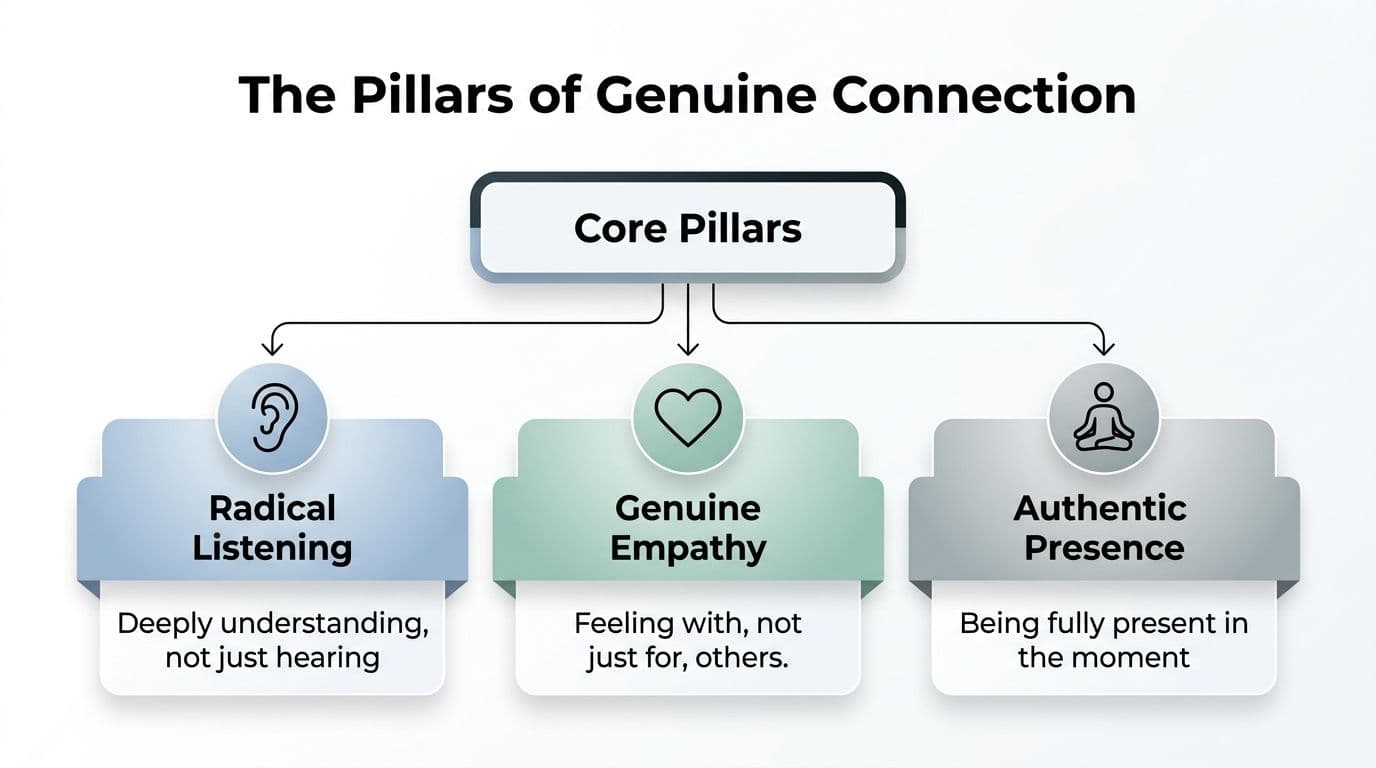
Start with listening that changes your behavior
Listening isn't nodding while planning your next point.
A useful benchmark from communication psychology is the 43:57 talk-to-listen ratio, which means you should spend more time listening than speaking if you want the other person to feel heard and valued, as explained in this piece on the psychology of rapport. That ratio is practical because it forces you out of performance mode.
In day-to-day work, radical listening sounds like this:
- You reflect before replying: “So the blocker isn't capacity. It's that legal still hasn't approved the draft.”
- You ask one more layer down: “What's the part of this that feels most risky?”
- You notice energy shifts: a pause, a sigh, a shorter answer than usual.
- You don't rescue silence too quickly: people often reveal the main point a beat later.
Listening also means resisting the urge to prove that you understand too early. Many people derail rapport by jumping in with advice before they've earned the full picture.
Authenticity needs boundaries
People trust people who feel real. They don't trust oversharing, self-display, or fake vulnerability.
A common mistake is treating authenticity like total openness. In professional settings, authenticity works better as proportionate self-disclosure. Share enough to feel human. Not so much that the conversation starts orbiting you.
A grounded example:
- “I've had weeks like that. Too many moving parts and no clean handoff.”
- Not: a five-minute story about your own workload, burnout, or personal history.
The difference is simple. One response creates connection. The other creates burden.
Practical rule: Share something true only if it helps the other person feel understood, not if it helps you feel interesting.
Empathy is a verb
Empathy isn't just caring. It's showing the other person that you grasp what their situation feels like from their side.
That means naming pressure accurately, adjusting your pace, and responding to context rather than sticking to your script. In practice, empathy often looks quieter than people expect.
Try these moves:
-
Name what seems present
“It sounds like you're trying to move fast without creating a mess for the team.”
-
Check, don't assume
“Is that accurate, or am I missing it?”
-
Adapt in real time
If someone is concise, don't force long conversational detours. If they're overloaded, simplify.
Presence is now a professional advantage
Presence sounds abstract until you see the absence of it. Split attention. Half-reading messages during calls. Generic follow-ups. Questions asked purely because they're on the checklist.
People notice when your attention is thin.
Authentic presence means doing a few unfashionable things well:
- Close other tabs before an important conversation
- Read the notes before the meeting starts
- Use their exact language when summarizing
- Remember what matters to them, not just what matters to you
If you want to know how to build rapport consistently, this is the part many people skip. They want a phrase or trick. What works is disciplined attention.
Mastering Conversational Rapport Techniques
Good rapport in conversation doesn't come from being naturally smooth. It comes from knowing how to open, guide, and close a conversation without making it feel engineered.
The easiest way to see this is to compare two versions of the same interaction. In the first, a manager opens with, “Quick one, can you give me an update?” In the second, the manager starts by settling the moment, checking context, and then moving into substance. Same meeting. Different result.

A more effective conversational sequence is built around a simple progression: create ease, find relevance, show understanding, then follow through. According to this article on rapport-building mistakes and trust, a five-step, empathy-driven plan can accelerate trust by 56%, and generic questions limit connection depth to 22%.
Open without forcing warmth
The first minute matters because people decide quickly whether this conversation is safe, rushed, or performative.
Don't open with canned friendliness. Open with awareness.
Better opening lines:
- For a busy colleague: “I know your day's packed, so let's keep this clean and useful.”
- For a new client: “Before we get into the details, I'd like to understand what would make this feel like a win for you.”
- For a direct report: “We can talk status, but first tell me where this feels stuck from your side.”
These work because they low er pressure. They signal that you're not here to extract information mechanically.
Use F.O.R.D. with restraint
The F.O.R.D. framework stands for Family, Occupation, Recreation, Dreams. It's useful because it nudges you toward topics that reveal values, priorities, and motivations.
Used badly, it sounds like a networking script.
Used well, it helps you ask more human questions:
| F.O.R.D. prompt | Better version |
|---|---|
| Family | “How are things on your side outside work?” |
| Occupation | “What's taking most of your attention this quarter?” |
| Recreation | “What do you do when you need your brain off for a bit?” |
| Dreams | “What are you hoping this role or project opens up for you?” |
The key is relevance. If someone gives a short answer, don't push. If they light up around a topic, stay there.
Ask follow-up questions that prove you heard them
The fastest way to sound generic is to ask a decent question and then ignore the answer.
Suppose someone says, “The work itself is fine. It's the constant switching that's draining.” A weak response is, “Got it. So what's your timeline?” A stronger response is, “The switching is the core problem. Where is that coming from most?”
That follow-up tells them two things. You listened, and you care about the cause, not just the output.
One good follow-up question often builds more rapport than five clever opening lines.
Useful follow-up patterns:
- Clarifying: “When you say it's messy, what part is messy?”
- Expanding: “Tell me more about what changed.”
- Prioritizing: “Of those issues, which one matters most right now?”
- Emotional labeling: “It sounds frustrating. Is that the right word?”
Find uncommon common ground
Surface similarities are easy. Same city, same industry, same coffee preference.
Those rarely create memorable connection. What tends to land better is an uncommon commonality, something more specific and more revealing. Maybe both of you have managed a difficult handoff across time zones. Maybe you've both had to rebuild a process after rapid growth. Maybe you both care about protecting deep work from constant interruption.
That kind of overlap builds rapport because it signals shared experience, not social fluff.
A simple script:
- “You mentioned your team is growing fast.”
- “We hit that same strain point when responsibilities started getting fuzzy.”
- “What helped most was getting much clearer on ownership before adding more meetings.”
That's not small talk. That's connection through relevance.
A short visual explanation can help if you want to see these moves in action.
Close with a follow-through signal
A conversation with rapport doesn't end at “sounds good.”
It ends with evidence that you understood what mattered.
A strong close includes:
- A brief recap in their language
- One clear next step
- A detail that shows this wasn't a generic exchange
For example: “I'll send a short summary focused on the handoff issue and the timeline concern, and I'll keep the options narrow so it's easier to review.”
That's small, but it lands. The person leaves feeling tracked, not processed.
Reading the Room with Non-Verbal Cues
People decide how safe you feel before they consciously evaluate what you said. Tone, timing, posture, pace, eye contact, and facial tension all shape that judgment.
This is why someone can use all the right words and still come across as cold, rushed, or slightly off. Verbal content matters. Non-verbal alignment often determines whether it lands.

What to watch before you try to influence anything
Individuals often focus too quickly on their own delivery. Start by observing.
In the first stretch of a conversation, notice:
- Pace: Are they speaking quickly, slowly, or unevenly?
- Formality: Are they precise and restrained, or casual and expansive?
- Energy: Do they seem settled, agitated, skeptical, tired?
- Engagement: Are their answers opening up or narrowing down?
This isn't about profiling someone. It's about calibrating your approach so you don't create unnecessary mismatch.
A calm, reserved executive may pull back if you come in too animated. A stressed founder may relax if you reduce speed and tighten your phrasing.
Use mirroring with subtlety
Mirroring works because people tend to trust interactions that feel rhythmically familiar. The key word is subtlety.
According to HubSpot's article on rapport mistakes and mirroring, the mirroring technique can increase rapport by 67% in a first meeting when done well. The same source warns that over-mirroring is detected in 55% of failed pitches and leads to a 28% loss in trust.
That tells you exactly how to use it. Carefully.
A practical mirroring sequence looks like this:
-
Observe baseline first
Let them set the initial tone. Don't imitate immediately.
-
Match broad patterns
If they're concise, become more concise. If they're reflective, slow down a little.
-
Echo language, not scripts
If they say “streamline the workflow,” you can naturally say “streamlining that workflow matters here.”
-
Adjust, then release
Mirroring is temporary alignment, not a performance you maintain rigidly.
If the other person could accuse you of copying them, you've already gone too far.
Body language that signals warmth without trying too hard
You don't need textbook body language. You need signals that make people feel unpressured.
A few reliable ones:
| Cue | What it communicates |
|---|---|
| Relaxed shoulders | You're not bracing or dominating |
| Slight forward lean | You're engaged |
| Steady but not intense eye contact | You're attentive |
| Unhurried nods | You're following their meaning |
| Pauses before replying | You're considering, not reacting |
The opposite cues often create friction. Looking down repeatedly can suggest distraction. Speaking too quickly can feel impatient. Smiling constantly can read as forced.
Video calls change the rules a bit
On video, many physical cues are reduced or distorted. That means your voice and pacing matter more.
Use shorter sentences. Pause a little longer. Look at the camera when making a key point, but don't stare at it constantly. If someone seems hesitant, soften your cadence instead of filling the silence.
On camera, rapport often comes from restraint. Too much energy can feel overwhelming through a screen.
How to Scale Rapport with Smart Systems and Delegation
Most advice on rapport assumes you have unlimited time, a small circle, and the ability to remember every detail on your own. That isn't how modern work operates.
Leaders manage multiple stakeholders. Founders jump between hiring, clients, and operations. Project managers coordinate across functions. Freelancers move between accounts quickly. In that reality, rapport can't rely on memory and improvisation alone. It needs a system.
That doesn't make it less human. It makes it more dependable.

Build a repeatable relationship workflow
Think about rapport the way you'd think about project quality. You don't leave quality entirely to instinct. You create conditions that make good work more likely.
The same approach works here.
A scalable rapport system usually includes:
- Pre-conversation preparation: notes on context, priorities, and communication style
- Clean handoff rituals: clear recaps, written next steps, ownership
- Follow-up triggers: reminders tied to relationship moments, not just deadlines
- Shared visibility: one place where relevant context can be reviewed by the people involved
Delegation helps here. Not because someone else can “do the relationship” for you, but because they can support the parts that often get dropped. Researching context, organizing notes, preparing personalized follow-ups, and maintaining consistency.
If you're building that support layer, a practical guide on delegation can be helpful.
Delegate the admin, keep the judgment
Some rapport tasks should never be outsourced. Your empathy, your attention, your reading of the room, and your direct responses belong to you.
But supporting work can absolutely be systematized:
- Background research: recent company news, role changes, public interviews, shared contacts
- Meeting prep briefs: what matters to this person, what happened last time, what may need follow-up
- Recap drafts: concise summaries that you personalize before sending
- Reminder systems: prompts for meaningful check-ins, not random touch points
That split matters. People don't need maximum spontaneity from you. They need evidence that you remember what matters.
Asynchronous rapport is still rapport
A lot of professionals still act as if connection only counts when it happens live. That's outdated.
Written communication can build strong rapport when it's specific, considerate, and easy to act on. In fact, for many people it works better than spontaneous verbal interaction.
This matters especially for inclusive collaboration. According to Inspirus, neurodivergent professionals, including people with ADHD affecting about 4 to 5% of adults, often prefer clear, written instructions over verbal rapport-building, and 70% favor text-based communication in this context, as discussed in this piece on building trust with gig workers.
That should change how you think about connection.
For neurodivergent colleagues, contractors, or assistants, rapport often improves when you reduce ambiguity rather than adding more social rituals. A thoughtful written brief can feel more respectful than a vague “hop on a quick call.” A structured message can reduce cognitive load and make trust easier.
Inclusive rapport often looks quieter
Many workplaces over-index on visible friendliness. Icebreakers, social events, casual banter, and frequent group check-ins can help some people. They can also exhaust others.
An inclusive approach respects different routes to trust.
That looks like:
- Clear written expectations: scope, deadline, definition of done
- Low-social options: allowing updates in writing instead of requiring verbal performance
- Predictable formats: repeated structures for briefs, recaps, and feedback
- Specific recognition: appreciation tied to work completed, not personality display
The most respectful form of rapport is often clarity.
This is one reason strong delegation systems matter. They reduce the emotional labor required to decode what someone wants. If you need a practical framework for that side of the work, a practical guide on delegation can be helpful.
What scaling rapport actually means
Scaling rapport doesn't mean turning relationships into a process map and pretending that's enough.
It means creating support around human connection so it survives busy weeks, team growth, and context switching. It means your follow-up doesn't depend on memory alone. Your assistant or system surfaces the right note at the right time. Your task board preserves context. Your written handoff respects the way different people process information.
In practice, the professionals who build the strongest relationships at scale do a few things consistently:
- They capture personal and project context right after conversations.
- They prepare before important interactions instead of “winging it.”
- They follow up in a way that reflects the actual conversation.
- They make communication easier for the receiver, not just faster for themselves.
- They design workflows that support different communication needs.
That's how rapport holds up under pressure. Not as a vibe. As a habit supported by systems.
Maintaining Momentum and Avoiding Common Pitfalls
The hard part isn't getting rapport once. It's keeping it without becoming artificial, intrusive, or inconsistent.
A lot of professionals start strong and then slip into one of two errors. They either disappear after the initial conversation, or they overcompensate and force familiarity that hasn't been earned. Both weaken trust.
Long-term rapport depends on rhythm. Not intensity.
Keep the connection alive through useful follow-up
A strong follow-up doesn't say, “Just checking in.”
It says, in effect, “I remembered what mattered to you, and I'm making the next step easier.”
That can be simple:
- After a meeting: send a short recap in their language
- After a delay: acknowledge the delay directly and reset expectations clearly
- After a milestone: recognize the work with specificity
- After a difficult conversation: restate alignment and next action
Consistency matters more than charisma here. If your relationship style changes wildly depending on your stress level, people stop trusting the signal.
A practical discipline is to build a repeatable follow-up cadence for key relationships. This article on how to stay consistent is useful if your good intentions often get crowded out by workload.
Common rapport-building mistakes and how to fix them
| The Mistake | Why It Fails | The Fix |
|---|---|---|
| Talking too much | You make the interaction about your delivery instead of their reality | Ask shorter questions and leave more silence after answers |
| Forcing small talk | It feels generic and detached from what the other person actually cares about | Start with context, pressure, priorities, or purpose |
| Over-mirroring | People sense imitation and become guarded | Match only broad tone and pace, then relax back into your own style |
| Oversharing | You create emotional drag and shift attention to yourself | Use brief, relevant self-disclosure only when it serves the conversation |
| Solving too early | Advice before understanding makes people feel managed, not heard | Clarify the issue first, then ask whether they want ideas or simply space to think |
| Acting warmer than you feel | Inauthenticity is easier to detect than most people think | Be courteous, attentive, and honest instead of performing friendliness |
| Ignoring communication preferences | One-size-fits-all rapport can feel respectful to you and draining to them | Adapt the format, pace, and level of social interaction |
| Following up vaguely | Generic outreach signals low attention | Reference the actual conversation and offer a concrete next step |
The boundary most people miss
Rapport is not the same as instant closeness.
You don't need to become someone's friend to build trust with them. In many professional relationships, trying to accelerate intimacy creates discomfort. Respect usually comes first. Ease grows after that.
A better aim is simple: be warm, clear, and reliable. Let familiarity build at the pace the relationship can sustain.
Good rapport feels lighter than people expect. There's less performance, less pushing, and more precision.
A working standard for yourself
If you want one standard to use after any conversation, ask:
- Did this person likely feel heard?
- Did I adapt to them, or did I make them adapt to me?
- Did I leave them with more clarity than they had before?
- Did my follow-up match the conversation?
That's how you get better at how to build rapport over time. Not by memorizing lines. By improving the quality of attention you bring, the choices you make under pressure, and the systems you use to stay consistent.
If your work depends on delegation, follow-through, and clear communication, Fluidwave helps you support rapport with better systems. Use it to organize handoffs, keep personalized context visible, and make asynchronous collaboration easier for busy teams, assistants, and neurodivergent professionals who work best with clarity.
Focus on What Matters.
Experience lightning-fast task management with AI-powered workflows. Our automation helps busy professionals save 4+ hours weekly.