Learn how to be more productive with proven systems for goal-setting, time management, and focus. Get actionable tips to reclaim your time and achieve more.
January 2, 2026 (9mo ago) — last updated February 5, 2026 (8mo ago)
How to Be More Productive Using Smarter Systems
Learn how to be more productive with proven systems for goal-setting, time management, and focus. Get actionable tips to reclaim your time and achieve more.
← Back to blog
How to Be More Productive Using Smarter Systems
Summary: Use four proven systems—goals, time design, delegation, and automation—to reclaim time, focus deeply, and achieve high-impact results.
Introduction
If you want to get more done, you don’t need another fleeting productivity “hack.” You need a reliable system that helps you move from being busy to achieving what matters. This article lays out a practical, repeatable framework—clear goals, intentional time design, smart delegation, and automation—so you can reclaim your attention and make steady progress.
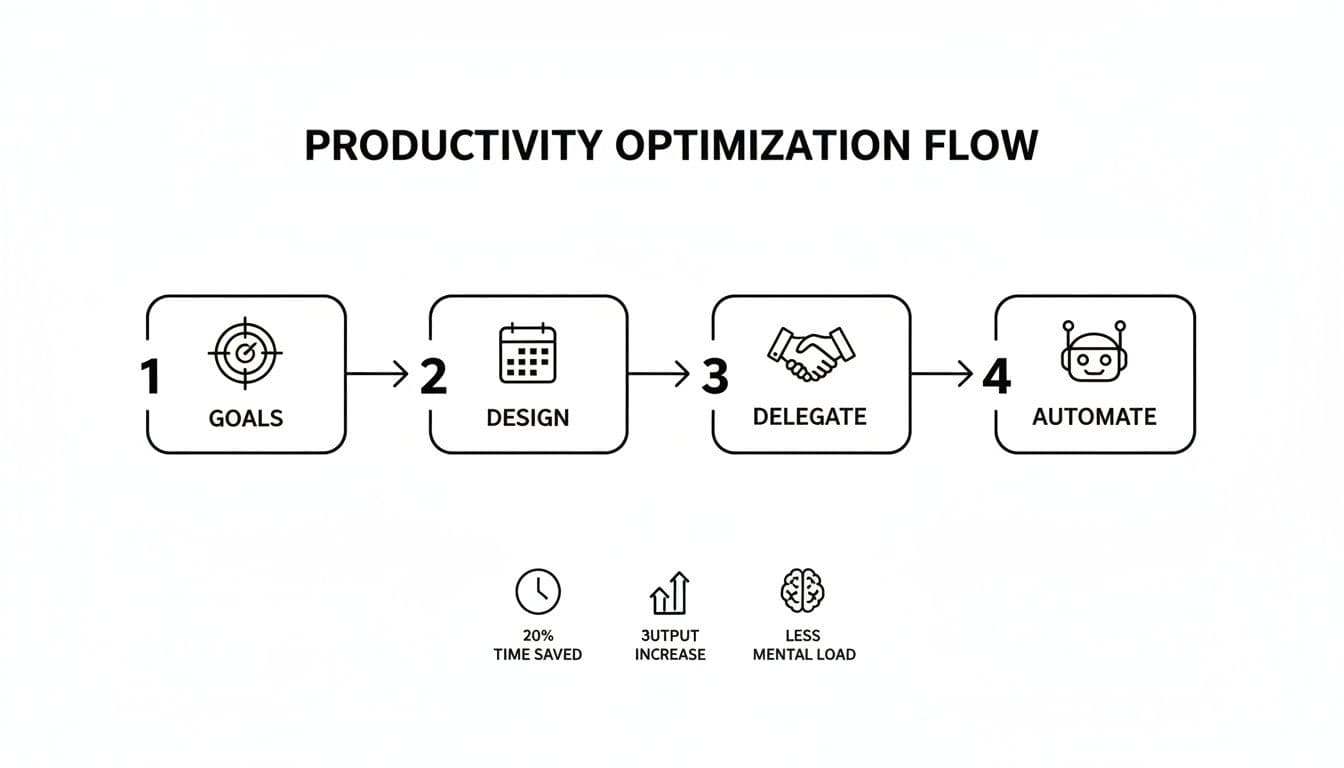
Your Blueprint for Sustainable Productivity
Real productivity isn’t logging longer hours; it’s working with clear intention. Pack your days with tasks that move you toward measurable results. The system below gives you a roadmap that lasts, rather than a stack of one-off tips.
The Four Pillars of High Performance
This framework has four pillars that build on each other: Goals, Time Design, Delegation, and Automation. Each pillar supports the next, creating a cycle of increasing leverage and clarity.
| Pillar | Core Action | Primary Outcome |
|---|---|---|
| Clear Goals | Define specific, measurable results you want to achieve. | Direction and focus on high-impact activities. |
| Time Design | Structure your schedule with dedicated blocks for focused work. | Protected attention and less multitasking. |
| Smart Delegation | Assign the right tasks to the right people. | More time for strategic work and leadership. |
| Workflow Automation | Systematize repetitive, rule-based tasks. | Less manual effort and more cognitive bandwidth. |
“The greatest productivity hack is simply focusing on the things that get you closer to where you want to be.”
This approach is flexible for individuals and teams. For more on workflow efficiency, see this guide on improving workflow efficiency and boosting productivity.[^note-meowtxt]
Master Your Mission with Clear Goals and Priorities
Productivity without direction is just busywork. The first step is moving past vague intentions and making goals tactical and actionable.

Set Goals That Actually Drive Action
SMART goals are useful, but the core idea is clarity. Replace vague aims with measurable steps. For example, change “increase sales” to “contact 15 qualified leads per week and book 3 demos.”
Ways to sharpen objectives:
- Focus on results, not tasks. Make finish lines clear.
- Break large projects into weekly or daily milestones to maintain momentum.
- Write goals down—people who record goals are significantly more likely to achieve them1.
Productivity isn’t about doing more; it’s about doing what actually matters. Ask, “What is one result I can accomplish right now that will make a real impact?”
For a deeper framework on goals, see our guide on setting effective professional and personal goals.https://fluidwave.com/blog/professional-and-personal-goals
Separate Urgent from Important with the Eisenhower Matrix
Use the Eisenhower Matrix to sort tasks by urgency and importance:
- Urgent & Important (Do First)
- Not Urgent & Important (Schedule)
- Urgent & Not Important (Delegate)
- Not Urgent & Not Important (Delete)
Carve out time for quadrant 2—strategic work that drives long-term progress.
Define Your Most Important Tasks (MITs) Every Day
Each morning or the night before, pick 1–3 MITs that will have the biggest impact on your goals. Commit to completing these before other distractions. Pull them from your “Not Urgent & Important” list to ensure consistent, meaningful progress.
Design Your Day with Time Blocking and Deep Focus
An open calendar invites interruptions. Time blocking turns your schedule into a plan with purposeful appointments for work, email, meetings, and breaks.

Build Your Ideal Week with Time Blocks
Start by slotting your MITs into morning deep work blocks, then batch meetings and shallow tasks. Example day:
- 9:00–11:00 AM Deep Work: Protected session for your top MIT.
- 11:00–11:30 AM Email & Comms: A single inbox window.
- 11:30–1:00 PM Project Meetings: Batch calls together.
- 1:00–2:00 PM Lunch & Break.
- 2:00–3:30 PM Shallow Work: Admin and follow-ups.
- 3:30–4:00 PM Planning: Review and set tomorrow’s MITs.
Begin with a time-blocking schedule to get started.
Defend Your Focus by Eliminating Interruptions
It can take over 20 minutes to get back on task after an interruption2, so protect deep work blocks. Turn off nonessential notifications, close unrelated tabs, and use noise-canceling headphones if you share space with others. Tell colleagues when you’re not available except for true emergencies.
Your ability to produce high-quality work is directly proportional to your ability to concentrate without interruption.
Unlock Growth Through Smart Delegation
Delegation is not offloading tasks you dislike. It’s multiplying your impact by shifting work to others who can do it well. Done right, delegation frees you to focus on strategic priorities.
What to Delegate and What to Keep
Think in four buckets:
- Repetitive & Routine: Scheduling, data entry, standard reports.
- Time-Consuming but Low-Impact: Formatting, vendor research.
- Tasks You’re Not Good At: Use others’ strengths for a better end product.
- Growth Opportunities for Others: Stretch assignments for team development.
Keep vision-setting, sensitive personnel matters, and core role responsibilities on your plate.
Craft Instructions That Actually Get Results
Vague requests fail. Provide a full delegation package that includes:
- A clear desired outcome.
- Specific constraints (budget, timeline, tools).
- Context and purpose.
- Defined authority and decision-making limits.
This clarity reduces revisions and builds trust.
Build Feedback Loops for Continuous Improvement
Agree on a check-in cadence up front—daily quick updates for critical projects, weekly syncs for ongoing tasks. Regular touchpoints increase accountability and prevent small issues from becoming big problems. Low engagement erodes productivity; only 21% of employees are fully engaged at work, costing the global economy billions each year3.
Automate Repetitive Workflows to Reclaim Your Time
Automation is the last pillar because it’s where you remove manual drag. Spot repetitive, rule-based tasks and let tools take them on so you can focus on creative and strategic thinking.
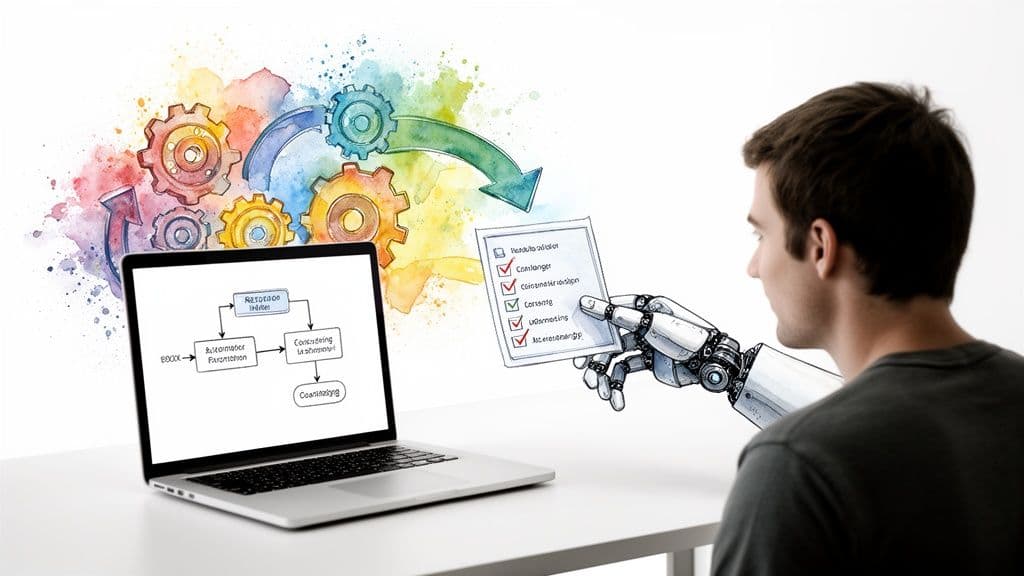
Pinpoint Your Automation Hotspots
Track a week of work and find tasks that are:
- Highly repetitive.
- Rule-based with clear if/then logic.
- Low-value but necessary.
Those are your hotspots where automation pays off most.
Build Simple Templates for Everything
Templates are a low-tech automation. Create checklists and reusable formats for project kickoffs, email replies, and regular reports. They save time and improve consistency.
Connect Your Tools with Low-Code Solutions
Platforms like Zapier and Make link apps so work happens without manual copying and pasting. For example:
- Save Gmail attachments to a Dropbox folder automatically.
- Sync new tasks with your calendar.
- Add new form respondents to your email list.
Use AI to Tame the Administrative Beast
AI can summarize documents, draft email first drafts, and transcribe meetings. Use it to remove administrative drag, not to add more busywork. Recent industry research finds many workers reporting productivity benefits from AI tools, though adoption requires careful setup to avoid extra overhead45.
Build Lasting Habits and Measure What Matters
Systems only work when they stick. Build habits that are easy to start, satisfying to repeat, and tied to clear outcomes.
Make Productive Behaviors Stick
Use habit stacking to attach a new behavior to an existing routine. Start very small—just showing up is the goal at first. Example stacks:
- After I pour my morning coffee, I will write my three MITs.
- Before opening email, I will work 30 minutes on a priority task.
Research shows habit formation varies widely, often taking months of repetition to become automatic6.
Measure Outputs, Not Just Inputs
Track results, not busywork. Replace vanity metrics like hours worked with outcome metrics tied to goals.
| Input Metric | Output Metric |
|---|---|
| Hours spent on calls | Number of demos booked this week |
| Time spent writing | Articles published this month |
| Tasks completed | Percentage of project milestones achieved |
Measure what moves the needle and adjust systems accordingly.
Don’t Forget Foundational Habits
Sleep, nutrition, and recovery are not optional. Sustained focus depends on physical and mental health. Protect downtime as a non-negotiable part of your system.
Your Top Productivity Questions, Answered
How long does it take to form a productive habit?
It varies a lot, from a few weeks to several months. Consistency matters more than an exact number—small, daily actions compound into automatic routines6.
If I could only use one technique, which should it be?
Time blocking. It eliminates decision fatigue and shields your most important work from interruptions.
How do I keep going when motivation is gone?
Rely on systems, not motivation. Use the two-minute rule for small tasks and shrink the starting step for big projects. Action creates momentum.
Ready to stop fighting your calendar and start making real progress? Fluidwave combines smart task management with on-demand virtual assistants to help you delegate, automate, and focus. Start streamlining your workflow for free today.
Quick Q&A — Common Reader Questions
Q: What’s the first thing I should change to be more productive?
A: Start by choosing 1–3 MITs each day and protect morning deep work blocks for them. Use time blocking to make those appointments real.
Q: How do I know what to delegate?
A: Delegate repetitive, time-consuming, or low-skill tasks, and use delegation as a development tool for team members who want growth.
Which automation should I build first?
A: Automate the small, frequent tasks that cost you time every week, such as saving attachments, onboarding new clients, or repeating report generation.
1.
Gail Matthews, “A Study of the Goal-Setting Strategies of 267 Participants,” Dominican University (summary), found that people who wrote down their goals and sent weekly progress reports were significantly more likely to achieve them. https://www.dominican.edu/academics/graduate/human-resources/gail-matthews-study
2.
Gloria Mark et al., “No Task Left Behind? Examining the Nature of Fragmented Work,” Proceedings of the SIGCHI Conference on Human Factors in Computing Systems, 2005. Study on interruption costs and task resumption times. https://www.sciencedirect.com/science/article/pii/S0749597805000451
3.
Gallup, “State of the Global Workplace,” findings on employee engagement and economic impact. https://www.gallup.com/workplace/349484/state-of-the-global-workplace.aspx
4.
European Journal of Social Psychology, Phillippa Lally et al., “How are habits formed: Modelling habit formation in the real world,” documents the wide range for habit formation timelines. https://onlinelibrary.wiley.com/doi/10.1002/ejsp.674
5.
Industry research on AI and productivity, including reports from PwC and Upwork, highlights both productivity gains and the need for careful implementation to avoid extra workload. See PwC and Upwork workforce insights for details. https://www.pwc.com/ https://www.upwork.com/research/
Focus on What Matters.
Experience lightning-fast task management with AI-powered workflows. Our automation helps busy professionals save 4+ hours weekly.