November 12, 2025 (1mo ago)

How to Achieve Flow State for Ultimate Focus

Discover how to achieve flow state with our guide. Learn the practical strategies and focus techniques used to unlock peak performance and productivity.

← Back to blog
Cover Image for How to Achieve Flow State for Ultimate Focus

Discover how to achieve flow state with our guide. Learn the practical strategies and focus techniques used to unlock peak performance and productivity.

To really master how to achieve flow state**, you first have to get a feel for what it's made of. It's that feeling of being so completely locked into a task that the rest of the world just fades away. This usually happens when you find that perfect balance between how hard the task is and what you're capable of, you have a super clear goal, and you can see your progress as it happens.

What Is the Flow State and Why It Matters

Ever been so wrapped up in a project that hours just fly by? That's flow. It isn't some mythical productivity hack; it's a real psychological state of peak performance, first written about by psychologist Mihaly Csikszentmihalyi. He described it as a state where people are so into an activity that nothing else seems to matter.

This isn't just about feeling good while you work—it's about really using your brain's full potential. When you hit a state of flow, your prefrontal cortex, the part of your brain that handles self-criticism and your sense of time, actually quiets down. This phenomenon, known as transient hypofrontality, pretty much silences your inner critic and lets you pour all your mental energy into the task at hand. Your brainwaves shift, letting different regions talk to each other faster, which is a huge boost for creativity and problem-solving.

Getting into flow isn't a happy accident. It grows out of a specific set of conditions that you can actually learn to build for yourself.

The Essential Ingredients for Flow

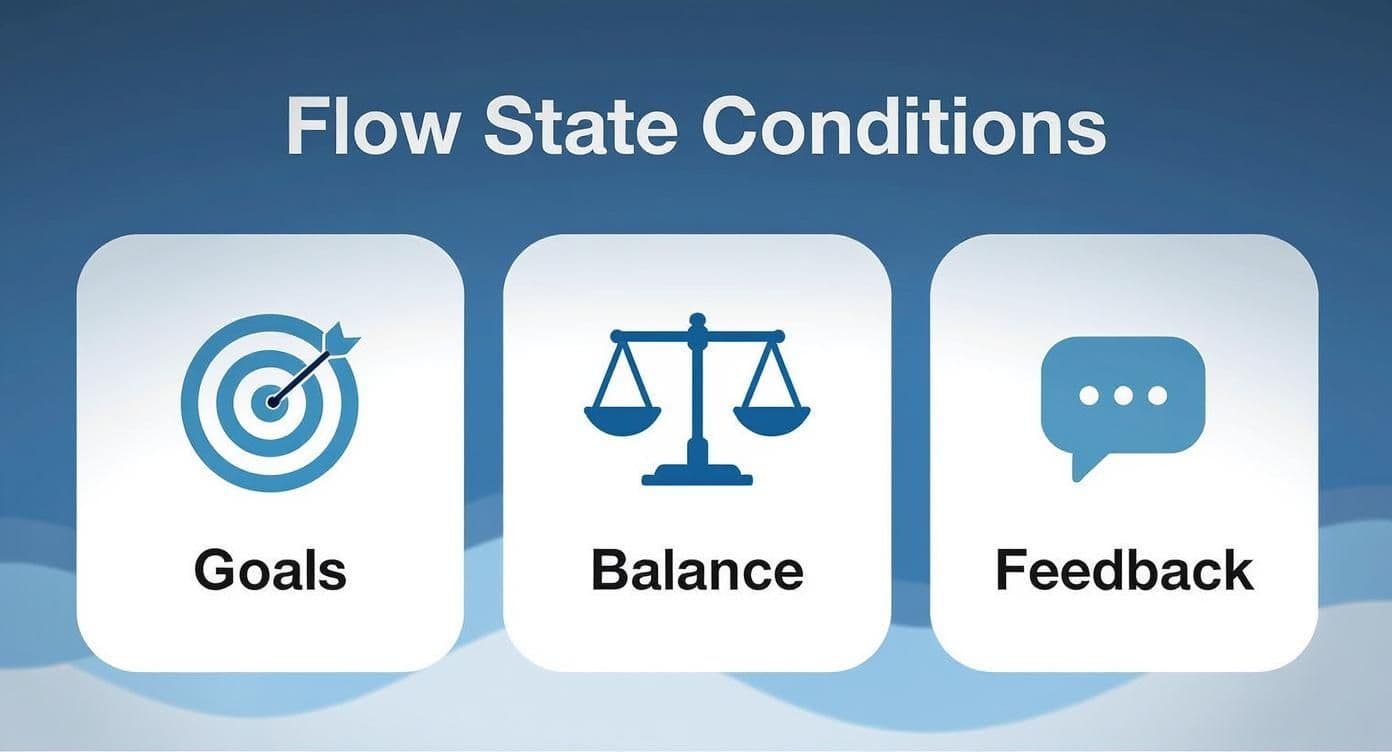
The whole idea of flow is built on three main pillars. When you get these things to line up, you create the perfect mental playground for deep, uninterrupted work. Think of it like a recipe—get the ingredients right, and you're pretty much guaranteed to get the result you want.

  • A Balance of Challenge and Skill: The task needs to be hard enough to keep you on your toes but not so tough that you start to freak out. If it’s too easy, you’ll just get bored. Flow happens right in that sweet spot, just at the edge of what you can do.
  • Crystal-Clear Goals: You have to know exactly what you're trying to do. Vague goals like "work on the report" are the enemy of flow. A specific target, like "draft the intro and the first two sections," gives your brain the clarity it needs to just get going.
  • Immediate Feedback: Your mind wants constant signals that you're making progress. This doesn't have to come from your boss; it can be as simple as watching your code compile without errors or seeing the word count on your document go up.

The infographic below does a great job of showing how these core conditions come together to create that perfect state of focus.

Infographic about how to achieve flow state

This visual really drives home how clear goals, the challenge-skill balance, and consistent feedback are all tangled up together. Understanding how these pieces fit is your first real step toward making flow a regular part of your work, a concept that ties directly into the principles of deep work. If you're interested, you can dive deeper into this in our summary of the deep work methodology.

To make this even clearer, here’s a quick breakdown of what these conditions look and feel like in the real world.

The Key Conditions for Achieving Flow

ConditionWhat It Looks LikeWhy It's Crucial
Clear GoalsYou know exactly what the finished task looks like, step by step.It gets rid of the guesswork and lets your brain focus on doing, not planning.
Challenge-Skill BalanceThe task feels tough but doable. It stretches you just enough.This keeps you from getting bored (too easy) or anxious (too hard).
Immediate FeedbackYou see the direct results of what you're doing as you're doing it.It tells you you're on the right track, which keeps you motivated and focused.

Nailing these three conditions is the foundation for everything else. They are the non-negotiables for getting into that focused, productive zone.

Flow isn't just about getting more done; it’s about changing the experience of work itself. When you’re in flow, the work becomes its own reward, creating a sense of deep satisfaction that a pat on the back rarely matches.

By getting a handle on these fundamentals, you can start intentionally shaping your tasks and your workspace to invite this powerful state of focus into your daily routine.

Engineer Your Environment for Deep Focus

Your surroundings are always talking to your brain, either pulling you toward distraction or nudging you into focus. Getting into a flow state often starts not in your head, but in the physical and digital spaces you're in. It's about more than just silencing your phone; it's about deliberately designing an environment that gets your mind ready for deep, immersive work.

A clean, organized desk with a computer, plants, and natural light, ready for focused work.

The main idea here is to create different zones for different activities. When your brain starts to realize that a specific desk or a certain corner of the room is only for focused work, it builds a powerful psychological trigger. This connection makes it so much easier to drop into a productive state when you sit down.

Think of it this way: a graphic designer might build a "fortress of concentration" with their high-res monitor, ergonomic chair, and specific lighting—a space completely separate from where they scroll through social media. A financial analyst might need multiple screens filled with data and a good pair of noise-canceling headphones to tune out the office buzz. The tools are different, but the idea is the same: create a dedicated, optimized space.

Crafting Your Physical Focus Zone

Your physical environment is your first line of defense against interruptions. The real goal is to get rid of any friction standing between you and the task.

  • Declutter Your Workspace: A messy desk is just visual noise, constantly begging for your attention. Keep only the absolute essentials for your current task within arm's reach. Everything else gets put away.
  • Control Your Soundscape: Silence isn't always the answer. For a lot of people, the low hum of a coffee shop or certain kinds of instrumental music can actually drown out more distracting noises. You have to experiment to find what works for you—it could be lo-fi beats, white noise, or maybe even total silence.
  • Communicate Your Needs: Let your family or colleagues know when you’re about to go into a deep work session. A simple sign on your door or an updated Slack status can prevent dozens of tiny interruptions that would otherwise shatter your focus.

Taming Your Digital Environment

Let's be real, digital distractions are often way more powerful than physical ones. A clean digital desktop is just as important as a clean physical one. Every notification, every open tab, and every icon on your screen is a potential off-ramp from your flow state.

This constant jumping between tasks is known as context switching, and it’s a huge killer of deep focus. Each time you hop from your project to your email and back, your brain pays a price.

Your environment isn't just the space around you; it's a strategic tool. By engineering it for focus, you're not just getting rid of distractions—you're actively building a runway for your brain to take off into flow.

A great way to reinforce this is by using a practical guide to time blocking, which helps structure your day and fence off those digital temptations. This method is all about scheduling specific chunks of time for a single task, basically putting up a "do not disturb" sign for your brain. When you pair an optimized environment with a structured schedule, you build a powerful, repeatable system for getting into flow.

Find the Sweet Spot Between Challenge and Skill

Getting into a flow state is like walking a tightrope. On one side, you have tasks that are so easy you get bored, and your mind wanders. On the other, you have work that’s so hard it just makes you anxious and stressed. You don't want to be in either of those places. The magic happens right in the middle, on that razor's edge where the challenge perfectly meets your current skill level.

Finding and staying in this sweet spot isn’t an accident; it's a skill you have to actively work on.

A person balancing on a tightrope, symbolizing the balance between challenge and skill needed for flow state.

This is where the practice of how to achieve flow state really begins. You need to become the curator of your own challenges, constantly tweaking the difficulty to match your abilities as they get better. The goal is to stretch yourself just enough to stay completely engaged, but not so far that you feel like you're drowning.

And this isn't just about feeling good while you work—it has a massive impact on results. A deep-dive report from McKinsey & Company found that when people are in a flow state, their productivity can shoot up by as much as 500%. That incredible boost comes directly from the intense focus that a perfectly balanced challenge creates. You can learn more about the business impact of flow on Monitask.com.

Deconstruct to Reconstruct

Let’s be honest: huge, vague projects are the enemy of flow. Staring down a goal like "master new software" is paralyzing. Your brain sees the giant gap between where you are now and where you need to be, and it just shuts down. The trick is to break that mountain down into a series of smaller, more manageable hills.

Instead of one giant goal, think in terms of a series of smaller challenges. For that "master new software" example, it might look something like this:

  • First up: Learn the five most important keyboard shortcuts.
  • Next: Recreate a simple project you've done before, but using only the new software's basic tools.
  • Then: Work through one of the software's built-in tutorials without having to re-read the instructions.

Each of these steps is its own little challenge. Finishing one gives you a hit of accomplishment and immediate feedback, which is exactly what your brain needs to stay hooked.

Scaling the Difficulty as You Grow

Of course, once you start getting good at something, you get bored. That's your cue to turn up the difficulty. Don't just wait for a tougher project to land on your desk; find ways to make your current work more interesting.

The point isn't just to get the task done. It's to engage with it in a way that pushes your abilities. Flow is a side effect of growth, and you can't grow without intentionally stepping just outside your comfort zone.

Let's stick with our software example. After mastering the basics, you could add new layers of challenge to keep things fresh:

Skill LevelNew Challenge to IntroduceWhy It Works
BeginnerSet a timer to complete a familiar task 20% faster than last time.Adds a little time pressure that forces you to focus more.
IntermediateComplete a project using a feature you've always dodged.Pushes you to learn and add a new skill to your toolkit.
AdvancedBuild a complex project from scratch without using any templates.Tests your true mastery and creative problem-solving skills.

By constantly adjusting the task—breaking it down when it’s too scary or adding complexity when it gets too easy—you can keep yourself in that perfect performance channel. This turns a normal workday from a list of to-dos into a chance to do your absolute best work.

Set Clear Goals and Get Instant Feedback to Stay Locked In

Not knowing what you're doing is the ultimate flow killer. If your brain doesn't have a crystal-clear picture of the finish line, it’s impossible to fully commit. To get completely absorbed in what you’re doing, you need two things: a precise target and a constant stream of feedback telling you you're on the right track.

When you have that clarity, you get rid of the mental drag of constantly stopping to ask, "Okay, what's next?" That hesitation is one of the fastest ways to break your concentration. So, instead of a vague goal like "work on the presentation," you get specific. The new goal is "design the first five slides and write the speaker notes for each."

Suddenly, your brain has a manageable mission it can grab onto.

Break Down Big Projects into Micro-Goals

Staring up at a massive project is overwhelming and makes it hard to even start. The trick is to slice it into a series of "micro-goals"—small, concrete tasks you can knock out in a single session. This turns a scary mountain of a project into a sequence of small, satisfying wins.

Let's say you're a developer building a new feature.

  • Vague Goal: Build the user authentication system.
  • Micro-Goals:
    • Set up the database schema for user profiles.
    • Write the registration endpoint logic.
    • Create the front-end login form.

Each time you check one of these off, you get a little hit of accomplishment. That dopamine rush fuels your motivation and keeps you locked in. This approach is the foundation of many productivity systems, which are all about creating clarity and momentum. For a deeper dive, our guide on the Getting Things Done methodology offers some great frameworks for this.

Create Your Own Feedback Loops

Some work comes with built-in feedback. A musician knows instantly when they hit a wrong note. A designer sees right away if a color palette looks weird. But for a lot of us, feedback is delayed. You won't know if that report landed well until your manager reads it next week.

To stay in flow, you have to create your own immediate feedback loops.

This sounds technical, but it’s not. It's just about creating simple signals that tell you you're making progress in real time.

Immediate feedback is the compass that keeps you pointed toward your goal. Without it, your mind is more likely to wander, looking for proof that your efforts are actually paying off.

Here are a few simple ways to build your own feedback loops:

  • Use a Project Tracker: The simple act of dragging a task from "In Progress" to "Done" on a Kanban board like Trello or Asana gives you a powerful visual cue of completion.
  • Set a Timer: The Pomodoro Technique is perfect for this. Working in focused 25-minute sprints gives you a clear finish line for each interval, and every completed "pomodoro" is a small victory.
  • Watch the Data: If you're a writer, keep your word count visible. If you're a data analyst, watch your charts update as you run your queries. The real-time change confirms your work is having an effect.

This isn't just theory; it's backed by research. One study had workers set just three specific goals each morning. The result? They reported a measurable increase in flow experiences throughout the day, which in turn led to lower stress and higher performance. You can read more about how goal-setting impacts work engagement from the National Center for Biotechnology Information.

By defining exactly where you're going and creating ways to see your progress, you set the stage for flow to happen, again and again.

Turn Flow State Into a Consistent Habit

Getting into the zone is one thing, but staying there—or getting back to it consistently—is where the real magic happens. The goal isn't just to experience flow once in a blue moon; it's to make it a reliable part of how you work. This means shifting your mindset from hoping for inspiration to intentionally building the habits that invite it.

It starts with managing your energy, not just your time. We all have natural rhythms to our focus. When you feel that mental fog rolling in and your concentration starts to dip, that's your cue. Instead of trying to power through, take a strategic break. That small pause can be the very thing that prevents a total burnout and helps you get your momentum back.

Of course, interruptions are a part of life. A coworker drops by, the dog starts barking, an urgent notification pops up. The trick isn't to build an impenetrable fortress, but to learn how to recover gracefully. When you get knocked out of focus, just take a deep breath, remind yourself of your immediate goal, and dive back in without getting frustrated.

Develop Your Own Flow Triggers

One of the best ways I’ve found to make flow a regular thing is to create a personal pre-work ritual. These are what I call flow triggers—simple, repeatable actions that tell your brain it’s time to get down to business. With enough repetition, your mind will build a powerful connection between the ritual and the intense focus that comes after.

Think of it as a warm-up for your brain. The best triggers are often the simplest ones.

  • Sensory Cues: Maybe it’s the smell of a specific type of coffee brewing or lighting a certain scented candle. That familiar scent can become a powerful anchor for your focus.
  • Auditory Anchors: I know a lot of people who listen to the exact same song or a specific ambient playlist every single time they start a deep work session.
  • Mindfulness Moments: Just a quick, two-minute breathing exercise can be enough to clear your mind and get you ready for the task ahead.

By consistently using your chosen trigger, you’re training your brain to enter flow almost on command. It turns a random burst of productivity into something you can do on purpose. To really master this, check out this guide on how to Know Your Flow: A Guide to Working Smarter, Not Harder for more strategies.

A consistent ritual is like creating a well-worn path to a quiet spot in your mind. The more you walk it, the easier and faster it becomes to get there.

This kind of deliberate practice is what separates the pros from the amateurs. You stop waiting for inspiration to strike and instead build a system that makes peak performance a predictable part of your day.

Frequently Asked Questions About Finding Flow

Even after you get the hang of what flow state is, actually getting there can bring up some real-world questions. I've found that having clear, practical answers makes the whole thing feel less like a mysterious art and more like a skill you can build. Let's dig into some of the most common things people ask.

A person looking thoughtful with question marks floating around their head, symbolizing common questions about flow.

Can I Really Get into a Flow State Doing Anything?

Pretty much. We tend to link flow with things like painting or playing sports, but it's not just for creative or athletic stuff. You can find flow in just about any task that has clear goals, gives you instant feedback, and hits that sweet spot between being too hard and too easy.

I've seen people get into it while coding, writing reports, gardening, or even untangling a complicated spreadsheet. The secret isn't what you're doing, but how you're doing it.

How Long Does It Usually Take to Get into the Zone?

There's no magic number, but most people find it takes about 15-20 minutes of uninterrupted focus to really get in the groove. This warm-up period is where you're most likely to get sidetracked.

If you're serious about finding flow, you have to be fierce about protecting that first chunk of your work session. Close those tabs, silence your phone, and give your brain a fighting chance to settle in.

The biggest mistake I see people make is trying to multitask their way into a flow state. It just doesn't work. Keeping your email open while trying to focus is like trying to fill a bucket that has a hole in it. True immersion needs your full attention.

Is It Bad to Be in a Flow State for Too Long?

Flow feels awesome, but it's also incredibly draining on your brain. Trying to stay in that high-intensity state for hours on end without a break is a surefire recipe for burnout. You have to listen to your body and mind.

Taking short, intentional breaks—even just 5-10 minutes every 90 minutes or so—is key for keeping up that high performance all day. This isn't a sign of weakness; it's how you work without crashing. It lets you recharge your mental batteries so you can dive back in, refreshed and focused.


Ready to stop fighting distractions and start building a workflow that actually invites focus? Fluidwave is designed to eliminate the friction that pulls you out of your zone. Its clean interface and smart task management help you create the clarity and structure needed to achieve flow consistently. Start organizing your work for deeper focus today at fluidwave.com.

← Back to blog

Focus on What Matters.

Experience lightning-fast task management with AI-powered workflows. Our automation helps busy professionals save 4+ hours weekly.