Stop procrastinating and start getting real work done. Eat the frog first by tackling your highest-impact task each morning when your focus and willpower are strongest—finish that one big item and the rest of the day becomes easier and more productive.
December 30, 2025 (9mo ago) — last updated March 24, 2026 (7mo ago)
Eat the Frog First: Boost Productivity Daily
Tackle your highest-impact task each morning to boost focus, cut busywork, and get more done every day.
← Back to blog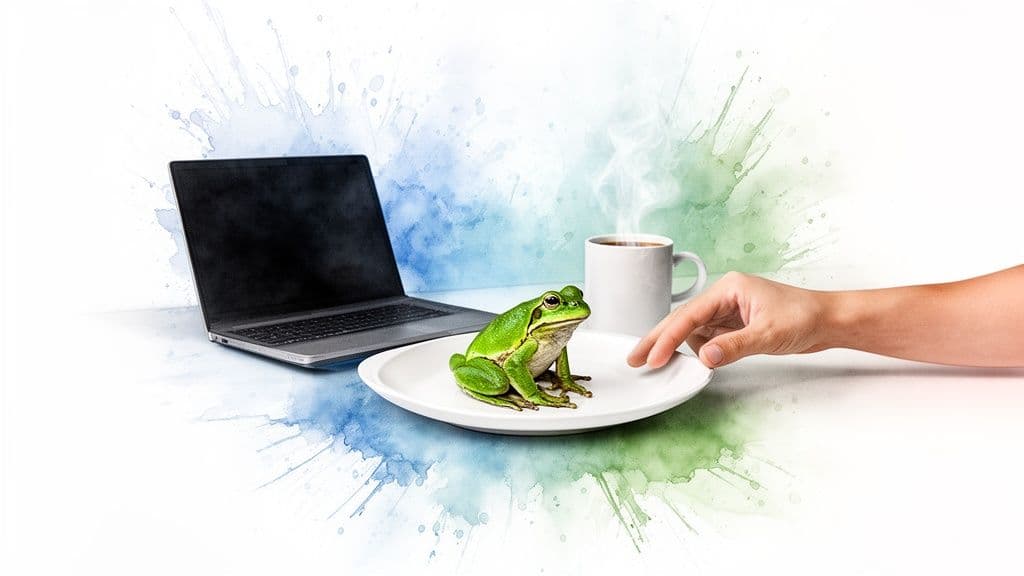
Eat the Frog First: Boost Productivity Daily
Summary: Stop procrastinating: tackle your highest-impact task first each morning to build momentum, reduce busywork, and reclaim productive time.
Introduction
Stop procrastinating and start getting real work done. “Eat the frog first” means doing your single most important—and often hardest—task first thing in the morning when your focus and willpower are strongest. Finish that one big item and the rest of the day becomes easier, more productive, and less stressful.
So, what does it actually mean to “eat the frog first”?
It’s simple: pick the one task that will move your goals forward the most and do it before smaller, reactive items hijack your attention. That early win builds momentum and reduces the background anxiety that fuels procrastination.
Why this simple strategy reclaims your day
Does your to-do list feel like a firehose of small, urgent tasks? If you end the day feeling busy but not accomplished, eating the frog first helps you cut through the noise and direct your best energy toward what truly matters.
The idea is often traced to a Mark Twain line: “Eat a live frog first thing in the morning and nothing worse will happen to you the rest of the day.” Whether Twain said it or not, the principle holds: use your peak mental energy on your highest-impact task before distractions wear you down.
This approach is less about counting hours and more about managing focus and energy. Not all hours are equal—prioritize by impact and you’ll get more done.
The real cost of busywork
Modern work often rewards activity over accomplishment. Low-value tasks—answering every email, attending unnecessary meetings—consume the hours you should be using for high-impact work. Teams can spend as little as 27% of their time on core job duties1. That lost focus has measurable costs: busywork and organizational drag reduce overall productivity2.
By choosing your frog intentionally, you shift from reactive work to proactive progress. It’s the difference between letting your inbox run your day and letting your goals guide your actions.
Creating a ripple effect of success
Eating the frog first creates a positive ripple through your day:
- Boost momentum: A meaningful win before mid-morning powers the next few hours.
- Reduce procrastination: Removing the looming difficult task lowers background anxiety.
- Clarify priorities: Choosing a frog forces you to be honest about what truly matters.
This habit turns a chaotic morning into a focused, high-impact work session.
How to identify your most important task
The biggest hurdle isn’t doing the work—it’s knowing which work deserves your best energy. Your to-do list may shout ten “urgent” items, but only one will be the true frog. The rest are tadpoles—tasks that feel productive but don’t move the needle.
Your frog isn’t always the task you dread most, though sometimes it is. It’s the single task that will have the biggest positive impact on your goals—once it’s done, everything else becomes easier or irrelevant.
Moving beyond gut feelings
Chasing the quick dopamine hit of checking easy items off your list is a recipe for a busy but unproductive day. Use a simple filter to find the real priority.
The Eisenhower Matrix—sorting tasks by urgency and importance—is a useful tool. Most frogs live in the Important but Not Urgent quadrant: strategic planning, skill development, or starting a major project.
- Urgent and Important: fires and crises—sometimes frogs, often reactive.
- Important but Not Urgent: where your frogs usually live.
- Urgent but Not Important: many emails and interruptions.
- Not Urgent and Not Important: time-wasters.
Your frog is the 20% of effort that generates 80% of your progress. Get this right and the whole strategy works.
From theory to reality
For a founder, the frog might be drafting the investor pitch that could land the next round. For a project manager, it might be the tough conversation with a stakeholder that unblocks progress. Comparing frogs to tadpoles makes the choice clearer.
| Characteristic | The Frog (High-Impact) | The Tadpole (Low-Impact) |
|---|---|---|
| Alignment | Directly tied to a major quarterly or annual goal. | Vaguely related, not a key objective. |
| Outcome | Creates significant, long-term value or solves a major problem. | Provides a small, short-term sense of accomplishment. |
| Effort | Requires deep focus, creativity, and proactive energy. | Can be done on autopilot or while distracted. |
| Feeling | Often accompanied by resistance or mild anxiety. | Feels easy, familiar, and comfortable. |
Ask a few clarifying questions and use a framework like this to cut through the noise. Knowing which task deserves your morning energy is the first step to making the method work.
Designing your unbreakable morning focus routine
Knowing your frog is one thing; creating the right environment to tackle it is another. A productive morning is designed. The goal is a simple, repeatable routine that shields your focus and gives you the best shot at real progress.
The average knowledge worker faces hundreds of interruptions and dozens of emails daily—constant context switching can reduce effectiveness by roughly 40%3. Carving out a distraction-free block is non-negotiable if you want to eat the frog first.
Prepare the night before
Start the night before to remove morning friction. Prep files, tabs, and the very first physical step to begin. Replace vague items like “Work on presentation” with concrete first actions such as “Create title slide and outline the first three talking points.” This setup ritual reduces hesitation.
- Open your tabs and documents.
- Gather tools and templates.
- Define the first physical step.
This primes your brain for immediate action.
Time-blocking and deep focus
Treat your morning focus session as a sacred appointment. Time-block a 60- to 90-minute slot first thing and label it “Frog Task” or “Deep Work.” Turn off notifications and let colleagues know you’re unavailable. A protected 90-minute block is far more valuable than scattered multitasking.
Use a focus interval technique
If 90 minutes feels long, use structured intervals. Classic Pomodoro is 25 minutes on, 5 minutes off; many people prefer 50/10—50 minutes focused, 10 minutes break. Adapt these windows to match your attention rhythm.
Combine preparation, strict time-blocking, and focus techniques to build a routine that’s hard to break.
Automate prioritization and delegate smaller tasks
Sifting through your list each morning can become its own procrastination ritual. Use tools to surface the true frog so you start focused rather than guessing. Automation can analyze deadlines and goals to recommend the day’s highest-impact task.
Taming the tadpole invasion with automation and delegation
The stream of smaller tasks—scheduling meetings, follow-ups, quick research—may seem harmless, but together they create major drag. Automation and delegation preserve your focus.
Automated workflows, email templates, and rules can clear much low-level admin work. For tasks that need a human but not your brain, delegate to assistants. Handing off well-defined tadpoles frees cognitive energy for the frog.
Example flow:
- Your Frog: Draft a strategic proposal that needs your insight.
- Delegated Tadpoles:
- “Research competitor pricing and summarize findings.”
- “Schedule a 30-minute follow-up call.”
- “Format the final draft in the company template.”
This structure reclaims hours and preserves your creative energy for high-value work.
Making this method work for neurodivergent brains
The classic advice to eat the frog first is useful, but it’s not one-size-fits-all. For people with ADHD or other executive-function differences, facing the toughest task can trigger shutdown. The trick is to adapt the principle so it works with your brain.
Build momentum with a warm-up
Start with a small “appetizer” task that takes 5–10 minutes. That quick win generates dopamine and helps you move into the first piece of the bigger task.
- Pick a short, mildly interesting task.
- Use that success to start the initial step of the frog.
Tools, rewards, and accountability partners are strategies to support sustained effort.
Make the frog smaller and more rewarding
Break large tasks into small, specific chunks. Try body doubling—working alongside someone, even silently—and pair each completed chunk with a brief reward.
- Break it into tangible steps.
- Work with a partner for accountability.
- Give yourself short, concrete rewards after each chunk.
These tactics give the brain the feedback it needs to stay engaged.
Navigating the murky waters: common questions answered
As you build the habit of eating the frog, you’ll face common “what ifs.” Here are concise answers to the most frequent ones.
What if I have multiple frogs?
Score each candidate task on two questions, 1–10:
- Impact: How much does finishing this move the needle?
- Consequence: What’s the cost if I don’t do it today?
Add the scores and pick the highest. If it’s a tie, choose the task you dread most and push through it first.
What if I can’t finish my frog in one morning?
You don’t have to finish it. The win is using your best energy on a meaningful chunk. A focused 90-minute session that makes real progress beats a day of fragmented busywork.
Can this method work for teams?
Yes. Identify a single team frog for the sprint or week. When everyone focuses on that highest-impact task each morning, you clear bottlenecks faster and build shared momentum.
Ready to stop guessing and start doing? Platforms can automatically surface your most important task each day and provide access to assistants to handle the rest. Sign up and start delegating your tadpoles today.
Frequently Asked Questions
Q: What exactly is a “frog” in this method? A: A frog is the single highest-impact task you can do that day—the work that will move your goals forward the most.
Q: How long should my morning frog session be? A: Aim for a 60- to 90-minute protected block. If that feels long, use focused intervals like 50/10 or 25/5.
Q: How do I avoid being derailed by emails and meetings? A: Time-block your frog, turn off notifications, and let teammates know you’re unavailable during your deep work window. Use automation and delegation for recurring low-value tasks.
Quick Q&A (3 concise answers)
Q: How do I pick today’s frog? A: Choose the one task that will create the biggest forward motion on your most important goal.
Q: What if I feel overwhelmed starting the frog? A: Begin with a 5–10 minute warm-up step to build momentum, then tackle the next small chunk.
Q: How do I protect focus daily? A: Prepare the night before, time-block a morning deep-work slot, and turn off notifications.
1.
https://www.microsoft.com/en-us/worklab/work-trend-index — Microsoft Work Trend Index reporting on how knowledge work time is distributed and the impact of meetings and busywork.
2.
https://hbr.org — Harvard Business Review reporting and analysis on the organizational cost of low-value work and wasted productivity.
3.
https://www.ics.uci.edu/~gmark/chi2004.pdf — Gloria Mark et al., study on interruption, context switching, and the cost to productivity.
4.
https://www.radicati.com — Email usage and industry analysis on daily email volumes and interruptions.
Focus on What Matters.
Experience lightning-fast task management with AI-powered workflows. Our automation helps busy professionals save 4+ hours weekly.