Unlock peak team performance by understanding the critical difference between accountable and responsible roles. Learn how to assign roles for success.
February 7, 2026 (8mo ago) — last updated February 10, 2026 (8mo ago)
The Difference Between Accountable and Responsible Roles
Unlock peak team performance by understanding the critical difference between accountable and responsible roles. Learn how to assign roles for success.
← Back to blog
Accountable vs Responsible: Clear Roles for Team Success
The core difference between accountable and responsible boils down to this: the accountable person owns the final outcome, while the responsible person is the one who actually performs the tasks to get there. Think of it as ownership versus execution.
Think of it as ownership and execution.
Defining Accountable vs. Responsible in Project Management
In the thick of a project, roles can get messy. When deadlines loom and tasks fly, it’s easy for wires to get crossed, which leads to confusion, delays, and frustration. A crystal‑clear understanding of who truly owns what keeps progress moving. This isn’t just semantics — it’s the bedrock of a high‑performing team.
Let’s use a filmmaking analogy to help it land. The director is accountable for the entire movie: they own the creative vision, manage the budget, and carry the weight of success or failure. If the film bombs, the director answers for it. 
By contrast, the camera operators, sound engineers, and actors are responsible for their specific jobs. The cinematographer is responsible for getting the perfect shot, while the sound mixer is responsible for capturing crisp, clear audio. These are the “doers” — the people on the ground completing the work. You can have many people responsible for different pieces of the film, but there’s only one person who is ultimately accountable for the finished product.
This separation is crucial because it ensures there’s always a single point of ownership for any big objective, which stops critical tasks from falling through the cracks. For a deeper dive into how these lines of ownership play out in specific roles, it’s worth exploring the distinction between Product Manager and Project Manager, as both have to navigate these concepts daily.
Accountable vs. Responsible Key Differences at a Glance
For a quick reference, this table breaks down the core differences in a practical way.
| Attribute | Accountable | Responsible |
|---|---|---|
| Focus | Owns the final outcome and results. | Completes the assigned tasks. |
| Scope | Strategic and big‑picture ("the buck stops here"). | Tactical and task‑oriented ("doing the work"). |
| Number of People | One person per initiative. | Can be multiple people or a team. |
| Delegation | Can delegate tasks to others. | Is the person to whom tasks are delegated. |
| Core Question | "Who answers for the final result?" | "Who is completing this task?" |
Basically, the accountable person is the owner, and the responsible person is the doer. Understanding this simple but powerful distinction is the first step toward building a more organized and effective team.
The Critical Nuances That Separate Each Role
The director‑and‑crew analogy gives us a good starting point, but the real world is full of subtleties when it comes to accountability versus responsibility. Getting these nuances right is what separates a team that just gets work done from one that consistently delivers exceptional results. The key difference isn’t just about the action — it’s about the very nature of ownership.
Ownership vs. Execution
The most fundamental distinction is ownership versus execution. The person who is responsible executes a task. They’re the ones with their hands on the keyboard, in the workshop, or on the phone, making sure the work gets done. Think of a developer writing code for a new feature — they are responsible for shipping clean, functional code.
On the other hand, the accountable person owns the outcome. The Engineering Manager is accountable for the successful launch of that feature. They might not write a single line of code, but they are the one who has to answer for whether the feature works, meets the business goals, and ships on time. The buck stops with them.
Singularity vs. Plurality
This leads us to a critical rule that, when broken, almost always leads to chaos. A project can have many people responsible for its different pieces, but it must have only one person who is accountable.
Responsibility can be shared; accountability cannot. When you try to make multiple people accountable, you’ve really made no one accountable. We’ve all seen this in group projects where everyone is “accountable” for the final presentation. Key details fall through the cracks because everyone assumes someone else has it covered. Assigning a single accountable individual clears up the ambiguity.
Direction of Obligation
Responsibility usually flows downward or peer‑to‑peer. A manager assigns a task, and the team member becomes responsible for getting it done. Their obligation is to complete the assigned work. Accountability, in contrast, faces upward. The accountable person is obligated to answer for the results to leadership, clients, or other stakeholders. They report on progress, explain what went right and wrong, and own the consequences. This is why blame shifting happens when these roles get muddy.
This idea of distinct roles is so important that it’s practiced even at the highest levels, sometimes by splitting stewardship to ensure focus.
Scope of Focus
Finally, think about the scope of each role. Responsibility is task‑focused. It’s often narrow and has a clear finish line. “Complete the user research by Friday” is a well‑defined responsibility. Accountability is outcome‑focused, with a much broader field of view. The accountable person isn’t worried about just one task; they’re looking at the entire initiative. “Ensure the new product design increases user engagement by 15%” is an accountability. This requires strategic thinking and oversight, not just task management. This bigger‑picture view is what ensures all the individual tasks add up to a meaningful goal.
Why This Distinction Drives High‑Performing Teams
Getting the difference between accountable and responsible isn’t just a mental exercise for managers — it’s the engine that powers truly high‑performing teams. When people are fuzzy on roles, projects stall, communication lines get crossed, and frustration grows. But when everyone knows who owns the outcome and who’s doing the work, the whole team dynamic shifts.
This clarity cuts right through the most common workplace bottlenecks. Instead of wasting hours in status meetings just trying to figure out who’s doing what, people can actually focus on their work. Decisions get made faster because there’s a single, designated person with the authority to make the final call, stopping analysis paralysis in its tracks.
This structure is also freeing. When a manager is ultimately accountable for a project’s success, they can delegate responsibilities with confidence. They trust their team to execute, and that trust fosters a culture of real ownership where people feel valued for their contributions, not just watched.
The Impact on Productivity and Culture
The psychological benefits for your team members are huge. Knowing exactly what you own is a massive relief from the stress and anxiety that comes with ambiguity. Job satisfaction goes up because people can see the direct impact of their work and understand how their piece fits into the bigger picture. You can learn more about how to amplify these effects by exploring ways to improve team communication within your projects.
A culture of accountability isn’t about blame; it’s about empowerment. It gives people the clarity and authority to make things happen, knowing that one person ultimately answers for the result.
The data backs this up. A recent HR analytics survey of 500 global firms found that companies with clear accountability structures saw 91% higher project success rates than those with responsibility‑only models. That gap really shows why accountability—the obligation to answer for the final result—is a much stronger driver of success than simply handing out tasks. You can read more about these findings and how accountability shapes HR analytics.
At the end of the day, this distinction isn’t a minor detail. It’s a cornerstone for building teams that aren’t just busy, but genuinely effective.
Putting Role Clarity Into Practice with a RACI Matrix
One of the best tools I’ve found for applying this understanding is the RACI matrix. It helps you map out who is Responsible, Accountable, Consulted, and Informed. The key relationship between R and A is what cuts through the noise and makes ownership crystal clear.
Breaking Down the RACI Roles
- Responsible (R): The doers who actually execute the task.
- Accountable (A): The single owner who signs off on the outcome.
- Consulted (C): Subject‑matter experts who provide input.
- Informed (I): Stakeholders kept in the loop.
When teams have this clarity, productivity and success rise. 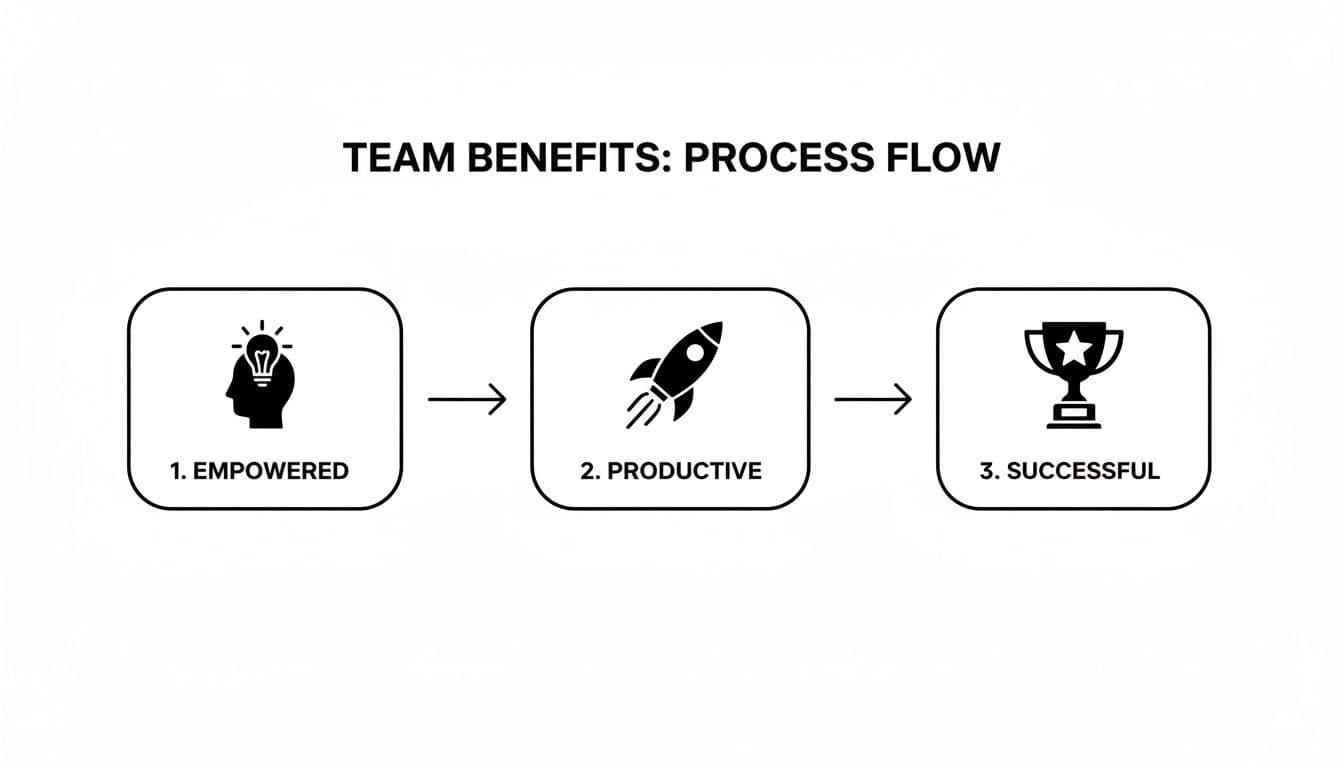
This approach isn’t merely theoretical; it’s practical and widely applicable, even when using a PM tool like Fluidwave.
Creating Your RACI Chart
To build a simple chart, use a real project example such as launching a new product feature:
- List all tasks: e.g., "Write marketing copy," "Develop backend code," "Design UI mockups," "Run user acceptance testing."
- Identify team members: list stakeholders; these names form the chart’s columns.
- Assign RACI roles: go task by task and assign R, A, C, or I. Be deliberate and discuss as a team.
The Golden Rule: For any given task, there can only be one A. This prevents multiple accountable owners and confusion. If you’re stuck, ask, “Who has the final sign‑off?”
The Workplace Accountability Index shows meaningful benefits from clear accountability. For details see the Culture Partners piece linked above, and you can explore more insights on Culture Partners article.
Once your RACI chart is complete, share it and treat it as a living document. It should guide your team’s communication and execution. For more on shaping team communication, see our project communications plan template.
Real‑World Scenarios in a Modern Workplace
Theory is useful, but seeing accountability and responsibility in action is where it clicks. Here are concise scenarios you’ll recognize from real projects.

The Startup App Launch
Sarah, the founder, is accountable for the launch. She delegates to the team for execution:
- Development team — responsible for code
- Marketing lead — responsible for the campaign
- Designer — responsible for UI assets
Sarah remains accountable for quality and outcomes. If issues arise, she directs fixes and owns the overall product success.
The Client Analytics Report
David, the PM, is accountable for the report’s accuracy and timely delivery. Maria, a virtual assistant, is responsible for gathering data; she’s also responsible for data corrections. David owns the narrative and the client’s satisfaction.
The Freelance Strategy Consultant
Alex is accountable for a market‑entry plan. He delegates initial market research to a junior contractor, who becomes responsible for research quality. The contractor’s work informs Alex’s final recommendations, but Alex remains accountable.
The core distinction remains: ownership of outcomes matters more than task lists. A landmark study of over 40,000 workers showed that 84% expect leaders to model accountability, underscoring the importance of accountability in leadership. See the HR Analytics Trends article for details.
Additional insight: a well‑implemented accountability structure correlates with higher performance and faster time‑to‑market in diverse teams. For more on integrating accountability into HR analytics, visit HR Analytics Trends.
Putting Role Clarity Into Practice
Two practical steps help embed accountability:
- Use a dedicated field or tag to mark the Accountable owner for each task, in addition to the Responsible assignee. This ensures visual clarity of ownership.
- Make accountability a constant in your workflow. Maintain a single source of truth in your PM tool and tie all major initiatives to a named accountable owner.
For example, in Fluidwave you can designate the assignee as Responsible and add an Accountable tag for the owner. This separation makes delegation safer and more effective. You can read more about delegation.
In practice, avoid simply handing off work without keeping accountability in view. A simple template can prompt teams to define both roles for every task: a “Responsible Team Members” field and a single “Accountable Project Lead.” This creates a culture of clarity from the ground up.
Frequently Asked Questions
Can a Person Be Both Accountable and Responsible?
Yes. On many teams or solo projects, a person can be both. For example, a freelance designer may be responsible for delivering a site and accountable for overall outcome. The roles can merge, but the distinction remains useful for clarity.
What Happens When the Accountable Person Fails?
The accountable person must own the outcome. They explain what went wrong to stakeholders and lead the recovery, focusing on learning and improvements rather than blame.
How Do You Build a Culture of Accountability in a Remote Team?
Remote teams need clear digital traces of ownership. Use a single accountable owner for each major initiative, assign tasks to doers, and conduct regular check‑ins focused on outcomes rather than busyness.
Better collaboration and a clear project owner reduce confusion and boost performance. See how to improve team communication for more ideas. Improve team communication.
Ready to build a culture of clarity and ownership in your team? With Fluidwave, you can easily assign roles, delegate tasks to skilled virtual assistants, and track progress in a single, distraction‑free platform. Start managing your projects with perfect clarity today.
Three Quick Answers
Q1: What is the simplest way to start applying accountability and responsibility in a team?
A: Define one accountable owner per initiative and assign tasks to responsible doers. Record these roles in your project tool and review weekly to ensure alignment.
Q2: How does RACI help with remote collaboration?
A: RACI makes expectations explicit, reducing email ping‑pongs and confusion. It clarifies who signs off on outcomes even when teammates are distributed.
Q3: Can accountability improve speed to market?
A: Yes. With a single accountable owner, decisions are quicker and ownership is clear, which reduces delays and helps teams move faster.
1.
Culture Partners, “How Higher Workplace Accountability Bolsters Organizational Achievement”.
2.
Culture Partners, “How Higher Workplace Accountability Bolsters Organizational Achievement”.
3.
HR Analytics Trends, “Understanding Accountability versus Responsibility in Human Resources Analytics”.
4.
Alhartman, “Accountability at Work”.
5.
HR Analytics Trends, “Understanding Accountability versus Responsibility in Human Resources Analytics”.
Focus on What Matters.
Experience lightning-fast task management with AI-powered workflows. Our automation helps busy professionals save 4+ hours weekly.