Master dependency management across software packages and project tasks. Learn versioning, risk mitigation, and how to implement with AI-driven platforms.
August 24, 2026 (1mo ago)
Dependency Management Guide for AI and Software Teams
Master dependency management across software packages and project tasks. Learn versioning, risk mitigation, and how to implement with AI-driven platforms.
← Back to blog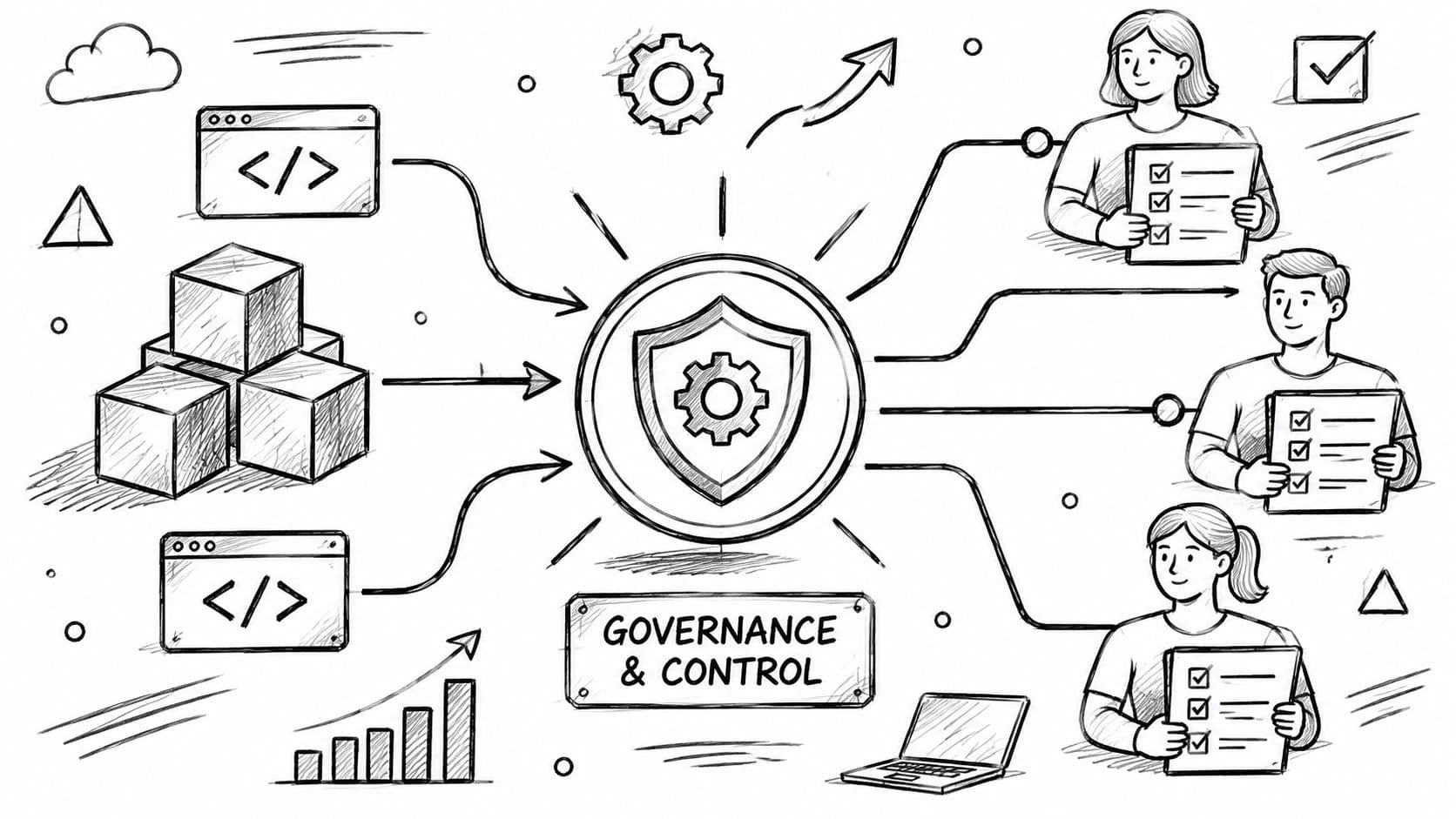
An average codebase now contains 581 known open-source vulnerabilities, up 107% year over year. Dependency management is no longer optional, it's a critical security and delivery control.
That number changes how I think about dependency work. A package file may look like a small implementation detail, but it defines part of the software you ship, the code your build trusts, and the updates your team must absorb. The same logic applies outside the repository. A product launch, migration, or client delivery also contains dependencies between people, decisions, approvals, and tasks.
A team can miss both kinds of risk in the same week. An outdated library can break the pipeline, while an uncommunicated design decision blocks QA and leaves marketing working from stale information. The practical answer is a unified approach: map dependencies, make changes visible, verify downstream effects, and give people clear control over what happens next.
Why Dependency Management Is a Security Imperative Now
The vulnerability count is a useful way to reframe the problem, but it isn't the whole story. The same industry analysis found that 87% of codebases contained at least one vulnerability, and the average codebase had risen from 280 known open-source vulnerabilities to 581 in the prior scan cycle, a 107% increase (Black Duck's open-source security risk analysis). A build can remain green while the application carries libraries nobody has reviewed recently.
I've seen this failure pattern repeatedly. A developer opens a routine update pull request, the tests pass, and the team assumes the change is harmless. Later, a transitive package changes an API, a container image pulls an unsafe component, or an abandoned library remains exposed because nobody owns the decision to replace it. The incident rarely begins with malicious intent. It begins with an incomplete inventory and an assumption that installation equals control.

The risk exists in software and operations
Software dependencies include direct packages your team selects and transitive packages those packages bring along. Human task dependencies work similarly. A copywriter may depend on approved product messaging, the designer may depend on that copy, and the launch manager may depend on both before scheduling a campaign.
The failure modes also rhyme:
- Hidden ownership: Nobody knows who must approve, update, or replace the dependency.
- Stale state: The package manifest or project board no longer reflects reality.
- Unverified change: A new version or revised deliverable reaches downstream work without compatibility checks.
- Blocked execution: Engineers wait for a build fix, while project teams wait for an approval or handoff.
The Fluidwave guide to AI-powered workflow automation is relevant here because automation only helps when the workflow exposes the relationships between tasks. An automatic reminder sent without dependency context creates noise. A reminder that says which upstream change affected which downstream commitment gives a manager something actionable.
Practical rule: Treat every dependency as a relationship with an owner, a current state, and a verification condition.
Security teams often focus on software components, while operations leaders focus on schedules and handoffs. Mature dependency management connects those views. The question isn't only whether a package is vulnerable or a task is late. It's what else will be affected, how quickly the team can identify it, and whether the organization has a safe response path.
Defining Dependency Management in Software Engineering
Dependency management identifies, selects, records, updates, and verifies the external components a software project needs. These may include libraries, frameworks, plugins, operating-system packages, build tools, and hosted services outside the code maintained directly by the team.
The practice became more structured with package managers in the 1990s. CPAN, the Perl Archive Network launched in 1995, became an early milestone for language-specific package repositories. By the late 1990s, Linux distributions had popularized package managers that installed programs alongside their dependencies, reducing the need to compile every component manually and moving delivery toward centralized, reproducible resolution (a brief history of dependency management).
What a manifest actually does
A dependency manifest is the project's declared inventory of external requirements. In a JavaScript project, it may be a package configuration file. In Maven, it may be a project object model. The manifest records package names and version constraints. A lockfile can preserve the exact versions resolved for a build, giving the team a stable baseline to review and reproduce.
Version constraints define how much change the project accepts. A team might permit patch updates, allow a compatible range, or pin an exact release. Each option exchanges convenience for control:
- Exact pins improve reproducibility but require deliberate maintenance.
- Flexible ranges reduce manual work but can admit unexpected behavior.
- Lockfiles make resolution more consistent, but they do not replace update review.
- Automated pull requests improve visibility, but each change still needs validation and an owner.
Dependency graphs grow faster than manual review habits. An analysis of leading open-source AI repositories found an average of 208 direct and transitive dependencies per project, 77% of repositories with manifest files referenced more than 50 dependencies, and 11% relied on 500 or more (the study of dependency scale in open-source AI repositories). At that size, remembering every relationship by hand becomes a reliability risk.
Why passing tests isn't enough
Automated update tools can detect a version change, open a pull request, and run the existing test suite. That workflow helps, yet it does not establish compatibility. In a study of dependency-update safety, fault injection was detected by test suites only 47% of the time for direct dependencies and 35% for transitive dependencies (the study on automated dependency updates).
A green pipeline measures the behavior covered by tests. It does not show every path a changed dependency can affect. Teams need incremental updates, API-difference review, compatibility checks, and targeted tests for the interfaces most exposed to the change.
Dependency management is therefore a continuing control loop: inventory, constrain, update, inspect, test, and monitor. The same discipline can later describe human work dependencies, where an approved artifact, decision, or handoff becomes the prerequisite for downstream execution.
Translating Package Logic to Human Task Dependencies
A software dependency means one component cannot function correctly until another is available in an acceptable form. Human task dependencies follow the same logic. The management questions remain: what must happen first, who owns it, and what becomes possible afterward?
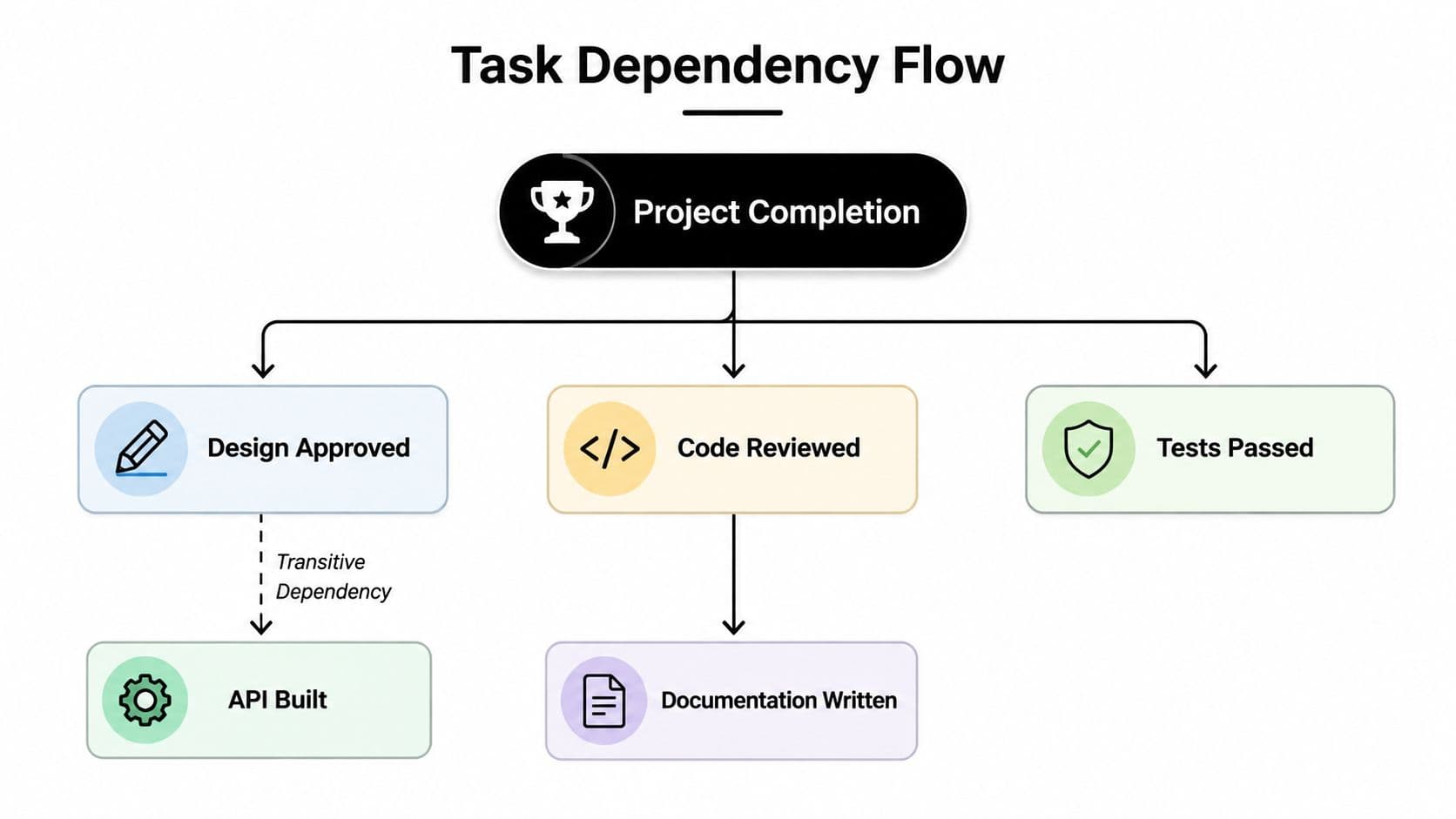
A product release makes the chain visible. Design approval enables implementation. An API may need to exist before integration testing starts. QA findings require resolution before deployment, while approved screenshots and release notes may depend on the final interface. These are transitive dependencies: Task C depends on Task B, and Task B depends on Task A.
The shared mental model
A useful task record contains counterparts to the controls used for package management:
| Software dependency | Human task dependency |
|---|---|
| Package name | Task or deliverable |
| Version constraint | Acceptance criteria or required format |
| Manifest entry | Project-board record |
| Lockfile | Approved baseline |
| Compatibility test | Review or verification step |
| Vulnerability alert | Blocker or change notification |
Freelance coordination exposes weak prerequisites quickly. If a contractor receives a brief without approved source files, deadlines, or a defined handoff format, the assignment may be marked “in progress,” yet production cannot proceed reliably. The same condition appears when a library is installed without checking its compatibility requirements. The component exists, but the surrounding system is not ready to use it safely.
Flowcharts and process maps help teams make these relationships visible, distinguishing a true prerequisite from work that merely appears nearby on the schedule. The Fluidwave article on flowcharts and process mapping provides a practical reference for documenting those connections. For teams using AI-driven workflow platforms, the same map can connect package changes, approvals, handoffs, and human owners in one dependency record.
Visibility beats memory
Without a dependency map, managers discover relationships through delay. An engineer reports an integration blocker, a client asks why a deliverable is late, or two people produce overlapping work because neither knew who owned the prerequisite.
A visible graph lets change propagate through the work. If an upstream requirement shifts, downstream owners receive a clear signal and can reassess scope, timing, or compatibility. That approach applies equally to a package update that affects modules and to a changed approval that affects several human tasks.
Common Failure Modes Across Both Domains
Dependency failures often become visible only after a downstream action breaks. A package update can invalidate a consumer, while a changed requirement can invalidate an approved deliverable. In both cases, the missing control is usually the same: nobody can identify the affected dependency, its owner, or the verification step that should have caught the change.
Automatic updates show the risk clearly. In a large study, 79.05% of applicable updates succeeded, while 20.97% failed, and 11.58% caused build failures after recompilation (research on automatic dependency updates). The study also found that 4.35% of dependency version increments exposed breaking changes after successful adjacent-version compilations were accounted for. A version increment that looks minor can still fail under the compiler, integration path, or tests that exercise changed behavior.
Diagnose the failure, not just the symptom
Start a retrospective by reconstructing the dependency state at the point of failure. Record what changed, who approved it, which downstream component or task relied on the previous state, and what evidence was available before release. This exposes whether the failure came from an unrecorded prerequisite, an ownership gap, an incomplete test, or a notification that never reached the affected party.
Several patterns recur across code and human work:
- Hidden ownership: Nobody knows who must approve, update, or replace the dependency.
- Unrecorded constraints: A package requires a compatible runtime, or a task requires an approved input, but that condition exists only in conversation.
- Transitive impact: A nested package introduces a conflict, or a small upstream decision changes work for several teams.
- Stale records: The manifest omits an indirect dependency, or the project board marks work complete while review remains outstanding.
- Weak verification: Tests miss the affected execution path, or a handoff lacks evidence that the result meets the brief.
A useful diagnostic question is whether the recorded graph matches the way work flows. If it does not, the graph is stale, regardless of how current the documentation appears.
Version conflicts add a related lesson. In a study of 124 GitHub pull requests across 85 Maven-based Java projects, developers resolved conflicts through library harmonization in 67.7% of pull requests, often using version-alignment techniques (the Delft study of dependency conflicts). Aligning related components is usually safer than patching each symptom independently.
The human equivalent is a shared decision baseline. If design, engineering, and documentation use different requirement versions, managers must reconcile the deliverables around one approved state. Otherwise, each team can finish its assignment and still produce an incompatible release. Retrospectives should end with a specific control change, such as an owner, notification rule, acceptance criterion, or verification check.
Building a Dependency Governance Framework
Governance works when it makes safe behavior easier than ad hoc behavior. For software, that means versioned manifests, controlled update policies, vulnerability monitoring, and tests that run after changes. For project work, it means structured briefs, explicit prerequisites, visible ownership, and a confirmation step before downstream work begins.
HM Revenue & Customs' dependency management standard states that teams must version software dependencies, produce a complete dependency list, keep dependencies current, monitor for vulnerabilities, prevent known vulnerable dependencies from being used, and test appropriately after an update. The standard is practical because it treats the inventory and the response process as equally important.
Four controls that hold up
-
Version the baseline. Record the exact package state, configuration, or approved requirement that downstream work should use. For a task, a versioned brief can be a dated or revision-controlled document linked directly to the assignment.
-
Manage constraints deliberately. Decide which updates are allowed automatically and which require review. Deny lists, approved ranges, compatibility rules, and ownership boundaries prevent a convenient update from becoming an unreviewed architectural decision.
-
Visualize the graph. Engineers need dependency trees and change diffs. Project managers need a board or map showing blocked tasks, upstream owners, and downstream impact. A list of tasks without relationships is an inventory, not a dependency system.
-
Verify before release or handoff. The check may be a security scan, API comparison, integration test, peer review, or acceptance test. The method can vary, but “it passed the default workflow” shouldn't be the only evidence.
The UK Government's Service Manual guidance on managing software dependencies describes several options, including a dependency management tool, copying vendor code into a project, or maintaining an internal repository. It also warns teams not to trust a dependency without testing it, including security testing. That principle transfers cleanly to human delegation: don't treat a completed handoff as usable until someone verifies the result against the agreed requirement.
A governance checklist for managers
- Inventory: Can the team produce the complete package or task dependency list?
- Ownership: Does every dependency have a responsible maintainer or task owner?
- Freshness: Is there a defined process for updates, stale tasks, and abandoned components?
- Change control: Are high-risk changes reviewed before they reach production or downstream work?
- Verification: Does each update have an appropriate test, review, or acceptance condition?
- Escalation: Can the team identify affected work quickly when an upstream item changes?
Automation should support these controls, not replace judgment. A pull request bot can surface a version bump. A workflow platform can reorder tasks. Neither can decide whether a breaking change is acceptable without context.
Implementing Dependency Management with Fluidwave
A unified dependency strategy needs an operational surface where teams can see both technical prerequisites and human handoffs. Fluidwave can serve as one option for the task side of that system, particularly when a team needs task prioritization, multiple views, collaboration, and delegation in the same workspace. The platform's task-prioritization workflow analyzes deadlines, importance, user-defined importance, and dependencies to surface the next action.
Start with the graph, not the reminders
Create a release or migration board and record the work in dependency order. Link deployment preparation to the code review and QA checklist, then link marketing assets and customer communications to the approved release details. Don't begin by creating recurring reminders. First establish which tasks block which other tasks.
A practical implementation looks like this:
- Map the release path. Add engineering, QA, documentation, support, and launch tasks. Mark genuine prerequisites instead of connecting every related activity.
- Attach a controlled brief. Put acceptance criteria, required files, expected output, and revision information on each delegated task. This is the human equivalent of recording a package constraint.
- Set change notifications. When an upstream requirement changes, notify owners of affected downstream tasks. They should be able to pause, revise, or reject work rather than discovering the change at handoff.
- Choose the right view. Use a Kanban view for flow, a calendar for deadlines, a table for ownership, and a dependency-aware overview for blockers. Different views answer different management questions.
- Delegate bounded work. Assign research, data cleanup, documentation preparation, or asset checks to virtual assistants with a defined budget, timeline, and verification condition.

A release example
Suppose a product team is preparing a deployment. Engineering owns the implementation and deployment tasks. QA owns a checklist that cannot begin until a review build is available. Marketing owns release assets that depend on approved interface details, while support needs documentation before customer communication goes out.
The manager can represent those relationships explicitly:
- Implementation: Complete against the approved requirements.
- Code review: Required before the QA environment is treated as ready.
- QA verification: Records test evidence and unresolved blockers.
- Release documentation: Uses the final behavior, not an earlier draft.
- Marketing handoff: Begins only after the product details are approved.
- Deployment: Requires QA sign-off and a recorded rollback plan.
Fluidwave's auto-prioritization and multi-view tracking can help surface the next available task while preserving the dependency context. Its delegation model also supports pay-per-task work, which can suit bounded operational assignments better than handing an assistant an undefined project.
The technical package workflow still belongs in engineering systems such as manifest files, lockfiles, CI checks, vulnerability scanners, and pull requests. The value of a shared task layer is coordination. When a dependency update changes release scope, the manager can connect that technical event to QA, documentation, support, and launch work instead of leaving each group to infer the impact.
Emerging Risks from AI Coding Agents and Final Thoughts
AI coding agents and MCP servers add a new layer to software supply-chain risk. Recent analysis argues that public guidance still concentrates on traditional package upgrades and SBOMs, while agent workflows and model-driven tool use can shift the trust boundary from the code author to the agent and its connected tools (the State of Dependency Management 2025 analysis).
That shift changes the inventory teams need to maintain. A repository may contain package manifests and lockfiles, but the wider workflow may also include agent instructions, tool permissions, generated code, external actions, and human approvals. Each one can influence what enters the build or what gets changed in production.
Extend the governance boundary
AI-assisted development needs the same controls described earlier, applied more broadly:
- Record provenance: Identify which code, configuration, or dependency an agent introduced.
- Limit permissions: Give tools only the access required for the task.
- Review generated changes: Treat agent output as a proposal, not an approval.
- Test downstream effects: Run security, compatibility, and integration checks after changes.
- Connect technical and human work: Assign owners for review, remediation, and release decisions.
The organizational side deserves equal attention. Teams increasingly need to describe agentic workflows clearly to colleagues, customers, and hiring managers. For a useful communication angle, framing agentic AI on resumes can help professionals explain these systems as accountable engineering work rather than vague claims about using AI.
Dependency management is ultimately a discipline of visibility, control, and continuous verification. Software packages and human tasks differ in implementation, but both fail when teams can't see the relationships, don't control change, or accept work without checking compatibility.
Audit your current setup now. List the dependencies your codebase and projects rely on, identify the owners, mark the unverified links, and decide which changes require human review before the next release.
Fluidwave combines AI-assisted task prioritization, multiple project views, real-time collaboration, and human delegation so teams can make task dependencies visible and actionable. Create a dependency-aware workflow, define budgets and handoff criteria, and visit Fluidwave to put the framework into practice.
Focus on What Matters.
Experience lightning-fast task management with AI-powered workflows. Our automation helps busy professionals save 4+ hours weekly.