Learn to define out of scope to prevent scope creep, manage expectations, and deliver projects on time. Get practical examples and tips for any task.
May 27, 2026 (3mo ago)
How to Define Out of Scope for Total Project Clarity
Learn to define out of scope to prevent scope creep, manage expectations, and deliver projects on time. Get practical examples and tips for any task.
← Back to blog
A project rarely blows up because of one giant bad decision. It usually happens because people keep saying yes to small extras.
A landing page turns into a landing page plus three email variations. A content brief becomes a brief, a draft, a round of research, a slide deck for leadership, and a “quick” competitive review. A delegated task that looked clean on Monday is a messy handoff by Thursday because nobody wrote down what happens when the first attempt fails.
That's why professionals need to define out of scope long before a project looks dramatic. Not as a legal shield. Not as stiff PM jargon. As a working boundary that tells everyone where the job ends, when a new request starts, and who owns the next move.
The Slippery Slope of 'Just One More Thing'
The pattern is familiar because it sounds reasonable at every step.
A manager asks for a website refresh. The designer agrees. Then someone wants new copy for the homepage because “the old text won't fit the new layout.” Marketing adds a request for updated lead forms. Sales wants a comparison page because prospects keep asking for it. Leadership asks whether analytics can be cleaned up while the team is “already in there.”
Nobody thinks they're changing the project. They think they're being practical.
By the time the team notices the damage, the original deadline is shaky, the budget logic is broken, and the people doing the work are making trade-offs in the dark. They start skipping reviews, cutting corners, or working late to absorb tasks that were never priced or planned.
Unclear boundaries create chaos because every extra request feels too small to challenge on its own.
This isn't limited to formal projects with contracts and kickoff decks. It happens in everyday delegation too. A founder asks an assistant to clean up a CRM list. Halfway through, the work expands into research, duplicate resolution, follow-up tagging, and drafting outreach notes. What started as one task is now four different kinds of work, each with a different level of judgment and effort.
Why small additions feel harmless
Most scope problems arrive dressed as common sense:
- “It'll only take a minute” and nobody checks whether that minute repeats across dozens of items.
- “Can we just add this too?” and no one pauses to ask what gets removed.
- “You're already working on it” and the current task becomes a bucket for unrelated work.
- “It's implied” and assumptions replace decisions.
Professionals who keep projects under control don't avoid flexibility. They avoid ambiguity. They know that if a team can't define what's outside the boundary, the boundary doesn't exist.
The real enemy is vagueness
The trouble isn't the extra request itself. The trouble is failing to label it correctly.
Sometimes the request should be approved. Sometimes it should wait. Sometimes it belongs to another person, another budget, or another workflow entirely. But if nobody calls it out of scope, the team treats it like part of the original agreement and pays for it through delay, confusion, and friction.
What 'Out of Scope' Actually Means
Out of scope means work that falls outside the approved deliverables, budget, timeline, or level of effort defined in the scope statement or statement of work, and good scope practice includes stating both what is included and what is excluded because unclear boundaries drive scope creep, as noted in this explanation of out-of-scope work.
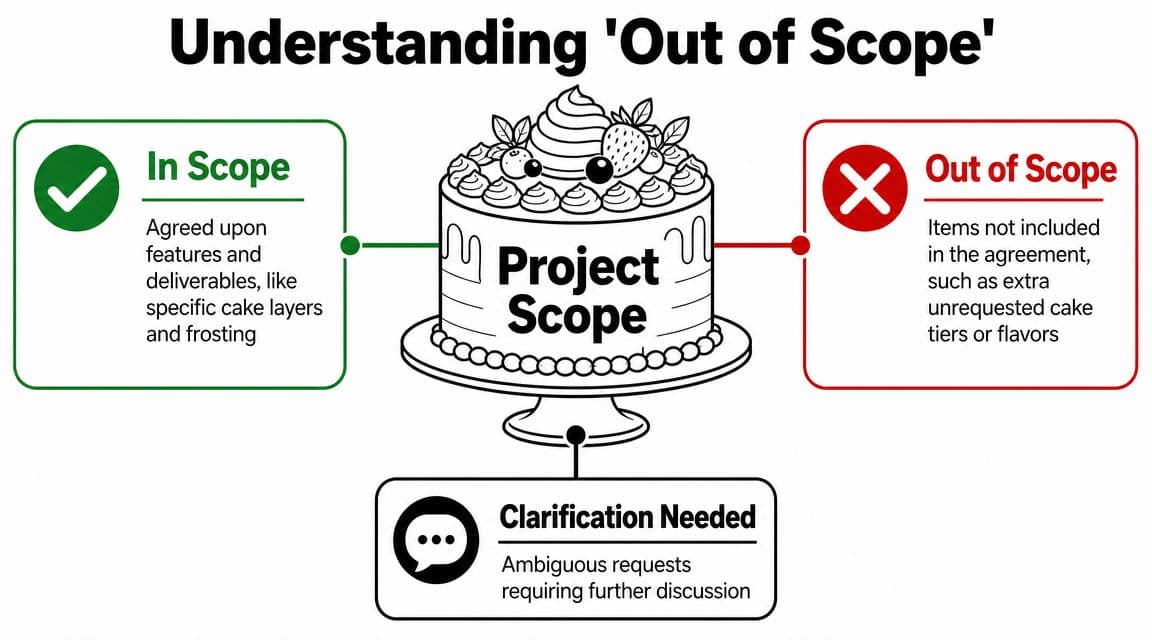
Think of it like hiring a crew to repaint your office. In scope is sanding, priming, painting the agreed rooms, and cleaning up afterward. Out of scope is moving heavy furniture from storage, replacing damaged drywall behind a cabinet, or repainting the hallway because someone decided it should “match while we're at it.”
Those things may be worth doing. They just aren't part of the original job.
The simplest way to define out of scope
When you define out of scope well, you answer four questions:
- What result are we delivering
- What work is included to produce that result
- What limits apply
- What requests are explicitly excluded
That last part matters more than is often realized. If you only list deliverables, people fill the gaps with assumptions. A stronger approach is to pair every major deliverable with a plain-language exclusion.
If you need a practical model for the document itself, this guide on what scope of work means is a useful companion.
Related terms people confuse
These terms get mixed together, but they are not the same thing:
- Scope is the boundary of agreed work.
- Out of scope is anything outside that boundary.
- Scope creep is unauthorized addition of work after the boundary is set.
- Gold plating is when a team adds extras nobody asked for, usually with good intentions and bad consequences.
- Change request is the formal path for evaluating and approving new work.
Practical rule: If the request changes effort, ownership, timing, or output, treat it as a scope question before treating it as a task.
A day-to-day version of scope
This matters outside project plans too. Say you delegate “draft blog post from approved outline.” That doesn't automatically include keyword research, sourcing images, formatting in CMS, legal review, social promotion, and comment moderation. Those are separate activities unless you state otherwise.
That's the heart of it. To define out of scope, don't ask only, “What are we doing?” Ask, “What might a reasonable person assume is included that we are not agreeing to do?”
Why Defining Scope Boundaries Is Non-Negotiable
Scope management became a formal discipline because projects got larger and more expensive to control, and weak scope control can waste money, reduce satisfaction, and block the value a project was supposed to create, which is why change control became standard practice in professional project work, according to Galorath's discussion of project scope.
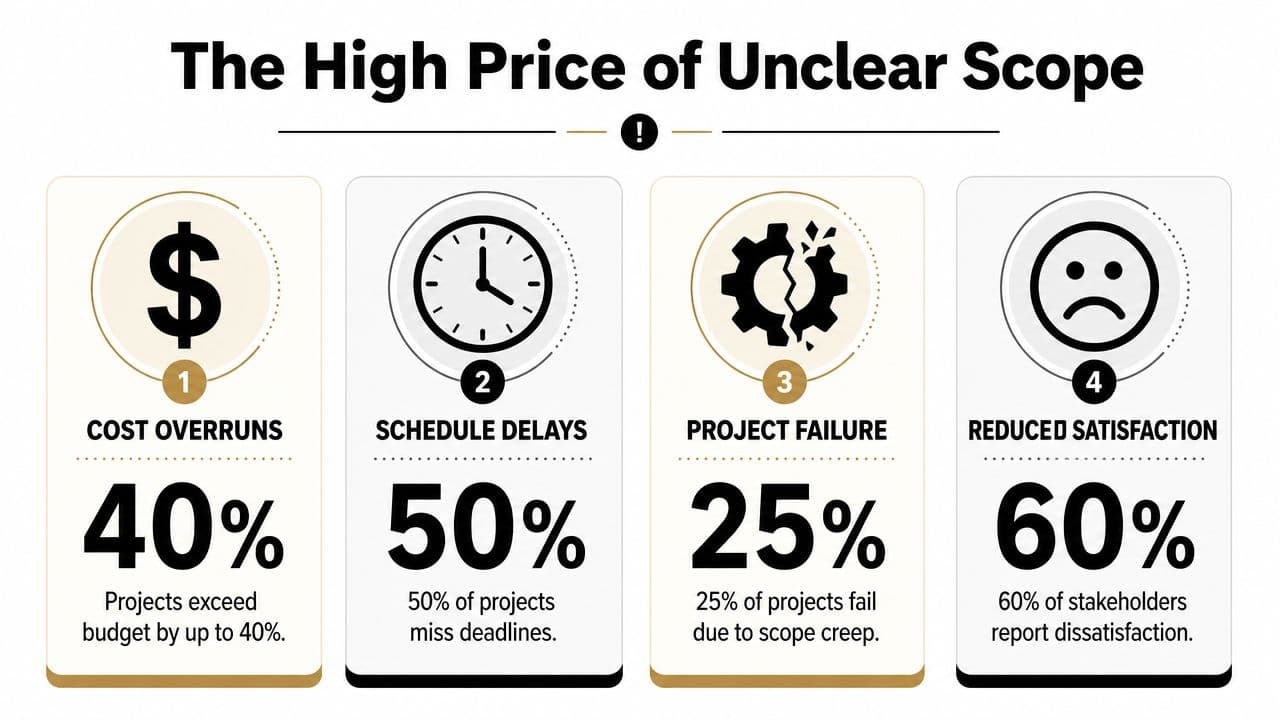
That history matters because the same failure pattern shows up in small teams, agencies, startups, and solo operators. The labels may be lighter, but the mechanics are identical. People agree to one thing. The work expands. Nobody resets expectations. Delivery quality suffers.
What breaks first
In real work, unclear scope usually damages the project in a predictable order.
First, the schedule slips because unplanned tasks consume time that had no slot. Then the team starts making hidden choices about what to drop, shorten, or rush. Finally, trust erodes because stakeholders think they approved one plan while the team is living another.
The worst part is that everyone can feel busy and responsible while the project is still heading off course.
Why teams resist doing this
Some people avoid hard scope boundaries because they don't want to seem rigid. Others think explicit exclusions sound defensive. In practice, the opposite is true.
A clear boundary makes collaboration easier because it removes silent assumptions. It gives clients, executives, teammates, and assistants a shared map. They can still ask for changes. They just know those changes have to be recognized as changes.
Teams don't burn out only from too much work. They burn out from carrying work that was never properly named, priced, or prioritized.
The cost of skipping exclusions
If you define only the goal and not the limits, you create three operational problems:
- Planning breaks down because the estimate applies to one version of the job while delivery drifts into another.
- Accountability gets blurry because nobody knows whether a missed item was forgotten or never included.
- Conversations get emotional because people start arguing from memory instead of from an agreed boundary.
That's why “what we are not doing” deserves the same attention as “what we are doing.” A team with clear exclusions can move fast without constantly renegotiating reality.
Real-World Examples of In-Scope vs Out-of-Scope
The easiest way to define out of scope is to stop treating it as a theory problem. Look at the actual task in front of you and write down where the line sits.
A lot of confusion disappears when teams use examples instead of abstract labels. “Marketing support” is vague. “Draft three approved email variations from provided messaging” is specific. One invites expansion. The other creates a boundary people can work with.
Everyday examples that make the line visible
| Task | In Scope (What's Included) | Out of Scope (What's Excluded) |
|---|---|---|
| Website refresh | Update approved page templates, revise existing copy blocks, publish agreed pages | New information architecture, new brand positioning, custom illustrations, analytics cleanup |
| Quarterly marketing campaign | Build campaign brief, write email copy, coordinate scheduled launch assets | New audience research, full product messaging rewrite, paid media buying, sales enablement deck |
| CRM cleanup | Standardize fields, remove obvious duplicates, apply agreed tags | Deciding new segmentation strategy, writing outreach sequences, lead scoring redesign |
| Blog post delegation | Draft article from approved outline, revise for clarity, deliver final copy | Custom graphics, backlink outreach, paid promotion, repurposing into video script |
| Customer support workflow | Document current process, define ticket routing rules, create response templates | Replatforming support software, retraining the whole team, rewriting SLAs |
| Virtual assistant task | Book travel within stated budget and dates, confirm itinerary, send final schedule | Visa research, loyalty strategy, expense reconciliation, changing broader travel policy |
Where people get tripped up
Some requests are obviously extra. Others sit in the gray area.
For example, if a sales team asks marketing to build messaging for a new segment, the campaign might stall because the team never agreed who owns customer definition. In that case, upstream strategy work matters more than the asset itself. A resource like this guide on how to identify ideal customers helps clarify where targeting work belongs before execution starts.
For more formal planning examples, this article with an example of a project scope statement is useful because it shows how exclusions look when written into a real project document.
A good test for ambiguous requests
When a request feels fuzzy, ask these:
- Does it create a new deliverable rather than improve the existing one?
- Does it require different expertise than the original task?
- Does it change who approves the work or how success gets judged?
- Does it add exception handling that wasn't discussed upfront?
If the answer is yes to any of those, treat it as likely out of scope until the team agrees otherwise.
The best scope decisions happen before work starts. The second best happen the moment a request changes shape.
How to Document and Communicate Scope
A useful scope statement doesn't need to be long. It needs to remove guesswork.
Teams often fail here by writing broad summaries that sound polished but don't guide decisions. “Support launch execution” is not enough. “Prepare launch checklist, coordinate assets supplied by team leads, and track approvals through final handoff” is better because a person can use it.
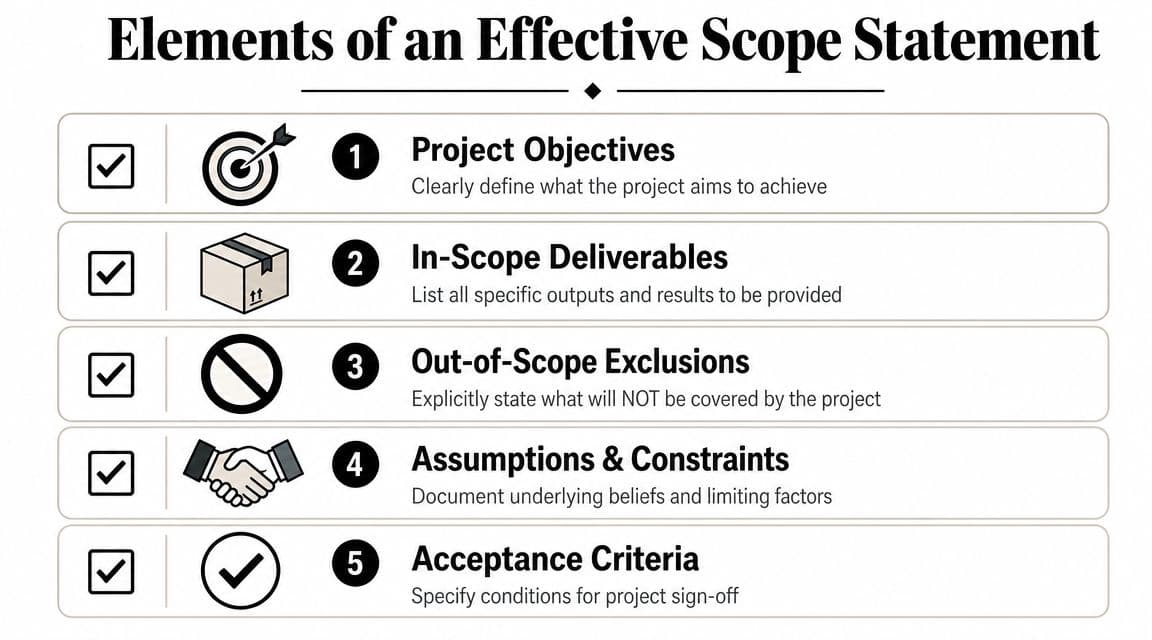
A simple scope template that works
For most projects and delegated tasks, these five parts are enough:
-
Objective
State the outcome in one sentence. Example: “Publish the updated pricing page using approved messaging and existing design system components.” -
Deliverables
List the actual outputs. Not effort. Not intentions. Outputs. -
Exclusions
Name what is not included, especially the items people commonly assume come with the task. -
Assumptions and constraints
Record the conditions the work depends on, such as provided assets, decision timelines, or approval access. -
Acceptance criteria
Define what “done” looks like so the team doesn't keep polishing indefinitely.
Copy-and-paste checklist
Use this when assigning a task or opening a project:
-
Task name
One clear label. -
Requested outcome
What should exist when the work is finished. -
Included work
The specific actions the assignee is responsible for. -
Out-of-scope items
Related tasks that are excluded unless separately approved. -
Inputs provided by requester
Files, links, access, instructions, or prior decisions. -
Dependencies
Anything that must happen before the assignee can proceed. -
Deadline and review point
When draft, check-in, or completion is expected. -
Definition of done
The standard for acceptance.
Hybrid human and AI workflows need tighter boundaries
This gets more complicated when software automation handles part of the job and a human finishes the rest. Standard definitions of out of scope don't fully solve the handoff problem in mixed workflows. As noted in this discussion of out-of-scope meaning in hybrid work, teams still have to classify partial delegation, exception handling, and rework when ownership changes midstream.
That's where many modern teams stumble. The automation completes the routine portion, then a person inherits edge cases with no written rule for what counts as completion, correction, or new work.
If you're using a tool such as Fluidwave, where tasks can be organized, prioritized, and delegated with human assistance in the same workflow, the task card itself should contain the boundary. Don't rely on a chat thread. Put exclusions and exception rules where the assignee will see them during execution.
A simple rule helps: if the automation fails on a known exception, document whether the human should fix it, flag it, or return it for re-scoping.
For teams that struggle to preserve these decisions, good clear meeting notes strategies are often the missing piece. Scope gets lost less in planning than in follow-up.
Negotiating Scope and Handling Change Requests
A professional response to out-of-scope work isn't a blunt no. It's a clean classification.

In legal and operational terms, out-of-scope issues can include applications, services, or errors that exceed agreed specifications, and that matters because responsibility for remediation can depend on whether the issue belongs to the provider's defined environment or to client misuse or external systems, as explained in this legal definition of out of scope.
That same logic helps in day-to-day work. Before you absorb a new request, ask whether it is:
- a clarification of existing work,
- a defect against the agreed specification,
- or new work.
Those are different conversations, and teams get into trouble when they treat all three as if they were the same thing.
Scripts that protect the project without damaging the relationship
Use language like this:
“That request makes sense. It isn't part of the current scope, so we have two options. We can log it as a change and assess the impact, or we can save it for the next phase.”
Or this:
“We can take that on, but it changes the effort and timeline. Let's decide what moves out if this moves in.”
That phrasing does three things. It validates the request, protects the boundary, and moves the conversation toward trade-offs instead of emotion.
A fast change review
When someone adds work midstream, check four points before answering:
-
Impact on timeline
What slips if this gets added now? -
Impact on effort
Is this a quick extension or a different kind of work? -
Impact on approvals
Does another stakeholder now need to review the output? -
Impact on ownership
Is the current assignee still the right person for the job?
If you need a practical framework for catching this early, this guide on managing project scope creep is worth reviewing.
A short walkthrough can help teams align on how to handle these conversations in practice.
The main skill isn't saying no. It's refusing to let unnamed work sneak into an old agreement. Once you can define out of scope clearly, you stop every new request from becoming a hidden obligation.
If your team needs a cleaner way to assign tasks, document exclusions, and manage handoffs between automation and human support, Fluidwave is one option to consider. It lets you organize work, set task details, and delegate with clearer ownership, which makes scope boundaries easier to hold in everyday operations.
Focus on What Matters.
Experience lightning-fast task management with AI-powered workflows. Our automation helps busy professionals save 4+ hours weekly.