Discover agile release planning best practices to align teams, manage dependencies, and reliably deliver value.
February 23, 2026 (7mo ago) — last updated March 9, 2026 (7mo ago)
Agile Release Planning Mastery: Align Teams and Deliver Value
Discover agile release planning best practices to align teams, manage dependencies, and reliably deliver value.
← Back to blog
Agile release planning is how you map out a series of product releases, step by step. It’s the essential bridge between your big-picture product vision and the daily grind of development sprints. At its core, it creates a flexible forecast that answers a simple but crucial question: "What are we building, and when will it be ready?"
What Is Agile Release Planning Anyway?

Let's cut through the jargon. Don't think of agile release planning as a rigid schedule carved in stone. It's more like a strategic, ongoing conversation. This is the forum where your team, product owners, and key stakeholders all get on the same page about the direction for the next few months. It’s the process that turns lofty goals into a real, tangible plan for delivering value.
Instead of aiming for one massive "big-bang" launch that takes a year to build, you map out a series of smaller, incremental releases. Each release is built to deliver a specific chunk of value to the customer, which lets your team gather feedback, learn, and pivot. This iterative rhythm is a world away from traditional project management.
To see just how different this approach is, let’s quickly compare it to the old-school Waterfall method.
Agile Release Planning vs Traditional Waterfall Planning
The table below breaks down the fundamental differences in philosophy and execution.
| Aspect | Agile Release Planning | Traditional Waterfall Planning |
|---|---|---|
| Flexibility | Highly adaptive; changes are expected and welcomed. | Rigid; changes are difficult and costly to implement. |
| Timeline | Short, iterative cycles (e.g., 2-4 months). | Long, single cycle with a fixed end date. |
| Scope | Scope is variable but time is fixed. | Scope is fixed; time and cost are variable. |
| Feedback Loop | Continuous feedback from stakeholders and users. | Feedback is gathered at the end of the project. |
| Customer Involvement | High collaboration throughout the entire process. | Minimal involvement after initial requirements gathering. |
| Risk Management | Risks are identified and mitigated in each cycle. | Risks are identified upfront, but new ones are hard to manage. |
As you can tell, the agile approach is built for a world where change is the only constant. It prioritizes learning and adapting over sticking to a static plan.
Why It's More Than Just a Timeline
The real power of agile release planning is that it creates alignment and a sense of predictable progress. It's not just about picking dates on a calendar; it's about building a shared understanding of what needs to be built and why. To really get this, it helps to understand the core principles of an Agile in design framework, which is the foundation for these kinds of methodologies.
This kind of proactive planning forces you to tackle potential risks, dependencies between teams, and capacity limitations early on. By facing these challenges upfront, teams can build a much more realistic and achievable forecast. It’s a shift in focus from outputs (shipping features) to outcomes (achieving business goals).
The numbers back this up. A staggering 86% of software teams were using agile methods by 2021, a huge leap from just 37% in 2020. This massive growth shows how the industry is embracing iterative planning where release cycles are broken into short sprints, allowing for constant adaptation.
The Core Components of a Plan
A solid agile release plan rests on a few key pillars. Without them, your plan is just a wishlist.
- A Clear Product Vision: Everyone needs to be rowing in the same direction, with a clear understanding of the product's long-term goal.
- Defined Release Goals: What specific business outcomes or customer problems will this release solve? This is about value, not just features.
- A Prioritized Backlog: You need a well-groomed list of user stories and epics, ranked by importance, to serve as the raw material for your plan.
- Team Capacity Awareness: This requires an honest, data-driven assessment of what the team can realistically deliver, not what you hope they can deliver.
The goal of agile release planning isn’t to create a perfect plan. The goal is to create a shared understanding that allows the team to make smart decisions when the plan inevitably changes.
When you bring these elements together, you create a dynamic roadmap. It’s a living document that empowers your team to deliver value consistently, respond to market shifts, and keep stakeholders confident and in the loop every step of the way.
Setting the Stage for a Great Planning Session
A productive agile release planning session is won long before anyone walks into the room. Think of it like preparing for a big game—the groundwork you lay beforehand directly impacts the outcome. This pre-game prep ensures the meeting is a strategic collaboration, not just another chaotic calendar invite.
The single biggest factor for success? Clarity. If the team doesn’t understand the “why” behind the work, the “what” and “how” will be completely unfocused. Your product vision isn’t just a fluffy statement; it’s the North Star that guides every single decision made during the planning session.
Before you even think about booking a conference room, make sure this vision is sharp, well-communicated, and genuinely understood by everyone who will be attending.
Polishing Your Product Backlog
With a clear vision in place, your product backlog becomes the next critical focus. A messy, poorly defined backlog is a recipe for a derailed meeting. The goal is to walk in with a list of features and user stories that are ready for a real conversation, not a first-time introduction.
Here’s what a "ready" backlog looks like:
- Well-Defined Features: Each feature needs a clear description and acceptance criteria. Someone on the team should be able to read it and immediately grasp the intended value without a 20-minute explanation.
- Prioritized Items: The backlog should be ruthlessly prioritized. What delivers the most value to the business and the customer right now? Those items absolutely must be at the top.
- Ready for Estimation: Stories have to be small enough to be estimated. If an item is too large or vague (we often call these "epics"), it needs to be broken down into smaller, more manageable user stories before the planning meeting.
This isn't just busywork. Teams with a well-groomed backlog consistently report significantly higher predictability in their forecasts. Prepping the backlog ensures the conversation stays high-level and strategic, focusing on the release goals rather than getting bogged down in the weeds of defining individual stories.
A great planning session doesn't create a backlog; it consumes one. The work you do here is about refining and sequencing value, not defining it from scratch.
Preparing the Planning Environment
Whether your team is all in one room or distributed across the globe, creating a dedicated planning space is essential. This environment, physical or digital, becomes the tangible representation of your plan. It’s where ideas become visible and collaboration happens naturally.
For a physical setup, this could mean dedicating a large whiteboard or an entire wall. Use sticky notes or index cards for features and user stories—this lets team members physically move them around as they discuss priorities and dependencies. The tactile nature of this can be surprisingly powerful.
For remote teams, a digital equivalent is crucial. In Fluidwave, for instance, you can set up a dedicated Kanban board specifically for the release plan. You can pre-populate columns for each sprint in the upcoming release cycle and create cards for the top-priority features from your backlog. This visual setup gets everyone on the same page, interacting with the plan in real-time.
A clear communications plan is also a must-have for a smooth session. Check out our guide on creating a project communications plan template to make sure everyone stays aligned from start to finish.
Setting the Agenda and Inviting the Right People
Finally, you need a clear agenda and the right participants. The success of agile release planning hinges on cross-functional collaboration. This isn't a meeting just for developers or product managers; it's for everyone involved in actually delivering the product.
Your invite list should include:
- The Entire Delivery Team: Developers, QA engineers, designers, and anyone else building the product. Their input on technical feasibility and effort is absolutely non-negotiable.
- Product Owners and Product Managers: They are the voice of the customer and the business, there to explain the "why" and make the tough calls on prioritization.
- Key Stakeholders: This could include executives, marketing leads, or support managers who have a vested interest in the release's outcome. Their presence ensures buy-in and helps remove organizational roadblocks before they become real problems.
Your agenda should be designed to maintain energy and focus. Start with the business context and product vision, move into breakout sessions for estimation and drafting plans, and end with a final review and a confidence vote. By taking care of these preparatory steps, you transform what could be a chaotic meeting into a powerful alignment machine.
How to Run Your Agile Release Planning Session
You've done the prep work, and now it's time to bring everyone together. This meeting is where all that careful stage-setting pays off, transforming potential chaos into focused, collaborative energy. Running a great agile release planning session isn't about sticking to a rigid script; it's about creating a structured environment that encourages honest conversation and leads to real alignment.
The entire process, from establishing the vision to preparing the space, sets the foundation for this critical event.
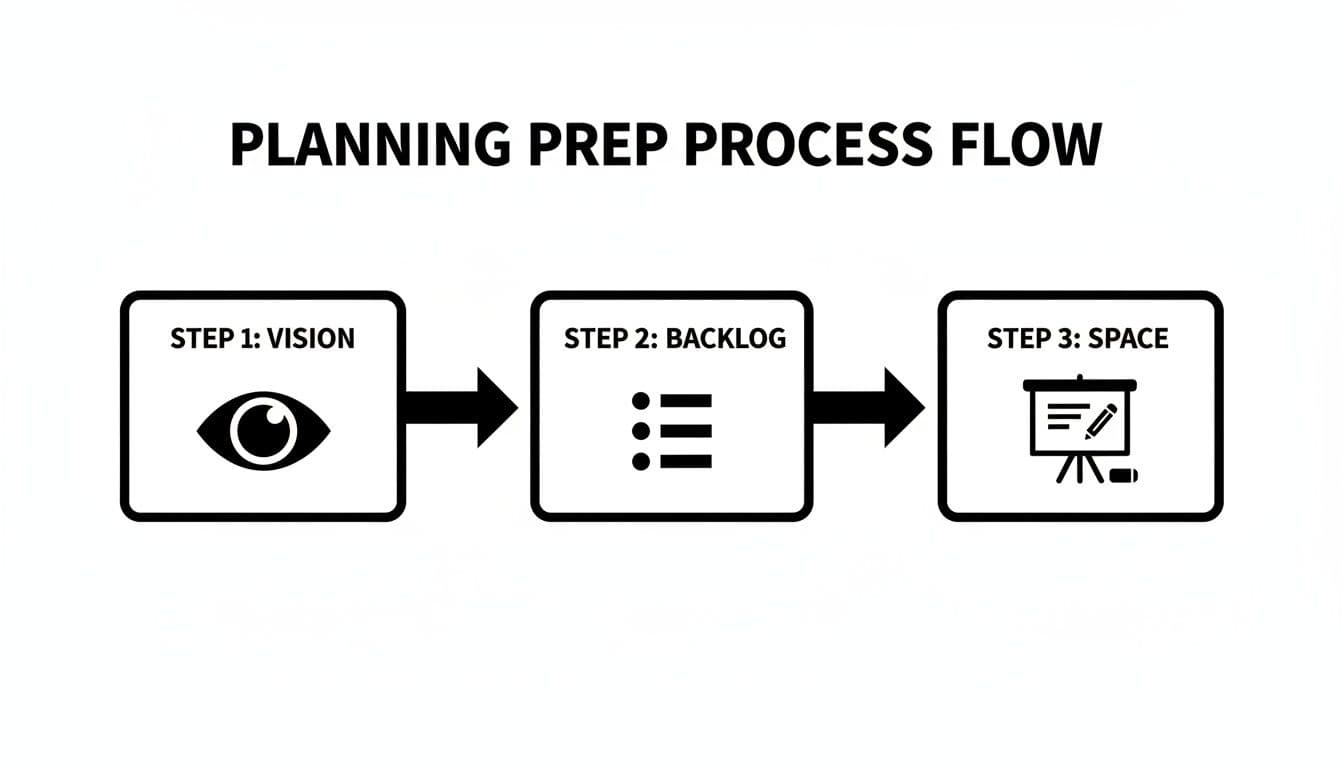
This simple flow—Vision, Backlog, Space—shows how each step builds on the last, giving you a solid launchpad for the meeting itself.
Kicking Off with Context and Vision
You can't expect a team to build a great plan if they don't get the big picture. I always start these meetings by grounding everyone in the business context. Why are we here? What market shifts are we responding to? What are our top-level goals for this quarter?
This isn't just a throwaway intro. It’s the crucial moment that connects the team's day-to-day work to the company's success. Once the stage is set, the Product Owner or Product Manager should passionately present the product vision and the specific goals for the upcoming release. This narrative gives everyone the "why" and gets them invested in the outcome.
Breaking Down the Work, Together
With the vision clear, the focus shifts to the "what." This is the hands-on part of the meeting where the team digs into the backlog. Instead of a manager just assigning work, the team needs to review the high-priority epics and user stories as a group.
This is where the tough but essential questions start to fly:
- Is this user story actually clear enough to work on?
- Do we all agree on the acceptance criteria?
- What hidden complexities are we missing?
As a facilitator, your most important job is to create a space where these questions are encouraged, not shut down. This collaborative breakdown makes sure the plan is built on shared understanding, not just top-down directives.
The real goal of an agile release planning meeting isn't to produce a perfect, unchangeable plan. It is to build a shared commitment to a realistic forecast, forged through honest conversation and collective problem-solving.
This collaborative spirit is non-negotiable in larger organizations. In fact, a significant 65% of enterprises now use frameworks like SAFe for their large-scale projects, often running multi-day Program Increment (PI) planning events that forecast work over 10-12 weeks. These sessions can involve anywhere from 50 to 125 people, making that collaborative alignment absolutely critical.
The Art of Realistic Estimation
Once the stories are understood, it’s time to talk effort. Whatever you do, avoid guessing or pulling numbers out of thin air. Techniques like Planning Poker are fantastic because they turn estimation into a structured conversation. Each team member privately estimates the effort for a story, and then everyone reveals their number at the same time.
Don't see discrepancies as a problem; they're an opportunity. A wide range of estimates—like one developer voting a 3 and another an 8—is an immediate red flag that you have a difference in understanding. This forces a discussion that can uncover hidden assumptions, technical risks, or misunderstood requirements before a single line of code gets written.
Mapping Dependencies and Facing Risks
No team is an island. One of the most valuable activities in release planning is mapping dependencies between teams. A simple dependency board, maybe with some yarn or lines drawn between user stories, can make these connections painfully obvious.
Visualizing these links helps teams sequence their work and proactively tackle bottlenecks. This is also the time to get all the risks out on the table. What could go wrong? What are our biggest unknowns? Documenting these risks and assigning owners to mitigation plans is how you turn anxiety into action.
The Final Confidence Vote
After the sprints are roughed out and the dependencies are understood, it’s time for the final gut check. The confidence vote is a simple but incredibly powerful tool. On a scale of 1 to 5, how confident is each person that the team can actually deliver this plan?
This isn’t about pressuring people into saying yes. If someone votes a 2 or a 3, you stop and ask why. Their concerns are priceless data. It might lead to adjusting scope, re-evaluating a risky feature, or simply clearing up a misunderstanding. The goal is to walk out of that room with a plan the entire team genuinely believes in and is committed to achieving together.
Running these sessions well is a skill that takes practice. To get more into the nuts and bolts of facilitation, check out our guide on effective meeting management.
Defining the Key Outcomes of Your Plan
A great release planning session feels productive, but feelings don't ship products. The real value comes from the tangible artifacts you walk away with. These documents are your shared blueprint, the concrete outputs that turn high-level strategy into an executable plan for your teams.
Without these, the alignment and energy from the session evaporate. Teams inevitably revert to their old silos, and all that hard work goes to waste. The goal is to produce living documents that provide genuine clarity day-to-day, not just another set of files destined to gather dust in a shared folder.
Let's dig into the three critical outcomes you should have locked down by the end of your planning event.
The Release Roadmap
Think of the release roadmap as the visual story of your product's near future. It’s not a rigid, line-by-line project plan. Instead, it’s a strategic overview that lays out the timeline for major features and initiatives, summarizing the value you’ll deliver over the next few months.
This is your single most important tool for communicating with stakeholders. It gives them a quick, at-a-glance view of what's coming and when. A solid roadmap will highlight key milestones and themes, clearly connecting the planned work back to the bigger business goals. When defining the key outcomes of your agile release plan, understanding how it contributes to the broader project roadmap is essential for strategic alignment.
It should instantly answer questions like:
- What major capabilities are we shipping this quarter?
- Which customer problems are we tackling first?
- How do these features set the stage for what comes next?
By keeping it visual and focused on outcomes, you create a powerful reference point for keeping everyone in the organization on the same page.
Clear Program Increment (PI) Objectives
If the roadmap shows what you're building, the Program Increment (PI) objectives explain why. These are a few concise, high-impact statements that spell out the specific business and customer value your teams will deliver in the upcoming release cycle (usually about a quarter).
This is a critical distinction: PI objectives are not just a to-do list of features. They articulate the outcomes you're aiming for. This small shift in perspective is a game-changer, as it rallies the team around solving real problems, not just closing tickets.
For example, instead of a feature-based objective like, "Build the new user dashboard," a much better, outcome-driven PI objective would be: "Improve user retention by 10% with a personalized dashboard that surfaces key data and actionable insights."
This approach anchors everyone on the real goal. It gives the team the creative freedom to figure out the best technical path forward, all while ensuring their work directly serves a measurable business purpose. At the end of the PI, you can score each objective, creating an honest feedback loop that makes your next planning session even sharper.
A Refined Release Backlog
Finally, your planning session must result in a well-groomed and sequenced release backlog. This is where the rubber meets the road. It’s the most granular of the three outputs and becomes the direct source of work for the development teams' upcoming sprints.
This isn't your entire product backlog, but a curated slice of it. It contains the user stories and epics that have been discussed, estimated, and prioritized for the release window. Crucially, it should also clearly flag any dependencies between tasks or teams that were uncovered during planning.
Inside Fluidwave, this is where you can bring it all together. You could set up a dedicated Kanban board for the release, with columns representing each sprint. The user stories become cards that you can sequence visually. By using labels and task links to show dependencies, you create a dynamic plan that makes it obvious how everyone's work fits together. This gives teams the context and confidence they need to pull work into sprint planning and start executing immediately.
Navigating Capacity, Dependencies, and Risks

This is where the rubber meets the road. It's one thing to have a neat, tidy plan on paper, but it's another thing entirely to execute it in the real world. Any team can sketch out a roadmap, but the truly resilient ones are those who get ahead of the three big complexities that can sink any release: capacity, dependencies, and risks.
It's about moving from wishful thinking to a realistic, battle-tested plan. Building this resilience from the very start is what separates a successful agile release from a purely theoretical one. You have to confront the hard truths early to build a forecast your team can actually deliver on without burning out.
Honestly Assessing Team Capacity
First things first: you have to get real about what your team can actually accomplish. Hope is not a strategy. The most reliable way to forecast future work is to look at how your team has performed in the past. This is where historical velocity becomes your best friend.
Velocity is simply the average amount of work a team knocks out during a sprint, usually measured in story points. It's not a stick to measure one team against another; it's a forecasting tool for a single team. By looking at the average velocity over the last several sprints, you get a data-driven baseline for how much work you can realistically commit to in the future.
For instance, if a team consistently completes between 25 and 30 story points per sprint, it’s just setting them up for failure to build a release plan that demands they suddenly hit 45. Using historical velocity grounds your plan in reality, prevents overcommitment, and protects your team from the inevitable crunch that always follows. You can learn more about how this fits into the bigger picture in our guide on resource allocation in project management.
Untangling Dependencies Before They Become Blockers
Think of dependencies as the invisible threads connecting tasks, features, and even entire teams. If you don't manage them, they create bottlenecks that can bring progress to a screeching halt. A dependency could be anything—one team needing an API from another, or the design team needing to finalize mockups before development can even start.
The trick is to make these connections impossible to ignore during the planning session itself.
A fantastic, low-fi technique for this is creating a dependency board (sometimes called a program board). It’s surprisingly simple and effective:
- Visualize the Work: Lay out cards for each feature or major story, organizing them by the sprint they’re planned for.
- Connect the Dots: Use colored string, yarn, or just lines on a whiteboard to physically connect tasks that depend on each other.
- Identify Problem Areas: The trouble spots become obvious almost immediately. A card with a ton of lines pointing to it is a clear bottleneck. A string stretching across multiple sprints signals a long-term risk that needs a conversation right now.
This simple act of visualization turns an abstract problem into something tangible the teams can solve together. They can re-sequence work, hash out delivery dates for specific components, or even rethink the tasks to eliminate the dependency altogether.
A dependency that’s identified and discussed during planning is a manageable problem. A dependency discovered mid-sprint is a crisis waiting to happen.
Shifting from Reactive to Proactive Risk Management
Finally, a solid release plan doesn't pretend the path forward will be perfect. It anticipates roadblocks and builds in contingency. The goal here is to shift your team from a reactive "firefighting" mode to a proactive one where you identify and plan for risks before they ever happen.
During your planning session, set aside dedicated time to just brainstorm potential risks. Don't hold back—get everything out on the table.
Common risks often fall into a few familiar categories:
- Technical Risks: "We've never integrated with this third-party service before."
- Resource Risks: "Our lead database expert is on vacation for two weeks during that critical sprint."
- Scope Risks: "The requirements for this feature are still pretty vague and could easily expand."
Once you have a list, use a simple framework like ROAM (Resolved, Owned, Accepted, Mitigated) to decide how you'll handle each one. This process ensures every potential issue has a clear owner and an action plan, turning team anxiety into a concrete strategy for building a much more resilient and achievable release.
Common Agile Release Planning Mistakes to Avoid
Even the most seasoned teams have the battle scars to prove they've made a few of these mistakes. Learning from their experience is a shortcut to making your agile release planning process more effective right from the start. Sidestepping these common pitfalls is less about following a rigid process and more about fostering the right mindset.
Let’s be honest—a lot can go wrong. A poorly run planning session can do more harm than good, creating a false sense of security around a plan that’s destined to fail. We'll look at the most frequent blunders and, more importantly, how you can steer clear of them.
Treating the Plan as a Rigid Contract
This is probably the biggest and most common mistake of all. Teams and stakeholders spend days crafting a beautiful release plan, and then they treat it like an unbreakable contract. They laminate it, stick it on the wall, and any deviation is seen as a failure. This completely misses the whole point of being agile.
The plan isn't a promise; it's a forecast. It's our best guess based on what we know today. As soon as your team starts working, they'll learn new things. The market will shift. A competitor will launch a new feature. Your plan must be built to adapt.
A successful agile release plan is a living document, not a historical artifact. Its value comes from the alignment it creates, not its initial accuracy. The real goal is to build a shared understanding that empowers the team to make smart decisions when things inevitably change.
Failing to Involve the Entire Team
Another classic error is cooking up the plan in a small, isolated room with just a few senior managers or architects. This top-down approach is almost always a recipe for disaster. The people who are closest to the work—the developers, designers, and testers—are the ones who truly understand the technical complexity and the real effort involved.
When you exclude them from planning, you get a plan based on wishful thinking, not reality. You also squander a massive opportunity to create ownership and buy-in. A plan dictated from above breeds compliance at best and resentment at worst. A plan built collaboratively, on the other hand, creates a deep sense of shared commitment.
Here’s why getting the whole team in the room is non-negotiable:
- Accurate Estimates: You can't get realistic effort estimates without the input of the people who will actually be doing the work. It's that simple.
- Early Risk Detection: A developer might spot a technical dependency that a product manager would completely miss.
- Increased Motivation: Teams that help create the plan are far more motivated to see it through to success. They own it.
Ignoring Technical Debt
It's always tempting to focus solely on shiny new features during release planning. They're exciting, and they're what stakeholders want to see. But ignoring the "unseen" work of paying down technical debt is like building a skyscraper on a shaky foundation. Sooner or later, it's going to cause serious problems.
Technical debt is a drag on future development, making it harder and more expensive to add new functionality down the road. If you don't intentionally set aside capacity to address it, it will keep piling up until your team's velocity grinds to a halt.
Here’s a real-world scenario: A team I worked with continuously prioritized new features over refactoring an old, clunky part of their codebase. Their release plan looked fantastic on paper, but every sprint was plagued by mysterious bugs and slow progress. They ended up missing their release target by over a month because they spent most of their time firefighting issues in the very code they had neglected.
The fix is simple in theory: explicitly allocate a percentage of your team's capacity in every release plan to tackle tech debt and make architectural improvements. Even reserving 15-20% of your capacity can make a huge difference in long-term sustainability and speed.
A Few Common Questions About Agile Release Planning
As teams start folding release planning into their rhythm, a few questions almost always surface. Getting these sorted out early can mean the difference between a smooth, confident start and a bumpy, confusing one. Let's dig into some of the most practical questions about timing, roles, and where this all fits in the grand scheme of things.
How Often Should We Be Doing This?
For most teams, especially those working within a larger framework like SAFe®, the sweet spot for release planning (what they call Program Increment or PI Planning) is every 8-12 weeks. This cadence is long enough to deliver a meaningful batch of value but short enough to pivot based on what you learn from customers and the market.
If you're part of a smaller team or just getting your feet wet, planning on a quarterly basis is a fantastic starting point. The real magic isn't in the specific number of weeks but in the consistency. A predictable rhythm is what gets the entire organization in sync.
Remember, the release planning session is the starting line, not the finish. The plan you create is just the beginning of an ongoing conversation about value, not a contract set in stone.
Isn't This Just a Big Sprint Planning Meeting?
Not at all. This is probably the most common point of confusion, and it really boils down to strategy versus tactics. Think of it as planning a major kitchen renovation versus just deciding what you're going to cook for dinner tonight.
-
Release Planning is the big-picture strategy. You're looking out across multiple sprints—often an entire quarter—to define the major goals. The core question is, "What significant outcomes are we aiming for over the next three months?" You walk away with a high-level roadmap and a clear set of objectives.
-
Sprint Planning is pure tactics. Here, you're zoomed way in, focusing only on what one team can realistically finish in the next one to four weeks. The question becomes, "What specific user stories can we complete in our next sprint?" The output is a very detailed sprint backlog.
When you do release planning well, it makes your sprint planning sessions infinitely more productive because the team already shares a clear sense of direction and purpose.
Who Actually Needs to Be in the Room?
For release planning to work, you absolutely need the right people in the room (whether it's a physical or virtual one). If you leave out key perspectives, you’re basically guaranteeing your plan will be built on shaky assumptions.
Make sure your invite list includes these three groups:
- The Entire Agile Team: This means every developer, QA engineer, designer, and anyone else who has hands on the keyboard. Their firsthand knowledge of what's technically possible is indispensable.
- Product Owners and Product Managers: They champion the vision. They're there to represent the customer, explain the "why" behind the features, and make the tough calls on what comes first.
- Key Business Stakeholders: This could be anyone from a C-level executive to heads of marketing or customer success. Having them present from the beginning ensures the plan supports wider company goals and gets their buy-in right away.
Getting this diverse group together creates a powerful sense of shared ownership and results in a plan that is both ambitious and achievable.
Ready to turn chaotic planning meetings into focused, strategic sessions that actually move the needle? Fluidwave gives you the visual boards, real-time collaboration, and smart prioritization to build and track a release plan that works. Align your team and simplify your entire workflow. Get started today at https://fluidwave.com.
Focus on What Matters.
Experience lightning-fast task management with AI-powered workflows. Our automation helps busy professionals save 4+ hours weekly.