Learn what an A major triad is: its notes A, C♯ and E, interval structure, notation, voicings and simple playing examples.
November 5, 2026 (1d ago)
A Major Triad Explained: Notes, Intervals and Voicings
Learn what an A major triad is: its notes A, C♯ and E, interval structure, notation, voicings and simple playing examples.
← Back to blog
An A major triad is the notes A, C♯ and E, with C♯ four half steps above A and E seven half steps above A. Why do so many learners play exactly those notes, in exactly the shape they were taught, and still hear something that sounds off?
That's the gap in the usual diagram approach. A diagram tells your fingers where to go, but it doesn't tell you what each note is doing, which note your ear should check first, or why the same chord can feel settled in one position and restless in another. Once you can hear the job of each note, you can build a major triad anywhere, move it between instruments, and fix it when it sounds harsh without starting over.
A Major Triad Notes and Intervals at a Glance
An A major triad is three notes played together, A, C♯ and E. A is the root, the note the chord is named after and the point everything is measured from. C♯ is the major third, and E is the perfect fifth.
The University of North Texas triads transcript defines a major triad as a three-note chord built from a root, a major third, and a perfect fifth, with the major third spanning 4 half steps and the perfect fifth spanning 7 half steps from the root. That same document uses C major as its example, with C as root, E as major third, and G as perfect fifth.
| Role | Note | Semitones above A | Interval name |
|---|---|---|---|
| Root | A | 0 | Root |
| Major third | C♯ | 4 | Major third |
| Perfect fifth | E | 7 | Perfect fifth |
The pattern works from any root
You don't need to memorize A major as a special case. Start on any note, go up four half steps for the third, then seven half steps from the start for the fifth, and you've built a major triad.
- E major triad: E, G♯ and B, because G♯ sits four half steps above E and B sits seven above.
- C major triad: C, E and G, following the same distances with no sharps needed.
- A major triad: A, C♯ and E, where the sharp on C is what stretches the third out to four half steps.
Quick ear test: Play A on its own, then add C♯, then add E. The sound should turn bright and settled once all three ring together, with no note feeling like it wants to move.
Try that test slowly on whatever instrument is in front of you. Play the notes one at a time first, so you can confirm each pitch, then play them together and listen to how the character changes when C♯ arrives. If it sounds darker or smaller than you expected, you've probably landed on C natural instead.
Every voicing, inversion and notation form that follows still contains exactly these three pitch classes. Notes may move to different octaves, get doubled, or change order, but if A, C♯ and E aren't the notes present, you aren't playing an A major triad.
Why the Major Third Gives the Chord Its Sound
Think of a triad as a small staircase with two steps stacked on a root. The lower step is the third. The upper step is the fifth. You don't jump straight from the root to the top, you climb through the middle note, and the size of that first step decides what kind of chord you've built.
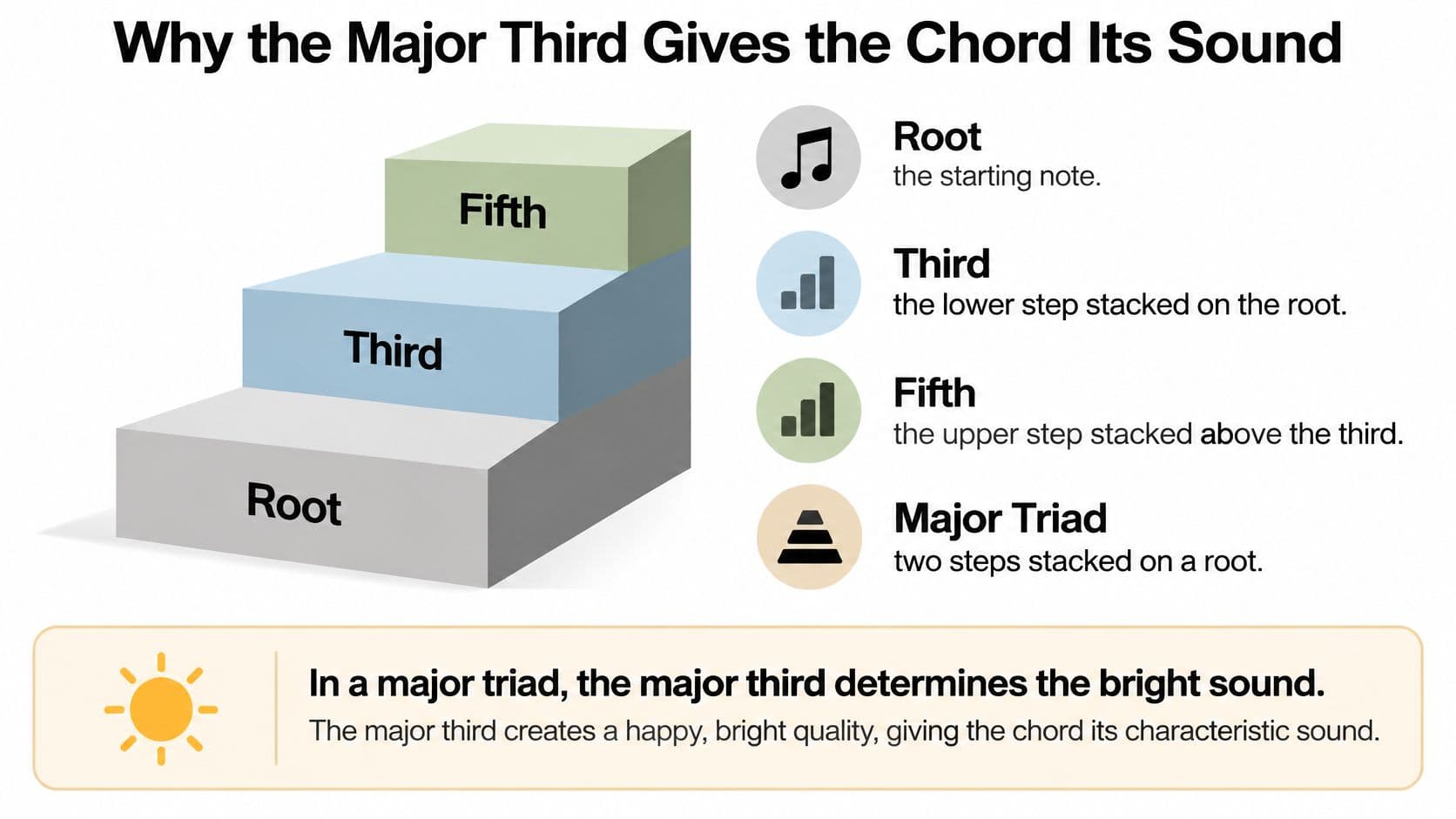
The Open University music theory course explains that if the lower interval is a major third and the upper interval is a minor third, the result is a major triad, and together those intervals produce a perfect fifth from root to fifth. In compact, stacked form, the lowest note is treated as the root, the middle note as the third, and the highest note as the fifth.
Walking up the A major staircase
From A to C♯ is the big first step, a major third. From C♯ to E is the smaller second step, a minor third. Put those two steps together and the total climb from A to E is the perfect fifth that frames the chord.
Now shrink only the first step. Play A, C natural and E instead, and the lower step drops by one half step while E stays exactly where it was. The chord instantly turns minor, darker and more inward sounding, even though two of the three notes didn't move.
That's why the third, not the fifth, controls the mood. Major and minor triads share the same perfect fifth, so the fifth can't be the difference you're hearing. The brightness you associate with a major triad lives entirely in that wider first step.
A stacking test for any unfamiliar chord
When you meet three notes you don't recognize, stack them as tightly as you can and measure the gaps. Take the lowest note as a possible root, measure up to the middle note, then measure from the middle note to the top.
- First gap of four half steps, second gap of three: You've got a major triad.
- First gap of three, second gap of four: You've got a minor triad, because the small step now comes first.
- Any other pairing: You're looking at a different chord type, so keep stacking and measuring before you name it.
The most common slip with A major is lowering C♯ to C natural by accident, often because a finger lands one fret or one key short. The fifth still sounds solid, which makes the mistake hard to spot, but the chord has changed quality. When something sounds vaguely sadder than the chart suggests, check the third before you check anything else, and if you want structured practice that fits around a busy schedule, you can find flexible music theory study options that let you work through intervals at your own pace.
Reading A Major Triad in Notation and Chord Symbols
Most players meet this chord as a single letter on a chart long before they see it written out on a staff. A bare A on a lead sheet almost always means an A major triad, because major is the default when no quality is marked. That default saves space, but it also catches beginners who assume a plain letter means something neutral.
| Notation | Written as | Meaning | Watch for |
|---|---|---|---|
| Chord symbol | A | A major triad | Default on most lead sheets |
| Chord symbol | AM or Amaj | A major triad | Explicit form common in jazz charts |
| Chord symbol | Am | A minor triad | Third lowered to C natural |
| Staff notation | A3, C♯4, E4 | A major triad in a stated octave | Sharp must appear unless the key signature holds it |
Symbols first, then the staff
AM and Amaj say the same thing as a bare A, just more explicitly, and you'll see them often in jazz and session charts where writers don't want any ambiguity. Am is a different chord altogether, because the lowercase m tells you the third drops to C natural. One small letter changes the whole colour, so read symbols slowly until that distinction is automatic, and use a tool to find chords for your songs when you're checking a symbol against the notes you think it contains.
On the staff, you write A in whatever octave the part needs, then C♯ on the next line or space above, then E above that. The sharp is the part people miss. If you write or play C natural, you haven't made a small error, you've built a minor chord.
When the key signature does the work
The key of A major carries three sharps, F♯, C♯ and G♯, written at the start of every staff. In that key, every C you see is already C♯, so no separate accidental appears next to the note. Outside A major, the sharp has to be printed beside the C itself, and a player who overlooks it changes the chord without realizing.
When a chart shows only a letter, check the symbols around it and check the key before you decide whether the chord is major or minor.
That habit takes two seconds and prevents the most common reading mistake with this chord. Context tells you whether the sharp is hiding in the key signature, printed as an accidental, or missing because the chord really is minor.
How Inversions and Doubling Change the Chord
An inversion keeps the same three notes and changes which one sits at the bottom. That sounds like a small rearrangement, but your ear pays close attention to the lowest note, so the chord's stability and direction change with it. The notes haven't changed. The feeling has.
| Position | Bottom note | Stacking from bottom | Typical use |
|---|---|---|---|
| Root position | A | A, C♯, E | Most stable, the default starting point |
| First inversion | C♯ | C♯, E, A | Smooth bass movement by step |
| Second inversion | E | E, A, C♯ | Passing or cadential, sounds unsettled |
| Open spacing | A | A, E, C♯ with a wide gap above the root | Piano and guitar voicings with a clear low register |
What each bottom note does
Root position puts A underneath everything, and that's why it sounds like home. The chord's name and its foundation match, so listeners hear it as settled and final. Start here when you're learning, because the identity of a major triad is clearest in this shape.
First inversion puts C♯ at the bottom, which softens the chord and makes it glide. It works beautifully when the bass line moves by step, since the bottom note can walk smoothly into the next chord instead of leaping. Second inversion puts E at the bottom and feels noticeably unsettled, almost like the chord is leaning forward, which is why players use it as a passing chord or just before a strong resolution rather than as a resting place.
Doubling and spacing
Real parts often have more than three voices, so one note gets doubled in another octave. Players usually double the root or the fifth, because doubling the third can make the chord sound heavy and overly sweet. Doubling A also gives a bass player a clear anchor and lets a piano chord fill more space without adding foreign notes.
Open spacing spreads the notes out, leaving a wide gap between the low root and the voices above. It suits piano and guitar well because low notes played close together turn muddy, while a gap keeps each pitch distinct. Close spacing keeps everything within a small range and works better higher up, where the notes stay clear.
Choosing by voice leading
Say you're moving from A major to D major. Both chords contain A, so keep that A in the same voice and let it ring through the change. Move the other notes by the smallest distance available, and the progression will sound connected rather than jumpy.
That's the decision rule. You don't pick an inversion because it's the correct one; you pick it because the chords around it need a smooth bass line, a shared note, or a moment of tension that resolves.
Playing the A Major Triad on Piano, Guitar and Bass
The notes don't change when you change instruments, but your hands face completely different problems. What's effortless on piano can be cramped on guitar and unnecessary on bass, so it helps to learn one reliable shape per instrument and understand why each shape looks the way it does.
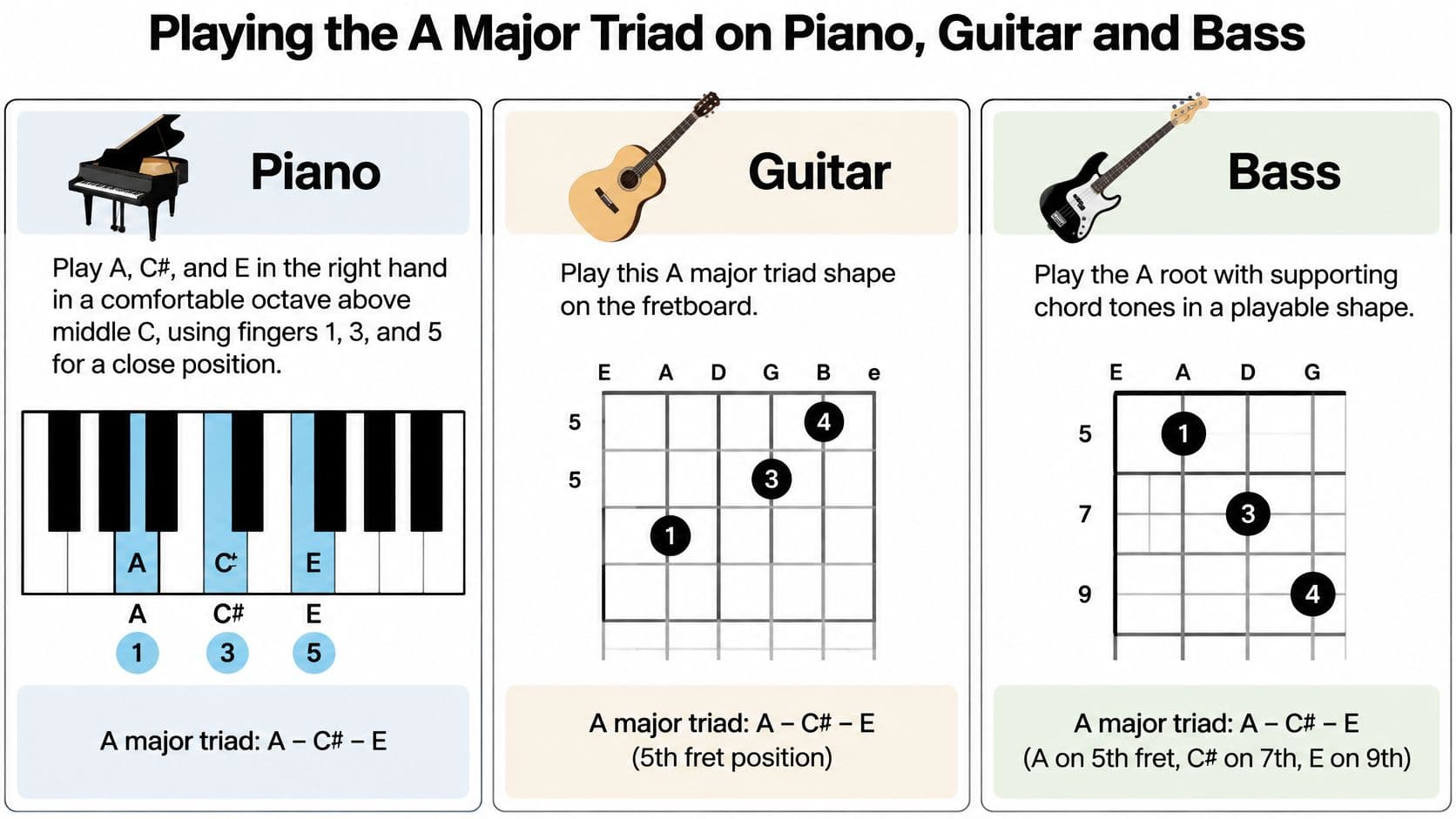
The comparison below shows the three starting shapes side by side.
Piano
Place your right hand in a comfortable octave above middle C and play A, C♯ and E with fingers 1, 3 and 5. Your thumb takes A, your middle finger reaches the black key C♯, and your fifth finger lands on E. It's a compact, natural hand shape, and you can hear all three notes cleanly.
For a fuller sound, split the chord between your hands. Play a low A with your left hand and put C♯ and E in your right, which gives you the open spacing that keeps the low register clear. Piano gives you the widest reach of the three instruments, so you can choose spacing for sound rather than survival.
Guitar
The standard open shape is x, 0, 2, 2, 2, 0 from the lowest string to the highest. You mute the sixth string, let the open fifth string ring as A, fret the fourth string at the second fret for E, the third string at the second fret for A, and the second string at the second fret for C♯, then let the open first string ring as E. Three fingers crowd into the same fret, which is why beginners often mute a neighbouring string by accident.
Watch the shape being built and checked one string at a time here.
A barre form with the root on the sixth string at the fifth fret gives you the same three notes higher on the neck. It asks more of your hand strength, but it proves the point that a major triad is defined by its intervals, not by one position on the fretboard.
Bass
On bass, your job is usually the root, not the whole chord. Play A on the open A string and let it anchor the harmony while other instruments supply the rest. When you do use C♯, treat it as a passing note that colours the line briefly rather than a note you sustain, because a low third held too long can blur the chord's foundation.
As the guitar adaptation guide from GuitarWiz notes, forcing a pianist's exact voicing onto guitar is unnecessary, and minimizing movement between successive chords improves voice leading. The same guide identifies accidental muting and buzzing as frequent causes of failure on guitar, and warns that instrument tuning can be mistaken for a fingering error.
Decision rule: Choose the voicing that keeps the root clear, the third audible, and the move to the next chord small.
Piano offers reach, guitar gives you a handful of shapes and demands clean muting, and bass needs a stable root above all else. Correct doesn't mean copying a diagram exactly. It means the voicing works cleanly in the music you're playing, with C♯ audible enough that nobody mistakes the chord for minor.
Diagnose and Verify Why the Chord Sounds Wrong
Every note is correct, yet the chord still sounds harsh. You've checked your fingers twice, the notes are A, C♯ and E, and something still grates. Most learners assume they've made a fingering mistake and start rebuilding their technique, when the problem often sits somewhere else entirely.
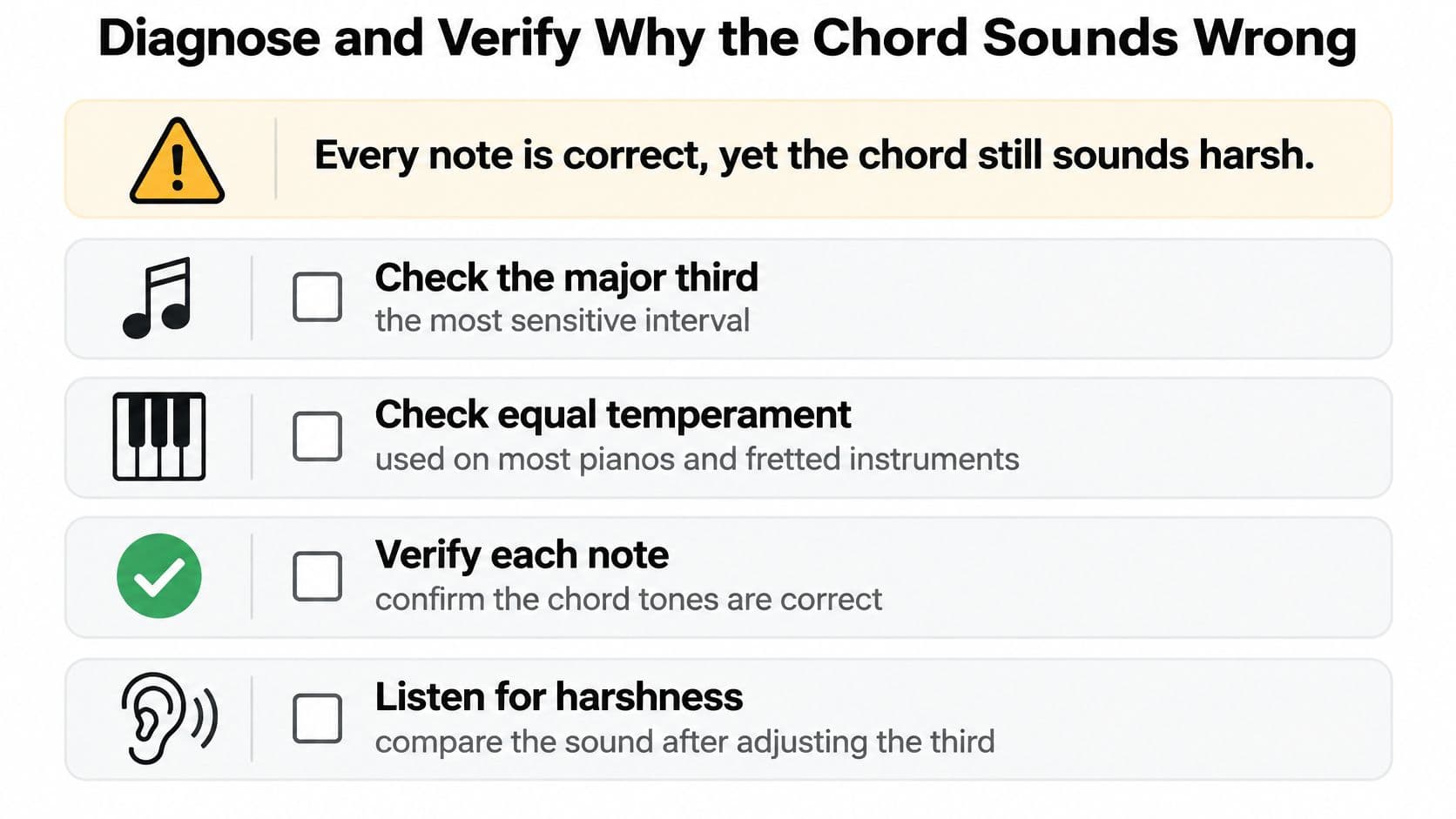
Use this checklist before you blame your hands.
Why the third is the sensitive note
The major third is the interval your ear judges most harshly in a major triad, and tuning systems don't all place it in the same spot. An article in Transactions of the International Society for Music Information Retrieval explains that the idealized just intonation ratio for a major triad is 4:5:6, and that equal temperament is only one tuning system, so the major third may need slightly different treatment depending on instrument, ensemble, and musical context. The same article describes audible upper partials beyond the three written notes, including pitch classes corresponding approximately to the major seventh and ninth above the root.
In plain terms, a piano or fretted guitar in equal temperament makes major thirds slightly wider than the pure ratio, which lets every key work equally well but leaves thirds a touch restless. Singers and string players, who can adjust pitch continuously, often narrow the third a little so the chord settles. Neither group is playing wrong. They're tuning to different reference points.
Those upper partials matter too. When three notes ring together, your ear picks up faint extra pitches the notes generate between them, and some of those sit near notes that don't belong to the chord. In a low register or a tight voicing, those partials crowd together and the chord can feel sharp or buzzy even though a tuner says every note is spot on.
The diagnostic checklist in order
Work through these steps in sequence, because each one rules out a different cause and the early ones are the easiest to fix.
- Confirm C♯ is sounding: Play each note alone and name it. A muted string or a finger one fret short gives you C natural or nothing at all.
- Retune against a reference A at 440 Hz: Check every string or use a tuner app before you judge the chord. One drifted string makes a correct shape sound wrong.
- Compare close and open voicings: Play the notes tightly grouped, then spread them out. If the open version clears up, spacing was the problem, not pitch.
- Test two or three octaves: Low thirds sound muddy and harsh far more often than high ones. Move the chord up and listen to whether the roughness follows.
- Listen for blend in an ensemble: If you're playing with others, match their third rather than your tuner. A chord that blends beats a chord that's individually perfect.
That last step surprises people. If a singer narrows the third toward the pure ratio and your fretted guitar can't follow, the clash you hear is real, but nobody is out of tune in a simple sense. You're hearing two tuning systems disagree, and the fix is adjusting voicing, register, or dynamics so the third is less exposed.
A short practice check you can run today
Say the three notes aloud, A, C♯ and E, before you play. Naming them forces you to verify the sharp instead of trusting muscle memory. Then play root position, first inversion and second inversion in turn, slowly, and listen to how the bottom note changes the chord's stability.
Next, build the same pattern from a new root to prove you own the rule rather than one shape. From D you get D, F♯ and A. From E you get E, G♯ and B. If you can spell those without counting on your fingers, the interval pattern has stuck.
You know you've got this chord when you can do four things without hesitation. You can name it from its notes, write it on the staff with the sharp in the right place, play it cleanly in at least two positions, and check its tuning against the players around you. Anything less and one of those skills will let you down in a real song.
A chord can be played correctly and still need adjustment for its context. Technical accuracy and musical effect are two different checks.
That's the mindset that carry you past the diagram stage. Don't just ask whether your fingers are in the right place. Ask whether the third is sounding, whether the spacing suits the register, and whether your tuning matches the room you're playing in. Those questions turn a memorized shape into a sound you can build, voice and trust anywhere.
Building this kind of step by step practice into a packed week is easier when your tasks, reminders and study blocks stay organized in one place, and Fluidwave helps you auto-prioritize that work and delegate the busywork to virtual assistants on a pay per task basis. Set up your next practice session as a task, protect the time for it, and let Fluidwave keep the rest of your list moving while you play.
Focus on What Matters.
Experience lightning-fast task management with AI-powered workflows. Our automation helps busy professionals save 4+ hours weekly.