強力なADHD整理術で生活を効率化。タスク管理、散らかりの削減、集中力向上のための7つの実践的な戦略を学びましょう。
August 9, 2025 (1y ago) — last updated March 12, 2026 (7mo ago)
2025年版:実証済みADHD整理術7選
実証済みの7つのADHD整理術で散らかりを減らし、集中力と生産性を高める方法を今すぐ学べます。
← Back to blog
2025年版:実証済みADHD整理術7選
強力なADHD整理術で生活を効率化。タスク管理、散らかりの削減、集中力向上のための7つの実践的な戦略を学びましょう。
はじめに
For many adults with ADHD, conventional organization advice feels frustrating or ineffective. ADHD affects executive functions such as planning, prioritizing, and working memory, so systems that rely on sustained internal control often fail. This isn’t a personal failing; it’s neurobiology. Building effective organization means designing systems that work with your brain’s wiring: using visual cues, lowering cognitive load, and externalizing memory to reduce friction and free attention for meaningful work.1
This guide moves beyond platitudes to present seven neuroscience-informed, practical strategies you can try immediately. You’ll learn quick wins like the One-Minute Rule, visual time-blocking, external brain systems, and dopamine-driven rewards—all selected to help you reduce clutter, meet deadlines, and sustain focus.
1. The One-Minute Rule
The One-Minute Rule—if a task takes less than one minute, do it now—cuts down on micro-tasks piling up and creating mental clutter. Originating from productivity frameworks like Getting Things Done, this rule creates momentum and reduces the cognitive cost of keeping track of many small items.2

How to implement
- Physical: File documents immediately, hang your coat, or put dishes in the dishwasher right after meals.
- Digital: Reply to quick emails, archive or delete unneeded messages, and add small items to your list instantly.
- Behavioral: Use transitional moments—arriving at your desk, between meetings, or before leaving—to process one-minute tasks.
Key insight: Reserve the rule for transitions or short breaks to avoid interrupting deep work. A sticky note on your monitor reading “Does this take < 1 minute?” is an effective habit trigger.
2. Color-Coded Organization Systems
Color-coding turns abstract categories into immediate visual cues, reducing the reliance on working memory and speeding retrieval. For visual thinkers, limited, consistent color keys are especially effective.

How to implement
- Documents: Use 3–4 colored folders for high-level categories (e.g., Work, Home, Health, Finance).
- Digital calendars: Assign colors to event types to visualize your day at a glance.
- Home: Colored bins or hangers make sorting automatic.
Key insight: Start small. A simple legend posted where you see it keeps consistency across physical and digital systems.
3. External Brain Systems (Digital and Physical)
An external brain—one trusted place for notes, tasks, and ideas—reduces working-memory demands and frees attention for higher-value thinking. Offloading memory to reliable tools is supported by research on transactive memory and reduces the anxiety of “trying to remember everything.”3
How to implement
- Digital: Try Notion, Obsidian, or a dedicated task manager that syncs across devices. Use voice memos for fleeting ideas.
- Physical: Create a command center with a whiteboard, family calendar, and trays for incoming mail.
- Workspace: Design clear zones for incoming work vs. long-term reference.
Key insight: Schedule a weekly review to process captured items so your external brain stays current, not a cluttered archive.
4. Body Doubling and Accountability Partners
Body doubling—working alongside another person, in person or virtually—creates gentle social accountability that helps with task initiation and sustained focus. This technique is widely used in ADHD communities and coaching because the simple presence of another person reduces avoidance and isolation.4
How to implement
- Virtual co-working: Use services like Focusmate or set up timed Zoom sessions with a friend.
- In person: Work in a library, café, or co-working space with a buddy.
- Family: Ask a roommate or family member to be in the room while you tackle a task.
Key insight: Set expectations before a session—silent work, short check-ins, or Pomodoro-style focus blocks—to ensure the partner supports rather than distracts.
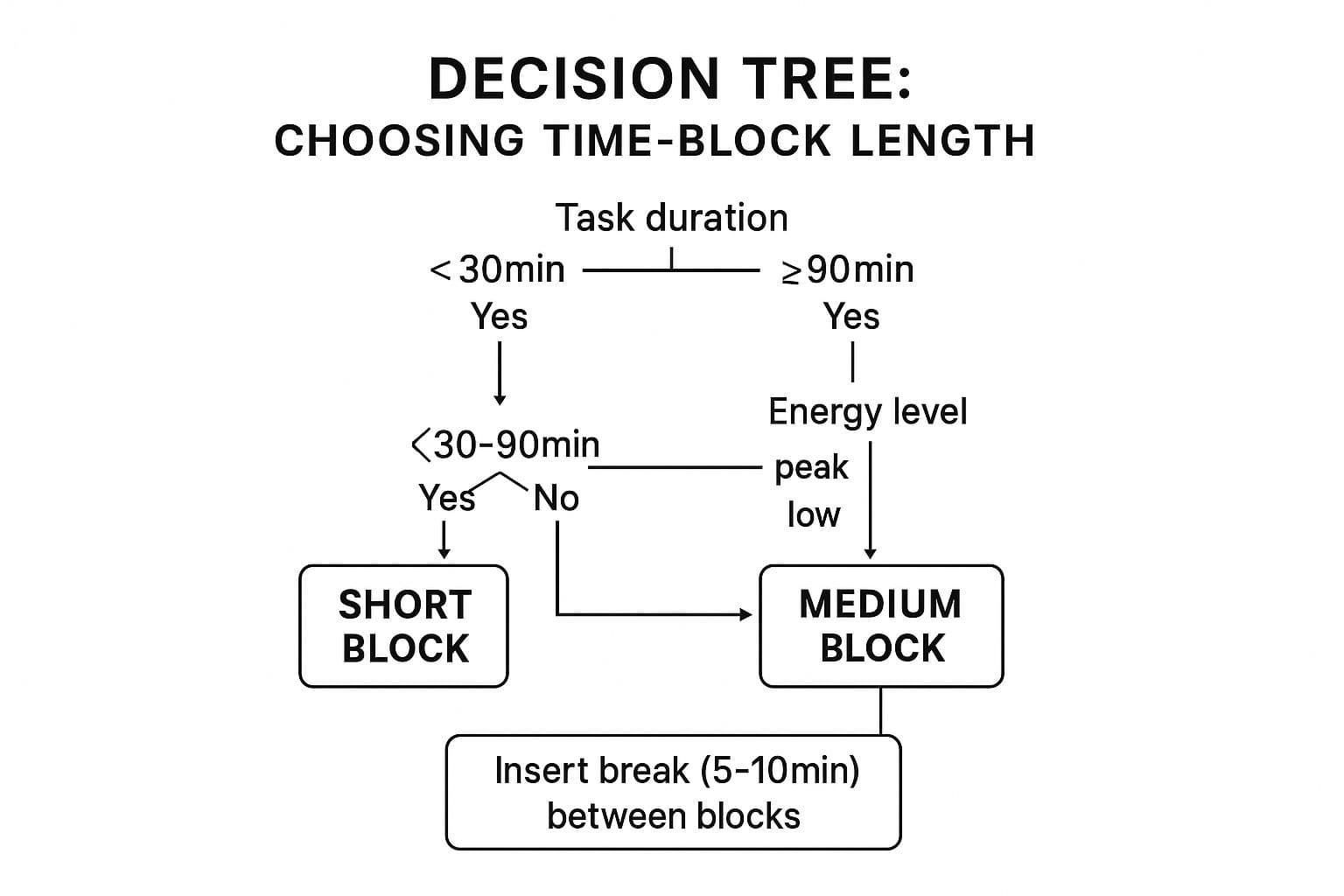
5. Time Blocking with Visual Schedules
Time blocking gives structure to the day and combats time blindness by mapping tasks to visual blocks. Pairing blocks with color-coding turns schedules into an intuitive roadmap for action.
How to implement
- Digital: Use Google Calendar or Outlook with color-coded event types (deep work, meetings, personal time).
- Physical: Use a wall planner or sticky notes you can move as priorities shift.
- Monitor: Track actual time spent with apps like Clockify or RescueTime to refine your blocks.
Key insight: Always include 5–15 minute buffers between blocks to ease transitions. Start by blocking non-negotiables (meals, sleep) and place high-priority work in your peak energy windows. For a starter template, see our time-blocking guide at /blog/time-blocking.
6. The ADHD-Friendly Filing System: FAST Method
FAST—File, Act, Store, Toss—gives one clear action for every item, removing decision paralysis. Touch each item once and route it immediately to one of the four outcomes.
How to implement
- File: Active documents you reference regularly.
- Act: Items requiring immediate action (due bills, replies).
- Store: Long-term archives (taxes, legal documents).
- Toss: Unnecessary items—be decisive.
Key insight: Prepare labeled trays or folders for each FAST action before you start. Use short sprints (15–20 minutes) to process backlogs without overwhelm.
7. Dopamine-Driven Reward Systems
Because ADHD is associated with differences in reward processing and dopamine signaling, pairing tasks with immediate rewards can increase motivation. Gamifying chores and adding small, immediate reinforcements helps bridge the motivation gap and sustain new habits.5

How to implement
- Gamify: Use Habitica or similar apps that convert tasks into game rewards.
- Reward jar: Draw small treats after a session (15 minutes of a podcast, a coffee).
- Visual progress: Use sticker charts or progress bars for big projects.
Key insight: Combine immediate micro-rewards with larger milestone rewards and rotate rewards regularly to keep them fresh.
Comparison of the 7 Methods
| Method | Complexity | Resources | Expected Outcome | Best Use Case | Key Advantage |
|---|---|---|---|---|---|
| One-Minute Rule | Low | Minimal | Reduced micro-clutter | Quick everyday tasks | Fast wins, momentum |
| Color-Coding | Medium | Moderate | Faster recognition | Visual learners, multi-category organization | Low cognitive load |
| External Brain | High | High | Memory support, less anxiety | Complex projects, knowledge work | Reliable storage |
| Body Doubling | Medium | Low–Moderate | Better initiation, focus | Tasks you avoid starting | Social anchoring |
| Time Blocking | Medium–High | Moderate | Structured day, time awareness | Managing time blindness | Reduces decision fatigue |
| FAST Filing | Low–Medium | Low | Less clutter, decision clarity | Paper and digital inboxes | Simple, fast decisions |
| Dopamine Rewards | Medium | Moderate | Increased engagement | Making tasks enjoyable | Motivation aligned with neurochemistry |
Integrating your ADHD-friendly system
There’s no single cure-all. The most sustainable approach is to pick one or two strategies that resonate, experiment, and adapt. Your external brain becomes the hub: store your FAST folders there, schedule time blocks on your calendar, and log rewards for completed sprints.
Be kind to yourself. Use the One-Minute Rule on low-energy days and tackle bigger projects when you feel capable. Outsource consistently draining tasks to conserve executive function for high-impact work. Strategic delegation can be a game-changer for professionals with ADHD—consider services that offer flexible, pay-per-task support for admin tasks at /services/virtual-assistants.
Frequently Asked Questions
Q1: Which single strategy should I start with?
A1: Start with one simple habit—The One-Minute Rule or a single color code for your most important category. Small consistent wins build momentum and lower overwhelm.
Q2: How often should I review my external brain?
A2: Schedule a weekly 20–30 minute review to process new items, update projects, and prune outdated notes. Regular reviews keep your system trustworthy.
Q3: Can these strategies replace professional treatment for ADHD?
A3: No. Organizational strategies help daily function but don’t replace medical or psychological treatment when needed. Consult a clinician for diagnosis and treatment options.
1.
Centers for Disease Control and Prevention, “Adults with ADHD,” https://www.cdc.gov/ncbddd/adhd/adults.html.
2.
David Allen, Getting Things Done (GTD) concept and principles; see the GTD website: https://gettingthingsdone.com/.
3.
Sparrow, Liu, and Wegner, “Google Effects on Memory: Cognitive Consequences of Having Information at Our Fingertips,” Science, 2011; https://www.science.org/doi/10.1126/science.1207745.
4.
ADDitude Magazine, “Body Doubling for ADHD: How It Works and Why It Helps,” https://www.additudemag.com/body-doubling-adhd/.
5.
National Institute of Mental Health, “What Is ADHD?” discussion of neurobiology and reward pathways in ADHD: https://www.nimh.nih.gov/health/topics/attention-deficit-hyperactivity-disorder-adhd.
重要なことに焦点を当てる。
AI搭載のワークフローで超高速なタスク管理を体験。忙しいプロフェッショナルの週4時間以上の時間を節約します。