Feeling overwhelmed? This guide offers actionable strategies for prioritizing tasks at work. Learn how to use proven frameworks to boost productivity and focus.
March 1, 2026 (7mo ago) — last updated March 16, 2026 (6mo ago)
A Modern Guide to Prioritizing Tasks at Work
Feeling overwhelmed? This guide offers actionable strategies for prioritizing tasks at work. Learn how to use proven frameworks to boost productivity and focus.
← Back to blog
Prioritizing your tasks isn't just about making a to-do list; it's about strategically deciding where your focus needs to go. It’s the art of sorting through the noise to pinpoint the work that actually moves the needle, ensuring you’re making real progress on your goals instead of just putting out fires.
Why Prioritizing Your Work Is a Non-Negotiable Skill
Does your workday feel like a relentless game of whack-a-mole? If you consistently end the day feeling exhausted but not accomplished, you've hit on a core problem of modern work. That nagging sense of being perpetually behind isn't a personal failing—it’s a signal that your method for managing tasks just isn't cutting it anymore.
Learning how to prioritize is way more than just a productivity hack; it's a fundamental survival skill in any job. It’s about having the clarity to look at a mountain of requests and confidently say, This matters right now, while knowing what can—and should—wait. Without that clarity, you're on a fast track to burning out on trivial tasks while your most important projects collect dust.
From Reactive Chaos to Strategic Focus
The real difference between top performers and everyone else isn't how many hours they work. It’s how they use them. They have a system. High-achievers don't magically get more time; they just allocate it with incredible intention. They get out of the reactive cycle where every ping and email dictates their next move and shift into a proactive state where they are firmly in control.
Making this shift pays off almost immediately. You’ll notice:
- Less Stress: The constant anxiety from a messy to-do list disappears when you have a clear plan of attack.
- Greater Impact: You can finally pour your best energy into the work that directly supports your biggest goals.
- Better Work-Life Balance: When you command your day, your day is far less likely to bleed into your personal time.
Here's a powerful motivator: Task prioritization has become a serious competitive advantage. Teams that master it are 1.4 times more likely to outperform their peers. That’s a massive edge in any field.
Adopting a Proven Framework
This is where a solid framework comes in. Something like the Eisenhower Matrix provides a surprisingly simple yet effective way to bring order to the chaos. By sorting your tasks based on their urgency and importance, you create a clear roadmap for your day, week, and month. It’s a foundational tool that forces you to make conscious, smart decisions about where your attention goes.
And it works. Recent survey data found that a full 50% of professionals using the Eisenhower Matrix reported feeling in control of their tasks every single day. This shows just how transformative a simple system can be, giving you back a sense of command over your work. You can explore insights from the task management study to see how other professionals are getting ahead.
Getting Real About Work Today
Trying to prioritize your to-do list without first understanding the pressures of modern work is like sailing into a storm without checking the weather. The game has changed. The old productivity hacks just don't cut it anymore because we're all dealing with a completely new set of challenges that make it incredibly hard to focus.
The shift to remote and hybrid models has been a double-edged sword. Sure, the flexibility is great, but it has completely erased the boundaries between work and home for many of us. This creates an always-on expectation that makes the workday feel endless, leading to serious mental exhaustion. It’s tough to switch off and recharge when your office is also your kitchen table.
The New Rules of the Workplace
On top of that, we're in the middle of a massive generational shift that's turning old-school workplace dynamics on their head. These changes directly affect how we all need to think about managing our time and energy. With Millennials on track to make up about 75% of the global workforce by 2025, their demand for meaningful work and a real work-life balance is setting the new standard.
This isn't a generation just punching the clock for a paycheck. People want to feel that their work matters and that their time is respected, which is a big problem for traditional, top-down management styles that often ignore employee well-being.
The reality is, this pressure is taking a serious toll. A jaw-dropping 90% of US workers report dealing with at least one mental health challenge, and 59% say they struggle to maintain a decent work-life balance as their workloads keep piling up.
These aren’t just statistics; they represent millions of professionals who feel completely overwhelmed and unsupported. The feeling is often made worse by a lack of support from managers and what feels like unfair task distribution. It's no wonder effective prioritization feels like an uphill battle. You can dig into more of this data on workplace well-being from My Hours.
Why All This Context Matters
So, what does this have to do with organizing your tasks? Everything. You can't just slap a trendy framework onto your workload and hope for the best. To actually work, your prioritization strategy has to be grounded in the reality of today's pressures.
- Burnout is a real threat. Think of prioritization as more than just being efficient—it's a critical tool for survival. Learning to recognize when you're overloaded is the first and most important step to avoiding burnout.
- Well-being fuels productivity. You can't be truly productive if you're running on fumes. Any system you use must build in non-negotiable time for rest and disconnecting.
- Uneven workloads are common. A staggering 69% of workers feel that tasks aren't distributed fairly. This proves that prioritization can't just be a solo effort; it requires open, honest conversations with your team about what truly matters.
Understanding this bigger picture is essential. Your prioritization techniques don't exist in a vacuum. By facing these challenges head-on, you can build a system that provides real relief and helps you get your focus back, even when things feel chaotic.
Actionable Frameworks for Effective Task Prioritization
Knowing you need to prioritize is one thing; actually doing it is another. Without a clear, repeatable system, you're just reacting to whatever lands on your plate. Let's move past the abstract ideas and dig into three battle-tested frameworks you can put to work immediately. I'll even share some real-world examples to show you how they work in practice.
A simple decision tree is a great starting point for sorting through tasks as they fly in.
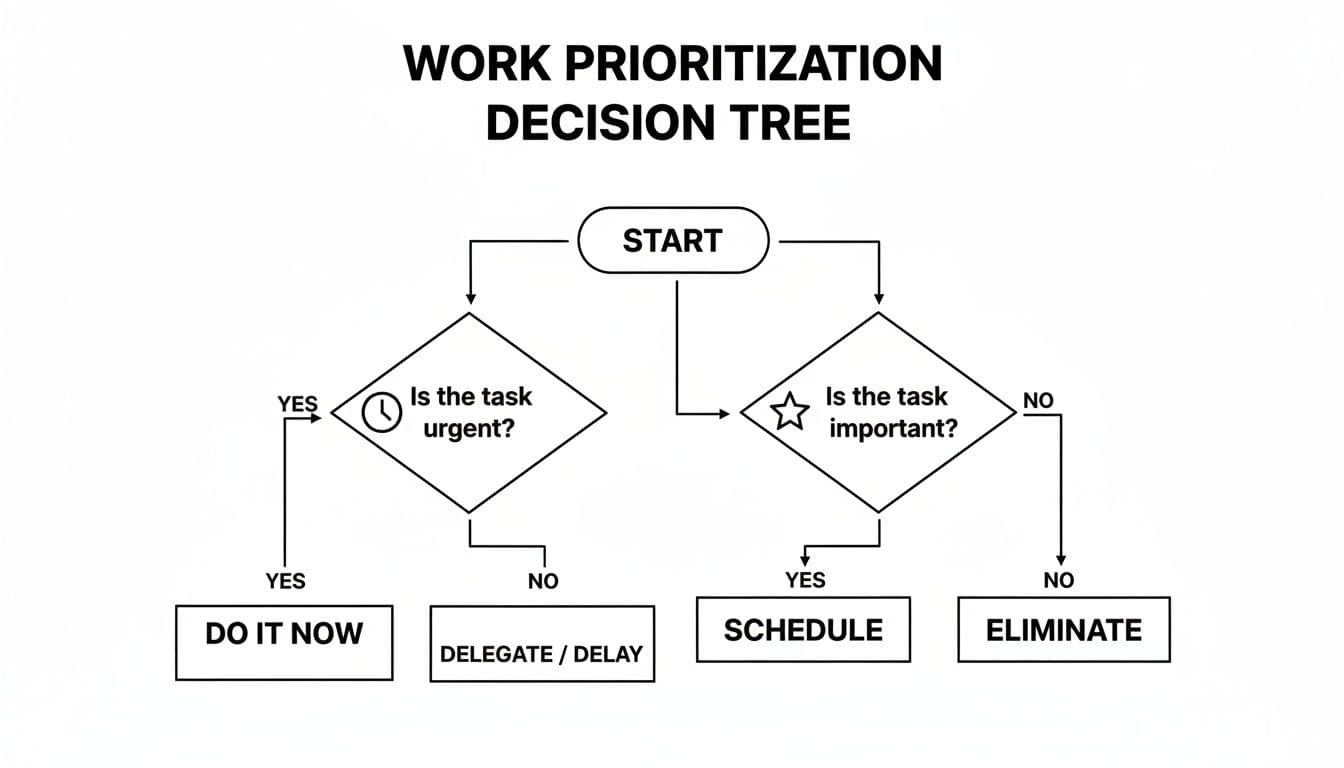
As you can see, the first questions to ask revolve around urgency and importance. These two factors are the bedrock of solid decision-making, and they lead us right into our first framework.
The Eisenhower Matrix: Urgent vs. Important
You've probably come across the Eisenhower Matrix before, and for good reason—its power lies in its simplicity. This method forces you to evaluate every task by asking two questions: Is it urgent and is it important? From there, everything falls into one of four quadrants.
- Do: These are your fires—urgent and important tasks with firm deadlines and big consequences if you miss them.
- Schedule: This is where strategic work lives. It's important but not urgent, so these tasks need dedicated time on your calendar to make sure they get done.
- Delegate: These tasks are urgent but not important for you to do. They need attention now but don't require your unique expertise.
- Delete: The distractions. These tasks are neither urgent nor important and just get in the way of real progress.
Think of it this way: a business owner gets an angry email from a major client. That's a Do task. The goal to develop next quarter's marketing strategy goes into Schedule. Book travel for an upcoming conference? A perfect candidate for Delegate.
MoSCoW for Team Alignment
When you're working on a project with a team, the MoSCoW method is fantastic for getting everyone on the same page. It categorizes all requirements into four groups, which gets rid of ambiguity and sets crystal-clear expectations.
- Must-Have: These are the non-negotiables. Without them, the project fails or is incomplete.
- Should-Have: Important additions that add a lot of value but aren't strictly necessary for launch.
- Could-Have: Desirable, low-impact improvements. Think of them as nice-to-haves if time and resources allow.
- Won't-Have: Anything explicitly ruled out for the current project to prevent scope creep.
Let's say a project manager is overseeing a new app launch. The user login functionality is a clear Must-Have. Push notifications would be a Should-Have. A dark mode theme? That’s a Could-Have. Integrating with a niche third-party service is a Won't-Have for this release.
When prioritizing as a team, clarity is kindness. The MoSCoW method prevents ambiguity by forcing everyone to agree on what's essential versus what's simply nice to have. This shared understanding is key to delivering a successful project on time.
Choosing Your Prioritization Framework
Not sure which method to start with? Each one has its strengths. This table can help you decide which framework best fits your current needs.
| Framework | Best For | Key Benefit |
|---|---|---|
| Eisenhower Matrix | Individual task management and daily planning. | Quickly sorts personal to-do lists to focus on what truly matters. |
| MoSCoW | Team projects and product development. | Creates clear, shared alignment on project deliverables and scope. |
| Eat the Frog | Overcoming procrastination and tackling big goals. | Builds momentum by getting the most difficult task done first. |
Ultimately, the best framework is the one you'll actually use. Feel free to experiment or even combine elements to create a system that works for you. If you want to explore even more options, you can find other useful task prioritization techniques in our detailed guide.
Eat the Frog to Beat Procrastination
This technique, made famous by Brian Tracy, is brutally simple: identify your most challenging task of the day the frog and do it first. Your frog is usually a high-impact task you're most likely to put off.
I’ve seen this work wonders for creative professionals. For instance, a designer might dread starting a complex and vaguely defined brief—that's their frog. By tackling it first thing in the morning with their best mental energy, the rest of the day feels lighter and more productive. It’s a powerful psychological win.
To dig deeper into the philosophies behind these methods, check out some of the best books on time management and productivity.
Using Smart Delegation to Reclaim Your Focus

Knowing what to focus on is only half the battle. After you’ve used a framework to map out your priorities, you're often left with a practical problem: where does the time to do the important work actually come from?
This is where smart delegation becomes your secret weapon. It’s not about shirking responsibility or just dumping tasks you don’t like on someone else. Real delegation is a strategic move to protect your most valuable resource—your focus. By offloading tasks that don't need your unique expertise, you free up the mental bandwidth for the high-impact work that only you can do.
Identifying Your Delegate Quadrant
Think back to the Eisenhower Matrix. That Delegate quadrant—home to tasks that are urgent but not truly important for you—is a goldmine. These are the little fires that constantly demand your attention but don't move the needle on your core objectives.
So, what are we talking about here? Here are some classic examples I see all the time:
- Administrative Overhead: The constant back-and-forth of scheduling meetings, booking travel, or trying to stay on top of an overflowing inbox.
- Repetitive Data Work: Things like manually entering data into a spreadsheet, transcribing meeting notes, or pulling the same weekly report.
- Routine Research: Compiling background information for a project, digging up contact details, or doing initial competitor scans.
- Basic Social Media Tasks: Scheduling pre-written posts, monitoring for routine comments, or creating simple graphics from a template.
The trick is to look for patterns. If you find yourself doing the same low-impact, time-consuming task every single week, that's a bright red flag. It’s a prime candidate for delegation.
How to Seamlessly Offload Tasks with Technology
These days, you don't need a complex, formal handoff for every little thing. Modern tools have made delegation incredibly straightforward. Platforms like Fluidwave, for instance, allow you to pass tasks to skilled virtual assistants with just a few clicks.
Imagine you've identified that pulling a weekly competitor report is eating up 90 minutes every Friday. Instead of dreading it, you can assign it to a specialist who can get it done faster and more efficiently, freeing you up for strategic planning.
This isn’t just about getting things off your plate; it’s a fundamental mindset shift. You move from being reactive to proactively building a system that filters out the noise.
Delegation isn't a sign of weakness; it’s a declaration of your priorities. You are actively choosing to invest your best energy where it delivers the greatest return.
When you start viewing delegation this way, it becomes a powerful tool for growth. For a deeper look at the mechanics, check out our guide on delegation.
By pairing strong prioritization frameworks with intelligent delegation, you create a powerful one-two punch for productivity. You know what matters most, and you have a reliable way to clear the decks so you can actually get it done. This is how you escape the trap of constant context-switching and find the deep focus needed for truly exceptional work.
Building Sustainable Habits for Long-Term Success
Getting a handle on prioritization frameworks and delegation is a fantastic start. But the real magic happens when these actions become second nature. Effective prioritization isn’t a quick fix you apply once; it’s an ongoing practice. Without building solid routines, even the most brilliant systems will crack under the pressure of a busy week.
This is all about crafting a workflow that’s resilient. One that shields you from burnout and keeps you zeroed in on the tasks that actually move the needle. It starts with a few core habits that reinforce your priorities day in and day out.
Defend Your Deep Work with Time-Blocking
One of the most effective habits I’ve ever adopted is time-blocking. It’s simple, but it’s a game-changer. Instead of just staring at a to-do list, you assign every single task a dedicated spot on your calendar. This simple act transforms your abstract priorities into a concrete plan of attack.
When you schedule blocks for those Important but Not Urgent tasks—the big-picture thinking, skill development, or long-term planning—you're making an appointment with your own goals. You’re treating them with the same seriousness as a major client meeting. This is how you proactively defend your most valuable hours from the endless flood of distractions and last-minute requests.
The Power of a Weekly Review
Think of the weekly review as your personal command center. It’s your chance to zoom out and ensure you're still on the right path. Carve out 30-60 minutes every Friday afternoon or Monday morning to look back at the week that was and plan the one ahead.
This isn’t just about rescheduling overdue tasks. It's a moment for a strategic check-in. Ask yourself a few honest questions:
- What were my big wins? Did I knock out my most important tasks?
- What threw me off course? Where did my plan get derailed?
- Looking ahead, what are my top 1-3 priorities for next week?
This simple ritual builds incredible self-awareness and helps you make course corrections before you drift too far. To make these efforts stick, it helps to understand the mechanics behind habit formation. You can explore practical strategies for goal-setting and habit-building that apply just as well to your professional life as they do to any personal goal.
A weekly review is where you stop being a victim of your calendar and start becoming its architect. It’s the single most effective habit for ensuring your daily actions align with your long-term vision.
Learning to Say No Without Feeling Like a Jerk
This might be the toughest habit to build, but it’s crucial. Every time you say yes to a low-priority ask, you are simultaneously saying no to your most important work. Protecting your focus means you have to get comfortable setting firm, professional boundaries.
But saying no doesn’t have to be harsh or unhelpful. Try reframing your response:
- My focus is tied up with [Project X] at the moment, but I could likely get to this next week. Would that timeline work for you?
- That’s an interesting idea, but I don’t have the bandwidth right now to give it the attention it deserves.
- I'm probably not the best person for this, but have you thought about connecting with [Colleague's Name]? She has more expertise in this area.
Saying no isn't about shutting people down. It’s about being realistic about your capacity and strategic with your commitments. Making this a regular practice is the key, and you can learn more about how to stay consistent with your goals in our dedicated article that covers staying consistent. By weaving weekly reviews, time-blocking, and strategic no's into your routine, you create a truly sustainable system for getting the right things done.
Wrestling with Your To-Do List? Let's Untangle Some Common Knots
Even the most organized professionals hit roadblocks. You've got the frameworks and you're building the habits, but then reality throws a curveball. Let's dig into a few of those real-world challenges and talk through how to handle them.
What if Everything Is a Top Priority?
We've all been there. Your to-do list feels less like a plan and more like a hostage situation. When every single task screams urgent, it's usually a sign that the actual business value of each item has gotten lost in the noise. This is your cue to get some clarity.
It’s time for a frank conversation with your manager or team lead. Don’t just show up with a list of things you're stressed about; bring a framework to the table. The MoSCoW method is perfect for this. It forces a tough but necessary conversation about what truly moves the needle.
Try asking this simple but powerful question: If we could only get one of these things done today, which one would deliver the most value to our goal? This reframes the entire discussion, shifting it away from deadlines and pressure toward tangible results. You’ll often find that what felt like a five-alarm fire is really just something that can wait.
How Do I Deal with Unexpected Tasks Derailing My Day?
Let’s be honest: a plan that can’t handle a disruption isn't much of a plan. The workday is unpredictable. The secret isn't to prevent interruptions—it's to plan for them.
One of the best habits I ever developed was building buffer time directly into my calendar. This is a dedicated 30 to 60-minute block each day that’s intentionally left empty. It’s my go-to slot for handling whatever curveballs the day throws my way.
When a new task lands on your plate, resist the urge to just jump on it. Take a breath and give it a quick triage using the Eisenhower Matrix in your head.
- Is it genuinely Urgent and Important? If so, it might be time to bump something else.
- Is it Urgent but Not Important? This is a perfect opportunity to delegate.
- Is it neither? Don't let it distract you. Add it to your backlog to schedule later.
This quick mental check ensures you’re making a deliberate choice, not just reacting to the latest email. The experts at Asana have a great breakdown of the Eisenhower Matrix if you want to dive deeper.
When you feel buried under a mountain of priorities, just remember this: Productivity isn't about getting more things done. It's about getting more of the right things done. The most effective people are ruthless at saying no to everything else.
How Do I Get My Team to Agree on What's Important?
You can’t agree on the what until everyone is aligned on the why. If your team is constantly pulling in different directions, it’s almost always because there isn’t a clear, shared understanding of the main objective. Without that North Star, everyone is just working off their own personal interpretation of what matters.
Try holding quick, regular prioritization huddles. A visual tool like a Kanban board is great for this, as everyone can see the backlog together. When debates arise—and they will—your job as a leader is to steer the conversation back to the goal.
Challenge your team members to articulate the why behind their choice. Ask them: How does this task directly get us closer to our quarterly target? This approach not only builds consensus but also fosters a powerful sense of shared ownership. Suddenly, it’s not just a list of tasks; it’s our plan.
When the weight of your to-do list feels like too much, having the right technology in your corner can be a game-changer. Fluidwave is built to help you organize your work, automatically surface what’s important, and delegate tasks without friction. It’s all about freeing you up to focus on the work that truly drives results. Start reclaiming your focus with Fluidwave today.
Focus on What Matters.
Experience lightning-fast task management with AI-powered workflows. Our automation helps busy professionals save 4+ hours weekly.